
Join Our JEE Preparation Group
Prep with like-minded aspirants; Get access to free daily tests and study material.
Sign in
Please select an account to continue using cracku.in
↓ →
Join Our JEE Preparation Group
Prep with like-minded aspirants; Get access to free daily tests and study material.
A hemispherical glass body of radius 10 cm and refractive index 1.5 is silvered on its curved surface. A small air bubble is 6 cm below the flat surface inside it along the axis. The position of the image of the air bubble made by the mirror is seen:
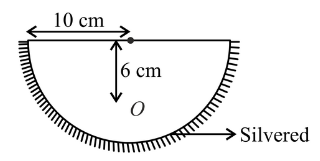
The air bubble is $$6\text{ cm}$$ below the flat surface. Since the total radius is $$10\text{ cm}$$, the bubble is $$10 - 6 = 4\text{ cm}$$ above the pole. Thus, $$u = +4\text{ cm}$$.
$$R = +10\text{ cm}$$ and focal length $$f = \frac{R}{2} = +5\text{ cm}$$
$$\frac{1}{v} + \frac{1}{u} = \frac{1}{f}$$
$$\frac{1}{v} + \frac{1}{4} = \frac{1}{5}$$
$$\frac{1}{v} = \frac{1}{5} - \frac{1}{4} = -\frac{1}{20}$$
$$v = -20\text{ cm}$$
The image formed by the mirror is $$20\text{ cm}$$ below the pole ($$P$$).
The light now travels from the mirror's image toward the flat surface to exit into the air.
Real Depth ($$H$$): The image is $$20\text{ cm}$$ below the pole, and the pole is $$10\text{ cm}$$ below the flat surface.
$$\text{Total real depth from flat surface} = 20\text{ cm} + 10\text{ cm} = 30\text{ cm}$$
Light travels from glass ($$\mu = 1.5$$) to air. Using the Apparent Depth formula:
$$\text{Apparent Depth} = \frac{\text{Real Depth}}{\mu}$$
$$\text{Apparent Depth} = \frac{30\text{ cm}}{1.5} = \mathbf{20\text{ cm}}$$
Was this solution helpful?
Create a FREE account and get:
_1.webp)

Educational materials for JEE preparation

Ask our AI anything

AI can make mistakes. Please verify important information.
AI can make mistakes. Please verify important information.
