
Join Our JEE Preparation Group
Prep with like-minded aspirants; Get access to free daily tests and study material.
Sign in
Please select an account to continue using cracku.in
↓ →
Join Our JEE Preparation Group
Prep with like-minded aspirants; Get access to free daily tests and study material.
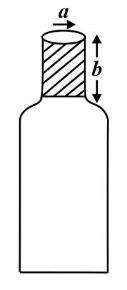
A bottle has an opening of radius a and length b. A cork of length b and radius $$(a + \Delta a)$$ where $$(\Delta a \ll a)$$, is compressed to fit into the opening completely (see figure). If the bulk modulus of the cork is B and the coefficient of friction between the bottle and the cork is $$\mu$$, then the force needed to push the cork into the bottle is
$$\Delta V = \pi a^2 b - \pi (a + \Delta a)^2 b$$
$$\Delta V = \pi b [a^2 - (a^2 + 2a\Delta a + (\Delta a)^2)]$$
$$\Delta V \approx -2\pi a b \Delta a$$
$$\frac{\Delta V}{V} = \frac{-2\pi a b \Delta a}{\pi a^2 b} = -\frac{2 \Delta a}{a}$$
The Bulk Modulus ($$B$$) relates pressure to volumetric strain:
$$B = -\frac{P}{\Delta V/V}$$
$$P = -B \left( -\frac{2 \Delta a}{a} \right) = \frac{2 B \Delta a}{a}$$
This pressure $$P$$ acts as the normal stress on the inner surface of the bottle neck.
The total Normal Force ($$N$$) exerted by the cork on the bottle is the pressure multiplied by the contact area (lateral surface area of the cylinder):
$$N = P \times (2\pi a b)$$
$$N = \left( \frac{2 B \Delta a}{a} \right) \times 2\pi a b = 4\pi B b \Delta a$$
The force ($$F$$) needed to push the cork must overcome the frictional force ($$f = \mu N$$):
$$F = \mu (4\pi B b \Delta a)$$
$$F = (4\pi \mu B b) \Delta a$$
Was this solution helpful?
Create a FREE account and get:
_1.webp)

Educational materials for JEE preparation

Ask our AI anything

AI can make mistakes. Please verify important information.
AI can make mistakes. Please verify important information.
