
Join Our JEE Preparation Group
Prep with like-minded aspirants; Get access to free daily tests and study material.
Sign in
Please select an account to continue using cracku.in
↓ →
Join Our JEE Preparation Group
Prep with like-minded aspirants; Get access to free daily tests and study material.
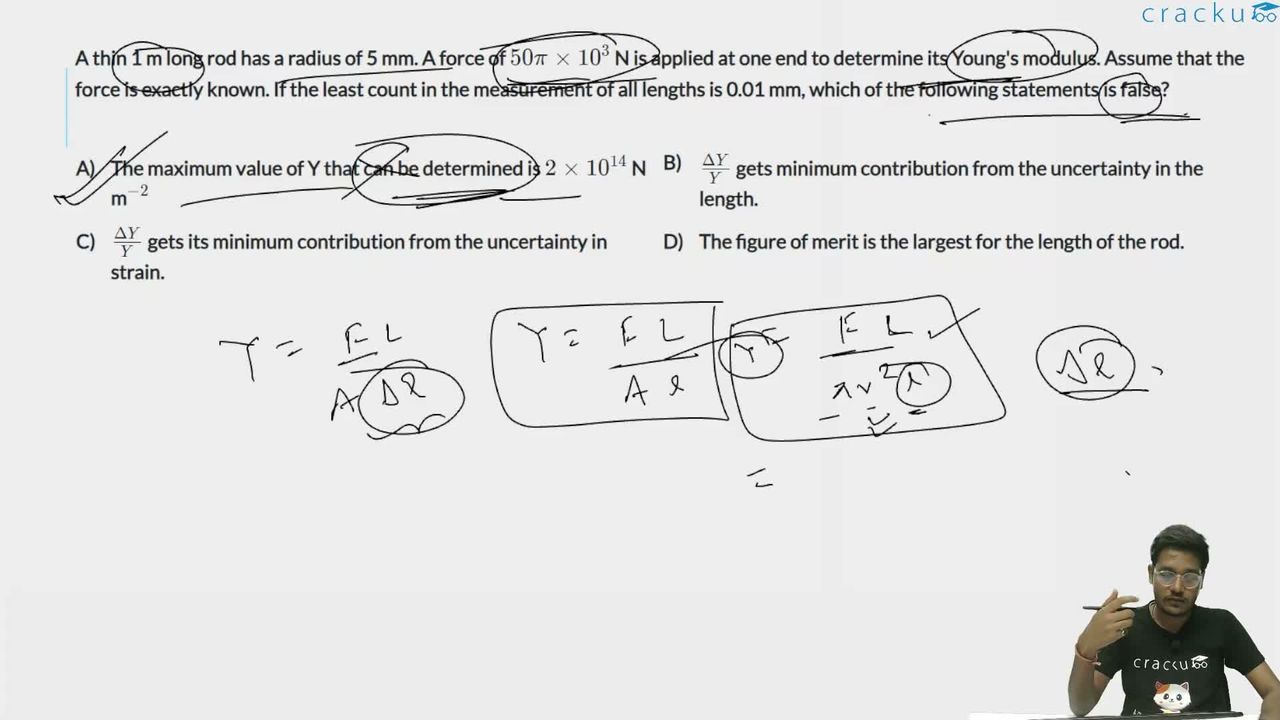
A thin 1 m long rod has a radius of 5 mm. A force of $$50\pi \times 10^3$$ N is applied at one end to determine its Young's modulus. Assume that the force is exactly known. If the least count in the measurement of all lengths is 0.01 mm, which of the following statements is false?
The problem involves finding which statement is false regarding the determination of Young's modulus for a rod. The rod has a length $$L = 1 \text{m}$$ and radius $$r = 5 \text{mm} = 5 \times 10^{-3} \text{m}$$. A force $$F = 50\pi \times 10^3 \text{N} = 50000\pi \text{N}$$ is applied, and the least count for all length measurements is $$0.01 \text{mm} = 10^{-5} \text{m}$$. The force is exactly known, so its uncertainty is zero. Young's modulus $$Y$$ is given by: $$$ Y = \frac{\text{stress}}{\text{strain}} = \frac{F / A}{\Delta L / L} = \frac{F \cdot L}{A \cdot \Delta L} $$$ where $$A$$ is the cross-sectional area and $$\Delta L$$ is the change in length. For a circular rod, $$A = \pi r^2$$. First, compute the area: $$$ A = \pi r^2 = \pi (5 \times 10^{-3})^2 = \pi \times 25 \times 10^{-6} = 25\pi \times 10^{-6} \text{m}^2 $$$ Substitute the values into the formula for $$Y$$: $$$ Y = \frac{F \cdot L}{A \cdot \Delta L} = \frac{(50000\pi) \times 1}{(25\pi \times 10^{-6}) \cdot \Delta L} = \frac{50000\pi}{25\pi \times 10^{-6} \cdot \Delta L} = \frac{50000}{25 \times 10^{-6} \cdot \Delta L} $$$ Simplify: $$$ \frac{50000}{25 \times 10^{-6} \cdot \Delta L} = \frac{50000 \times 10^6}{25 \cdot \Delta L} = \frac{5 \times 10^4 \times 10^6}{25 \cdot \Delta L} = \frac{5 \times 10^{10}}{25 \cdot \Delta L} = \frac{2 \times 10^9}{\Delta L} \text{N/m}^2 $$$ So, $$Y = \frac{2 \times 10^9}{\Delta L}$$. The maximum value of $$Y$$ occurs when $$\Delta L$$ is minimum. The smallest measurable $$\Delta L$$ is the least count, $$10^{-5} \text{m}$$. Thus: $$$ Y_{\text{max}} = \frac{2 \times 10^9}{10^{-5}} = 2 \times 10^{14} \text{N/m}^2 $$$ Option A states that the maximum $$Y$$ is $$2 \times 10^{14} \text{N m}^{-2}$$, which matches. So, A is true. To analyze the relative uncertainty in $$Y$$, denoted $$\frac{\Delta Y}{Y}$$, use error propagation. Since $$Y = \frac{F L}{A \Delta L}$$ and $$A = \pi r^2$$, the relative uncertainty is: $$$ \frac{\Delta Y}{Y} = \sqrt{ \left( \frac{\Delta F}{F} \right)^2 + \left( \frac{\Delta L}{L} \right)^2 + \left( 2 \frac{\Delta r}{r} \right)^2 + \left( \frac{\Delta (\Delta L)}{\Delta L} \right)^2 } $$$ Given $$\Delta F = 0$$, this simplifies to: $$$ \frac{\Delta Y}{Y} = \sqrt{ \left( \frac{\Delta L}{L} \right)^2 + \left( 2 \frac{\Delta r}{r} \right)^2 + \left( \frac{\Delta (\Delta L)}{\Delta L} \right)^2 } $$$ The uncertainties are: - $$\Delta L = 10^{-5} \text{m}$$ (uncertainty in length $$L$$) - $$\Delta r = 10^{-5} \text{m}$$ (uncertainty in radius $$r$$) - $$\Delta (\Delta L) = 10^{-5} \text{m}$$ (uncertainty in change in length $$\Delta L$$) Substitute the values: - $$L = 1 \text{m}$$, so $$\frac{\Delta L}{L} = \frac{10^{-5}}{1} = 10^{-5}$$ - $$r = 5 \times 10^{-3} \text{m}$$, so $$\frac{\Delta r}{r} = \frac{10^{-5}}{5 \times 10^{-3}} = \frac{10^{-5}}{0.005} = 2 \times 10^{-3}$$, and $$2 \frac{\Delta r}{r} = 2 \times 2 \times 10^{-3} = 4 \times 10^{-3}$$ - For $$\Delta L$$, the minimum measurable value is $$10^{-5} \text{m}$$ (since $$\Delta L$$ could be as small as the least count), so $$\frac{\Delta (\Delta L)}{\Delta L} = \frac{10^{-5}}{10^{-5}} = 1$$ The squared contributions are: - $$\left( \frac{\Delta L}{L} \right)^2 = (10^{-5})^2 = 10^{-10}$$ - $$\left( 2 \frac{\Delta r}{r} \right)^2 = (4 \times 10^{-3})^2 = 16 \times 10^{-6} = 1.6 \times 10^{-5}$$ - $$\left( \frac{\Delta (\Delta L)}{\Delta L} \right)^2 = (1)^2 = 1$$ Thus: $$$ \frac{\Delta Y}{Y} = \sqrt{ 10^{-10} + 1.6 \times 10^{-5} + 1 } \approx \sqrt{1} = 1 $$$ The contributions are dominated by the $$\Delta (\Delta L)$$ term (which is 1), as the other terms are negligible. Option B states that $$\frac{\Delta Y}{Y}$$ gets minimum contribution from the uncertainty in length $$L$$. The contribution from $$L$$ is $$10^{-10}$$, while from $$r$$ it is $$1.6 \times 10^{-5}$$ and from $$\Delta L$$ it is 1. Since $$10^{-10}$$ is the smallest, B is true. Option C states that $$\frac{\Delta Y}{Y}$$ gets its maximum contribution from the uncertainty in strain. Strain is $$\epsilon = \frac{\Delta L}{L}$$, and its uncertainty contributes via the terms for $$\Delta L$$ and $$\Delta (\Delta L)$$. The relative uncertainty in strain is: $$$ \frac{\Delta \epsilon}{\epsilon} = \sqrt{ \left( \frac{\Delta (\Delta L)}{\Delta L} \right)^2 + \left( \frac{\Delta L}{L} \right)^2 } = \sqrt{1^2 + (10^{-5})^2} \approx \sqrt{1} = 1 $$$ In $$\frac{\Delta Y}{Y}$$, the strain contribution is approximately 1, which is the largest (compared to $$1.6 \times 10^{-5}$$ and $$10^{-10}$$). So, C is true. Option D states that the figure of merit is the largest for the length of the rod (meaning $$L$$). The figure of merit refers to the relative error contribution per unit measurement. The relative error contributions (without squaring) are: - For $$L$$: $$\frac{\Delta L}{L} = 10^{-5}$$ - For $$r$$: $$2 \frac{\Delta r}{r} = 4 \times 10^{-3}$$ - For $$\Delta L$$: $$\frac{\Delta (\Delta L)}{\Delta L} = 1$$ The contribution for $$\Delta L$$ (1) is the largest, followed by $$r$$ ($$4 \times 10^{-3}$$), and then $$L$$ ($$10^{-5}$$). Thus, the figure of merit is largest for $$\Delta L$$, not for $$L$$. Therefore, D is false. Hence, the correct answer is Option D.
Was this solution helpful?
Click on the Email ☝️ to Watch the Video Solution
Create a FREE account and get:
_1.webp)

Educational materials for JEE preparation

Ask our AI anything

AI can make mistakes. Please verify important information.
AI can make mistakes. Please verify important information.
