
Join Our JEE Preparation Group
Prep with like-minded aspirants; Get access to free daily tests and study material.
Sign in
Please select an account to continue using cracku.in
↓ →
Join Our JEE Preparation Group
Prep with like-minded aspirants; Get access to free daily tests and study material.
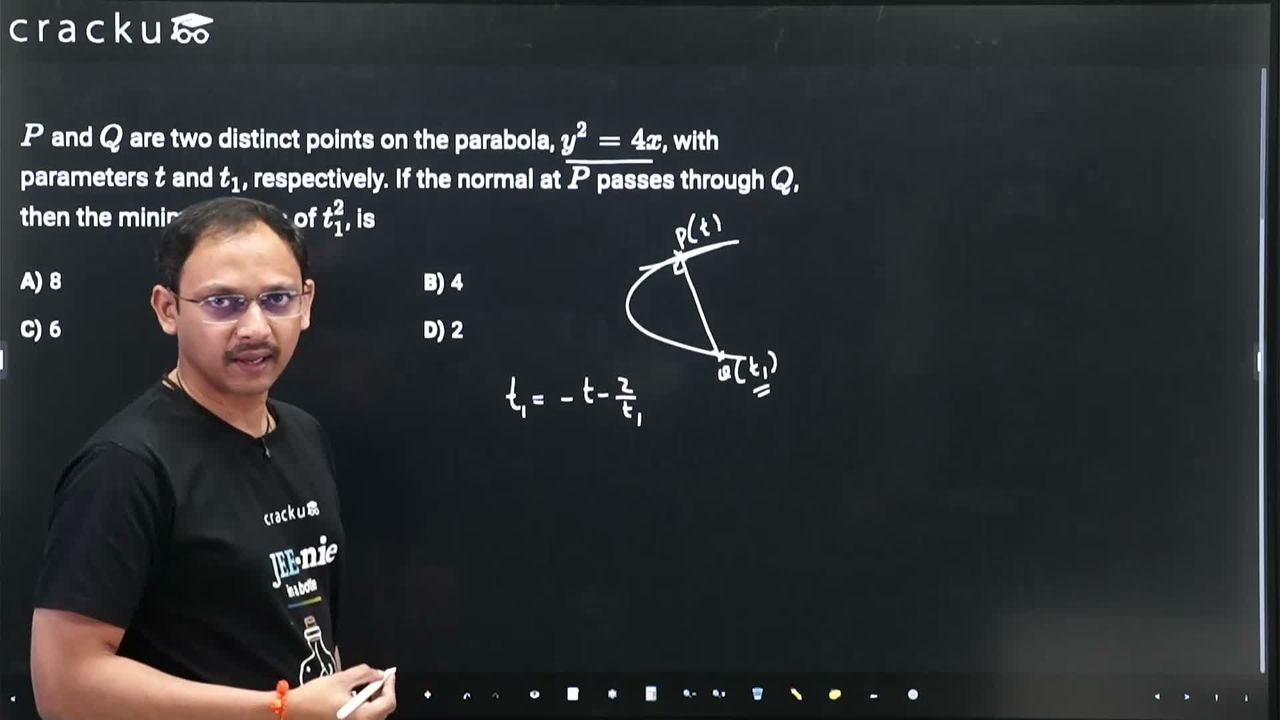
$$P$$ and $$Q$$ are two distinct points on the parabola, $$y^2 = 4x$$, with parameters $$t$$ and $$t_1$$, respectively. If the normal at $$P$$ passes through $$Q$$, then the minimum value of $$t_1^2$$, is
We have the standard parabola $$y^{2}=4x$$.
For this curve, a convenient parametric form is obtained by putting $$y=2t$$. Substituting in $$y^{2}=4x$$ gives $$4t^{2}=4x$$, so $$x=t^{2}$$. Hence a general point on the parabola can be written as
$$P(t)\;:\;\bigl(t^{2},\,2t\bigr).$$
Let $$P$$ correspond to the parameter $$t$$ and $$Q$$ correspond to the parameter $$t_{1}$$, so that
$$P\equiv\bigl(t^{2},\,2t\bigr),\qquad Q\equiv\bigl(t_{1}^{2},\,2t_{1}\bigr).$$
First we need the equation of the normal to the parabola at the point $$P$$. To do that, we recall the formula for the slope of the tangent to $$y^{2}=4x$$ at a point:
The curve is given implicitly by $$y^{2}=4x$$. Differentiating, we obtain
$$2y\frac{dy}{dx}=4 \;\;\Longrightarrow\;\; \frac{dy}{dx}=\frac{2}{y}.$$
At the point $$P(t)$$ we have $$y=2t$$, so the slope of the tangent is
$$m_{\text{tangent}}=\frac{2}{\,2t\,}=\frac{1}{t}.$$
The slope of the normal is the negative reciprocal of the tangent’s slope. Thus
$$m_{\text{normal}}=-t.$$
The point-slope form of a straight line with slope $$m_{\text{normal}}$$ passing through $$P(t^{2},2t)$$ is
$$y-2t=-t\bigl(x-t^{2}\bigr).$$
This is the required normal at $$P$$. By hypothesis, the point $$Q\bigl(t_{1}^{2},2t_{1}\bigr)$$ lies on this normal. Therefore we substitute $$x=t_{1}^{2}$$ and $$y=2t_{1}$$ into the normal’s equation:
$$2t_{1}-2t=-t\bigl(t_{1}^{2}-t^{2}\bigr).$$
We expand the right-hand side:
$$2t_{1}-2t=-t\left(t_{1}^{2}-t^{2}\right) =-t\bigl(t_{1}-t\bigr)\bigl(t_{1}+t\bigr).$$
Because $$P$$ and $$Q$$ are distinct, $$t_{1}\neq t$$, so we can safely divide both sides by the factor $$\bigl(t_{1}-t\bigr)$$. First we factor out $$2$$ on the left:
$$2\,(t_{1}-t)=-t\bigl(t_{1}-t\bigr)\bigl(t_{1}+t\bigr).$$
Now cancelling the common factor $$t_{1}-t$$ from both sides gives
$$2=-t\bigl(t_{1}+t\bigr).$$
We rearrange this relation to express $$t_{1}$$ in terms of $$t$$:
$$t_{1}+t=-\frac{2}{t}\quad\Longrightarrow\quad t_{1}=-\,\frac{2}{t}-t.$$
Our aim is to find the minimum possible value of $$t_{1}^{2}$$. Substituting the above expression, we obtain
$$t_{1}^{2}=\left(-\frac{2}{t}-t\right)^{2} =\left(t+\frac{2}{t}\right)^{2}.$$
To minimise $$t_{1}^{2}$$ we can instead minimise the non-negative quantity
$$g(t)=\left(t+\frac{2}{t}\right)^{2}.$$
Let us set $$h(t)=t+\dfrac{2}{t}$$ and first minimise $$h(t)^{2}$$ by minimising $$|h(t)|$$. The derivative of $$h(t)$$ is
$$h'(t)=1-\frac{2}{t^{2}}.$$
Setting $$h'(t)=0$$ gives
$$1-\frac{2}{t^{2}}=0\quad\Longrightarrow\quad t^{2}=2.$$
Thus the critical points are $$t=\sqrt{2}$$ and $$t=-\sqrt{2}$$ (both are admissible because the parameter $$t$$ may be positive or negative, but never zero).
Evaluating $$h(t)$$ at these values:
For $$t=\sqrt{2}$$,
$$h(\sqrt{2})=\sqrt{2}+\frac{2}{\sqrt{2}} =\sqrt{2}+\sqrt{2} =2\sqrt{2}.$$
For $$t=-\sqrt{2}$$,
$$h(-\sqrt{2})=-\sqrt{2}+\frac{2}{-\sqrt{2}} =-\sqrt{2}-\sqrt{2} =-2\sqrt{2}.$$
In magnitude both values are equal, so $$|h(t)|_{\min}=2\sqrt{2}$$. Squaring this gives the minimum of $$h(t)^{2}$$ and therefore of $$g(t)$$:
$$t_{1,\min}^{2}= \bigl(2\sqrt{2}\bigr)^{2}=8.$$
Hence, the minimum possible value of $$t_{1}^{2}$$ is $$8$$.
Hence, the correct answer is Option A.
Was this solution helpful?
Click on the Email ☝️ to Watch the Video Solution
Create a FREE account and get:
_1.webp)

Educational materials for JEE preparation

Ask our AI anything

AI can make mistakes. Please verify important information.
AI can make mistakes. Please verify important information.
