
Join Our JEE Preparation Group
Prep with like-minded aspirants; Get access to free daily tests and study material.
Sign in
Please select an account to continue using cracku.in
↓ →
Join Our JEE Preparation Group
Prep with like-minded aspirants; Get access to free daily tests and study material.
Consider a thin metallic sheet perpendicular to the plane of the paper moving with speed v in a uniform magnetic field B going into the plane of the paper (see the figure below). If the charge densities $$\sigma_1$$ and $$\sigma_2$$ are induced on the left and right surfaces respectively of the sheet, then (ignore fringe effects)
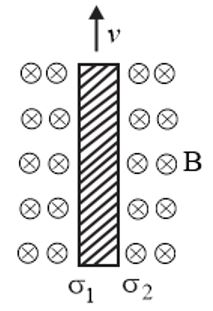
When the metallic sheet moves with a velocity $$\vec{v}$$ in a uniform magnetic field $$\vec{B}$$, the free electrons inside the conductor experience a Lorentz force ($$\vec{F}_m$$) given by $$\vec{F}_m = q(\vec{v} \times \vec{B})$$
Velocity $$\vec{v}$$ is in the upward direction ($$+\hat{j}$$). Magnetic field $$\vec{B}$$ is into the plane of the paper ($$-\hat{k}$$).
Using the right-hand rule for the cross product $$\vec{v} \times \vec{B}$$, $$(\hat{j}) \times (-\hat{k}) = -(\hat{j} \times \hat{k}) = -\hat{i}$$ (direction to the left). For a positive charge, the force is toward the left. For an electron (negative charge), the force is toward the right.
$$qE = qvB$$ (In the steady-state equilibrium, the electric force ($$q\vec{E}$$) on the charges must exactly balance the magnetic Lorentz force)
$$E = vB$$
$$E = \frac{\sigma}{\epsilon_0}$$ (field between the surfaces for a thin sheet can be modeled as that of two parallel oppositely charged plates)
$$\frac{\sigma}{\epsilon_0} = vB \implies \sigma = \epsilon_0 vB$$
The left surface is positively charged: $$\sigma_1 = +\epsilon_0 vB$$. The right surface is negatively charged: $$\sigma_2 = -\epsilon_0 vB$$
Was this solution helpful?
Create a FREE account and get:
_1.webp)

Educational materials for JEE preparation

Ask our AI anything

AI can make mistakes. Please verify important information.
AI can make mistakes. Please verify important information.
