JEE WhatsApp Group


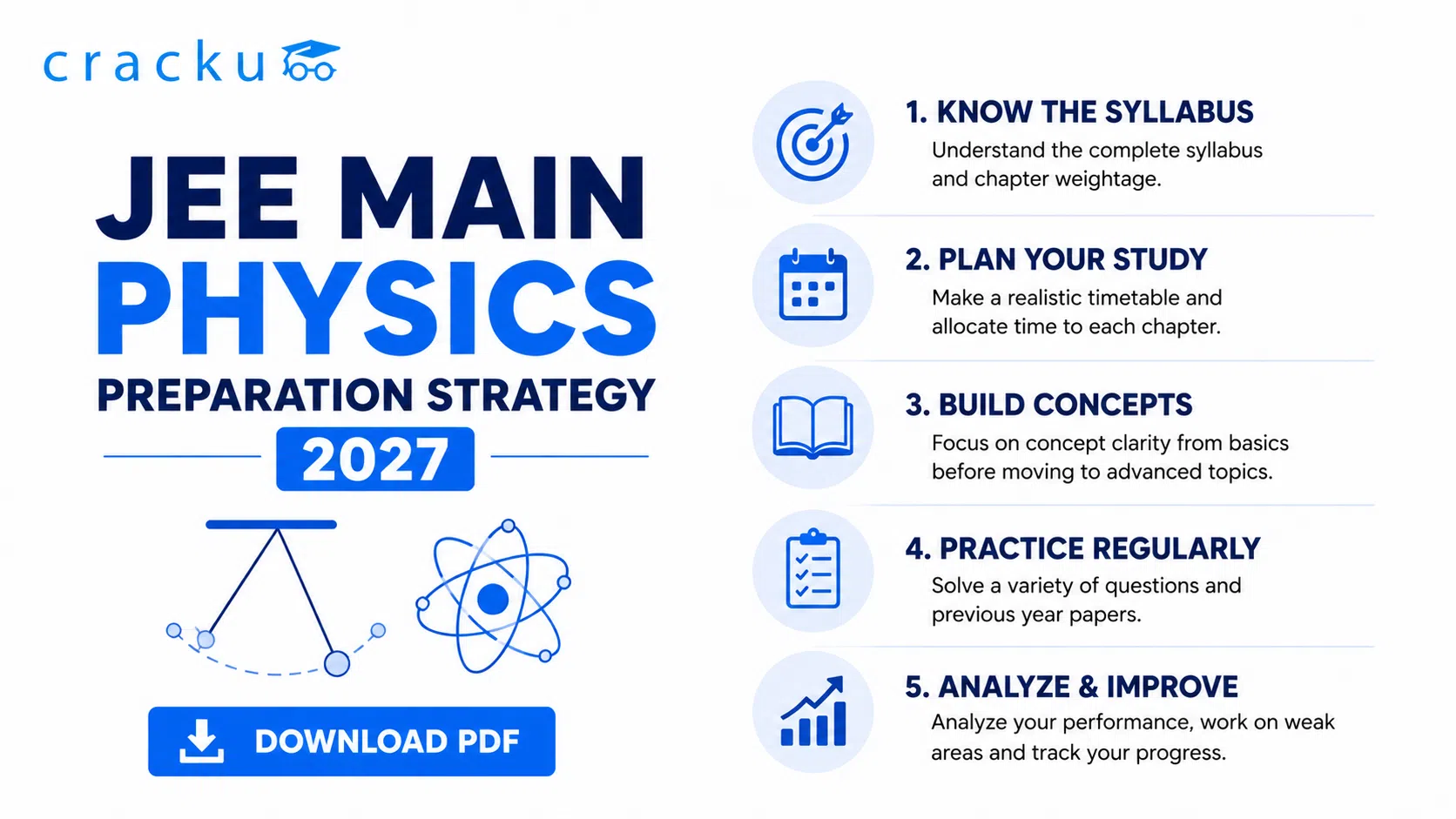
JEE Main Physics Preparation Strategy 2027
Physics is one of the most scoring yet concept-driven subjects in JEE Main. Success in this section depends on building strong fundamentals, practising numerical problems consistently, and revising formulas regularly. Instead of relying on rote memorisation, aspirants should focus on understanding concepts and applying them to different types of questions.
A structured JEE Main Physics Preparation Strategy 2027 helps students complete the syllabus systematically while giving enough time for revision and practice. Begin with high-weightage chapters, strengthen conceptual clarity using NCERT and standard reference books, and solve chapter-wise questions daily. Check out the article to know more about the JEE Main Physics Preparation Strategy 2027.
JEE Main Physics Chapter-Wise Preparation Strategy
Since each chapter requires a different approach, focusing on the right concepts, formulas, and question types can make your preparation more effective. The JEE Main Physics Chapter-Wise Preparation Strategy below highlights the best way to study every chapter, helping you build conceptual clarity, improve numerical-solving skills, and revise efficiently for the exam.
Chapter | Preparation Strategy |
Physics & Measurement | Learn SI units, dimensions, significant figures, and error analysis. Practise unit conversion and numerical problems. |
Kinematics | Master equations of motion, graphs, and projectile motion. Focus on conceptual questions and graphical analysis. |
Understand free-body diagrams, friction, circular motion, and Newton's laws. Solve application-based numericals. | |
Practise work-energy theorem, conservation of energy, and power-related problems. Focus on mixed-concept questions. | |
Strengthen concepts of torque, moment of inertia, angular momentum, and rolling motion. Revise formulas regularly. | |
Learn gravitational potential, escape velocity, satellites, and Kepler's laws. Practise numerical applications. | |
Properties of Solids & Liquids | Focus on elasticity, viscosity, surface tension, and fluid mechanics. Memorise important formulas and concepts. |
Thermodynamics & Kinetic Theory | Understand gas laws, heat transfer, Carnot engine, and thermodynamic processes. Solve conceptual and numerical questions. |
Oscillations & Waves | Practise SHM equations, wave motion, sound waves, resonance, and Doppler effect. Focus on formula-based questions. |
Electrostatics | Study Coulomb's law, electric field, potential, capacitance, and combinations of capacitors. Practise numerical problems extensively. |
Current Electricity | Master Ohm's law, Kirchhoff's laws, Wheatstone bridge, and meter bridge. Solve circuit-based numericals regularly. |
Focus on Biot-Savart law, Ampere's law, magnetic force, and moving charges. Practise derivations and applications. | |
Learn Faraday's law, Lenz's law, inductors, transformers, and AC circuits. Revise formulas and waveform concepts. | |
Understand the electromagnetic spectrum, properties, and applications. Revise NCERT theory thoroughly. | |
Ray Optics & Optical Instruments | Practise mirrors, lenses, refraction, optical instruments, and sign conventions. Draw ray diagrams for better understanding. |
Focus on interference, diffraction, polarisation, and Young's Double Slit Experiment. Solve conceptual questions. | |
Learn the photoelectric effect, de Broglie hypothesis, and Bohr's model. Memorise key equations and concepts. | |
Study radioactive decay, nuclear reactions, and binding energy. Practise formula-based numericals. | |
Semiconductor Electronics | Understand diodes, transistors, logic gates, and digital electronics. Revise circuit diagrams and truth tables. |
Experimental Skills | Revise laboratory experiments, measuring instruments, graphs, errors, and practical applications from NCERT. |
JEE Main Physics Most Important Chapters 2027 Month-Wise
A month-wise study plan ensures that you complete the JEE Main Physics Most Important Chapters 2027 systematically while leaving enough time for revision, JEE Mains Previous Papers. The schedule below prioritises high-weightage chapters first, helping you build a strong foundation and maximise your score in the exam.
Month | Most Important Chapters to Cover | Focus Areas |
August | Properties of Solids & Liquids, Thermodynamics, Kinetic Theory, Oscillations & Waves | Strengthen conceptual understanding and practise numerical problems from thermal physics and SHM. |
September | Electrostatics, Current Electricity | Prioritise electric field, potential, capacitance, Kirchhoff's laws, and circuit analysis, as these are consistently high-weightage topics. |
October | Magnetic Effects of Current, Magnetism, Electromagnetic Induction, Alternating Current, Electromagnetic Waves | Practise derivations, magnetic force, induction, transformers, and AC circuit numericals. |
November | Ray Optics, Wave Optics, Dual Nature of Matter, Atoms, Nuclei, Semiconductor Electronics | Cover optics thoroughly and finish Modern Physics, which frequently contributes several questions every year. |
December | Complete Revision of High-Weightage Chapters | Revise Mechanics, Electrostatics, Current Electricity, Optics, Thermodynamics, and Modern Physics. Solve chapter-wise PYQs and maintain a formula sheet. |
January (Exam Month) | Mock Tests & Final Revision | Attempt full-length JEE Main mock tests, revise formulas, analyse mistakes, and avoid starting new chapters. |
Also Read: JEE Main 2027 Preparation Strategy with Study Timeline
JEE Main Physics Preparation Plan
A well-planned study schedule is essential for completing the JEE Main Physics Preparation Plan on time. Dividing your preparation into phases allows you to build strong fundamentals, practise chapter-wise questions, revise regularly, and gradually improve your problem-solving speed. The plan below helps you cover the complete syllabus systematically while leaving sufficient time for JEE Main Physics Formula Sheet revision, and JEE Mains Mock Tests before the exam.
Phase | Duration | Preparation Plan |
Phase 1: Build Fundamentals | Weeks 1–4 | Complete the JEE Main Physics Syllabus, starting with Mechanics (Kinematics, Laws of Motion, Work, Energy & Power). Focus on understanding concepts from the NCERT Solutions and preparing short notes. |
Phase 2: Strengthen Core Concepts | Weeks 5–8 | Cover Rotational Motion, Gravitation, Thermodynamics, Oscillations, and Waves. Solve chapter-wise questions and revise formulas after each topic. |
Phase 3: Master Electricity & Magnetism | Weeks 9–12 | Study Electrostatics, Current Electricity, Magnetism, Electromagnetic Induction, Alternating Current, and Electromagnetic Waves. Practise numerical and application-based problems daily. |
Phase 4: Complete Optics & Modern Physics | Weeks 13–16 | Finish Ray Optics, Wave Optics, Dual Nature of Matter, Atoms, Nuclei, Semiconductors, and Experimental Skills. Revise NCERT diagrams and theory. |
Phase 5: Solve JEE Mains Previous Papers | Weeks 17–20 | Attempt chapter-wise and full-length JEE Mains Previous Papers. Analyse mistakes, identify weak chapters, and revise concepts accordingly. |
Phase 6: Mock Tests & Final Revision | Last 4–6 Weeks | Take 2–3 JEE Mains Mock Tests every week, revise the JEE Main Physics Formula Sheet, review short notes, and focus |
Also Read: JEE Mains Maths Preparation Strategy 2027, Important PYQ PDF
Best Books for JEE Main Physics Preparation
Choosing the right study material is just as important as following a preparation strategy. Instead of referring to multiple books, focus on a few trusted resources that provide conceptual clarity, extensive numerical practice, and exam-oriented questions. The best books for JEE Main Physics Preparation listed below are recommended by experts and toppers
Book | Author | Best For |
NCERT Physics (Class 11 & 12) | NCERT | Building fundamental concepts, understanding theory, and covering the complete JEE Main Physics syllabus. |
Concepts of Physics (Vol. I & II) | H.C. Verma | Developing conceptual clarity and practising quality numerical problems. |
Understanding Physics Series | D.C. Pandey (Arihant) | Chapter-wise theory, solved examples, and JEE Main-level practice questions. |
Fundamentals of Physics | Halliday, Resnick & Walker | Strengthening concepts through in-depth explanations and advanced problem-solving. |
Problems in General Physics | I.E. Irodov | Challenging numerical problems for students targeting top ranks (best after mastering the basics). |
University Physics | Young & Freedman | Detailed conceptual learning and strengthening theoretical understanding. |
Problems and Solutions in Physics | Shashi Bhushan Tiwari | Advanced problem-solving with detailed solutions for concept application. |
Chapter-wise Previous Year Papers | Disha Publications / MTG | Practising JEE Main previous year questions chapter-wise and analysing exam trends. |
Also Read: JEE Main Physics Important Chapters 2027, Topic-wise PYQ PDF
Common Mistakes Students Make While Preparing for Physics
Many students lose valuable marks in JEE Main Physics not because the questions are too difficult, but due to avoidable mistakes during preparation. Errors such as skipping conceptual learning, neglecting revision, or taking too few mock tests can significantly impact performance. By identifying these common pitfalls early, you can adopt a smarter study approach, improve accuracy, and strengthen your overall JEE Main Physics Preparation Strategy 2027. Here are some of the most common mistakes students make while preparing for Physics.
Skipping NCERT: Many students jump straight to advanced books without thoroughly understanding NCERT concepts, which are essential for JEE Main.
Ignoring High-Weightage Chapters: Spending too much time on low-weightage topics while neglecting chapters like Current Electricity, Electrostatics, Modern Physics, and Optics can affect scores.
Not Practising Enough Numerical Problems: Physics requires consistent problem-solving. Reading theory alone is not enough to develop speed and accuracy.
Avoiding Previous Year Questions: Many aspirants overlook JEE Mains Previous Papers, missing out on understanding the exam pattern and frequently tested concepts.
Taking Too Few Mock Tests: Not attempting regular JEE Mains Mock Tests can result in poor time management and difficulty handling exam pressure.
Neglecting Revision: Forgetting to revise formulas, short notes, and important concepts regularly leads to poor retention before the exam.
Ignoring Weak Areas: Focusing only on favourite chapters while avoiding difficult topics creates gaps in preparation and reduces overall performance.
Also Read: JEE Mains Physics Chapter-Wise Weightage 2027
JEE Main Physics Preparation Strategy 2027: Conclusion
A successful JEE Main Physics Preparation Strategy 2027 should combine conceptual understanding, regular numerical practice, formula revision and detailed test analysis. Students should complete the syllabus in planned phases, beginning with fundamental chapters before moving to Electricity, Magnetism, Optics and Modern Physics. Using NCERT, limited reference books and chapter-wise previous year questions can make preparation more focused and manageable.
Consistency is more valuable than studying for long hours occasionally. Maintain short notes, revise the JEE Main Physics Formula Sheet regularly and analyse every mock test to identify weak concepts and repeated mistakes. With a structured month-wise plan, daily question practice and frequent revision, students can improve their speed, accuracy and confidence for JEE Main 2027.
.webp)