
 Group
Group
 Group
Group

JEE Main 2027 Roadmap for Class 12 Students
Starting Class 12 and dreaming about a top engineering college? You're not late, but every day matters now. JEE Mains 2027 exam pattern is the first thing to understand before making any study plan. Ever wondered why some students improve so fast while others stay stuck? The answer is simple. Smart work beats random hard work. But it's not just smart work, it is called strategic hard work. JEE Mains 2027 Syllabus should become your daily guide, not something you check once or some other friend practicing some maths or physics books from a popular author. As the proverb says, "Where there is a will, there is a way." Stay focused, trust the process, and keep moving. Your goal is to crack JEE; then stick to it.
Understand the JEE Main 2027 Exam Pattern and Syllabus
Students open books without knowing what the exam actually demands. That wastes time. Before solving a single chapter, understand what success looks like.
The exam does not check how many hours you study. It checks how clearly you understand concepts and how quickly you solve problems.
JEE Main 2027 Paper 1 (B.E./B.Tech) Exam
If You Want to Know... | JEE Main 2027 Details |
How many subjects are tested? | 3 – Physics, Chemistry, and Mathematics |
Questions from each subject | 25 questions per subject (20 MCQs + 5 Numerical Value Questions) |
Total questions in the exam | 75 compulsory questions |
Maximum score | 300 marks (100 marks per subject) |
Time available | 3 hours (180 minutes) |
Extra time for PwD candidates | 4 hours |
Marks for every correct answer | +4 marks |
Penalty for every incorrect answer | –1 mark |
Marks for unanswered questions | 0 marks |
Does Section B have negative marking? | Yes. Numerical Value Questions also carry –1 mark for incorrect answers. |
Exam mode | Computer-Based Test (CBT) |
Calculator allowed? | No. Physical or virtual calculators are not permitted. |
Languages available | Conducted in 13 languages across India. |
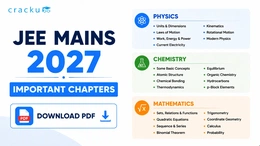
Chapters That Deserve Extra Attention
Subject | Chapters That Usually Carry More Weight |
Physics | Current Electricity, Mechanics, Electrostatics, Ray Optics, Modern Physics |
Chemistry | Thermodynamics, Equilibrium, Solutions, Coordination Compounds, p-Block, d-Block, Alcohols, Aldehydes & Ketones, Amines |
Mathematics | Calculus, Coordinate Geometry, Complex Numbers, Matrices & Determinants, 3D Geometry, Vectors |
Download JEE Main 2027 Syllabus
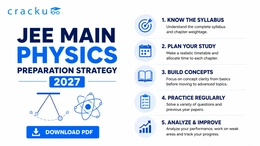
Start by reading every topic carefully. Mark chapters that already feel comfortable. Circle topics that need extra effort. This simple exercise helps you build a practical study plan instead of copying someone else's timetable.
Your preparation should always move in three stages.
- Learn the concept.
- Practice enough questions.
- Revise until it feels natural.
Use JEE study material that explains ideas clearly instead of collecting five different books. Too many resources usually create confusion.
After completing every chapter, solve a few JEE questions without checking notes. If mistakes happen, don't panic. They simply show where improvement is needed.
Also Read: JEE Mains Syllabus 2027 PDF, Weightage, Important Topics
How to Balance Class 12 Boards and JEE Main Preparation
The biggest fear during Class 12 is managing board exams and JEE together. Many students think they need separate preparation for both. That's rarely true.
Most board chapters are already part of the entrance syllabus. If your concepts become strong, both exams benefit.
- Instead of dividing your entire day into two completely different schedules, divide it by goals.
- Morning hours usually work well for learning fresh concepts because your mind feels active.
- Afternoons can be used for school homework, assignments, and revision.
- Evenings are great for solving problems and checking speed.
If school takes longer than expected, don't feel guilty. Adjust the next study session instead of giving up on the entire day.
Whenever you complete a chapter in school, revise it again within two days. Small revisions stop topics from disappearing from memory.
In case you need help, join JEE online coaching and ace the preparation.
Feature | What Students Get |
Live Classes | 120+ |
Recorded Video Lessons | 250+ |
Practice Questions | 10,700+ |
Full-Length Mock Tests | 5 |
Daily Study Plan | Available |
Previous Year Questions | Chapter-wise |
Performance Analysis | Included |
Revision Notes & Formula Sheets | Included |
Access | Learn Anytime, Anywhere |
Once every week, attempt one JEE Main mock test in a proper exam environment. Don't pause the timer. Don't check answers in between. Train your mind to stay calm under pressure. Your schedule does not have to be perfect. It simply has to be repeatable.
Also Read: JEE Mains Exam Pattern 2027, Negative Marking, Duration
Month-Wise JEE Main 2027 Roadmap for Class 12 Students
Start maintaining your own JEE Main 2027 formula sheet. Write formulas in your own words. Revise them every weekend. Start slowly and end with JEE Main rank.
July 2026 – Build Strong Concepts
Focus Area | What to Do |
School Chapters | Finish every chapter taught in school within the same week. |
Physics | Complete Units & Dimensions, Kinematics, Current Electricity (if scheduled). Focus on concepts first. |
Chemistry | Build strong basics in Physical Chemistry and revise Organic reactions taught in Class 12. |
Mathematics | Practice Functions, Limits, and Relations without skipping fundamentals. |
Daily Practice | Solve 25–30 questions every day (mixed subjects). |
Weekly Goal | Revise everything studied during the week every Sunday. |
Mock Tests | No full mocks yet. Attempt 1 chapter test every week. |
August 2026 – Increase Problem Solving
Focus Area | What to Do |
School Chapters | Stay one chapter ahead whenever possible. |
Physics | Start Mechanics and Electrostatics revision along with Class 12 topics. |
Chemistry | Strengthen Thermodynamics, Solutions, and Coordination Compounds. |
Mathematics | Continue Calculus and begin Coordinate Geometry practice. |
Daily Practice | Solve 40–50 questions every day. |
Weekly Goal | Analyse mistakes and maintain an error notebook. |
Mock Tests | Attempt 1 subject-wise test every week. |
September 2026 – Strengthen Weak Chapters
Focus Area | What to Do |
School Chapters | Complete pending portions before half-yearly exams. |
Physics | Focus on weak numerical chapters and improve calculation speed. |
Chemistry | Revise Organic Chemistry reactions every alternate day. |
Mathematics | Practice Algebra and Coordinate Geometry regularly. |
Daily Practice | Solve 60 questions every day. |
Weekly Goal | Revise one completed chapter from each subject. |
Mock Tests | Attempt 1 part syllabus mock every week. |
October 2026 – Start Full Revision
Focus Area | What to Do |
School Chapters | Balance board preparation with JEE revision. |
Physics | Revise Mechanics and Modern Physics. |
Chemistry | Complete Inorganic revision with short notes. |
Mathematics | Focus on Calculus and Vectors. |
Daily Practice | Solve 70–80 questions every day. |
Weekly Goal | Spend extra time only on weak topics. |
Mock Tests | Attempt 1 full-length mock every week. |
November 2026 – Improve Speed and Accuracy
Focus Area | What to Do |
Revision | Finish the first complete syllabus revision. |
Physics | Practice mixed numerical sets. |
Chemistry | Revise NCERT line by line for Inorganic Chemistry. |
Mathematics | Solve mixed-topic problem sets under time limits. |
Daily Practice | Solve 80–100 questions every day. |
Weekly Goal | Analyse every mistake before the next mock. |
Mock Tests | Attempt 2 full-length mocks every week. |
December 2026 – Enter Exam Mode
Focus Area | What to Do |
Revision | Revise only short notes and formulas. |
Physics | Focus on accuracy in calculation-heavy chapters. |
Chemistry | Revise reactions, exceptions, and important facts daily. |
Mathematics | Solve complete papers instead of individual chapters. |
Daily Practice | Solve 1 complete paper or 90–100 questions daily. |
Weekly Goal | Improve time management after every test. |
Mock Tests | Attempt 3 full-length mocks every week. |
January 2027 – Final Preparation
Focus Area | What to Do |
Revision | Avoid learning completely new topics. |
Physics | Revise formula sheets and frequently asked concepts. |
Chemistry | Focus on NCERT revision and important reactions. |
Mathematics | Solve high-scoring chapters to build confidence. |
Daily Practice | Solve 1 full mock and analyse it every alternate day. |
Weekly Goal | Sleep well, stay healthy, and keep confidence high. |
Mock Tests | Attempt 4–5 full-length mocks before the exam. |
If you wish to go for JEE Main phase 2 or session 2, ensure this rhythm is followed for the next few months.
Also Read: JEE Mains Maths Important Chapters 2027, Topic-wise PYQ PDF
JEE Main 2027 Subject-Wise Preparation Strategy
Trying to study all three in the same way rarely works. Maths needs formulas and more practice. Physics requires understanding and modifying formulas accordingly, and chemistry requires memorization; however, all three need multiple revisions.
Physics Preparation Strategy
High-Weightage Chapters | How to Work on Them |
Mechanics (20–25% weightage) | Build concepts first before solving numericals. Practice 20–25 questions daily and revise formulas every weekend. |
Current Electricity & Electrostatics (10–15%) | Focus on circuit-based problems and calculations. Repeat similar question types until the approach becomes natural. |
Modern Physics (8–10%) | Learn formulas, understand concepts, and solve previous year questions regularly. These chapters are generally scoring. |
Ray Optics & Wave Optics (8–10%) | Draw diagrams while solving questions. Spend extra time on numerical practice instead of memorising derivations. |
Revision Strategy | Maintain an error notebook and revisit difficult questions every week instead of solving only new ones. |
Chemistry Preparation Strategy
High-Weightage Chapters | How to Work on Them |
Physical Chemistry (25–30%) | Practice 15–20 numericals every day. Focus on Thermodynamics, Equilibrium, Electrochemistry, and Solutions. |
Organic Chemistry (30–35%) | Revise reaction mechanisms daily. Learn named reactions through repeated practice instead of memorising them once. |
Inorganic Chemistry (25–30%) | Read NCERT regularly. Concentrate on Coordination Compounds, p-Block, and d-Block by making short notes. |
Biomolecules, Polymers & Chemistry in Everyday Life | These chapters are short and scoring. Revise them during weekends to secure easy marks. |
Revision Strategy | Spend at least 30–40 minutes every day revising previously completed chapters to improve retention. |
Mathematics Preparation Strategy
High-Weightage Chapters | How to Work on Them |
Calculus (30–35%) | Give it the highest priority. Practice 20 questions daily from Limits, Differentiation, Integration, and Application of Derivatives. |
Coordinate Geometry (18–20%) | Solve a variety of problems and improve calculation speed through regular practice. |
Algebra (20–25%) | Focus on Complex Numbers, Matrices & Determinants, Binomial Theorem, and Sequences & Series. Solve mixed question sets every week. |
Vectors & 3D Geometry (10–12%) | Learn standard concepts first and then practice previous year questions to improve accuracy. |
Revision Strategy | Rework incorrect questions every week and maintain a separate notebook for tricky methods and shortcuts. |
Common Mistakes Class 12 Students Should Avoid
Many students lose marks because of avoidable habits instead of difficult questions.
- The first mistake is chasing too many resources.
- The second mistake is avoiding mock analysis.
- Another common habit is studying only favourite subjects.
- Many students also wait for the "perfect" timetable.
- Another mistake is ignoring health.
- Finally, stop measuring your journey through someone else's marks.
Your competition is yesterday's version of yourself. Even a one percent improvement every day creates huge progress over months.
Also Read: How to Score 99+ Percentile in JEE Mains 2027?
JEE Main 2027 Roadmap for Class 12 Students: Conclusion
JEE Main 2027 preparation for Class 12 students requires a clear roadmap, consistent practice, and smart time management. Starting early helps students complete the syllabus, revise important concepts, solve previous year questions, and improve accuracy through mock tests. A structured approach towards Physics, Chemistry, and Mathematics can make preparation more effective and result-oriented.
Success in JEE Main 2027 depends on building strong fundamentals, maintaining regular revision habits, and analysing mistakes throughout the preparation journey. Students who follow a disciplined study plan, balance board exams with entrance preparation, and stay consistent can improve their chances of achieving a strong percentile and securing admission to their preferred engineering college.
.webp)