Group
Group
 Group
Group


 Preferred Source

 Google Discover
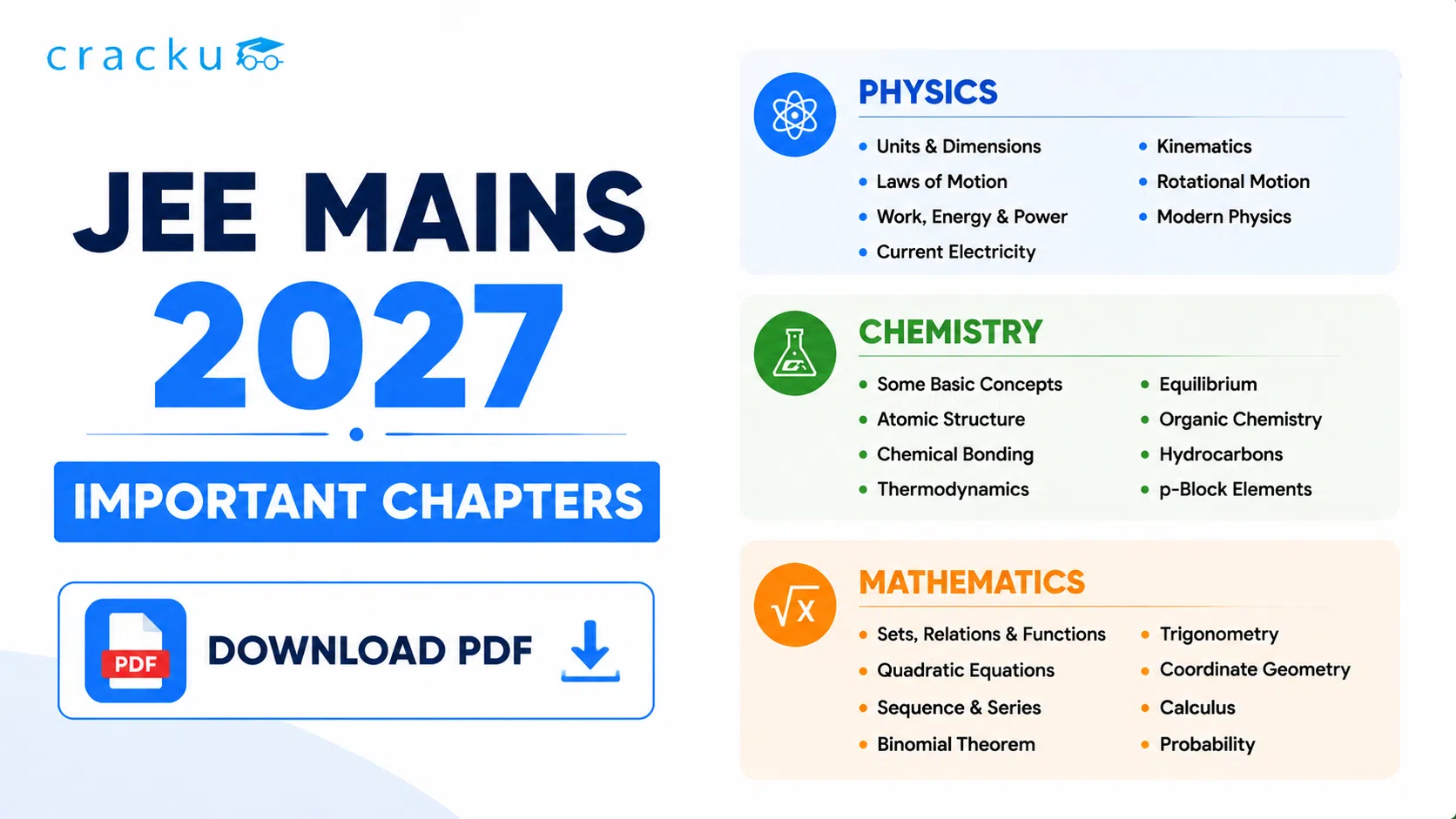
JEE Mains Important Chapters 2027
The JEE Mains 2027 Important Chapters help students identify the topics that have consistently carried higher weightage in previous years. Focusing on these chapters is a smart way to begin your preparation, as they contribute a significant number of questions in the exam. However, they should be treated as a priority list rather than a substitute for the complete JEE Mains 2027 Syllabus. A balanced preparation strategy ensures that you don't miss scoring opportunities from lower-weightage topics.
In this article, we have provided a subject-wise list of the most important chapters in Physics, Chemistry, and Mathematics based on previous JEE Main trends. Use these chapters to plan your study schedule, prioritise revision, and allocate more practice time to frequently tested concepts. Along with high-weightage topics, make sure to revise the remaining syllabus, solve previous year questions, and take regular mock tests to maximise your chances of scoring well in JEE Main 2027.
JEE Main 2027 Chapter-Wise Weightage
Understanding the JEE Main Important Chapters 2027 chapter-wise weightage is one of the most effective ways to prepare strategically for the exam. While the National Testing Agency (NTA) does not officially release chapter-wise marks distribution, an analysis of previous years' papers reveals recurring trends in the number of questions asked from different chapters.
Subject-wise important Chapters |
Physics
| Chapter | Expected Weightage | Expected Questions |
|---|---|---|
| Current Electricity | Very High | 2–3 |
| Electrostatics | Very High | 2 |
| Modern Physics | Very High | 2–3 |
| Magnetic Effects of Current & Magnetism | High | 2 |
| Semiconductor Electronics | High | 1–2 |
| Ray Optics | High | 1–2 |
| Thermodynamics | High | 1–2 |
| Work, Energy & Power | Medium | 1 |
| Rotational Motion | Medium | 1 |
| Oscillations & SHM | Medium | 1 |
| Waves | Medium | 1 |
| Gravitation | Medium | 1 |
| Laws of Motion | Medium | 1 |
| Units & Dimensions | Low-Medium | 1 |
| Experimental Physics | Low-Medium | 1 |
Chemistry
| Chapter | Expected Weightage | Expected Questions |
|---|---|---|
| Chemical Bonding | Very High | 2–3 |
| Coordination Compounds | Very High | 2 |
| General Organic Chemistry (GOC) | Very High | 2 |
| Aldehydes, Ketones & Carboxylic Acids | High | 2 |
| Amines | High | 1–2 |
| Biomolecules | High | 1–2 |
| d & f Block Elements | High | 2 |
| Electrochemistry | High | 1–2 |
| Equilibrium | Medium | 1–2 |
| Chemical Kinetics | Medium | 1 |
| Thermodynamics | Medium | 1 |
| Solutions | Medium | 1 |
| Haloalkanes & Haloarenes | Medium | 1 |
| Alcohols, Phenols & Ethers | Medium | 1 |
| Surface Chemistry | Low-Medium | 1 |
| Environmental Chemistry | Low | 1 |
Mathematics
| Chapter | Expected Weightage | Expected Questions |
|---|---|---|
| Calculus | Very High | 6–8 |
| Coordinate Geometry | High | 3–4 |
| Vectors & 3D Geometry | High | 3 |
| Probability | High | 2 |
| Matrices & Determinants | High | 2 |
| Complex Numbers | Medium | 1–2 |
| Sequence & Series | Medium | 1 |
| Binomial Theorem | Medium | 1 |
| Trigonometry | Medium | 1–2 |
| Permutation & Combination | Medium | 1 |
| Straight Lines & Circle | Medium | 1–2 |
| Quadratic Equations | Medium | 1 |
| Statistics | Medium | 1 |
| Sets, Relations & Functions | Low-Medium | 1 |
JEE Main Physics Important Chapters 2027
The following table highlights the important Physics chapters for JEE Main 2027 based on the analysis of recent exam trends and JEE Mains Previous Papers. While every chapter in the JEE Mains 2027 Syllabus is important, these topics have consistently been among the most frequently tested.
| Chapter | Preparation Focus |
|---|---|
| Current Electricity | Circuit analysis, Kirchhoff's Laws, Wheatstone Bridge |
| Electrostatics | Electric field, Gauss's Law, Capacitors |
| Modern Physics (Atoms, Nuclei & Dual Nature) | Formula-based numericals, Photoelectric Effect, Radioactivity |
| Magnetic Effects of Current & Magnetism | Biot-Savart Law, Ampere's Law, Force on Current-Carrying Conductors |
| Electromagnetic Induction & Alternating Current | Faraday's Law, LCR Circuits, Transformers |
| Ray Optics | Mirrors, Lenses, Optical Instruments |
| Wave Optics | Interference, Diffraction, Polarisation |
| Thermodynamics | Laws of Thermodynamics, Heat Engines, Thermodynamic Processes |
| Kinetic Theory of Gases | Gas Laws, Degrees of Freedom, Maxwell's Distribution |
| Work, Energy & Power | Conservation of Energy, Power, Collisions |
| Rotational Motion | Torque, Moment of Inertia, Angular Momentum |
| Laws of Motion | Newton's Laws, Friction, Circular Motion |
| Kinematics | Projectile Motion, Relative Motion, Graph-Based Problems |
| Oscillations & Simple Harmonic Motion | Time Period, Energy in SHM, Spring Systems |
| Waves | Sound Waves, Standing Waves, Doppler Effect |
| Gravitation | Universal Gravitation, Satellite Motion, Escape Velocity |
| Semiconductor Electronics | Diodes, Transistors, Logic Gates |
| Units, Dimensions & Experimental Physics | Dimensional Analysis, Error Analysis, Measuring Instruments |
Also Read: JEE Mains 2027 6-Months Roadmap, Subject-Wise Preparation
JEE Main Chemistry Important Chapters 2027
The following table highlights the Chemistry chapters for JEE Main Important Chapters 2027 based on the analysis of recent exam trends and JEE Mains Previous Papers. The list covers key topics from Physical, Organic, and Inorganic Chemistry that have consistently been tested in recent years.
| Chapter | Preparation Focus |
|---|---|
| Chemical Bonding & Molecular Structure | VSEPR Theory, Hybridisation, Molecular Orbital Theory |
| Coordination Compounds | Isomerism, Crystal Field Theory, Nomenclature |
| General Organic Chemistry (GOC) | Electronic Effects, Acidity & Basicity, Reaction Mechanisms |
| Hydrocarbons | Alkanes, Alkenes, Alkynes, Aromatic Compounds |
| Aldehydes, Ketones & Carboxylic Acids | Named Reactions, Preparation, Chemical Properties |
| Alcohols, Phenols & Ethers | Reaction Mechanisms, Acidity, Conversions |
| Amines | Basicity, Diazonium Salts, Important Reactions |
| Biomolecules | Carbohydrates, Proteins, Vitamins, Nucleic Acids |
| Chemical Thermodynamics | Enthalpy, Entropy, Gibbs Free Energy |
| Electrochemistry | Nernst Equation, Conductance, Electrochemical Cells |
| Chemical Kinetics | Rate Laws, Order of Reaction, Arrhenius Equation |
| Equilibrium | Chemical & Ionic Equilibrium, Buffer Solutions, Solubility Product |
| Solutions | Concentration Terms, Colligative Properties |
| Atomic Structure | Quantum Numbers, Electronic Configuration, Bohr's Model |
| Mole Concept | Stoichiometry, Limiting Reagent, Empirical Formula |
| d & f Block Elements | Electronic Configuration, Oxidation States, Properties |
| p-Block Elements | Group Trends, Important Compounds, NCERT-Based Concepts |
| Haloalkanes & Haloarenes | Nucleophilic Substitution, Elimination Reactions |
| Redox Reactions | Oxidation Number, Balancing Redox Equations |
| Surface Chemistry | Adsorption, Catalysis, Colloids |
Also Read: JEE Mains 2027 Sample Paper, Based on Latest Exam Pattern
JEE Main Maths Important Chapters 2027
The following table lists the important Mathematics chapters for JEE Main 2027 based on the analysis of recent exam trends and JEE Mains Previous Papers. Mathematics is a practice-intensive subject, and these chapters have consistently contributed a significant share of questions in recent JEE Main examinations.
| Chapter | Preparation Focus |
|---|---|
| Calculus (Limits, Continuity, Differentiation & Integration) | Limits, Applications of Derivatives, Definite & Indefinite Integration |
| Differential Equations | Formation and Solution of Differential Equations |
| Coordinate Geometry | Straight Lines, Circle, Parabola, Ellipse, Hyperbola |
| Vectors | Dot Product, Cross Product, Direction Cosines & Ratios |
| Three-Dimensional Geometry | Line, Plane, Shortest Distance, Angle Between Planes |
| Matrices & Determinants | Inverse Matrix, Adjoint, Properties of Determinants |
| Probability | Conditional Probability, Bayes' Theorem, Random Variables |
| Complex Numbers | Argand Plane, Modulus, Quadratic Equations |
| Sequence & Series | AP, GP, HP, Special Series |
| Binomial Theorem | Expansion, General Term, Properties |
| Permutations & Combinations | Counting Principles, Arrangements, Selections |
| Trigonometry | Trigonometric Identities, Equations, Inverse Trigonometric Functions |
| Quadratic Equations | Nature of Roots, Graphs, Relations Between Roots and Coefficients |
| Sets, Relations & Functions | Types of Functions, Composition, Inverse Functions |
| Statistics | Mean, Median, Variance, Standard Deviation |
| Mathematical Reasoning | Logical Statements, Truth Tables, Validity of Arguments |
Also Read: JEE Main 2027 Roadmap for Class 12 Students
Subject-Wise Preparation Strategy Based on Important Chapters
A subject-wise preparation plan helps you allocate your time efficiently, strengthen your conceptual understanding, and improve problem-solving skills. Along with regular revision using a JEE Mains Formula Sheet, solving JEE Questions, and taking frequent JEE Mains Mock Tests will help maximise your score.
Physics Preparation Strategy
- Build strong conceptual clarity before attempting numerical problems.
- Prioritise high-weightage chapters such as Current Electricity, Electrostatics, Modern Physics, and Optics.
- Revise formulas daily using a JEE Mains Formula Sheet.
- Solve chapter-wise JEE Questions to improve accuracy and problem-solving speed.
- Practise numerical questions from JEE Mains Previous Papers regularly.
- Take a JEE Mains Mock Test every week to strengthen time management.
Chemistry Preparation Strategy
- Divide your preparation equally among Physical, Organic, and Inorganic Chemistry.
- Read NCERT thoroughly, especially for Inorganic Chemistry.
- Understand reaction mechanisms instead of memorising them.
- Revise important chemical reactions, exceptions, and formulas regularly.
- Solve chapter-wise questions and analyse JEE Mains Previous Papers.
- Use reliable JEE Study Material and attempt regular mock tests to improve accuracy.
Mathematics Preparation Strategy
- Begin with concept-building before solving advanced problems.
- Give extra practice time to Calculus, Coordinate Geometry, Vectors, and 3D Geometry.
- Revise formulas and identities every day using a JEE Mains Formula Sheet.
- Solve a variety of JEE Questions to improve speed and accuracy.
- Practise mixed-topic question sets instead of studying one chapter at a time.
- Attempt a JEE Mains Mock Test regularly and analyse mistakes after each test.
Also Read: JEE Main 2027 Preparation Strategy with Study Timeline
How to Study JEE Main Important Chapters
Studying only important chapters is not sufficient because questions can be asked from any topic in the syllabus. However, prioritising high-weightage chapters helps improve overall preparation.
Some effective strategies include:
- Complete the JEE Mains 2027 Syllabus before focusing solely on revision.
- Prepare concise notes and maintain a personal JEE Mains Formula Sheet for Physics and Mathematics.
- Solve chapter-wise practice questions every day.
- Analyse JEE Mains Previous Papers to understand recurring concepts.
- Use reliable JEE Study Material that follows the latest syllabus and exam pattern.
- Attempt a JEE Mains Mock Test every week and analyse mistakes after each test.
- Revise important formulas and reactions multiple times before the examination.
Also Read: How to Score 99+ Percentile in JEE Mains 2027?
Common Mistakes While Preparing Important Chapters
While focusing on the JEE Main Important Chapters 2027 can improve your preparation, many aspirants make avoidable mistakes that affect their overall performance. The table below highlights some common errors and practical ways to avoid them.
| Common Mistake | How to Avoid It |
|---|---|
| Studying only high-weightage chapters | Complete the entire JEE Mains 2027 Syllabus, as questions can be asked from any topic. |
| Ignoring NCERT textbooks | Use NCERT as the primary source, especially for Chemistry, before referring to additional JEE Study Material. |
| Memorising formulas without understanding concepts | Focus on conceptual clarity and revise regularly using a JEE Mains Formula Sheet. |
| Not solving enough practice questions | Solve chapter-wise JEE Questions daily to strengthen problem-solving skills. |
| Skipping JEE Mains Previous Papers | Analyse previous years' papers to understand important topics, question trends, and difficulty levels. |
| Avoiding mock tests until the last stage | Attempt a JEE Mains Mock Test regularly to improve speed, accuracy, and time management. |
| Spending too much time on one subject | Maintain a balanced study schedule and allocate time to Physics, Chemistry, and Mathematics every week. |
| Not revising completed chapters | Revise formulas, concepts, and short notes at regular intervals to retain information. |
| Using too many books and resources | Stick to one reliable set of JEE Study Material and revise it thoroughly instead of switching between multiple sources. |
Also Read: JEE Mains Maths Preparation Strategy 2027
JEE Mains Important Chapters 2027: Conclusion
Knowing the JEE Main 2027 important chapters helps students create a focused preparation strategy and prioritise topics that have higher chances of appearing in the exam. Chapters like Current Electricity, Modern Physics, Chemical Bonding, Calculus, Coordinate Geometry, and Vectors have consistently shown strong weightage trends in previous years. However, students should remember that every topic in the JEE Main 2027 syllabus is important and should not be ignored completely.
A successful JEE Main 2027 preparation plan requires a combination of smart chapter prioritisation, regular practice, revision, and mock test analysis. Along with completing important chapters, students should solve JEE Main previous year papers, use reliable study material, and regularly evaluate their progress. With consistent effort and the right strategy, aspirants can improve their accuracy, confidence, and chances of achieving a strong percentile in JEE Main 2027.