
 Group
 Group


 Preferred Source

 Google Discover
JEE Main 2027 3-Month Study Plan
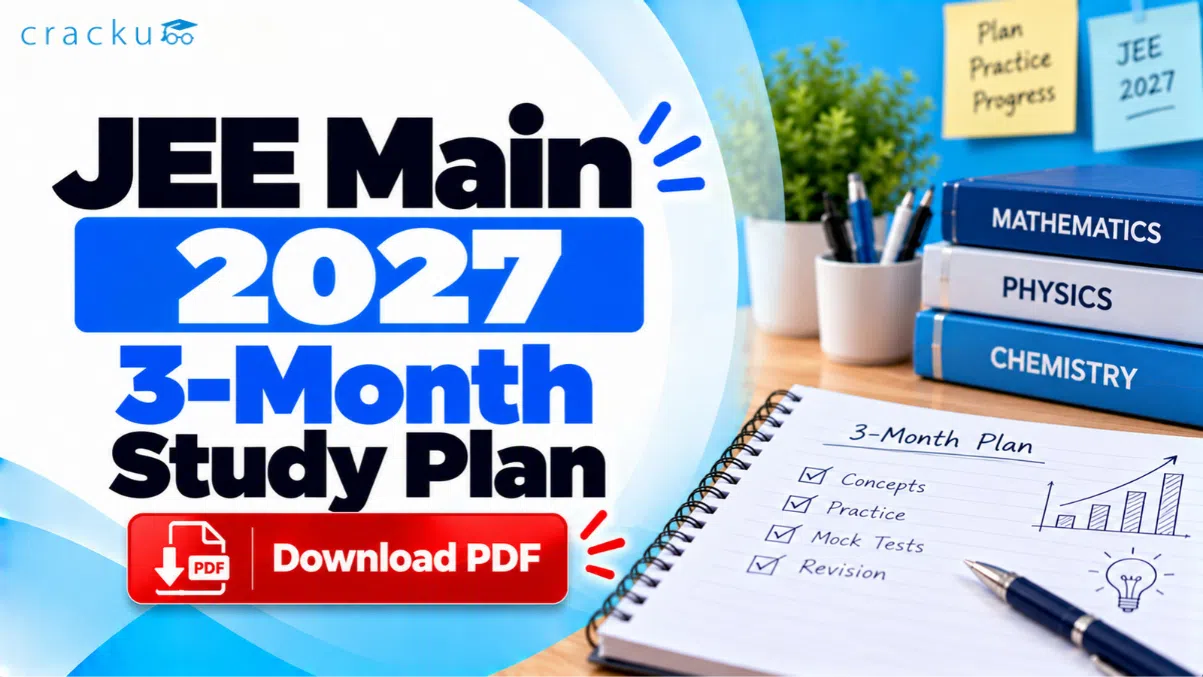
A JEE Main 2027 3-month study plan should balance concept revision, question practice and mock test analysis. With around 90 days available, start by reviewing the JEE Main syllabus, identifying unfinished chapters and setting realistic weekly targets for Physics, Chemistry and Mathematics. Give extra attention to weak concepts while regularly revising topics you already know.
Divide your preparation into three stages: strengthen concepts in the first month, improve speed and accuracy in the second, and focus on revision and full-length mocks in the third. Practise previous year questions, track repeated mistakes and adjust your schedule based on your progress. The goal is to understand, recall and apply what you study within the exam’s time limit.
How to Prepare for JEE Main 2027 in 3 Months?
A 3-month preparation strategy should be divided into different stages instead of treating every month equally. These 3 months can become a turning point for most aspirants. When students follow a focused 3-month study plan, they naturally strengthen their mock test performance and increase their chances of scoring high in the actual exam. The 3-month preparation schedule must have a proper timetable for all subjects. Students must allocate time for Physics, Chemistry, and Math.
Phase 1: Strengthen Your Concepts (First Month)
This month will be the deciding month for all your preparation. Most of the students start with high motivation, but as soon as a few days pass, their motivation also fades. Make sure not to get trapped in such a thing. You must focus on strengthening basic concepts while revising the most important chapters from Physics, Chemistry, and Mathematics.
- First, try to find major high-weightage topics like Mechanics, Thermodynamics, Organic Chemistry, and Calculus. This can be identified using the previous year papers.
- Secondly, build short, easy-to-revise notes containing formulas and definitions.
- Third, make a habit of practising concept-based questions every day.
- Additionally, use NCERT, especially for Chemistry, as your base.
Phase 2: Improve Accuracy and Speed (Second Month)
If you completed all the targets of the first month, you have already covered the difficult phase. This phase converts your knowledge into actual exam performance. Here your goal must revolve around practice, speed, accuracy, and consistency.
- Try attempting chapter-wise and topic-wise mock tests regularly.
- Second, analyse mistakes after each mock test to understand weak topics and concepts.
- Make a goal of setting daily problem-solving targets for time-bound practice.
- Also, try to solve mixed questions to get the real JEE exam pressure.
Phase 3: Final Revision and Full-Length (Third Month)
This will be your final month before the exam; here you have to stay confident as well as motivated.
- Attempt full-length mock tests every 2–3 days.
- Take these tests in real exam-like conditions to build confidence.
- Revise short notes and formulas you made during the first phase.
- Avoid reading any new topics and focus on existing weaknesses
JEE Main 2027 Important Chapters to Cover in the Last 3 Months
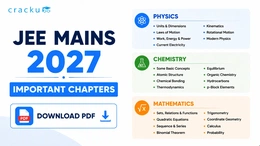
The following table shows the important chapters for JEE Main 2027 based on the analysis of recent exam trends and JEE Mains Previous Papers. The list covers key topics from Physics, Chemistry and Maths.
| Physics | Chemistry | Mathematics |
|---|---|---|
| Current Electricity | Chemical Bonding & Molecular Structure | Calculus (Limits, Continuity, Differentiation & Integration) |
| Electrostatics | Coordination Compounds | Differential Equations |
| Modern Physics (Atoms, Nuclei & Dual Nature) | General Organic Chemistry (GOC) | Coordinate Geometry |
| Magnetic Effects of Current & Magnetism | Hydrocarbons | Vectors |
| Electromagnetic Induction & Alternating Current | Aldehydes, Ketones & Carboxylic Acids | Three-Dimensional Geometry |
| Ray Optics | Alcohols, Phenols & Ethers | Matrices & Determinants |
| Wave Optics | Amines | Probability |
| Thermodynamics | Biomolecules | Complex Numbers |
| Kinetic Theory of Gases | Chemical Thermodynamics | Sequence & Series |
| Work, Energy & Power | Electrochemistry | Binomial Theorem |
| Rotational Motion | Chemical Kinetics | Permutations & Combinations |
| Laws of Motion | Equilibrium | Trigonometry |
| Kinematics | Solutions | Quadratic Equations |
| Oscillations & Simple Harmonic Motion | Atomic Structure | Sets, Relations & Functions |
| Waves | Mole Concept | Statistics |
| Gravitation | d & f Block Elements | — |
| Semiconductor Electronics | p-Block Elements | — |
| Units, Dimensions & Experimental Physics | Haloalkanes & Haloarenes | — |
| — | Redox Reactions | — |
How to Use JEE Main PYQs in a 3-Month Study Plan?
JEE Main PYQs will be helpful for the students to know about the type of questions that are being asked in the JEE Main examination in recent years. It will also help in knowing where you stand in your preparation. Do not treat PYQs as just another mock test. Use them to understand the topics which can be repeated this year also.
While solving PYQs, students should check:
- The type of question has been asked in previous years.
- Which topics are asked regularly and have chances to be asked again.
- The difficulty level of questions from every subject.
- Time taken to solve every question.
- In which topics mistakes are repeated.
- Topics that require more revision.
- Correct and incorrect answers
- Topics that need more practice
JEE Main 2027 Mock Test Strategy for 3 Months
Make mock tests a regular part of your preparation during the last three months, gradually increasing their frequency as you cover more topics. After each JEE Mains mock test, review your correct, incorrect and unattempted questions to understand where you lost marks or spent too much time. Go beyond the final score: check whether errors came from weak concepts, forgotten formulas or calculation mistakes. Maintain an error notebook, revise the relevant topics and attempt incorrect questions again before taking the next test.
| Week | Primary Focus | Mocks (Full-Length) | Target |
|---|---|---|---|
| Weeks 1–4 | Fix core concept gaps and revise short topics | 1 per week | Bring accuracy to 70–80% in basic topics |
| Weeks 5–8 | Build speed and sectional accuracy; start timed sectional drills | 2 per week | Maintain consistency across sections and reduce careless mistakes |
| Weeks 9–10 | Focus on time management | 3 per week | Build exam-day stamina and improve question selection |
| Weeks 11–12 | Focused revision, manageable mock practice and confidence building | 1–2 per week (low stress) | Refine your exam strategy |
Common Mistakes to Avoid During 3 Months of JEE Main Preparation
Most JEE aspirants begin with high energy and high motivation but lose momentum within a few days. Here is why that happens and what you should watch out for.
| Common Mistake | Better Alternative |
|---|---|
| Avoiding NCERT | Start revision with NCERT Solutions to strengthen your basics before moving to advanced practice. |
| Using multiple reference books | Stick to 1–2 books per subject and practise consistently. |
| Studying without a study plan | Follow a structured 3-month JEE Main study plan with realistic daily and weekly targets. |
| No revision schedule | Set aside regular time to revise previously studied chapters. |
| Avoiding mock tests | Attempt at least one mock test every two weeks and analyse your performance. |
| Studying till exhaustion | Take short breaks between study sessions and maintain a consistent sleep schedule. |
JEE Main 2027 3-Month Study Plan: Conclusion
A practical JEE Main 2027 3-month study plan should balance concept revision, question practice and mock test analysis. Divide your preparation into monthly goals and manageable daily targets for Physics, Chemistry and Mathematics. Use the first month to strengthen your basics, the second to improve speed and accuracy, and the final month to revise and refine your test-taking strategy.
Make JEE Main PYQs, short notes and an error notebook part of your regular routine. Follow the suggested mock test schedule, but leave enough time to understand mistakes and revisit weak chapters. Track your progress weekly and adjust your 90-day study plan to your needs. Consistent practice and careful revision can help you make better use of the remaining preparation time.