For the following questions answer them individually
In a typical combustion engine the workdone by a gas molecule is given by $$W = \alpha^2 \beta e^{\frac{-\beta x^2}{kT}}$$, where $$x$$ is the displacement, $$k$$ is the Boltzmann constant and $$T$$ is the temperature. If $$\alpha$$ and $$\beta$$ are constants, dimensions of $$\alpha$$ will be:
If two similar springs each of spring constant $$K_1$$ are joined in series, the new spring constant and time period would be changed by a factor:
A particle is moving with uniform speed along the circumference of a circle of radius $$R$$ under the action of a central fictitious force $$F$$ which is inversely proportional to $$R^3$$. Its time period of revolution will be given by:
Given below are two statements: one is labelled as Assertion A and the other is labelled as Reason R.
Assertion A: Body P having mass M moving with speed u has head-on collision elastically with another body Q having mass m initially at rest. If $$m \ll M$$, body Q will have a maximum speed equal to 2u after collision.
Reason R: During elastic collision, the momentum and kinetic energy are both conserved.
In the light of the above statements, choose the most appropriate answer from the options given below:
Four identical solid spheres each of mass $$m$$ and radius $$a$$ are placed with their centres on the four corners of a square of side $$b$$. The moment of inertia of the system about one side of square where the axis of rotation is parallel to the plane of the square is:
A planet revolving in elliptical orbit has:
A. a constant velocity of revolution.
B. has the least velocity when it is nearest to the sun.
C. its areal velocity is directly proportional to its velocity.
D. areal velocity is inversely proportional to its velocity.
E. to follow a trajectory such that the areal velocity is constant.
Choose the correct answer from the options given below:
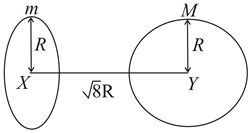
Find the gravitational force of attraction between the ring and sphere as shown in the diagram, where the plane of the ring is perpendicular to the line joining the centres. If $$\sqrt{8}R$$ is the distance between the centres of a ring (of mass $$m$$) and a sphere (mass $$M$$) where both have equal radius $$R$$.
The normal density of a material is $$\rho$$ and its bulk modulus of elasticity is $$K$$. The magnitude of increase in density of material, when a pressure $$P$$ is applied uniformly on all sides, will be:
A large number of water drops, each of radius $$r$$, combine to have a drop of radius $$R$$. If the surface tension is $$T$$ and mechanical equivalent of heat is $$J$$, the rise in heat energy per unit volume will be:
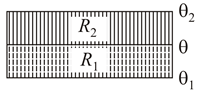
The temperature $$\theta$$ at the junction of two insulating sheets, having thermal resistances $$R_1$$ and $$R_2$$ as well as top and bottom temperatures $$\theta_1$$ and $$\theta_2$$ (as shown in figure) is given by: