
Join Our JEE Preparation Group
Prep with like-minded aspirants; Get access to free daily tests and study material.
Sign in
Please select an account to continue using cracku.in
↓ →
Join Our JEE Preparation Group
Prep with like-minded aspirants; Get access to free daily tests and study material.
The temperature $$\theta$$ at the junction of two insulating sheets, having thermal resistances $$R_1$$ and $$R_2$$ as well as top and bottom temperatures $$\theta_1$$ and $$\theta_2$$ (as shown in figure) is given by: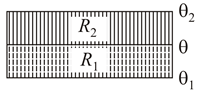
Let the steady-state heat current flowing through the composite slab be $$Q$$ (units: W).
Because the two sheets are in series, the same $$Q$$ flows through each sheet.
For a slab, the thermal resistance is defined as $$R = \dfrac{\text{temperature difference}}{\text{heat current}} \; \Rightarrow \; Q = \dfrac{\Delta \theta}{R}$$.
Applying this definition to the upper sheet (resistance $$R_1$$, temperature drop $$\theta_1 - \theta$$):
$$Q = \dfrac{\theta_1 - \theta}{R_1}$$ $$-(1)$$
Applying the same definition to the lower sheet (resistance $$R_2$$, temperature drop $$\theta - \theta_2$$):
$$Q = \dfrac{\theta - \theta_2}{R_2}$$ $$-(2)$$
Since the heat current $$Q$$ is the same in $$-(1)$$ and $$-(2)$$, equate the two expressions:
$$\dfrac{\theta_1 - \theta}{R_1} = \dfrac{\theta - \theta_2}{R_2}$$
Cross-multiply to eliminate the denominators:
$$R_2(\theta_1 - \theta) = R_1(\theta - \theta_2)$$
Expand both sides:
$$R_2\theta_1 - R_2\theta = R_1\theta - R_1\theta_2$$
Collect the terms containing $$\theta$$ on the right and the remaining terms on the left:
$$R_2\theta_1 + R_1\theta_2 = R_1\theta + R_2\theta$$
Factor out $$\theta$$ on the right:
$$R_2\theta_1 + R_1\theta_2 = (R_1 + R_2)\theta$$
Finally, solve for the junction temperature $$\theta$$:
$$\theta = \dfrac{R_2\theta_1 + R_1\theta_2}{R_1 + R_2}$$
This matches Option C.
Answer: Option C
Was this solution helpful?
_1.webp)

Educational materials for JEE preparation

Ask our AI anything

AI can make mistakes. Please verify important information.
AI can make mistakes. Please verify important information.