
Join Our JEE Preparation Group
Prep with like-minded aspirants; Get access to free daily tests and study material.
Sign in
Please select an account to continue using cracku.in
↓ →
Join Our JEE Preparation Group
Prep with like-minded aspirants; Get access to free daily tests and study material.
Find the electric field at point P (as shown in figure) on the perpendicular bisector of a uniformly charged thin wire of length $$L$$ carrying a charge $$Q$$. The distance of the point P from the centre of the rod is $$a = \frac{\sqrt{3}}{2}L$$.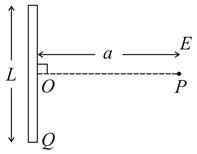
The thin wire has length $$L$$ and total charge $$Q$$, so its linear charge density is $$\lambda = \dfrac{Q}{L}$$.
Choose the origin at the centre $$O$$ of the wire. Take the wire along the $$x$$-axis from $$x=-\dfrac{L}{2}$$ to $$x=\dfrac{L}{2}$$. Point $$P$$ lies on the perpendicular bisector (the $$y$$-axis) at a distance $$a=\dfrac{\sqrt{3}}{2}L$$ from $$O$$.
Consider a small element of length $$dx$$ at coordinate $$x$$. Its distance from $$P$$ is $$r=\sqrt{a^{2}+x^{2}}$$. The electric field magnitude due to this element is $$dE=\dfrac{1}{4\pi\varepsilon_0}\dfrac{\lambda\,dx}{r^{2}}$$.
Because of symmetry, the horizontal components cancel. Only the vertical component (towards $$P$$ along the $$y$$-axis) survives, given by $$dE_y = dE\cos\theta,$$ where $$\cos\theta=\dfrac{a}{r}$$.
Thus $$dE_y = \dfrac{1}{4\pi\varepsilon_0}\dfrac{\lambda\,dx}{r^{2}}\cdot\dfrac{a}{r}= \dfrac{1}{4\pi\varepsilon_0}\dfrac{\lambda a\,dx}{(a^{2}+x^{2})^{3/2}}.$$
Add contributions from the whole wire. The integrand is even, so integrate from $$0$$ to $$\dfrac{L}{2}$$ and double it:
$$E = 2\int_{0}^{L/2}\dfrac{1}{4\pi\varepsilon_0}\dfrac{\lambda a\,dx}{(a^{2}+x^{2})^{3/2}} = \dfrac{\lambda a}{2\pi\varepsilon_0}\int_{0}^{L/2}\dfrac{dx}{(a^{2}+x^{2})^{3/2}}.$$
To evaluate the integral, set $$x=a\tan\theta$$, so $$dx=a\sec^{2}\theta\,d\theta$$ and $$(a^{2}+x^{2})^{3/2}=a^{3}\sec^{3}\theta.$$ Hence $$\dfrac{dx}{(a^{2}+x^{2})^{3/2}}=\dfrac{a\sec^{2}\theta\,d\theta}{a^{3}\sec^{3}\theta}=\dfrac{\cos\theta\,d\theta}{a^{2}}.$$
Limits: when $$x=0$$, $$\theta=0$$; when $$x=\dfrac{L}{2}$$, $$\tan\theta_0=\dfrac{L/2}{a}$$. Therefore
$$\int_{0}^{L/2}\dfrac{dx}{(a^{2}+x^{2})^{3/2}} =\dfrac{1}{a^{2}}\int_{0}^{\theta_0}\cos\theta\,d\theta =\dfrac{\sin\theta_0}{a^{2}}.$$
Substitute back:
$$E=\dfrac{\lambda a}{2\pi\varepsilon_0}\cdot\dfrac{\sin\theta_0}{a^{2}} =\dfrac{\lambda}{2\pi\varepsilon_0}\cdot\dfrac{\sin\theta_0}{a}.$$
The right-triangle at $$x=\dfrac{L}{2}$$ gives $$\sin\theta_0=\dfrac{L/2}{\sqrt{a^{2}+(L/2)^{2}}}.$$
With $$a=\dfrac{\sqrt{3}}{2}L$$ we have $$a^{2}=\dfrac{3}{4}L^{2},\quad \left(\dfrac{L}{2}\right)^{2}=\dfrac{1}{4}L^{2},$$ so $$a^{2}+\left(\dfrac{L}{2}\right)^{2}=L^{2}$$ and $$\sqrt{a^{2}+(L/2)^{2}}=L.$$ Thus $$\sin\theta_0=\dfrac{L/2}{L}=\dfrac{1}{2}.$$
Insert this value:
$$E=\dfrac{\lambda}{2\pi\varepsilon_0}\cdot\dfrac{1/2}{a} =\dfrac{\lambda}{4\pi\varepsilon_0\,a}.$$
Replace $$\lambda$$ by $$\dfrac{Q}{L}$$ and $$a$$ by $$\dfrac{\sqrt{3}}{2}L$$:
$$E=\dfrac{Q/L}{4\pi\varepsilon_0\left(\dfrac{\sqrt{3}}{2}L\right)} =\dfrac{Q}{2\sqrt{3}\pi\varepsilon_0 L^{2}}.$$
Therefore the magnitude of the electric field at point $$P$$ is $$\boxed{\dfrac{Q}{2\sqrt{3}\pi\varepsilon_0 L^{2}}}$$, which matches Option B.
Was this solution helpful?
_1.webp)

Educational materials for JEE preparation

Ask our AI anything

AI can make mistakes. Please verify important information.
AI can make mistakes. Please verify important information.