
Join Our JEE Preparation Group
Prep with like-minded aspirants; Get access to free daily tests and study material.
Sign in
Please select an account to continue using cracku.in
↓ →
Join Our JEE Preparation Group
Prep with like-minded aspirants; Get access to free daily tests and study material.
In the circle given below, let $$OA = 1$$ unit, $$OB = 13$$ unit and $$PQ \perp OB$$. Then, the area of the triangle PQB
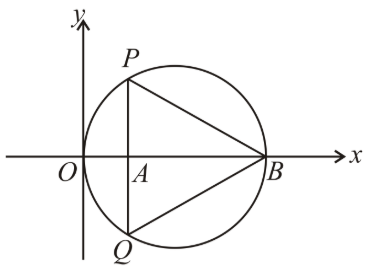
(in square units) is:
Given: $$OA = 1, \quad OB = 13 \implies A = (1, 0), \quad B = (13, 0)$$
Since the circle passes through $$O(0,0)$$ and $$B(13,0)$$, its center lies on the perpendicular bisector of $$OB$$:
$$x_c = \frac{13}{2} = 6.5$$
Let the circle's equation be: $$\left(x - \frac{13}{2}\right)^2 + (y - y_c)^2 = R^2$$
Since the circle passes through the origin $$(0,0)$$: $$\frac{169}{4} + y_c^2 = R^2 \implies R^2 - y_c^2 = \frac{169}{4}$$
At $$x = 1$$ (the line $$PQ \perp OB$$ at $$A$$):
$$\left(1 - \frac{13}{2}\right)^2 + (y - y_c)^2 = R^2$$
$$\frac{121}{4} + (y - y_c)^2 = R^2 \implies (y - y_c)^2 = R^2 - \frac{121}{4}$$
Using $$R^2 = y_c^2 + \frac{169}{4}$$: $$(y - y_c)^2 = y_c^2 + \frac{169}{4} - \frac{121}{4} = y_c^2 + 12$$
$$y^2 - 2y_c y - 12 = 0$$
Let the roots be $$y_P$$ and $$y_Q$$. Since $$PQ \perp OB$$, the product of the roots (y-coordinates) is:
$$y_P \cdot y_Q = -12 \implies (AP)(AQ) = 12$$
Since $$AP = AQ$$ by vertical symmetry across the x-axis: $$AP^2 = 12 \implies AP = \sqrt{12} = 2\sqrt{3}$$
$$PQ = 2(AP) = 4\sqrt{3}$$
The height of $$\triangle PQB$$ corresponding to base $$PQ$$: $$h = AB = OB - OA = 13 - 1 = 12$$
Area of $$\triangle PQB$$:
$$\text{Area} = \frac{1}{2} \cdot \text{base} \cdot \text{height} = \frac{1}{2} \cdot (4\sqrt{3}) \cdot 12 = 24\sqrt{3}$$
Was this solution helpful?
_1.webp)

Educational materials for JEE preparation

Ask our AI anything

AI can make mistakes. Please verify important information.
AI can make mistakes. Please verify important information.