
Join Our JEE Preparation Group
Prep with like-minded aspirants; Get access to free daily tests and study material.
Sign in
Please select an account to continue using cracku.in
↓ →
Join Our JEE Preparation Group
Prep with like-minded aspirants; Get access to free daily tests and study material.
Find the gravitational force of attraction between the ring and sphere as shown in the diagram, where the plane of the ring is perpendicular to the line joining the centres. If $$\sqrt{8}R$$ is the distance between the centres of a ring (of mass $$m$$) and a sphere (mass $$M$$) where both have equal radius $$R$$.
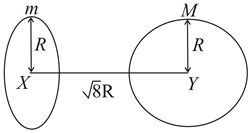
Let the centre of the sphere be $$O$$ and the centre of the ring be $$C$$. The line $$OC$$ is taken as the $$z$$-axis. Given radius of both sphere and ring $$= R$$, distance between centres $$OC=d=\sqrt{8}R$$.
Because $$d \gt R$$, the whole ring lies outside the sphere. According to Newton’s shell theorem, the gravitational field produced by a uniform solid sphere at an external point is the same as that produced by a point mass $$M$$ placed at its centre. Hence each element of the ring experiences a force directed towards $$O$$ whose magnitude is
$$dF=\frac{G\,M\,dm}{r^{2}}$$
where $$dm$$ is the mass of the element and $$r$$ is its distance from $$O$$.
Distance $$r$$ of any ring element from the sphere centre
Each element of the ring has cylindrical co-ordinates
$$\rho =R,\; z=d=\sqrt{8}R$$.
Thus
$$r=\sqrt{\rho^{2}+z^{2}}=\sqrt{R^{2}+(\sqrt{8}R)^{2}}=\sqrt{9R^{2}}=3R$$.
Component of the elemental force along the axis
The angle $$\theta$$ between the line $$O$$ to the element and the axis is given by
$$\cos\theta=\frac{z}{r}=\frac{\sqrt{8}R}{3R}= \frac{\sqrt{8}}{3}.$$
Therefore the axial component of the elemental force is
$$dF_z=dF\,\cos\theta =\frac{G\,M\,dm}{(3R)^{2}}\;\frac{\sqrt{8}}{3} =\frac{G\,M\,dm}{9R^{2}}\;\frac{\sqrt{8}}{3} =\frac{\sqrt{8}}{27}\,\frac{G\,M\,dm}{R^{2}}.$$
Net force on the ring
Because of symmetry, the transverse components (perpendicular to the axis) cancel when integrated around the ring, whereas all axial components add.
Integrating $$dm$$ over the whole ring simply gives its total mass $$m$$:
$$F=\int dF_z =\frac{\sqrt{8}}{27}\,\frac{G\,M}{R^{2}}\int dm =\frac{\sqrt{8}}{27}\,\frac{G\,M\,m}{R^{2}}.$$
The force acts along the line joining the two centres, attracting the ring and sphere towards each other.
Hence the gravitational force of attraction is $$\boxed{\displaystyle F=\frac{\sqrt{8}}{27}\,\frac{G\,M\,m}{R^{2}}}.$$ So the correct option is Option D.
Was this solution helpful?
_1.webp)

Educational materials for JEE preparation

Ask our AI anything

AI can make mistakes. Please verify important information.
AI can make mistakes. Please verify important information.