An oxide of iron contains 69.9% iron, its empirical formula, is:
(Given: Molar mass of Fe and O are 56 and 16 g mol$$^{-1}$$ respectively.)
JEE Basic Concepts in Chemistry Questions
How many grams of residue is obtained by heating 2.76 g of silver carbonate? (Given: Molar mass of C, O and Ag are 12, 16 and 108 g mol$$^{-1}$$ respectively)
Identify the correct statements
A. Hydrated salts can be used as primary standard.
B. Primary standard should not undergo any reaction with air.
C. Reactions of primary standard with an other substance should be instantaneous and stoichiometric.
D. Primary standard should not be soluble in water.
E. Primary standard should have low relative molar mass.
Choose the correct answer from th e options given below :
We need to identify correct statements about primary standards.
A. Hydrated salts can be used as primary standard.
True. Hydrated salts with stable and definite water of crystallisation (e.g., oxalic acid dihydrate $$H_2C_2O_4 \cdot 2H_2O$$, Mohr's salt $$(NH_4)_2Fe(SO_4)_2 \cdot 6H_2O$$) can serve as primary standards because their composition is well-defined and reproducible.
B. Primary standard should not undergo any reaction with air.
True. A primary standard must be stable in air - it should not be hygroscopic (absorb moisture), should not react with $$CO_2$$ or $$O_2$$ in air. Otherwise its composition would change, making accurate weighing impossible.
C. Reactions of primary standard with another substance should be instantaneous and stoichiometric.
True. The reaction must be quantitative (complete) and follow a definite stoichiometry so that the equivalence point can be accurately determined.
D. Primary standard should not be soluble in water.
False. On the contrary, a primary standard should be readily soluble in water so that accurate solutions of known concentration can be prepared.
E. Primary standard should have low relative molar mass.
False. A primary standard should ideally have a high molar mass to minimize weighing errors (a larger mass for a given number of moles means the percentage error in weighing is smaller).
The correct answer is Option 2: A, B and C only.
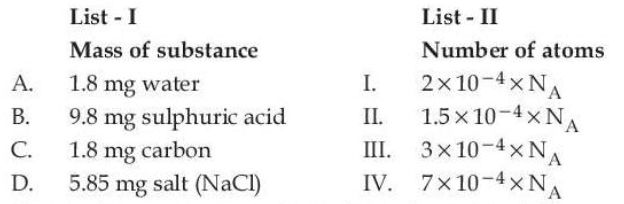
Match List - I with List - II.

Choose the correct answer from the options given below :
Number of moles and number of molecules in 1.4187 L of $$\text{SO}_2$$ at STP respectively are :
At STP (273 K and 1 atm) one mole of any ideal gas occupies $$22.4\; \text{L}$$.
Number of moles of $$SO_2$$ present is given by the relation $$n = \frac{V}{V_m} = \frac{1.4187\; \text{L}}{22.4\; \text{L mol}^{-1}}$$
Carrying out the division, $$n = 0.0633\; \text{mol}$$ (rounded to four significant figures).
The number of molecules $$N$$ is obtained by multiplying the moles by Avogadro’s number $$N_A = 6.022 \times 10^{23}\; \text{mol}^{-1}$$: $$N = n N_A = 0.0633 \times 6.022 \times 10^{23}$$
$$N = 3.812 \times 10^{22}\; \text{molecules}$$
Thus, the sample contains $$0.0633$$ moles and $$3.812 \times 10^{22}$$ molecules of $$SO_2$$.
Option B which is: $$0.0633;\; 3.812 \times 10^{22}$$
The correct order of total number of atoms in: (A) 2 moles of cyclohexane, (B) 684 g of sucrose, (C) 90.8 L of dihydrogen at STP, is :
We must compare the total number of atoms present in each of the three given samples.
Avogadro’s law: $$1\text{ mol}$$ of any substance contains $$N_A = 6.022 \times 10^{23}$$ particles (molecules, atoms, ions, etc.).
At STP, $$1\text{ mol}$$ of any gas occupies $$22.4\text{ L}$$.
Cyclohexane formula: $$C_6H_{12}$$.
Atoms in one molecule $$= 6 + 12 = 18$$.
Moles given $$= 2$$.
Total atoms $$= 2 \times 18 \times N_A = 36\,N_A$$.
Sucrose formula: $$C_{12}H_{22}O_{11}$$.
Molar mass $$= 342\text{ g mol}^{-1}$$.
Mass given $$= 684\text{ g}$$.
Moles $$= \dfrac{684}{342} = 2$$.
Atoms in one molecule $$= 12 + 22 + 11 = 45$$.
Total atoms $$= 2 \times 45 \times N_A = 90\,N_A$$.
Dihydrogen formula: $$H_2$$.
Volume given $$= 90.8\text{ L}$$.
Moles $$= \dfrac{90.8}{22.4} \approx 4.05$$.
Atoms in one molecule $$= 2$$.
Total atoms $$\approx 4.05 \times 2 \times N_A \approx 8.1\,N_A$$.
Comparing totals: $$90\,N_A \gt 36\,N_A \gt 8.1\,N_A$$.
Therefore: sucrose (B) has the most atoms, followed by cyclohexane (A), and dihydrogen (C) has the least.
Hence the correct order is $$\text{B} \gt \text{A} \gt \text{C}$$.
Option D which is: B > A > C.
The mass of iron converted into Fe$$_3$$O$$_4$$ by the action of 18 g of steam is : (Given : Molar mass of H, O and Fe are 1, 16 and 56 g mol$$^{-1}$$ respectively) Assume iron is present in excess :
The reaction of iron metal with steam is
$$3\,Fe \;+\; 4\,H_2O(g) \;\longrightarrow\; Fe_3O_4 \;+\; 4\,H_2(g)$$
Step 1 : Calculate moles of steam available.
Mass of steam given = $$18 \text{ g}$$.
Molar mass of $$H_2O$$ = $$2(1) + 16 = 18 \text{ g mol}^{-1}$$.
Hence
$$n_{H_2O} = \frac{18}{18} = 1 \text{ mol}$$
Step 2 : Use stoichiometry of the balanced equation.
According to the equation, $$4$$ mol of $$H_2O$$ react with $$3$$ mol of $$Fe$$.
Therefore
$$1 \text{ mol } H_2O \; \text{will react with} \; \frac{3}{4} \text{ mol } Fe = 0.75 \text{ mol}$$
Step 3 : Convert moles of iron to mass.
Molar mass of $$Fe$$ = $$56 \text{ g mol}^{-1}$$.
$$m_{Fe} = 0.75 \times 56 = 42 \text{ g}$$
Thus, when iron is in excess, $$18 \text{ g}$$ of steam can convert $$42 \text{ g}$$ of iron into $$Fe_3O_4$$.
Option D which is: $$42$$ g
The ratio of mass percentage (w/w) of C : H in a hydrocarbon is 12 : 1. It has two carbon atoms. The weight (in g) of CO$$_2$$(g) formed when 3.38 g of this hydrocarbon is completely burnt in oxygen is : (Given: Molar mass in g mol$$^{-1}$$ C : 12, H : 1, O : 16)
Let the empirical formula of the hydrocarbon be $$C_2H_n$$ because the problem states that it contains two carbon atoms.
Given mass-percentage ratio of carbon to hydrogen is $$12:1$$ (w/w).
For one mole of $$C_2H_n$$:
mass of carbon $$= 2 \times 12 = 24 \text{ g}$$
mass of hydrogen $$= n \times 1 = n \text{ g}$$
Using the given ratio,
$$\frac{24}{n} = \frac{12}{1} \quad \Longrightarrow \quad 24 = 12n \quad \Longrightarrow \quad n = 2.$$
Hence the molecular formula is $$C_2H_2$$ (ethyne/acetylene). The molar mass of $$C_2H_2$$ is
$$M_{C_2H_2}=2(12)+2(1)=26 \text{ g mol}^{-1}.$$
Moles of hydrocarbon present in 3.38 g sample:
$$n_{C_2H_2} = \frac{3.38}{26}=0.13 \text{ mol}.$$
Complete combustion reaction:
$$C_2H_2 + \frac{5}{2}O_2 \;\rightarrow\; 2CO_2 + H_2O.$$
From the stoichiometry, $$1$$ mole of $$C_2H_2$$ produces $$2$$ moles of $$CO_2$$.
Therefore, moles of $$CO_2$$ produced:
$$n_{CO_2}=0.13 \times 2 = 0.26 \text{ mol}.$$
Mass of $$CO_2$$ formed:
$$m_{CO_2}=n_{CO_2}\times M_{CO_2}=0.26 \times 44 = 11.44 \text{ g}.$$
Thus, the weight of carbon dioxide produced is $$11.44$$ g.
Option B which is: $$11.44$$
What volume of hydrogen gas at STP would be liberated by action of 50 mL of $$H_2SO_4$$ of 50% purity (density = 1.3 g mL$$^{-1}$$) on 20 g of zinc?
Given : Molar mass of H, O, S, Zn are 1, 16, 32, 65 g mol$$^{-1}$$ respectively.
Which of the following contain the same number of atoms?
(Given : Molar mass in g mol$$^{-1}$$ of H, He, O and S are 1, 4, 16 and 32 respectively)
A. 2 g of O$$_2$$ gas
B. 4 g of SO$$_2$$ gas
C. 1400 mL of O$$_2$$ at STP
D. 0.05 L of He at STP
E. 0.0625 mol of H$$_2$$ gas
Choose the correct answer from the options given below :
By usual analysis, 1.00 g of compow1d (X) gave 1.79 g of magnesium pyrophosphate. The percentage of phosphorus in compound (X) is: (nearest integer)
(Given, molar mass in $$gmol^{-1}$$ : 0 = 16, Mg = 24, P = 31 )
1.00 g of compound X gives 1.79 g of $$Mg_2P_2O_7$$ (magnesium pyrophosphate).
Molar mass of $$Mg_2P_2O_7 = 2(24) + 2(31) + 7(16) = 48 + 62 + 112 = 222$$ g/mol.
Each mole of $$Mg_2P_2O_7$$ contains 2 moles of P.
Moles of $$Mg_2P_2O_7 = \frac{1.79}{222}$$
Moles of P = $$\frac{2 \times 1.79}{222} = \frac{3.58}{222}$$
Mass of P = $$\frac{3.58}{222} \times 31 = \frac{110.98}{222} = 0.4999 \approx 0.50$$ g
% P = $$\frac{0.50}{1.00} \times 100 = 50\%$$
The answer is Option 4: 50.
$$A + 2B \rightarrow AB_{2}$$
36.0 g of ' A' (Molar mass : 60 g $$mol^{-1}$$) and 56.0 g of 'B' (Molar mass: 80 g $$mol^{-1}$$) are allowed to react. Which of the following statements are correct?
A. 'A' is the limiting reagent.
B. 77.0 g of $$AB_{2}$$ is formed.
C. Molar mass of $$AB_{2} is 140 g $$mol^{-1}$$
D. 15.0 g of A is left unreacted after the completion of reaction.
Choose the correct answer from the options given below :
We need to identify correct statements about the reaction $$A + 2B \rightarrow AB_2$$. Since 36.0 g of A (M = 60 g/mol) and 56.0 g of B (M = 80 g/mol) are provided, we first calculate the amount of each reactant in moles: Moles of A = $$36/60 = 0.6$$ mol and moles of B = $$56/80 = 0.7$$ mol.
Because the stoichiometry requires 2 moles of B per mole of A, the 0.6 mol of A would consume $$0.6 \times 2 = 1.2$$ mol of B, but only 0.7 mol is available. Therefore B is the limiting reagent, which means Statement A that claims A is limiting is incorrect.
In this context, 0.7 mol of B reacts completely with $$0.7/2 = 0.35$$ mol of A to produce 0.35 mol of $$AB_2$$. The unreacted A amounts to $$0.6 - 0.35 = 0.25$$ mol, corresponding to $$0.25 \times 60 = 15.0$$ g, so Statement D is correct.
The molar mass of $$AB_2$$ is $$60 + 2(80) = 220$$ g/mol, so Statement C, which suggests 140 g/mol, is incorrect. The mass of $$AB_2$$ formed is $$0.35 \times 220 = 77.0$$ g, confirming that Statement B is correct.
The correct answer is Option 3: B and D only.
Aqueous HCI reacts with $$MnO_{2} \left(s\right)$$ to form $$MnCl_{2}\left(aq\right)$$, $$Cl_{2}\left(g\right)$$ and $$H_{2}O\left(l\right)$$. What is the weight (in g) of Cl_{2} liberated when 8.7 g of $$MnO_{2} \left(s\right)$$ is reacted with excess aqueous HCI solution ?
(Given Molar mass in g $$mol^{-1}$$ Mn = 55, Cl = 35.5, 0 = 16, H = l )
Reaction: $$MnO_2 + 4HCl \to MnCl_2 + Cl_2 + 2H_2O$$
Molar mass of $$MnO_2 = 55 + 32 = 87$$ g/mol.
Moles of $$MnO_2 = \frac{8.7}{87} = 0.1$$ mol.
From stoichiometry: 1 mol $$MnO_2$$ → 1 mol $$Cl_2$$.
Moles of $$Cl_2 = 0.1$$ mol.
Mass of $$Cl_2 = 0.1 \times 71 = 7.1$$ g.
The answer is Option 4: 7.1 g.
14.0 g of calcium metal is allowed to react with excess HCI at 1.0 atm pressure and 273 K
Which of the following statements is incorrect?
[Given : Molar mass in g $$\text{mol}^{-1}$$ of Ca-40, Cl-35.5, H-1]
Ca + 2HCl → CaCl₂ + H₂. Moles Ca = 14/40 = 0.35 mol.
Moles H₂ = 0.35 mol. Volume at STP = 0.35 × 22.4 = 7.84 L ✓.
Mass CaCl₂ = 0.35 × 111 = 38.85 g. Option 4 says 33.3 g — incorrect.
The answer is Option 4: 33.3 g of CaCl₂ is the incorrect statement.
Complete combustion of $$X$$ g of an organic compound gave 0.25 g of CO$$_2$$ and 0.12 g of H$$_2$$O. If the % of carbon is 25% and of hydrogen is 4.89%, then $$X = $$ _____ $$\times 10^{-3}$$ g. (Nearest integer) (Molar mass of C, H and O are 12, 1 and 16 g mol$$^{-1}$$ respectively.)
During complete combustion, all the carbon present in the organic compound converts to $$CO_2$$ and all the hydrogen converts to $$H_2O$$. Hence we first find the actual masses of carbon and hydrogen in the combustion products.
1. Mass of carbon obtained
Each $$44\,\text{g}$$ of $$CO_2$$ contains $$12\,\text{g}$$ of carbon.
So carbon in $$0.25\,\text{g}$$ $$CO_2$$ is
$$m_C = 0.25 \times \frac{12}{44}\,\text{g} = \frac{3}{44}\,\text{g} \approx 0.06818\,\text{g}$$
2. Mass of hydrogen obtained
Each $$18\,\text{g}$$ of $$H_2O$$ contains $$2\,\text{g}$$ of hydrogen.
So hydrogen in $$0.12\,\text{g}$$ $$H_2O$$ is
$$m_H = 0.12 \times \frac{2}{18}\,\text{g} = \frac{0.24}{18}\,\text{g} \approx 0.01333\,\text{g}$$
3. Let the mass of the organic compound be $$X\,\text{g}$$.
Given mass percentages:
Carbon: $$25\% \implies \frac{m_C}{X}\times 100 = 25$$
Hydrogen: $$4.89\% \implies \frac{m_H}{X}\times 100 = 4.89$$
Using the carbon data
$$X = \frac{m_C \times 100}{25}
= \frac{0.06818 \times 100}{25}
= 0.27272\,\text{g}$$
Using the hydrogen data (cross-check)
$$X = \frac{m_H \times 100}{4.89}
= \frac{0.01333 \times 100}{4.89}
\approx 0.27259\,\text{g}$$
Both calculations are in excellent agreement, so we take $$X \approx 0.273\,\text{g}$$.
4. Expressing $$X$$ in the required form
$$0.273\,\text{g} = 273 \times 10^{-3}\,\text{g}$$
Therefore, $$X = 273 \times 10^{-3}\,\text{g}$$ (nearest integer).
Option A which is: 273
0.25 g of an organic compound "A" containing carbon, hydrogen and oxygen was analysed using the combustion method. There was an increase in mass of $$CaCl_{2}$$ tube and potash tube at the end of the experiment. The amount was found to be 0.15 g and 0.1837 g, respectively. The percentage of oxygen in compound A is __ %. (Nearest integer)
(Given: molar massing $$mol^{-1}$$ H : 1, C : 12, O : 16)
Mass of compound = 0.25 g, increase in CaCl$$_2$$ tube (water) = 0.15 g, increase in potash tube (CO$$_2$$) = 0.1837 g.
Mass of carbon.
$$\text{Mass of C} = \frac{12}{44} \times 0.1837 = 0.05010$$ g
Mass of hydrogen.
$$\text{Mass of H} = \frac{2}{18} \times 0.15 = 0.01667$$ g
Mass and percentage of oxygen.
Mass of O = $$0.25 - 0.05010 - 0.01667 = 0.18323$$ g
Percentage of oxygen = $$\frac{0.18323}{0.25} \times 100 = 73.3\% \approx 73\%$$
The answer is 73.
One mole of an alkane (x) requires 8 mole oxygen for complete combustion. Sum of number of carbon and hydrogen atoms in the alkane (x) is __________.
For an alkane having the general formula $$C_nH_{2n+2}$$, the balanced combustion reaction is
$$C_nH_{2n+2} + \left(n + \frac{2n+2}{4}\right)O_2 \rightarrow nCO_2 + (n+1)H_2O$$
The number of $$O_2$$ molecules needed equals the sum of:
• $$n$$ (for converting $$n$$ carbon atoms to $$nCO_2$$)
• $$\dfrac{n+1}{2}$$ (because each mole of $$H_2O$$ needs one atom of oxygen, and each mole of $$O_2$$ supplies two atoms)
Hence, moles of $$O_2$$ required per mole of alkane $$=$$
$$n + \frac{n+1}{2} = \frac{2n + n + 1}{2} = \frac{3n+1}{2}$$
The problem states that 1 mole of the alkane requires 8 moles of $$O_2$$:
$$\frac{3n+1}{2} = 8 \quad \Longrightarrow \quad 3n+1 = 16 \quad \Longrightarrow \quad 3n = 15 \quad \Longrightarrow \quad n = 5$$
So the alkane is $$C_5H_{2(5)+2} = C_5H_{12}$$.
The sum of the number of carbon and hydrogen atoms in one molecule is
$$5 + 12 = 17$$
Therefore, the required sum is 17.
x mg of pure HCl was used to make an aqueous solution. 25.0 mL of 0.1 M $$Ba(OH)_{2}$$ solution is used when the HCl solution was titrated against it. The numerical value of x is ______$$\times 10^{-1}$$. (nearest integer)
Given : Molar mass of HCl and $$Ba(OH)_{2}$$ are 36.5 and 171.0 g $$mol^{-1}$$ respectively.
We need to find the mass $$x$$ (in mg) of pure HCl that reacts completely with 25.0 mL of 0.1 M $$Ba(OH)_2$$.
The balanced equation is $$2HCl + Ba(OH)_2 \rightarrow BaCl_2 + 2H_2O$$ and the mole ratio is 2 mol HCl per 1 mol $$Ba(OH)_2$$.
The moles of $$Ba(OH)_2$$ are calculated as Molarity $$\times$$ Volume = $$0.1 \times 0.025 = 0.0025$$ mol, which equals 2.5 mmol.
The moles of HCl required are $$2 \times 2.5 = 5$$ mmol, or 0.005 mol.
The mass of HCl is then moles $$\times$$ molar mass = $$0.005 \times 36.5 = 0.1825$$ g, which equals 182.5 mg.
Expressing in the required form gives $$x = 182.5$$, so $$x \times 10^{-1} = 1825$$.
The answer is 1825.
At 300 K, an ideal dilute solution of a macromolecule exerts osmotic pressure that is expressed in terms of the height (h) of the solution (density = 1.00 g cm$$^{-3}$$) where h is equal to 2.00 cm. If the concentration of the dilute solution of the macromolecule is 2.00 g dm$$^{-3}$$, the molar mass of the macromolecule is $$X \times 10^4$$ g mol$$^{-1}$$. The value of $$X$$ is ______.
Use: Universal gas constant (R) = 8.3 J K$$^{-1}$$ mol$$^{-1}$$ and acceleration due to gravity (g) = 10 m s$$^{-2}$$
The osmotic pressure $$ \pi $$ exerted by the solution equals the hydrostatic pressure of a liquid column of height $$ h $$.
Hydrostatic pressure formula: $$\pi = \rho g h$$
Given data (convert to SI units):
• Density, $$ \rho = 1.00 \text{ g cm}^{-3} = 1000 \text{ kg m}^{-3} $$
• Acceleration due to gravity, $$ g = 10 \text{ m s}^{-2} $$
• Height, $$ h = 2.00 \text{ cm} = 0.02 \text{ m} $$
Hence
$$\pi = 1000 \times 10 \times 0.02 = 200 \text{ Pa}$$
For an ideal dilute solution, van’t Hoff equation applies:
$$\pi = c R T$$
Here $$ c $$ is the molar concentration (mol m$$^{-3}$$). The solution contains 2.00 g of solute per dm$$^{3}$$.
1 dm$$^{3} = 0.001 \text{ m}^{3}$$, so mass concentration is
$$\frac{2.00 \text{ g}}{0.001 \text{ m}^{3}} = 2000 \text{ g m}^{-3}$$
If the molar mass of the macromolecule is $$ M \text{ g mol}^{-1} $$, then
$$c = \frac{2000}{M} \text{ mol m}^{-3}$$
Substituting $$ c $$ into van’t Hoff equation:
$$\pi = \frac{2000}{M} R T$$
Solve for $$ M $$:
$$M = \frac{2000 R T}{\pi}$$
Insert the given constants $$ R = 8.3 \text{ J K}^{-1} \text{ mol}^{-1} $$ and $$ T = 300 \text{ K} $$:
$$M = \frac{2000 \times 8.3 \times 300}{200}$$
Calculate step by step:
$$8.3 \times 300 = 2490$$
$$2000 \times 2490 = 4\,980\,000$$
$$\frac{4\,980\,000}{200} = 24\,900$$
Thus
$$M \approx 24\,900 \text{ g mol}^{-1} = 2.49 \times 10^{4} \text{ g mol}^{-1}$$
Comparing with the required form $$ X \times 10^{4} \text{ g mol}^{-1} $$, we have $$ X \approx 2.49 $$.
Therefore, the value of $$ X $$ lies in the required range 2.4 - 2.55.
Concentrated nitric acid is labelled as 75% by mass. The volume in mL of the solution which contains 30 g of nitric acid is ____. Given : Density of nitric acid solution is 1.25 g/mL .
Mass of HNO₃ = 30 g. In 75% solution: mass of solution = 30/0.75 = 40 g. Volume = 40/1.25 = 32 mL.
The correct answer is Option 2: 32.
Density of 3 M NaCl solution is $$1.25 g/mL$$. The molality of the solution is :
3 M NaCl solution with density 1.25 g/mL.
Determine the mass of solute in 1 L of solution
Molarity = 3 M means 3 moles of NaCl per litre of solution.
Molar mass of NaCl = 23 + 35.5 = 58.5 g/mol.
Mass of NaCl = 3 × 58.5 = 175.5 g.
Determine the mass of 1 L of solution
Mass of solution = Volume × Density = 1000 mL × 1.25 g/mL = 1250 g.
Calculate mass of solvent
Mass of solvent (water) = 1250 - 175.5 = 1074.5 g = 1.0745 kg.
Calculate molality
$$\text{Molality} = \frac{\text{moles of solute}}{\text{mass of solvent in kg}} = \frac{3}{1.0745} \approx 2.79 \text{ m}$$
The answer is Option 2: 2.79 m.
Among $$10^{-9}$$ g (each) of the following elements, which one will have the highest number of atoms?
Element : Pb, Po, Pr and Pt
The number of atoms present in a given sample is obtained from the relation
$$\text{Number of atoms} = \frac{\text{mass of sample}}{\text{molar mass}} \times N_A$$
where $$N_A = 6.022 \times 10^{23}\ \text{mol}^{-1}$$ is Avogadro’s constant.
In this question every element is taken in the same mass, $$m = 10^{-9}\, \text{g}$$. Since $$N_A$$ and $$m$$ are common to all, the factor that decides the number of atoms is only the molar mass $$M$$. Smaller $$M$$ ⇒ larger $$\dfrac{m}{M}$$ ⇒ larger number of atoms.
Approximate molar masses of the given elements are:
$$M_{\text{Pb}} \approx 207\ \text{g mol}^{-1}$$
$$M_{\text{Po}} \approx 209\ \text{g mol}^{-1}$$
$$M_{\text{Pr}} \approx 141\ \text{g mol}^{-1}$$
$$M_{\text{Pt}} \approx 195\ \text{g mol}^{-1}$$
Comparing their molar masses:
$$141\lt 195\lt 207\lt 209$$
Praseodymium (Pr) has the smallest molar mass, so for the same sample mass $$10^{-9}\, \text{g}$$ it provides the largest number of atoms.
Therefore, the element with the highest number of atoms is Praseodymium (Pr).
Answer: Option B (Pr)
$$CaCO_3(s) + 2HCl(aq) \rightarrow CaCl_2(aq) + CO_2(g) + H_2O(l)$$
Consider the above reaction, what mass of $$CaCl_2$$ will be formed if 250 mL of 0.76 M HCl reacts with 1000 g of $$CaCO_3$$?
(Given: Molar mass of Ca, C, O, H and Cl are 40, 12, 16, 1 and 35.5 g mol$$^{-1}$$, respectively)
The balanced chemical equation is $$CaCO_3(s)+2HCl(aq)\rightarrow CaCl_2(aq)+CO_2(g)+H_2O(l)$$.
Step 1: Calculate moles of each reactant.
Molarity formula: $$M = \frac{\text{moles}}{\text{volume in L}} \; \Rightarrow \; \text{moles} = M \times V$$.
For $$HCl$$:
Volume $$V = 250\ \text{mL} = 0.250\ \text{L}$$,
Molarity $$M = 0.76\ \text{mol L}^{-1}$$.
Therefore, moles of $$HCl = 0.76 \times 0.250 = 0.19\ \text{mol}$$.
Molar mass of $$CaCO_3$$:
$$40 + 12 + 3(16) = 40 + 12 + 48 = 100\ \text{g mol}^{-1}$$.
Given mass = $$1000\ \text{g}$$, so moles of $$CaCO_3$$ are
$$\frac{1000}{100} = 10\ \text{mol}$$.
Step 2: Identify the limiting reagent.
From the equation, $$2$$ moles of $$HCl$$ react with $$1$$ mole of $$CaCO_3$$.
Required moles of $$HCl$$ for $$10$$ moles $$CaCO_3$$:
$$2 \times 10 = 20\ \text{mol}$$.
Available moles of $$HCl$$ = $$0.19\ \text{mol} \lt 20\ \text{mol}$$, so $$HCl$$ is the limiting reagent.
Step 3: Moles of $$CaCl_2$$ formed.
Stoichiometry: $$2\ \text{mol HCl} \rightarrow 1\ \text{mol CaCl}_2$$.
Thus, moles of $$CaCl_2 = \frac{0.19}{2} = 0.095$$.
Step 4: Mass of $$CaCl_2$$ produced.
Molar mass of $$CaCl_2$$:
$$40 + 2(35.5) = 40 + 71 = 111\ \text{g mol}^{-1}$$.
Mass = moles $$\times$$ molar mass = $$0.095 \times 111 = 10.545\ \text{g}$$.
Final Answer: $$10.545\ \text{g}$$ of $$CaCl_2$$ will be formed. This matches Option C.
The elemental composition of a compound is $$54.2\%C,\ 9.2\%H$$ and $$36.6\%O.$$ If the molar mass of the compound is $$132\ \text{g mol}^{-1},$$ the molecular formula of the compound is: [Given: Relative atomic masses C:H:O = 12:1:16]
Empirical formula: C: 54.2/12=4.52, H: 9.2/1=9.2, O: 36.6/16=2.29.
Ratio: 4.52/2.29 : 9.2/2.29 : 2.29/2.29 = 1.97 : 4.02 : 1 ≈ 2:4:1
Empirical formula: C₂H₄O. Empirical mass = 44. Molar mass = 132 = 3×44.
Molecular formula: C₆H₁₂O₃.
The correct answer is Option 4: C₆H₁₂O₃.
$$ K_{sp} \text{ for } Cr(OH)_3 \text{ is } 1.6\times10^{-30}.$$ What is the molar solubility of this salt in water?
Ksp for Cr(OH)₃ = 1.6×10⁻³⁰. Find molar solubility.
$$Cr(OH)_3 \rightleftharpoons Cr^{3+} + 3OH^-$$
If solubility = s: $$K_{sp} = s(3s)^3 = 27s^4$$
$$s^4 = \frac{1.6 \times 10^{-30}}{27}$$
$$s = \sqrt[4]{\frac{1.6 \times 10^{-30}}{27}}$$
The correct answer is Option 3.
Mass of magnesium required to produce 220 mL of hydrogen gas at STP on reaction with excess of dil. HCl is (Given: Molar mass of Mg is 24 g mol$$^{-1}$$)
The balanced reaction of magnesium with dilute hydrochloric acid is
$$Mg + 2\,HCl \rightarrow MgCl_2 + H_2$$
From the equation, $$1$$ mole of $$Mg$$ produces $$1$$ mole of $$H_2$$.
Step 1 - Convert volume of $$H_2$$ to moles
At STP, $$1$$ mole of any ideal gas occupies $$22.4$$ L $$= 22\,400$$ mL.
Given volume of $$H_2$$ $$= 220$$ mL.
Number of moles of $$H_2$$ produced
$$n_{H_2}= \frac{220 \text{ mL}}{22\,400 \text{ mL mol}^{-1}}$$
$$n_{H_2}= 9.821\times10^{-3} \text{ mol}$$ (keep four significant figures).
Step 2 - Relate moles of $$H_2$$ to moles of $$Mg$$
The stoichiometry is $$1:1$$.
Therefore,
$$n_{Mg}= n_{H_2}= 9.821\times10^{-3} \text{ mol}$$.
Step 3 - Calculate mass of magnesium
Molar mass of $$Mg = 24 \text{ g mol}^{-1}$$.
Mass of $$Mg$$ required
$$m_{Mg}= n_{Mg}\times M_{Mg}= (9.821\times10^{-3})\times24$$
$$m_{Mg}= 2.357\times10^{-1} \text{ g}= 0.2357 \text{ g}$$.
Convert grams to milligrams:
$$0.2357 \text{ g}= 235.7 \text{ mg}\approx 236 \text{ mg}$$.
Hence, the mass of magnesium needed is approximately $$236$$ mg.
Correct option: Option C.
On combustion 0.210 g of an organic compound containing C, H and O gave 0.127 g $$H_2O$$ and 0.307 g $$CO_2$$. The percentages of hydrogen and oxygen in the given organic compound respectively are :
The combustion analysis gives the following data:
Mass of organic compound burnt $$= 0.210 \text{ g}$$
Mass of $$CO_2$$ formed $$= 0.307 \text{ g}$$
Mass of $$H_2O$$ formed $$= 0.127 \text{ g}$$
Step 1: Calculate mass of carbon in the sample.
Molar mass of $$CO_2 = 44 \text{ g mol}^{-1}$$ and each mole contains $$12 \text{ g}$$ of C.
Therefore,
$$\text{Mass of C} = 0.307 \times \frac{12}{44} \text{ g}$$
$$\text{Mass of C} = 0.08372 \text{ g}$$
Step 2: Calculate mass of hydrogen in the sample.
Molar mass of $$H_2O = 18 \text{ g mol}^{-1}$$ and each mole contains $$2 \text{ g}$$ of H.
Therefore,
$$\text{Mass of H} = 0.127 \times \frac{2}{18} \text{ g}$$
$$\text{Mass of H} = 0.01411 \text{ g}$$
Step 3: Calculate mass of oxygen in the sample.
Total mass of C and H in the sample:
$$0.08372 + 0.01411 = 0.09783 \text{ g}$$
Hence,
$$\text{Mass of O} = 0.210 - 0.09783 = 0.11217 \text{ g}$$
Step 4: Convert masses to percentages.
Percentage of hydrogen:
$$\%H = \frac{0.01411}{0.210} \times 100 = 6.72\%$$
Percentage of oxygen:
$$\%O = \frac{0.11217}{0.210} \times 100 = 53.41\%$$
Step 5: State the result.
The percentages of hydrogen and oxygen in the organic compound are $$6.72\%$$ and $$53.41\%$$ respectively.
Thus, the correct choice is Option B.
$$2.8 \times 10^{-3}$$ mol of $$CO_{2}$$ is left after removing $$10^{21}$$ molecules from its 'x' mg sample. The mass of $$CO_{2}$$ taken initially is Given: $$N_{A} = 6.02 \times 10^{23} mol^{-1}$$
We need to find the initial mass of $$CO_2$$.
After removing $$10^{21}$$ molecules from the sample, $$2.8 \times 10^{-3}$$ mol of $$CO_2$$ remains.
The moles of $$CO_2$$ removed can be calculated as $$ n_{removed} = \frac{10^{21}}{6.02 \times 10^{23}} = \frac{1}{602} = 1.66 \times 10^{-3} \text{ mol} $$.
Adding this to the remaining moles gives the total initial moles: $$ n_{initial} = 2.8 \times 10^{-3} + 1.66 \times 10^{-3} = 4.46 \times 10^{-3} \text{ mol} $$.
The molar mass of $$CO_2$$ is $$12 + 2(16) = 44$$ g/mol.
Therefore, the initial mass is $$ x = 4.46 \times 10^{-3} \times 44 = 0.19624 \text{ g} = 196.2 \text{ mg} $$.
The correct answer is Option 3: 196.2 mg.
Choose the correct statements. (A) Weight of a substance is the amount of matter present in it. (B) Mass is the force exerted by gravity on an object. (C) Volume is the amount of space occupied by a substance. (D) Temperatures below $$O^{\circ}C$$ are possible in Celsius scale, but in Kelvin scale negative temperature is not possible. (E) Precision refers to the closeness of various measurements for the same quantity. Choose the correct answer from the options given below :
We need to identify which statements are correct among (A) through (E).
(A) "Weight of a substance is the amount of matter present in it."
This is INCORRECT. The amount of matter present in a substance is its mass, not weight. Weight is the force exerted by gravity on an object ($$W = mg$$).
(B) "Mass is the force exerted by gravity on an object."
This is INCORRECT. The force exerted by gravity is weight, not mass. Mass is an intrinsic property measuring the amount of matter.
(C) "Volume is the amount of space occupied by a substance."
This is CORRECT. This is the standard definition of volume.
(D) "Temperatures below 0°C are possible in Celsius scale, but in Kelvin scale negative temperature is not possible."
This is CORRECT. The Kelvin scale starts at absolute zero (0 K = -273.15°C), so negative Kelvin temperatures are not physically meaningful in classical thermodynamics.
(E) "Precision refers to the closeness of various measurements for the same quantity."
This is CORRECT. Precision measures the reproducibility of measurements (how close repeated measurements are to each other), as opposed to accuracy (closeness to the true value).
Correct statements: (C), (D), and (E).
The correct answer is Option B: (C), (D) and (E) Only.
On complete combustion 1.0 g of an organic compound (X) gave 1.46 g of $$CO_2$$ and 0.567 g of $$H_2O$$. The empirical formula mass of compound (X) is ________ g.
(Given molar mass in g mol$$^{-1}$$ C: 12, H: 1, O: 16)
During combustion, all carbon in the compound converts to $$CO_2$$ and all hydrogen converts to $$H_2O$$. We first calculate the moles of each element obtained from the given products.
Step 1: Moles of carbon
Mass of $$CO_2 = 1.46 \text{ g}$$.
Molar mass of $$CO_2 = 44 \text{ g mol}^{-1}$$.
$$\text{Moles of }CO_2 = \frac{1.46}{44} = 0.03318 \text{ mol}$$.
Each mole of $$CO_2$$ contains one mole of C, so
$$\text{Moles of C} = 0.03318 \text{ mol}$$.
Step 2: Mass of carbon
$$\text{Mass of C} = 0.03318 \times 12 = 0.398 \text{ g}$$.
Step 3: Moles of hydrogen
Mass of $$H_2O = 0.567 \text{ g}$$.
Molar mass of $$H_2O = 18 \text{ g mol}^{-1}$$.
$$\text{Moles of }H_2O = \frac{0.567}{18} = 0.0315 \text{ mol}$$.
Each mole of $$H_2O$$ contains two moles of H, so
$$\text{Moles of H} = 2 \times 0.0315 = 0.0630 \text{ mol}$$.
Step 4: Mass of hydrogen
$$\text{Mass of H} = 0.0630 \times 1 = 0.063 \text{ g}$$.
Step 5: Mass and moles of oxygen in the compound
Total mass of sample = 1.00 g.
Mass of C + H already determined = $$0.398 + 0.063 = 0.461 \text{ g}$$.
Remaining mass is oxygen:
$$\text{Mass of O} = 1.00 - 0.461 = 0.539 \text{ g}$$.
Moles of O:
$$\text{Moles of O} = \frac{0.539}{16} = 0.0337 \text{ mol}$$.
Step 6: Find simplest mole ratio
Divide each mole value by the smallest, $$0.03318$$:
$$\frac{\text{C}}{0.03318} = 1.00$$
$$\frac{\text{H}}{0.03318} = \frac{0.0630}{0.03318} \approx 1.90 \approx 2$$
$$\frac{\text{O}}{0.03318} = \frac{0.0337}{0.03318} \approx 1.02 \approx 1$$
Hence the empirical formula is $$CH_2O$$.
Step 7: Empirical formula mass
$$\text{E.F. mass} = 12 + 2(1) + 16 = 30 \text{ g mol}^{-1}$$.
Therefore, the empirical formula mass of compound (X) is $$30 \text{ g}$$.
Option A is correct.
0.1 M solution of KI reacts with excess of $$H_{2}SO_{4}$$ and $$KIO{3}$$ solutions. According to equation $$5I^- + IO_3^- + 6H^+ \rightarrow 3I_2 + 3H_2O$$ Identify the correct statements : (A) 200 mL of KI solution reacts with 0.004 mol of $$KIO_{3}$$ (B) 200 mL of KI solution reacts with 0.006 mol of $$H_{2}SO_{4}$$ (C) 0.5 L of KI solution produced 0.005 mol of $$I_{2}$$ (D) Equivalent weight of $$KIO_{3}$$ is equal to ( $$\frac{Molecular weight}{5}$$ ) Choose the correct answer from the options given below :
The reaction: $$5I^- + IO_3^- + 6H^+ \to 3I_2 + 3H_2O$$
0.1 M KI solution: moles of $$I^-$$ in 200 mL = $$0.1 \times 0.2 = 0.02$$ mol.
(A) 200 mL of KI has 0.02 mol $$I^-$$. From stoichiometry, 5 mol $$I^-$$ reacts with 1 mol $$IO_3^-$$.
Moles of $$KIO_3 = 0.02/5 = 0.004$$ mol. ✓
(B) 200 mL has 0.02 mol $$I^-$$. From stoichiometry, 5 mol $$I^-$$ reacts with 6 mol $$H^+$$.
Moles of $$H^+ = 0.02 \times 6/5 = 0.024$$ mol. Moles of $$H_2SO_4 = 0.024/2 = 0.012$$ mol ≠ 0.006. ✗
(C) 0.5 L of KI has $$0.1 \times 0.5 = 0.05$$ mol $$I^-$$. From stoichiometry, 5 mol $$I^-$$ produces 3 mol $$I_2$$.
Moles of $$I_2 = 0.05 \times 3/5 = 0.03$$ mol ≠ 0.005. ✗
(D) In this reaction, $$IO_3^-$$ goes from I(+5) to I₂(0), gaining 5 electrons per I atom.
Equivalent weight = Molecular weight / 5. ✓
The correct answer is Option 1: (A) and (D) only.
0.01 mole of an organic compound (X) containing 10% hydrogen, on complete combustion produced $$0.9_{g}H_{2}O$$. Molar mass of (X) is_____$$mol^{-1}$$.
0.01 mole of compound X containing 10% hydrogen produces 0.9 g H₂O on combustion. Find molar mass.
Find mass of hydrogen in the water produced
Mass of H in H₂O = $$\frac{2}{18} \times 0.9 = 0.1$$ g
Find mass of compound X
Since X contains 10% hydrogen:
Mass of H = 10% of mass of X
$$0.1 = 0.10 \times m_X$$
$$m_X = 1$$ g
Find molar mass
0.01 mol of X has mass 1 g:
$$M = \frac{1}{0.01} = 100$$ g/mol
The answer is 100.
$$ X\,g $$ of benzoic acid on reaction with aq. $$NaHCO_3$$ released $$CO_2$$ that occupied $$11.2\,L$$ volume at STP. $$X$$ is $$\underline{\hspace{2cm}}\,g. $$
We need to find the mass of benzoic acid that produces $$CO_2$$ occupying 11.2 L at STP.
Benzoic acid reacts with aqueous sodium bicarbonate: $$C_6H_5COOH + NaHCO_3 \rightarrow C_6H_5COONa + H_2O + CO_2 \uparrow$$ The stoichiometry shows that 1 mole of benzoic acid produces 1 mole of $$CO_2$$.
At STP (Standard Temperature and Pressure: 0 degC, 1 atm), 1 mole of any ideal gas occupies 22.4 L. $$\text{Moles of } CO_2 = \frac{11.2 \text{ L}}{22.4 \text{ L/mol}} = 0.5 \text{ mol}$$
From the 1:1 stoichiometry: $$\text{Moles of benzoic acid} = \text{Moles of } CO_2 = 0.5 \text{ mol}$$
The molar mass of benzoic acid ($$C_6H_5COOH = C_7H_6O_2$$) is $$(7 \times 12) + (6 \times 1) + (2 \times 16) = 84 + 6 + 32 = 122 \text{ g/mol}$$
$$X = 0.5 \times 122 = 61 \text{ g}$$
The answer is 61 g.
20 mL of 2 M NaOH solution is added to 400 mL of 0.5 M NaOH solution. The final concentration of the solution is _______ $$\times 10^{-2}M$$.(Nearest integer)
We need to find the final concentration when 20 mL of 2 M NaOH is added to 400 mL of 0.5 M NaOH.
When two solutions of the same solute are mixed, the total moles of solute are conserved:
$$C_{final} = \frac{n_1 + n_2}{V_{total}}$$
where $$n = C \times V$$ (moles = concentration times volume).
Solution 1: $$n_1 = C_1 \times V_1 = 2 \times 20 = 40$$ mmol (using mL for volume)
Solution 2: $$n_2 = C_2 \times V_2 = 0.5 \times 400 = 200$$ mmol
$$V_{total} = 20 + 400 = 420 \text{ mL}$$
$$C_{final} = \frac{n_1 + n_2}{V_{total}} = \frac{40 + 200}{420} = \frac{240}{420} = \frac{4}{7} \text{ M}$$
$$C_{final} = \frac{4}{7} \approx 0.5714 \text{ M} = 57.14 \times 10^{-2} \text{ M}$$
Rounding to the nearest integer: $$57 \times 10^{-2}$$ M.
The answer is 57.
Consider the following reaction occurring in the blast furnace: $$Fe_3O_4(s) + 4CO(g) \rightarrow 3Fe(l) + 4CO_2(g) x$$ kg of iron is produced when $$2.32\times10^3\,kg\,Fe_3O_4$$ and $$2.8\times10^2\,kg\,CO$$ are brought together in the furnace. The value of $$x$$ is $$\underline{\hspace{2cm}}$$ (nearest integer). Given: $$M(Fe_3O_4)=232\,g\,mol^{-1},$$ molar mass of $$CO=28\,g\,mol^{-1},$$ molar mass of $$(Fe)=56\,g\,mol^{-1}.$$
The reaction: $$Fe_3O_4(s) + 4CO(g) \to 3Fe(l) + 4CO_2(g)$$
Given: $$2.32 \times 10^3$$ kg $$Fe_3O_4$$ and $$2.8 \times 10^2$$ kg CO.
Moles of $$Fe_3O_4 = \frac{2.32 \times 10^6 \text{ g}}{232 \text{ g/mol}} = 10^4$$ mol.
Moles of CO $$= \frac{2.8 \times 10^5 \text{ g}}{28 \text{ g/mol}} = 10^4$$ mol.
From stoichiometry: 1 mol $$Fe_3O_4$$ needs 4 mol CO.
$$10^4$$ mol $$Fe_3O_4$$ needs $$4 \times 10^4$$ mol CO, but only $$10^4$$ mol CO is available.
CO is the limiting reagent.
From 4 mol CO, we get 3 mol Fe.
From $$10^4$$ mol CO: Fe produced $$= \frac{3}{4} \times 10^4 = 7500$$ mol.
Mass of Fe $$= 7500 \times 56 = 420000$$ g $$= 420$$ kg.
The answer is 420.
In Dumas' method 292 mg of an organic compound released 50 mL of nitrogen gas ($$N_2$$) at 300 K temperature and 715 mm Hg pressure. The percentage composition of 'N' in the organic compound is _____ %.(Nearest integer)
(Aqueous tension at 300 K = 15 mm Hg)
Mass of organic compound taken: $$m_{\text{compound}} = 292 \text{ mg} = 0.292 \text{ g}$$.
Volume of $$N_2$$ collected: $$V = 50 \text{ mL} = 0.050 \text{ L}$$.
Temperature: $$T = 300 \text{ K}$$.
Total pressure: $$P_{\text{total}} = 715 \text{ mm Hg}$$.
Aqueous tension (vapour pressure of water): $$P_{\text{H}_2O} = 15 \text{ mm Hg}$$.
First remove the vapour-pressure contribution to get the pressure of dry nitrogen.
$$P_{N_2} = P_{\text{total}} - P_{\text{H}_2O} = 715 - 15 = 700 \text{ mm Hg}$$.
Convert this pressure into atmospheres (1 atm = 760 mm Hg):
$$P_{N_2} = \frac{700}{760} \text{ atm} = 0.9211 \text{ atm}$$.
Use the ideal-gas equation $$PV = nRT$$. Take $$R = 0.0821 \text{ L atm mol}^{-1}\text{K}^{-1}$$.
$$n = \frac{P V}{R T} = \frac{0.9211 \times 0.050}{0.0821 \times 300} \text{ mol}$$.
$$n = 0.00187 \text{ mol of } N_2$$.
Molar mass of $$N_2$$ is $$28 \text{ g mol}^{-1}$$, so the mass of nitrogen obtained is
$$m_N = n \times 28 = 0.00187 \times 28 = 0.0524 \text{ g} = 52.4 \text{ mg}$$.
Percentage of nitrogen in the organic compound:
$$\%N = \frac{m_N}{m_{\text{compound}}} \times 100
= \frac{0.0524}{0.292} \times 100
= 17.94 \% \approx 18 \%$$.
Hence, the percentage composition of nitrogen in the organic compound is 18 %.
The amount of calcium oxide produced on heating 150 kg limestone (75% pure) is ______ kg. (Nearest integer)
Given : Molar mass (in g $$mol^{-1}$$) of $$Ca-40, O-16, C-12$$
The mineral limestone is almost entirely $$CaCO_3$$. When limestone is heated it undergoes thermal decomposition (calcination):
$$CaCO_3 \rightarrow CaO + CO_2$$ $$-(1)$$
Step 1 : Calculate the mass of pure $$CaCO_3$$ present in the given limestone.
Limestone given = $$150 \text{ kg}$$, but it is only $$75\%$$ pure.
Mass of pure $$CaCO_3 = 150 \times \frac{75}{100} = 112.5 \text{ kg}$$ $$-(2)$$
Step 2 : Use stoichiometry of reaction $$(1)$$.
Molar mass data:
$$CaCO_3 : 40 + 12 + 3 \times 16 = 100 \text{ g mol}^{-1}$$
$$CaO : 40 + 16 = 56 \text{ g mol}^{-1}$$
From the balanced equation $$(1)$$, $$100 \text{ g}$$ of $$CaCO_3$$ produce $$56 \text{ g}$$ of $$CaO$$.
Therefore, the mass ratio is
$$\frac{\text{mass of }CaO}{\text{mass of }CaCO_3} = \frac{56}{100} = 0.56$$ $$-(3)$$
Step 3 : Find the mass of $$CaO$$ obtained from the pure $$CaCO_3$$ in $$2$$.
Mass of $$CaO = 112.5 \times 0.56 = 63.0 \text{ kg}$$ $$-(4)$$
Hence, the amount of calcium oxide produced (nearest integer) = 63 kg.
The molarity of a 70% (mass /mass) aqueous solution of a monobasic acid (X) is __________ $$\times10^{-1}$$ M(Nearest integer) [Given: Density of aqueous solution of (X) is 1.25 g $$mL^{-1}$$ Molar mass of the acid is $$70 g mol^{-1}$$]
Find the molarity of a 70% (mass/mass) aqueous solution of a monobasic acid with density 1.25 g/mL and molar mass 70 g/mol.
Assuming 100 g of solution, the mass of acid is 70% of 100 g = 70 g, and the mass of water is 100 − 70 = 30 g.
Using the density, the volume of the solution is given by:
$$ V = \frac{\text{mass}}{\text{density}} = \frac{100 \text{ g}}{1.25 \text{ g/mL}} = 80 \text{ mL} = 0.080 \text{ L} $$
The number of moles of acid is
$$ n = \frac{70}{70} = 1 \text{ mol} $$
Thus the molarity is
$$ M = \frac{n}{V} = \frac{1}{0.080} = 12.5 \text{ M} $$
Expressing this in the required form gives $$12.5 = 125 \times 10^{-1}$$ M.
The answer is 125.
The observed and normal molar masses of compound $$MX_2$$ are $$65.6$$ and $$164$$ respectively. The percent degree of ionisation of $$MX_2$$ is $$\underline{\hspace{2cm}}\%.$$ (Nearest integer)
MX₂ → M²⁺ + 2X⁻. i = 1+2α where α is degree of ionization.
i = normal mass/observed mass = 164/65.6 = 2.5.
2.5 = 1+2α. α = 0.75 = 75%.
The answer is 75.
Butane reacts with oxygen to produce carbon dioxide and water following the equation given below
$$C_4H_{10}(g) + \frac{13}{2}O_2(g) \to 4CO_2(g) + 5H_2O(l)$$.
If 174.0 kg of butane is mixed with 320.0 kg of $$O_2$$, the volume of water formed in litres is _____.(Nearest integer)
[Given : (a) Molar mass of C, H, O are 12, 1, 16 g $$mol^{-1}$$ respectively, (b) Density of water = 1 g $$mL^{-1}$$]
Molar masses (in $$\mathrm{g\;mol^{-1}}$$): $$C_4H_{10}=58$$, $$O_2 = 32$$, $$H_2O = 18$$.
Moles of butane mixed
$$n_{C_4H_{10}}=\frac{174.0\times10^{3}}{58}=3000\;\text{mol}$$
Moles of oxygen mixed
$$n_{O_2}=\frac{320.0\times10^{3}}{32}=10000\;\text{mol}$$
Balanced equation (fractional coefficients as given) :
$$C_4H_{10}+ \frac{13}{2}O_2 \rightarrow 4CO_2 + 5H_2O$$
Stoichiometric ratios
$$1\;\text{mol}\;C_4H_{10} \;:\; \frac{13}{2}=6.5\;\text{mol}\;O_2$$
$$1\;\text{mol}\;C_4H_{10} \;:\; 5\;\text{mol}\;H_2O$$
Oxygen needed for the available butane
$$3000 \times 6.5 = 19500\;\text{mol}\;O_2$$
Only $$10000\;\text{mol}\;O_2$$ are present, so $$O_2$$ is the limiting reagent.
From the equation, $$6.5\;\text{mol}\;O_2 \rightarrow 5\;\text{mol}\;H_2O$$, or
$$n_{H_2O} = n_{O_2}\times\frac{5}{6.5} = 10000\times\frac{5}{6.5} = 10000\times\frac{10}{13} = 7692.3077\;\text{mol}$$
Mass of water formed
$$m_{H_2O} = 7692.3077 \times 18 = 1.3846 \times 10^{5}\;\text{g} = 138.46\;\text{kg}$$
Density of liquid water $$\approx 1\;\text{kg L}^{-1}$$, therefore
$$V_{H_2O} = 138.46\;\text{kg}\times\frac{1\;\text{L}}{1\;\text{kg}} \approx 138\;\text{L}$$
Hence, the volume of water produced is about $$\mathbf{138\;L}$$.
During " S " estimation, 160 mg of an organic compound gives 466 mg of barium sulphate. The percentage of Sulphur in the given compound is _______ %. (Given molar mass in $$gmol^{-1}$$ of Ba : 137, S : 32, O : 16)
In the estimation of sulphur, the organic compound is converted to $$BaSO_4$$.
The formula for percentage of sulphur is $$\% S = \frac{32}{233} \times \frac{\text{Mass of } BaSO_4}{\text{Mass of compound}} \times 100$$.
Here the molar mass of $$BaSO_4$$ is $$137 + 32 + 4(16) = 233$$ g/mol.
For a compound mass of 160 mg and a $$BaSO_4$$ precipitate of 466 mg, substitution into the formula gives $$\% S = \frac{32}{233} \times \frac{466}{160} \times 100$$.
This can be rewritten as $$= \frac{32 \times 466}{233 \times 160} \times 100$$ and then as $$= \frac{14912}{37280} \times 100$$.
Since $$\frac{466}{233} = 2$$, the calculation simplifies to $$\% S = \frac{32 \times 2}{160} \times 100 = \frac{64}{160} \times 100 = 40\%$$.
The answer is 40%.
Fortification of food with iron is done using $$FeSO_4 \cdot 7H_2O$$. The mass in grams of the $$FeSO_4 \cdot 7H_2O$$ required to achieve 12 ppm of iron in 150 kg of wheat is ________ (Nearest Integer) [Given: Molar mass of Fe, S and O respectively are 56, 32 and 16 g mol$$^{-1}$$]
For fortification, the required concentration is $$12\,\text{ppm}$$ of iron.
Step 1 : Relate ppm to mass.
By definition $$1\,\text{ppm} = 1\,\text{mg}$$ of solute per $$1\,\text{kg}$$ of sample.
Therefore $$12\,\text{ppm} = 12\,\text{mg}$$ Fe per $$1\,\text{kg}$$ wheat.
Step 2 : Calculate grams of iron needed for $$150\,\text{kg}$$ wheat.
Required Fe = $$12\,\text{mg kg}^{-1} \times 150\,\text{kg}$$
$$= 1800\,\text{mg} = 1.8\,\text{g}$$
Step 3 : Find molar mass of $$FeSO_4\cdot7H_2O$$.
Molar mass = $$M_{Fe}+M_S+4M_O+7(2M_H+M_O)$$
$$=56 + 32 + 4(16) + 7(2\cdot1 + 16)$$
$$=56 + 32 + 64 + 7(18)$$
$$=56 + 32 + 64 + 126$$
$$=278\,\text{g mol}^{-1}$$
Step 4 : Determine mass fraction of iron in the salt.
Mass fraction of Fe $$= \frac{56}{278}$$
$$\approx 0.2014$$
Step 5 : Compute mass of $$FeSO_4\cdot7H_2O$$ required.
Let $$m$$ be the grams of hydrate needed.
Iron supplied by this mass = $$0.2014\,m$$ (g).
Set equal to required iron:
$$0.2014\,m = 1.8$$
$$\Rightarrow m = \frac{1.8}{0.2014}$$
$$\Rightarrow m \approx 8.94\,\text{g}$$
Step 6 : Round to the nearest integer (as asked).
$$m \approx 9\,\text{g}$$
Hence, about 9 grams of $$FeSO_4\cdot7H_2O$$ are needed to fortify 150 kg of wheat to a level of 12 ppm iron.
When 81.0 g of aluminium is allowed to react with 128.0 g of oxygen gas, the mass of aluminium oxide produced in grams is_______ - (Nearest integer) Given : Molar mass of Al is 27.0 g $$mol^{-1}$$ Molar mass of O is 16.0 g $$mol^{-1}$$.
81 g Al reacts with 128 g O₂. Find mass of Al₂O₃ produced.
Write the balanced equation
$$4Al + 3O_2 \rightarrow 2Al_2O_3$$
Find moles
Moles of Al = 81/27 = 3 mol
Moles of O₂ = 128/32 = 4 mol
Find limiting reagent
For 3 mol Al, we need $$\frac{3}{4} \times 3 = 2.25$$ mol O₂. We have 4 mol O₂.
So Al is the limiting reagent.
Calculate product
3 mol Al produces $$\frac{2}{4} \times 3 = 1.5$$ mol Al₂O₃
Mass = 1.5 × 102 = 153 g
The answer is 153.
Quantitative analysis of an organic compound (X) shows following \% omposition. C : 14.5% Cl: 64.46\% H: 1.8 \%(Empirical formula mass of the compound (X) is__________$$\times 10^{-1}$$ (Given molar mass in $$gmil^{-1}$$ of C : 12, H : 1, O : 16, Cl : 35.5 )
Find the empirical formula mass of compound X with C: 14.5 %, Cl: 64.46 %, H: 1.8 %.
The total given percentages of C, Cl, and H add to 14.5 + 64.46 + 1.8 = 80.76 %, leaving 100 - 80.76 = 19.24 % for oxygen.
This corresponds to moles of each element per 100 g of compound: C: $$\frac{14.5}{12} = 1.208$$, H: $$\frac{1.8}{1} = 1.8$$, O: $$\frac{19.24}{16} = 1.2025$$, Cl: $$\frac{64.46}{35.5} = 1.816$$.
Dividing by the smallest mole value (1.2025 for O) gives the ratios C: $$1.208/1.2025 \approx 1.005 \approx 1$$, H: $$1.8/1.2025 \approx 1.497 \approx 1.5$$, O: $$1.2025/1.2025 = 1$$, Cl: $$1.816/1.2025 \approx 1.510 \approx 1.5$$.
Multiplying these ratios by 2 yields C = 2, H = 3, O = 2, Cl = 3, so the empirical formula is $$C_2H_3O_2Cl_3$$.
The empirical formula mass is calculated as $$2(12) + 3(1) + 2(16) + 3(35.5) = 24 + 3 + 32 + 106.5 = 165.5$$, which in units of $$\times 10^{-1}$$ becomes $$165.5 = 1655 \times 10^{-1}$$.
The answer is 1655.
A sample of CaCO$$_3$$ and MgCO$$_3$$ weighed 2.21 g is ignited to constant weight of 1.152 g. The composition of the mixture is: (Given molar mass in g mol$$^{-1}$$, CaCO$$_3$$: 100, MgCO$$_3$$: 84)
We need to find the composition of a mixture of CaCO$$_3$$ and MgCO$$_3$$ that weighs 2.21 g and leaves a residue of 1.152 g after ignition.
When carbonates are heated (ignited), they decompose to form the corresponding metal oxides and carbon dioxide:
$$\text{CaCO}_3 \xrightarrow{\Delta} \text{CaO} + \text{CO}_2$$
$$\text{MgCO}_3 \xrightarrow{\Delta} \text{MgO} + \text{CO}_2$$
We set up variables by letting $$x$$ represent the mass of CaCO$$_3$$ and $$y$$ represent the mass of MgCO$$_3$$, and since their total mass is 2.21 g, we have
$$x + y = 2.21 \quad \text{...(1)}$$
Next, we calculate the mass of oxide produced from each carbonate.
Since the molar mass of CaCO$$_3$$ is 100, $$x$$ g of CaCO$$_3$$ yields $$\frac{56}{100}\times x$$ g of CaO, given that the molar mass of CaO is 56.
Similarly, because the molar mass of MgCO$$_3$$ is 84, $$y$$ g of MgCO$$_3$$ produces $$\frac{40}{84}\times y$$ g of MgO, with MgO having a molar mass of 40.
The total residue mass therefore leads to the second equation:
$$\frac{56}{100}x + \frac{40}{84}y = 1.152$$
which simplifies to $$0.56x + 0.4762y = 1.152 \quad \text{...(2)}$$
Substituting $$x = 2.21 - y$$ from equation (1) into equation (2) yields:
$$0.56(2.21 - y) + 0.4762y = 1.152$$
which expands to $$1.2376 - 0.56y + 0.4762y = 1.152$$
or $$1.2376 - 0.0838y = 1.152$$
Rearranging gives $$-0.0838y = 1.152 - 1.2376 = -0.0856$$,
and hence $$y = \frac{0.0856}{0.0838} = 1.0215 \approx 1.023 \, \text{g}$$
Then $$x = 2.21 - 1.023 = 1.187 \, \text{g}$$
Verification shows $$0.56 \times 1.187 + 0.4762 \times 1.023 = 0.6647 + 0.4872 = 1.1519 \approx 1.152$$, confirming consistency.
The mixture contains 1.187 g of CaCO$$_3$$ and 1.023 g of MgCO$$_3$$.
The correct answer is Option (1): 1.187 g CaCO$$_3$$ + 1.023 g MgCO$$_3$$.
An organic compound has $$42.1\%$$ carbon, $$6.4\%$$ hydrogen and remainder is oxygen. If its molecular weight is 342, then its molecular formula is :
Organic compound has 42.1% carbon, 6.4% hydrogen, and the remainder is oxygen, with a molecular weight of 342.
First, we calculate the percentage of oxygen: % O = 100 - 42.1 - 6.4 = 51.5%.
Next, we determine the moles of each element in one mole of the compound:
C: $$\frac{42.1}{100} \times 342 / 12 = \frac{143.98}{12} = 12.0$$ → 12 atoms
H: $$\frac{6.4}{100} \times 342 / 1 = 21.89$$ → 22 atoms
O: $$\frac{51.5}{100} \times 342 / 16 = \frac{176.13}{16} = 11.0$$ → 11 atoms
Therefore, the molecular formula is $$C_{12}H_{22}O_{11}$$ (sucrose). We can verify this by checking the molar mass: $$12(12) + 22(1) + 11(16) = 144 + 22 + 176 = 342$$, which matches the given molecular weight.
The correct answer is Option C: $$C_{12}H_{22}O_{11}$$.
Choose the Incorrect Statement about Dalton's Atomic Theory
We need to identify the incorrect statement about Dalton's Atomic Theory.
Dalton's Atomic Theory states:
(i) Matter consists of indivisible atoms.
(ii) All atoms of a given element have identical properties including identical mass.
(iii) Chemical reactions involve reorganization of atoms (atoms are neither created nor destroyed).
(iv) Compounds are formed when atoms of different elements combine in fixed, simple whole number ratios.
Option 1: "Chemical reactions involve reorganization of atoms" - This is correct per Dalton's theory.
Option 2: "Matter consists of indivisible atoms" - This is correct per Dalton's theory.
Option 3: "Compounds are formed when atoms of different elements combine in any ratio" - This is INCORRECT. Dalton stated atoms combine in fixed simple ratios, not "any ratio."
Option 4: Combines "any ratio" with "identical mass" - while the "any ratio" part is wrong, the "identical mass" part is actually a correct postulate of Dalton.
Option 3 directly contradicts Dalton's law of definite proportions by stating "any ratio" instead of "fixed ratio."
The correct answer is Option 3.
Combustion of glucose $$(C_6H_{12}O_6)$$ produces $$CO_2$$ and water. The amount of oxygen (in g) required for the complete combustion of $$900 \text{ g}$$ of glucose is : [Molar mass of glucose in $$\text{gmol}^{-1} = 180$$]
C₆H₁₂O₆ + 6O₂ → 6CO₂ + 6H₂O. 900g glucose = 5 mol. O₂ needed = 30 mol = 960 g.
Option (3): 960.
The number of moles of methane required to produce $$11$$ g $$CO_2(g)$$ after complete combustion is : (Given molar mass of methane in $$g mol^{-1} : 16$$)
We need to find the number of moles of methane required to produce 11 g of $$CO_2$$ after complete combustion.
Write the balanced equation for the complete combustion of methane
$$CH_4 + 2O_2 \rightarrow CO_2 + 2H_2O$$
From the balanced equation, 1 mole of $$CH_4$$ produces 1 mole of $$CO_2$$. This is a 1:1 molar ratio.
Calculate the moles of $$CO_2$$ produced
The molar mass of $$CO_2 = 12 + 2(16) = 44$$ g/mol.
$$\text{Moles of } CO_2 = \frac{\text{mass}}{\text{molar mass}} = \frac{11}{44} = 0.25 \text{ mol}$$
Use the stoichiometric ratio to find moles of $$CH_4$$
Since the molar ratio of $$CH_4$$ to $$CO_2$$ is 1:1:
$$\text{Moles of } CH_4 = \text{Moles of } CO_2 = 0.25 \text{ mol}$$
Verification: 0.25 mol of $$CH_4 = 0.25 \times 16 = 4$$ g of methane, which upon complete combustion produces 0.25 mol of $$CO_2 = 0.25 \times 44 = 11$$ g. This matches the given data.
The correct answer is Option (4): 0.25.
The incorrect postulates of the Dalton's atomic theory are : (A) Atoms of different elements differ in mass. (B) Matter consists of divisible atoms. (C) Compounds are formed when atoms of different element combine in a fixed ratio. (D) All the atoms of given element have different properties including mass. (E) Chemical reactions involve reorganisation of atoms. Choose the correct answer from the options given below :
We need to identify the incorrect postulates of Dalton's atomic theory.
(A) Atoms of different elements differ in mass. This is a correct postulate. ✓
(B) Matter consists of divisible atoms. Dalton stated that atoms are indivisible. So this is an incorrect statement of Dalton's theory. ✗
(C) Compounds are formed when atoms of different elements combine in a fixed ratio. This is a correct postulate. ✓
(D) All the atoms of a given element have different properties including mass. Dalton stated that all atoms of a given element are identical in all properties including mass. So this is an incorrect statement. ✗
(E) Chemical reactions involve reorganisation of atoms. This is a correct postulate. ✓
The incorrect postulates are (B) and (D).
The correct answer is Option (2): (B), (D) only.
In a metal deficient oxide sample, $$M_XY_2O_4$$ (M and Y are metals), M is present in both +2 and +3 oxidation states and Y is in +3 oxidation state. If the fraction of $$M^{2+}$$ ions present in M is $$\frac{1}{3}$$, the value of X is ______.
Let the empirical formula of the oxide be $$M_xY_2O_4$$, where $$x$$ moles of metal $$M$$ are present per formula unit.
M exists in two oxidation states: $$+2$$ and $$+3$$.
Given fraction of $$M^{2+}$$ ions = $$\dfrac{1}{3}$$.
Therefore, fraction of $$M^{3+}$$ ions = $$1 - \dfrac{1}{3} = \dfrac{2}{3}$$.
Total number of $$M$$ ions = $$x$$.
Number of $$M^{2+}$$ ions = $$\dfrac{1}{3}x$$.
Number of $$M^{3+}$$ ions = $$\dfrac{2}{3}x$$.
Calculate the positive charge contributed by each metal:
Charge from $$M^{2+}$$ ions:
$$\left(\dfrac{1}{3}x\right)\times(+2)=\dfrac{2x}{3}$$
Charge from $$M^{3+}$$ ions:
$$\left(\dfrac{2}{3}x\right)\times(+3)=\dfrac{6x}{3}=2x$$
Total positive charge from $$M$$ ions:
$$\dfrac{2x}{3}+2x=\dfrac{8x}{3}$$
Metal $$Y$$ is only in the $$+3$$ state and its subscript is 2, so
Charge from $$Y$$ ions = $$2\times(+3)=+6$$.
Oxygen is in the $$-2$$ state.
Charge from oxygen = $$4\times(-2)=-8$$.
For overall electrical neutrality, the sum of all charges must be zero:
$$\dfrac{8x}{3}+6-8=0$$
Simplify:
$$\dfrac{8x}{3}-2=0 \; \Longrightarrow \; \dfrac{8x}{3}=2 \; \Longrightarrow \; x=\dfrac{2\times3}{8}=0.75$$
Hence, $$X = 0.75$$.
Option D which is: 0.75
Given below are two statements: Statement (I): Potassium hydrogen phthalate is a primary standard for standardisation of sodium hydroxide solution. Statement (II): In this titration phenolphthalein can be used as indicator. In the light of the above statements, choose the most appropriate answer from the options given below:
We analyze both statements about the standardisation of NaOH using potassium hydrogen phthalate (KHP).
Statement I: Potassium hydrogen phthalate (KHP) is a primary standard for standardisation of sodium hydroxide solution.
KHP is indeed a well-known primary standard. It is a stable, pure, non-hygroscopic solid with a high molecular weight, making it ideal for accurately standardizing NaOH solutions. Statement I is CORRECT.
Statement II: In this titration, phenolphthalein can be used as indicator.
KHP is a weak acid (monoprotic, from phthalic acid). The titration of a weak acid (KHP) with a strong base (NaOH) has an equivalence point in the basic pH range (around pH 8-10). Phenolphthalein changes colour in the pH range 8.2-10.0, which coincides with the equivalence point. Statement II is CORRECT.
Both statements are correct. The answer is Option A) Both Statement I and Statement II are correct.
The Molarity (M) of an aqueous solution containing 5.85 g of NaCl in 500 mL water is: (Given: Molar Mass Na: 23 and Cl: 35.5 g mol⁻¹)
Molar mass of NaCl = 23 + 35.5 = 58.5 g/mol
Moles of NaCl = 5.85/58.5 = 0.1 mol
Volume = 500 mL = 0.5 L
Molarity = 0.1/0.5 = 0.2 M
The correct answer is Option 4: 0.2.
$$0.05 \text{ cm}$$ thick coating of silver is deposited on a plate of area $$0.05 \text{ m}^2$$. The number of silver atoms deposited on plate are _______ $$\times 10^{23}$$. (At mass $$Ag = 108$$, $$d = 7.9 \text{ g cm}^{-3}$$) Round off to the nearest integer.
We need to find the number of silver atoms deposited on a plate.
The thickness of the silver coating is $$0.05$$ cm, the area of the plate is $$0.05$$ m² which equals $$0.05 \times 10^4$$ cm² = $$500$$ cm², the atomic mass of Ag is $$108$$ g/mol, and the density of silver is $$d = 7.9$$ g/cm³.
The volume of the silver deposited is given by the product of the area and thickness: $$V = \text{Area} \times \text{Thickness} = 500 \times 0.05 = 25 \text{ cm}^3$$.
The mass of silver deposited follows from mass = density × volume: $$\text{mass} = \text{density} \times \text{volume}$$, thus $$m = 7.9 \times 25 = 197.5 \text{ g}$$.
The number of moles of silver is $$n = \frac{m}{M} = \frac{197.5}{108} = 1.8287 \text{ mol}$$.
The number of silver atoms is given by $$N = n \times N_A$$ where $$N_A = 6.022 \times 10^{23}$$, hence $$N = 1.8287 \times 6.022 \times 10^{23} = 11.013 \times 10^{23}$$.
Rounding to the nearest integer gives $$N \approx 11 \times 10^{23}$$.
Answer: 11
10 mL of gaseous hydrocarbon on combustion gives 40 mL of $$CO_2(g)$$ and 50 mL of water vapour. Total number of carbon and hydrogen atoms in the hydrocarbon is ______.
10 mL of gaseous hydrocarbon on combustion gives 40 mL of $$CO_2$$ and 50 mL of water vapour (all at same T and P). We need the total number of carbon and hydrogen atoms in the hydrocarbon.
For a hydrocarbon $$C_xH_y$$:
$$C_xH_y + \left(x + \frac{y}{4}\right)O_2 \rightarrow xCO_2 + \frac{y}{2}H_2O$$
At the same temperature and pressure, equal volumes of gases contain equal numbers of molecules. So the volume ratios equal the mole ratios.
From 10 mL of $$C_xH_y$$:
- $$CO_2$$ produced = 40 mL, so $$10x = 40$$, giving $$x = 4$$
- $$H_2O$$ produced = 50 mL, so $$10 \times \frac{y}{2} = 50$$, giving $$y = 10$$
The hydrocarbon is $$C_4H_{10}$$ (butane).
Total number of carbon and hydrogen atoms = $$x + y = 4 + 10 = 14$$.
The answer is 14.
Consider the following reaction: $$3PbCl_2 + 2(NH_4)_3PO_4 \rightarrow Pb_3(PO_4)_2 + 6NH_4Cl$$. If $$72$$ mmol $$PbCl_2$$ is mixed with $$50$$ mmol of $$(NH_4)_3PO_4$$, then amount of $$Pb_3(PO_4)_2$$ formed in mmol is (nearest integer):
We are asked to find the number of millimoles of $$Pb_3(PO_4)_2$$ formed when 72 mmol of $$PbCl_2$$ reacts with 50 mmol of $$(NH_4)_3PO_4$$.
The reaction is represented by the balanced chemical equation $$ 3PbCl_2 + 2(NH_4)_3PO_4 \rightarrow Pb_3(PO_4)_2 + 6NH_4Cl $$. From this equation, the stoichiometric ratio is 3 mol of $$PbCl_2$$ to 2 mol of $$(NH_4)_3PO_4$$ to 1 mol of $$Pb_3(PO_4)_2$$.
Comparing the available amounts, 72 mmol of $$PbCl_2$$ would require $$\frac{2}{3} \times 72 = 48$$ mmol of $$(NH_4)_3PO_4$$, and since 50 mmol of $$(NH_4)_3PO_4$$ is available, there is more than enough of the phosphate. Conversely, 50 mmol of $$(NH_4)_3PO_4$$ would require $$\frac{3}{2} \times 50 = 75$$ mmol of $$PbCl_2$$, but only 72 mmol of $$PbCl_2$$ are present. Therefore, $$PbCl_2$$ is the limiting reagent.
According to the stoichiometry, 3 mmol of $$PbCl_2$$ yields 1 mmol of $$Pb_3(PO_4)_2$$, so the amount of product formed is $$ \text{mmol of } Pb_3(PO_4)_2 = \frac{72}{3} = 24 \text{ mmol} $$.
The answer is 24 mmol.
Mass of methane required to produce $$22$$ g of CO after complete combustion is _______ g. (Given Molar mass in g mol$$^{-1}$$, $$C = 12.0, H = 1.0, O = 16.0$$)
Number of moles of methane required to produce $$22$$ g $$CO_{2(g)}$$ after combustion is $$x \times 10^{-2}$$ moles. The value of $$x$$ is
$$CH_4 + 2O_2 \rightarrow CO_2 + 2H_2O$$. 1 mole CH₄ gives 1 mole CO₂ (44 g).
22 g CO₂ = 22/44 = 0.5 mol. So 0.5 mol CH₄ needed = 50 × 10⁻² mol. x = 50.
The answer is $$\boxed{50}$$.
The molarity of 1 L orthophosphoric acid $$H_3PO_4$$ having 70% purity by weight (specific gravity 1.54 g cm$$^{-3}$$) is ______ M. (Molar mass of $$H_3PO_4 = 98$$ g mol$$^{-1}$$)
We need to find the molarity of 1 L of orthophosphoric acid $$H_3PO_4$$ with 70% purity by weight and specific gravity $$1.54 \, \text{g/cm}^3$$.
First, we recall that molarity is defined as the number of moles of solute per litre of solution: $$M = \frac{\text{Mass of solute in 1 L solution}}{\text{Molar mass of solute}}$$.
Next, the mass of 1 L of solution follows from its density and volume: $$\text{Mass of 1 L solution} = \text{density} \times \text{volume} = 1.54 \, \text{g/cm}^3 \times 1000 \, \text{cm}^3 = 1540 \, \text{g}$$.
Since the acid is 70% by weight, the mass of pure $$H_3PO_4$$ in that litre is $$\text{Mass of } H_3PO_4 = \frac{70}{100} \times 1540 = 1078 \, \text{g}$$.
Dividing by its molar mass gives the number of moles: $$\text{Moles} = \frac{1078}{98} = 11.0 \, \text{mol}$$.
Because this amount is present in 1 L of solution, the molarity is $$M = 11.0 \, \text{M}$$.
The correct answer is 11 M.
Volume of 3M NaOH (formula weight 40 g mol$$^{-1}$$) which can be prepared from 84 g of NaOH is _____ $$\times 10^{-1}$$ dm$$^3$$.
Given: 84 g of NaOH, molar mass = 40 g/mol.
Moles of NaOH = $$\frac{84}{40} = 2.1$$ mol.
For a 3M solution: $$M = \frac{n}{V}$$, so $$V = \frac{n}{M} = \frac{2.1}{3} = 0.7$$ dm$$^3 = 7 \times 10^{-1}$$ dm$$^3$$.
The answer is $$\boxed{7}$$.
If $$50$$ mL of $$0.5$$ M oxalic acid is required to neutralise $$25$$ mL of NaOH solution, the amount of NaOH in $$50$$ mL of given NaOH solution is ______ g.
We need to find the amount of NaOH in 50 mL of NaOH solution, given that 50 mL of 0.5 M oxalic acid neutralises 25 mL of the NaOH solution.
The balanced neutralisation reaction is:
$$H_2C_2O_4 + 2NaOH \rightarrow Na_2C_2O_4 + 2H_2O$$
Oxalic acid ($$H_2C_2O_4$$) is diprotic, so 1 mole of oxalic acid reacts with 2 moles of NaOH.
$$\text{Moles of } H_2C_2O_4 = M \times V = 0.5 \times \frac{50}{1000} = 0.025 \text{ mol}$$
From the stoichiometry, moles of NaOH = 2 × moles of oxalic acid:
$$\text{Moles of NaOH in 25 mL} = 2 \times 0.025 = 0.05 \text{ mol}$$
Since the concentration is uniform, moles in 50 mL = 2 × moles in 25 mL:
$$\text{Moles of NaOH in 50 mL} = 2 \times 0.05 = 0.1 \text{ mol}$$
Molar mass of NaOH = 23 + 16 + 1 = 40 g/mol
$$\text{Mass} = 0.1 \times 40 = 4 \text{ g}$$
Therefore, the amount of NaOH in 50 mL of the solution is 4 g.
Number of oxygen atoms present in chemical formula of fuming sulphuric acid is ______.
We need to find the number of oxygen atoms in the chemical formula of fuming sulphuric acid.
Fuming sulphuric acid, also known as oleum, is a solution of sulphur trioxide ($$SO_3$$) in concentrated sulphuric acid ($$H_2SO_4$$). The chemical formula of oleum, also called pyrosulphuric acid or disulphuric acid, is:
$$H_2S_2O_7$$
It can be thought of as the combination of $$H_2SO_4$$ and $$SO_3$$:
$$H_2SO_4 + SO_3 \rightarrow H_2S_2O_7$$
Counting the atoms in $$H_2S_2O_7$$ gives 2 hydrogen atoms, 2 sulphur atoms, and 7 oxygen atoms. Therefore, the number of oxygen atoms in the chemical formula of fuming sulphuric acid is 7.
The mass of sodium acetate $$(CH_3COONa)$$ required to prepare $$250 \text{ mL}$$ of $$0.35 \text{ M}$$ aqueous solution is _____ g. (Molar mass of $$CH_3COONa$$ is $$82.02 \text{ g mol}^{-1}$$) Round off to the nearest integer.
We need to find the mass of sodium acetate required to prepare a given solution.
The formula for mass from molarity is:
$$ m = M \times V \times M_w $$
where $$M$$ is molarity, $$V$$ is volume in litres, and $$M_w$$ is molar mass.
Given:
$$M = 0.35$$ M, $$V = 250$$ mL $$= 0.250$$ L, $$M_w = 82.02$$ g/mol
Substituting:
$$ m = 0.35 \times 0.250 \times 82.02 = 0.0875 \times 82.02 = 7.177 \text{ g} $$
Rounding to the nearest integer: $$m \approx 7$$ g.
Therefore, the answer is $$\boxed{7}$$.
The number of white coloured salts among the following is: (A) $$SrSO_4$$ (B) $$MgNH_4PO_4$$ (C) $$BaCrO_4$$ (D) $$Mn(OH)_2$$ (E) $$PbSO_4$$ (F) $$PbCrO_4$$ (G) $$AgBr$$ (H) $$PbI_2$$ (I) $$CaC_2O_4$$ (J) $$Fe(OH)_2(CH_3COO)$$
The question asks for the number of white coloured salts among the given compounds. We will evaluate each compound based on standard colour properties.
Compound (A) SrSO₄ (Strontium sulfate):
Strontium sulfate is a white crystalline solid. It is insoluble in water and retains its white colour.
Colour: White
Compound (B) MgNH₄PO₄ (Magnesium ammonium phosphate):
Magnesium ammonium phosphate is a white crystalline precipitate, commonly formed in qualitative analysis for magnesium ions.
Colour: White
Compound (C) BaCrO₄ (Barium chromate):
Barium chromate is a yellow solid, often used as a yellow pigment. It is not white.
Colour: Yellow
Compound (D) Mn(OH)₂ (Manganese(II) hydroxide):
Manganese(II) hydroxide is initially white when freshly precipitated, though it oxidizes to brown on exposure to air. The pure compound is white.
Colour: White
Compound (E) PbSO₄ (Lead sulfate):
Lead sulfate is a white crystalline solid and insoluble in water.
Colour: White
Compound (F) PbCrO₄ (Lead chromate):
Lead chromate is a bright yellow solid, known as chrome yellow. It is not white.
Colour: Yellow
Compound (G) AgBr (Silver bromide):
Silver bromide is a pale yellow solid, sensitive to light. It is not white.
Colour: Pale yellow
Compound (H) PbI₂ (Lead iodide):
Lead iodide is a bright yellow solid at room temperature.
Colour: Yellow
Compound (I) CaC₂O₄ (Calcium oxalate):
Calcium oxalate is a white crystalline solid and insoluble in water.
Colour: White
Compound (J) Fe(OH)₂(CH₃COO) (Iron(II) acetate hydroxide):
This compound is a basic salt of iron(II). Iron(II) hydroxide is white when pure but oxidizes rapidly to green or brown. The acetate form is typically greenish or brown due to oxidation and is not considered white.
Colour: Not white (green/brown)
Summary of white salts:
- (A) SrSO₄: White
- (B) MgNH₄PO₄: White
- (D) Mn(OH)₂: White
- (E) PbSO₄: White
- (I) CaC₂O₄: White
Total: 5 white salts.
The compounds (C), (F), (G), (H), and (J) are not white.
Final Answer: 5
A metal chloride contains $$55.0\%$$ of chlorine by weight. $$100$$ mL vapours of the metal chloride at STP weigh $$0.57$$ g. The molecular formula of the metal chloride is
(Given: Atomic mass of chlorine is $$35.5$$ u)
A metal chloride has 55% chlorine by weight, and 100 mL of its vapour at STP weighs 0.57 g. The molecular formula can be determined by finding the molar mass from the STP data.
At STP (Standard Temperature and Pressure), one mole of an ideal gas occupies 22400 mL, so the molar mass $$M$$ is calculated as $$M = \frac{\text{mass} \times 22400}{\text{volume}} = \frac{0.57 \times 22400}{100} = \frac{12768}{100} = 127.68\;\text{g/mol}$$.
Since 55% of the compound’s mass is chlorine, the mass of Cl in one mole is $$55\% \times 127.68 = 70.22$$ g. The number of Cl atoms per molecule is then $$\frac{70.22}{35.5} \approx 1.98 \approx 2$$.
The remaining mass corresponds to the metal: $$127.68 - 2(35.5) = 127.68 - 71 = 56.68$$ g/mol. This value is close to the atomic mass of Mn (54.94) or Fe (55.85), indicating that the metal is M and the formula is $$MCl_2$$.
Therefore, the molecular formula is $$MCl_2$$, corresponding to Option 3.
Given below are two statements: one is labelled as Assertion A and the other is labelled as Reason R
Assertion A: Hydrogen is an environment friendly fuel.
Reason R: Atomic number of hydrogen is 1 and it is a very light element.
In the light of the above statements, choose the correct answer from the options given below
The Assertion states that hydrogen is an environment friendly fuel. This is true because when hydrogen burns, it produces only water as a byproduct:
$$2H_2 + O_2 \rightarrow 2H_2O$$
No harmful gases like CO$$_2$$, SO$$_2$$, or NO$$_x$$ are produced, making it environmentally friendly.
Now, the Reason states that the atomic number of hydrogen is 1 and it is a very light element. This is also true — hydrogen has atomic number 1 and is indeed the lightest element.
However, the reason is not the correct explanation of the assertion. Hydrogen being environment friendly is because its combustion product is water (non-polluting), not because of its atomic number or mass.
Hence, the correct answer is Option B: Both A and R are true but R is NOT the correct explanation of A.
Given below are two statements: one is labelled as Assertion A and the other is labelled as Reason R.
Assertion A: 3.1500 g of hydrated oxalic acid dissolved in water to make 250.0 mL solution will result in 0.1 M oxalic acid solution.
Reason R: Molar mass of hydrated oxalic acid is 126 g mol$$^{-1}$$.
In the light of the above statements, choose the correct answer from the options given below:
Assertion A: 3.1500 g of hydrated oxalic acid dissolved in water to make 250.0 mL solution will result in 0.1 M oxalic acid solution.
Reason R: Molar mass of hydrated oxalic acid is 126 g mol$$^{-1}$$.
Hydrated oxalic acid is $$H_2C_2O_4 \cdot 2H_2O$$.
Molar mass = $$2(1) + 2(12) + 4(16) + 2(18) = 2 + 24 + 64 + 36 = 126$$ g/mol.
Therefore, Reason R is TRUE.
$$\text{Moles of oxalic acid} = \frac{3.1500}{126} = 0.025 \text{ mol}$$
$$\text{Volume of solution} = 250.0 \text{ mL} = 0.250 \text{ L}$$
$$\text{Molarity} = \frac{\text{moles}}{\text{volume in litres}} = \frac{0.025}{0.250} = 0.1 \text{ M}$$
Therefore, Assertion A is TRUE.
The calculation in Assertion A directly uses the molar mass of 126 g/mol stated in Reason R. Without knowing the molar mass, we cannot compute the molarity. Hence, Reason R is the correct explanation for Assertion A.
The correct answer is Option (3): Both A and R are true and R is the correct explanation of A.
The number of molecules and moles in 2.8375 litres of O$$_2$$ at STP are respectively
At STP (Standard Temperature and Pressure), 1 mole of an ideal gas occupies 22.7 L (or 22.4 L at old STP).
Using 22.7 L/mol (new STP at 273.15 K, 1 bar):
$$\text{Moles} = \frac{2.8375}{22.7} = 0.125 \text{ mol}$$
Number of molecules:
$$N = 0.125 \times 6.022 \times 10^{23} = 7.527 \times 10^{22}$$
The correct answer is Option 4: $$7.527 \times 10^{22}$$ and 0.125 mol.
Which of the following have same number of significant figures?
(A) 0.00253
(B) 1.0003
(C) 15.0
(D) 163
Choose the correct answer from the options given below
Let us count the significant figures in each number:
(A) 0.00253: Leading zeros are not significant. So significant figures = 2, 5, 3 = 3 significant figures.
(B) 1.0003: All digits are significant (zeros between non-zero digits are significant). So significant figures = 1, 0, 0, 0, 3 = 5 significant figures.
(C) 15.0: The trailing zero after the decimal point is significant. So significant figures = 1, 5, 0 = 3 significant figures.
(D) 163: All non-zero digits are significant. So significant figures = 1, 6, 3 = 3 significant figures.
A, C, and D all have 3 significant figures.
The correct answer is Option 4: A, C and D only.
Match List-I with List-II
| List-I | List-II | ||
|---|---|---|---|
| A | 16 g of CH$$_4$$(g) | I | Weighs 28g |
| B | 1 g of H$$_2$$(g) | II | $$60.2 \times 10^{23}$$ electrons |
| C | 1 mole of N$$_2$$(g) | III | Weighs 32g |
| D | 0.5 mol of SO$$_2$$(g) | IV | Occupies 11.4 L volume at STP |
Choose the correct answer from the options given below:
Match List-I with List-II for mole concept calculations.
A. 16 g of CH$$_4$$(g):
Molar mass of CH$$_4$$ = 16 g/mol, so 16 g = 1 mole.
Electrons in CH$$_4$$: C has 6e, 4H have 4e = 10 electrons per molecule.
Total electrons = $$1 \times 6.02 \times 10^{23} \times 10 = 60.2 \times 10^{23}$$ electrons = II
B. 1 g of H$$_2$$(g):
Molar mass of H$$_2$$ = 2 g/mol, so 1 g = 0.5 mol.
Volume at STP = $$0.5 \times 22.4 = 11.2 \approx 11.4$$ L (using 22.7 L/mol for updated STP) = IV
C. 1 mole of N$$_2$$(g):
Mass = $$1 \times 28 = 28$$ g. Weighs 28 g = I
D. 0.5 mol of SO$$_2$$(g):
Mass = $$0.5 \times 64 = 32$$ g. Weighs 32 g = III
Matching: A-II, B-IV, C-I, D-III
The correct answer is Option B: A-II, B-IV, C-I, D-III.
For a good quality cement, the ratio of silica to alumina is found to be
We need to identify the correct ratio of silica to alumina in good quality cement.
Portland cement is manufactured by heating limestone ($$CaCO_3$$) with clay containing $$SiO_2$$ and $$Al_2O_3$$ in a kiln, and its quality depends on the ratios of these oxides.
For good quality Portland cement, the ratio of silica ($$SiO_2$$) to alumina ($$Al_2O_3$$) should be approximately 2.5 to 4, with an ideal value of about $$3$$, while the ratio of lime ($$CaO$$) to the total acidic oxides ($$SiO_2 + Al_2O_3 + Fe_2O_3$$) is about $$2$$.
When the silica to alumina ratio is too low, the cement sets quickly but lacks strength; conversely, a ratio that is too high causes slow setting.
Hence, the correct answer is Option 4: 3.
The concentration of dissolved Oxygen in water for growth of fish should be more than X ppm and Biochemical Oxygen Demand in clean water should be less than Y ppm. X and Y in ppm are, respectively.
We need to identify the minimum dissolved oxygen (DO) for fish growth and the BOD limit for clean water.
For the healthy growth of fish, the concentration of dissolved oxygen in water should be more than 6 ppm. Below this level, fish survival becomes difficult.
Clean water has a Biochemical Oxygen Demand (BOD) of less than 5 ppm. Water with BOD above 5 ppm is considered polluted, and highly polluted water has BOD > 17 ppm.
$$X = 6$$ ppm (dissolved oxygen for fish) and $$Y = 5$$ ppm (BOD for clean water).
The correct answer is Option A: X = 6, Y = 5.
Correct statement about smog is
We need to identify the correct statement about smog.
Classical smog:
- Occurs in cool, humid climate
- Contains smoke, fog, and $$\text{SO}_2$$
- $$\text{SO}_2$$ makes it a reducing smog
- Does NOT contain $$\text{NO}_2$$ as a primary component
Photochemical smog:
- Occurs in warm, dry, sunny climate
- Contains $$\text{NO}_2$$, ozone, PAN, formaldehyde
- Has high concentration of oxidizing agents (ozone, PAN, NO₂)
Evaluating each option:
Option A: "$$\text{NO}_2$$ is present in classical smog" — Incorrect. $$\text{NO}_2$$ is in photochemical smog, not classical.
Option B: "Both $$\text{NO}_2$$ and $$\text{SO}_2$$ are present in classical smog" — Incorrect. $$\text{NO}_2$$ is not in classical smog.
Option C: "Photochemical smog has high concentration of oxidizing agents" — Correct. Ozone and PAN are strong oxidizing agents.
Option D: "Classical smog also has high concentration of oxidizing agents" — Incorrect. Classical smog is reducing in nature.
The answer is Option C.
Formation of photochemical smog involves the following reaction in which A, B and C are respectively.
(i) NO$$_2$$ $$\xrightarrow{h\nu}$$ A + B
(ii) B + O$$_2$$ $$\to$$ C
(iii) A + C $$\to$$ NO$$_2$$ + O$$_2$$
Choose the correct answer from the options below:
We need to identify A, B, and C in the photochemical smog reactions.
Reaction (i): $$\text{NO}_2 \xrightarrow{h\nu} \text{A} + \text{B}$$
When NO$$_2$$ absorbs UV radiation, it undergoes photodissociation:
$$\text{NO}_2 \xrightarrow{h\nu} \text{NO} + \text{O}$$
So $$A = \text{NO}$$ and $$B = \text{O}$$ (atomic oxygen).
Reaction (ii): $$\text{B} + \text{O}_2 \to \text{C}$$
$$\text{O} + \text{O}_2 \to \text{O}_3$$
So $$C = \text{O}_3$$ (ozone).
Reaction (iii): $$\text{A} + \text{C} \to \text{NO}_2 + \text{O}_2$$
$$\text{NO} + \text{O}_3 \to \text{NO}_2 + \text{O}_2$$ ✓
Therefore, A = NO, B = O, C = O$$_3$$.
The correct answer is Option 4: NO, O and O$$_3$$.
For a good quality cement, the ratio of lime to the total of the oxides of Si, Al and Fe should be as close as to
Facts given in NCERT .For a good quality cement, the ratio of lime to the total of the oxides of Si, Al and Fe should be as close as to 4
Given below are two statements:
Statement-I: If BOD is 4 ppm and dissolved oxygen is 8 ppm, then it is a good quality water.
Statement-II: If the concentration of zinc and nitrate salts are 5 ppm each, then it can be a good quality water.
In the light of the above statements, choose the most appropriate answer from the options below:
We need to evaluate two statements about water quality parameters.
Evaluating Statement I: "If BOD is 4 ppm and dissolved oxygen is 8 ppm, then it is a good quality water."
BOD (Biochemical Oxygen Demand) measures the amount of dissolved oxygen consumed by microorganisms to decompose the organic matter present in water. A lower BOD indicates less organic pollution.
- Clean water typically has a BOD of less than 5 ppm.
- Water is considered polluted when BOD exceeds 17 ppm.
Dissolved oxygen (DO) indicates the amount of oxygen available in water for aquatic organisms. Higher DO values indicate better water quality.
- Good quality water has DO around 6-8 ppm or higher.
Given BOD = 4 ppm (which is less than 5 ppm, so acceptable) and DO = 8 ppm (which is in the good range), this water qualifies as good quality water. Statement I is correct.
Evaluating Statement II: "If the concentration of zinc and nitrate salts are 5 ppm each, then it can be good quality water."
The permissible limits for various ions in drinking water as per standard guidelines are:
- Zinc: The permissible limit is approximately 5 ppm. A concentration of 5 ppm of zinc is within the acceptable range.
- Nitrate (NO$$_3^-$$): The permissible limit for nitrate in drinking water is approximately 45-50 ppm. A concentration of 5 ppm of nitrate is well below this limit.
Since both zinc (5 ppm) and nitrate (5 ppm) are within their respective permissible limits, the water can be considered good quality. Statement II is correct.
Both statements are correct. The correct answer is Option 4: Both the statements I and II are correct.
Match List I with List II
| List I Industry | List II Waste Generated | ||
|---|---|---|---|
| (A) | Steel plants | (I) | Gypsum |
| (B) | Thermal power plants | (II) | Fly ash |
| (C) | Fertilizer Industries | (III) | Slag |
| (D) | Paper mills | (IV) | Bio-degradable wastes |
Choose the correct answer from the options below:
Matching industries with their waste:
(A) Steel plants → Slag (III): Steelmaking produces slag as a byproduct (mixture of metal oxides and silicon dioxide).
(B) Thermal power plants → Fly ash (II): Burning coal in thermal power plants produces fly ash.
(C) Fertilizer Industries → Gypsum (I): Phosphoric acid production in fertilizer industries produces phosphogypsum as waste.
(D) Paper mills → Bio-degradable wastes (IV): Paper mills produce biodegradable organic waste (lignin, cellulose residues).
Matching: A-III, B-II, C-I, D-IV
The correct answer is Option 1.
The possibility of photochemical smog formation will be minimum at
Photochemical smog formation requires:
- Sunlight (UV radiation)
- Warm temperature
- NOₓ and hydrocarbons from vehicular emissions
- Stagnant air conditions
Photochemical smog is minimum in cold conditions with less sunlight. Among the given options:
Srinagar, J&K in January: Very cold (below 0°C), minimal sunlight, low temperatures → least favorable for photochemical smog.
This matches option 1.
Match List I with List II
| List I | List II | ||
|---|---|---|---|
| A | Nitrogen oxides in air | I | Eutrophication |
| B | Methane in air | II | pH of rain water becomes 5.6 |
| C | Carbon dioxide | III | Global warming |
| D | Phosphate fertilisers in water | IV | Acid rain |
Choose the correct answer from the options given below :
Environmental Chemistry Analysis & Solution
List I:
A. Nitrogen oxides in air
B. Methane in air
C. Carbon dioxide
D. Phosphate fertilisers in water
List II:
I. Eutrophication
II. pH of rain water becomes 5.6
III. Global warming
IV. Acid rain
Each environmental pollutant matches a distinct ecological effect based on atmospheric and aquatic chemical properties.
Step-by-Step Matching Analysis:
Reason: Nitrogen oxides (NO_x) dissolve in cloud moisture and react with oxygen to form nitric acid (HNO_3), lowering the precipitation pH drastically below normal limits and causing Acid rain.
Reason: Methane (CH_4) is a potent greenhouse gas that traps infrared radiation in the atmosphere, significantly contributing to the greenhouse effect and Global warming.
Reason: Normal, unpolluted rain is naturally slightly acidic because atmospheric carbon dioxide (CO_2) dissolves in it to form weak carbonic acid (H_2CO_3), bringing the baseline clean rainwater pH to exactly 5.6.
Reason: Runoff containing agricultural phosphate fertilizers acts as a massive nutrient boost in water bodies, triggering dense algal blooms. When these plants die, their decomposition starves the water of oxygen, causing aquatic life to suffocate—a process called Eutrophication.
The delicate balance of CO$$_2$$ and O$$_2$$ is NOT disturbed by
We need to identify which process does NOT disturb the delicate balance of $$CO_2$$ and $$O_2$$ in the atmosphere.
Understanding the $$CO_2$$-$$O_2$$ balance: In nature, there is a natural cycle that maintains the balance between $$CO_2$$ and $$O_2$$:
- Photosynthesis (by plants): $$6CO_2 + 6H_2O \xrightarrow{sunlight} C_6H_{12}O_6 + 6O_2$$ (consumes $$CO_2$$, produces $$O_2$$)
- Respiration (by all living organisms): $$C_6H_{12}O_6 + 6O_2 \rightarrow 6CO_2 + 6H_2O$$ (consumes $$O_2$$, produces $$CO_2$$)
These two processes are complementary and have been occurring for millions of years, maintaining a natural equilibrium.
Analyzing each option:
Option 1: Respiration - Respiration is a natural biological process that is part of the natural carbon cycle. The $$CO_2$$ produced by respiration is consumed by photosynthesis, and the $$O_2$$ consumed by respiration is produced by photosynthesis. This natural cycle does NOT disturb the $$CO_2/O_2$$ balance.
Option 2: Burning of coal - Burning coal is combustion of fossil fuels, which releases large amounts of $$CO_2$$ that were stored underground for millions of years. This adds excess $$CO_2$$ to the atmosphere without a corresponding increase in photosynthesis, thereby disturbing the balance.
Option 3: Deforestation - Cutting down forests reduces the number of trees performing photosynthesis, which means less $$CO_2$$ is absorbed and less $$O_2$$ is produced. This disturbs the balance by shifting it toward higher $$CO_2$$ and lower $$O_2$$.
Option 4: Burning of petroleum - Like coal, burning petroleum releases stored carbon as $$CO_2$$, adding excess $$CO_2$$ to the atmosphere and disturbing the balance.
The correct answer is Option 1: Respiration does NOT disturb the $$CO_2/O_2$$ balance.
The industrial activity held least responsible for global warming is:
Among the given industrial activities, we need to identify the one least responsible for global warming.
Global warming is primarily caused by greenhouse gas emissions, especially CO₂.
Steel manufacturing: Produces large amounts of CO₂ from coke used in blast furnaces.
Electricity generation in thermal power plants: Burns fossil fuels (coal, gas), releasing enormous quantities of CO₂. This is one of the largest contributors to global warming.
Industrial production of urea: Uses CO₂ as a raw material ($$CO_2 + 2NH_3 \rightarrow (NH_2)_2CO + H_2O$$) but the process itself involves significant energy consumption and emissions.
Manufacturing of cement: While cement production does produce CO₂ (from limestone decomposition and fuel burning), its contribution is relatively lower compared to steel and thermal power generation in terms of the overall industrial share.
Therefore, among the given options, manufacturing of cement is held least responsible for global warming.
A metal M crystallizes into two lattices: face centred cubic (fcc) and body centred cubic (bcc) with unit cell edge length of $$2.0$$ and $$2.5$$ $$\text{\AA}$$ respectively. The ratio of densities of lattices fcc to bcc for the metal M is ______ (Nearest integer)
We need to find the ratio of densities of fcc to bcc lattices for metal M.
Formula: The density of a crystal lattice is given by:
$$\rho = \frac{Z \times M}{N_A \times a^3}$$
where $$Z$$ is the number of atoms per unit cell, $$M$$ is the molar mass, $$N_A$$ is Avogadro's number, and $$a$$ is the edge length.
Number of atoms per unit cell.
For fcc: $$Z_{fcc} = 4$$
For bcc: $$Z_{bcc} = 2$$
Given edge lengths.
$$a_{fcc} = 2.0$$ Angstrom
$$a_{bcc} = 2.5$$ Angstrom
Calculate the ratio of densities.
Since the metal M is the same in both cases, $$M$$ and $$N_A$$ are the same:
$$\frac{\rho_{fcc}}{\rho_{bcc}} = \frac{Z_{fcc}}{Z_{bcc}} \times \frac{a_{bcc}^3}{a_{fcc}^3}$$
$$= \frac{4}{2} \times \frac{(2.5)^3}{(2.0)^3}$$
$$= 2 \times \frac{15.625}{8.0}$$
$$= 2 \times 1.953125$$
$$= 3.90625$$
Rounding to the nearest integer: $$\approx 4$$
The correct answer is $$\mathbf{4}$$ (Option D).
0.5 g of an organic compound (X) with 60% carbon will produce ______ $$\times 10^{-1}$$ g of CO$$_2$$ on complete combustion.
When 0.5 g of the organic compound X containing 60% carbon undergoes complete combustion, the mass of carbon in the compound can be determined.
The mass of carbon in the compound is calculated as $$\text{Mass of C} = 0.5 \times \frac{60}{100} = 0.3$$ g.
From this mass, the number of moles of carbon is found by dividing by the molar mass of carbon:
$$n_C = \frac{0.3}{12} = 0.025$$ mol.
Under complete combustion, each mole of carbon produces one mole of carbon dioxide according to the reaction:
$$C + O_2 \rightarrow CO_2$$
Thus, the number of moles of CO₂ formed is $$n_{CO_2} = 0.025$$ mol.
The mass of CO₂ produced is then calculated by multiplying by its molar mass:
$$m_{CO_2} = 0.025 \times 44 = 1.1$$ g $$= 11 \times 10^{-1}$$ g.
The correct answer is 11.
If 5 moles of BaCl$$_2$$ is mixed with 2 moles of Na$$_3$$PO$$_4$$, the maximum number of moles of Ba$$_3$$(PO$$_4$$)$$_2$$ formed is ______ (Nearest integer)
The balanced chemical equation is:
$$3BaCl_2 + 2Na_3PO_4 \rightarrow Ba_3(PO_4)_2 + 6NaCl$$
We have 5 moles of $$BaCl_2$$ and 2 moles of $$Na_3PO_4$$.
From the stoichiometry, 3 moles of $$BaCl_2$$ react with 2 moles of $$Na_3PO_4$$. For 2 moles of $$Na_3PO_4$$, we need $$\frac{3}{2} \times 2 = 3$$ moles of $$BaCl_2$$. Since we have 5 moles of $$BaCl_2$$ (more than enough), $$Na_3PO_4$$ is the limiting reagent.
Now, from the stoichiometry, 2 moles of $$Na_3PO_4$$ produce 1 mole of $$Ba_3(PO_4)_2$$:
$$\text{Moles of } Ba_3(PO_4)_2 = \frac{2}{2} = 1\;\text{mole}$$
So, the maximum number of moles of $$Ba_3(PO_4)_2$$ formed is $$1$$.
On complete combustion, 0.492 g of an organic compound gave 0.792 g of CO$$_2$$. The % of carbon in the organic compound is (Nearest integer)
On complete combustion, the organic compound produces CO$$_2$$. The carbon in CO$$_2$$ comes entirely from the organic compound.
Mass of CO$$_2$$ produced = 0.792 g
Mass of carbon in CO$$_2$$:
$$ \text{Mass of C} = \frac{12}{44} \times 0.792 = \frac{12 \times 0.792}{44} = \frac{9.504}{44} = 0.216 \text{ g} $$
Percentage of carbon in the organic compound:
$$ \% C = \frac{0.216}{0.492} \times 100 = 43.9\% \approx 44\% $$
The energy of one mole of photons of radiation of frequency $$2 \times 10^{12}$$ Hz in J mol$$^{-1}$$ is ______ . (Nearest integer)
(Given: h $$= 6.626 \times 10^{-34}$$ Js, N$$_A = 6.022 \times 10^{23}$$ mol$$^{-1}$$)
We need to find the energy of one mole of photons of radiation with frequency $$2 \times 10^{12}$$ Hz.
Formula: $$E = N_A h\nu$$
Calculation:
$$E = 6.022 \times 10^{23} \times 6.626 \times 10^{-34} \times 2 \times 10^{12}$$
$$= 6.022 \times 6.626 \times 2 \times 10^{23-34+12}$$
$$= 6.022 \times 13.252 \times 10^{1}$$
$$= 79.80 \times 10^{1}$$
$$\approx 798$$ J mol$$^{-1}$$
The energy is $$\boxed{798}$$ J mol$$^{-1}$$.
The volume of hydrogen liberated at STP by treating 2.4 g of magnesium with excess of hydrochloric acid is _______ $$\times 10^{-2}$$ L. Given Molar volume of gas is 22.4 L at STP. Molar mass of magnesium is 24 g mol$$^{-1}$$
The reaction: $$\text{Mg} + 2\text{HCl} \rightarrow \text{MgCl}_2 + \text{H}_2$$
Moles of Mg = $$\frac{2.4}{24} = 0.1$$ mol
Moles of H$$_2$$ = 0.1 mol (1:1 ratio)
Volume at STP = $$0.1 \times 22.4 = 2.24$$ L = $$224 \times 10^{-2}$$ L
Zinc reacts with hydrochloric acid to give hydrogen and zinc chloride. The volume of hydrogen gas produced at STP from the reaction of 11.5 g of zinc with excess HCl is L (Nearest integer)
(Given: Molar mass of Zn is 65.4 g mol$$^{-1}$$ and Molar volume of H$$_2$$ at STP = 22.7 L)
The balanced equation for the reaction:
$$ Zn + 2HCl \rightarrow ZnCl_2 + H_2 $$
Moles of zinc:
$$ n_{Zn} = \frac{11.5}{65.4} = 0.1758 \text{ mol} $$
From the stoichiometry, 1 mole of Zn produces 1 mole of H$$_2$$:
$$ n_{H_2} = 0.1758 \text{ mol} $$
Volume of H$$_2$$ at STP:
$$ V = n \times V_m = 0.1758 \times 22.7 = 3.99 \approx 4 \text{ L} $$
The density of a monobasic strong acid (Molar mass 24.2 g mol) is 1.21 kg L. The volume of its solution required for the complete neutralization of 25 mL of 0.24 M NaOH is $$10^{-2}$$ mL (Nearest integer)
Find the volume of monobasic strong acid solution required to neutralize 25 mL of 0.24 M NaOH.
The molarity of the acid solution can be determined from its density and molar mass. With density = 1.21 kg/L = 1210 g/L and molar mass = 24.2 g/mol, the molarity is $$\frac{1210}{24.2} = 50$$ M.
For a monobasic strong acid neutralizing NaOH, the condition $$M_1V_1 = M_2V_2$$ applies. Substituting $$M_1 = 50$$ M, $$M_2 = 0.24$$ M and $$V_2 = 25$$ mL gives $$50 \times V_1 = 0.24 \times 25\,. $$
Solving for $$V_1$$ yields $$V_1 = \frac{0.24 \times 25}{50} = \frac{6}{50} = 0.12\text{ mL}$$ and expressing this in the required form gives $$V_1 = 0.12\text{ mL} = 12 \times 10^{-2}\text{ mL}\,,$$ so the required volume is $$\boxed{12}$$.
When $$0.01$$ mol of an organic compound containing $$60\%$$ carbon was burnt completely, $$4.4$$ g of CO$$_2$$ was produced. The molar mass of compound is ______ g mol$$^{-1}$$ (Nearest integer)
We need to find the molar mass of an organic compound containing 60% carbon, given that 0.01 mol produces 4.4 g of CO$$_2$$ on complete combustion.
Molar mass of CO$$_2$$ = 44 g/mol.
$$\text{Moles of CO}_2 = \frac{4.4}{44} = 0.1 \text{ mol}$$
Each mole of CO$$_2$$ contains 1 mole of carbon.
Moles of C = 0.1 mol from 0.01 mol of compound.
So each mole of compound contains $$\frac{0.1}{0.01} = 10$$ moles of carbon.
Mass of carbon per mole of compound = $$10 \times 12 = 120$$ g.
Since the compound is 60% carbon:
$$\frac{120}{M} = 0.60$$
$$M = \frac{120}{0.60} = 200 \text{ g/mol}$$
The correct answer is 200.
5 g of NaOH was dissolved in deionized water to prepare a 450 mL stock solution. What volume (in mL) of this solution would be required to prepare 500 mL of 0.1 M solution? Given : Molar Mass of Na, O and H is 23, 16 and 1 g mol$$^{-1}$$ respectively
We need to find the volume of stock NaOH solution required to prepare 500 mL of 0.1 M NaOH solution.
The molar mass of NaOH = 23 + 16 + 1 = 40 g/mol. Moles of NaOH = $$\frac{5}{40} = 0.125$$ mol, and the volume of the stock solution is 450 mL = 0.450 L, giving a molarity of $$\frac{0.125}{0.450} = \frac{25}{90} = \frac{5}{18}$$ M.
Using the dilution formula $$M_1V_1 = M_2V_2$$, we have $$\frac{5}{18} \times V_1 = 0.1 \times 500$$, which yields $$V_1 = \frac{50 \times 18}{5} = 180$$ mL.
Thus, 180 mL of the stock solution is required.
A metal M forms hexagonal close-packed structure. The total number of voids in $$0.02$$ mol of it is ______ $$\times 10^{21}$$ (Nearest integer)
(Given N$$_A = 6.02 \times 10^{23}$$)
In a hexagonal close-packed (hcp) structure, for every atom there are 2 tetrahedral voids and 1 octahedral void, giving a total of 3 voids per atom.
The number of atoms in 0.02 mol is $$N = 0.02 \times N_A = 0.02 \times 6.02 \times 10^{23} = 1.204 \times 10^{22}$$.
The total number of voids is $$3N = 3 \times 1.204 \times 10^{22} = 3.612 \times 10^{22} = 36.12 \times 10^{21}$$.
Rounding to the nearest integer, the total number of voids is $$\boxed{36} \times 10^{21}$$.
$$120$$ g of an organic compound which contains only carbon and hydrogen on complete combustion gives $$330$$ g of $$CO_2$$ and $$270$$ g of water. The percentage of carbon and hydrogen in the organic compound are respectively
We are given that $$120$$ g of an organic compound containing only carbon and hydrogen on complete combustion gives $$330$$ g of $$CO_2$$ and $$270$$ g of $$H_2O$$. Since the percentages of carbon and hydrogen are required, we begin by finding the moles of $$CO_2$$ and $$H_2O$$ produced.
Molar mass of $$CO_2 = 44$$ g/mol, so
$$\text{Moles of } CO_2 = \frac{330}{44} = 7.5 \text{ mol}$$
Similarly, molar mass of $$H_2O = 18$$ g/mol, giving
$$\text{Moles of } H_2O = \frac{270}{18} = 15 \text{ mol}$$
Since each mole of $$CO_2$$ contains one mole of carbon (atomic mass = 12 g/mol), the mass of carbon in the original compound is
$$\text{Mass of C} = 7.5 \times 12 = 90 \text{ g}$$
From each mole of $$H_2O$$ there are two moles of hydrogen (atomic mass = 1 g/mol), so the mass of hydrogen becomes
$$\text{Mass of H} = 15 \times 2 \times 1 = 30 \text{ g}$$
Adding these masses gives $$90 + 30 = 120$$ g, which matches the given mass of the compound. Now calculating the percentages:
$$\% \text{ of C} = \frac{90}{120} \times 100 = 75\%$$
$$\% \text{ of H} = \frac{30}{120} \times 100 = 25\%$$
Therefore, the correct option is Option D: 75 and 25.
Compound A contains 8.7% Hydrogen, 74% Carbon and 17.3% Nitrogen. The molecular formula of the compound is, Given: Atomic masses of C, H and N are 12, 1 and 14 amu respectively. The molar mass of the compound A is 162 g mol$$^{-1}$$.
The composition of the compound is 8.7% hydrogen, 74% carbon, and 17.3% nitrogen, and its molar mass is 162 g/mol. We first calculate the mole ratio of each element:
$$\text{Moles of C} = \frac{74}{12} = 6.167$$
$$\text{Moles of H} = \frac{8.7}{1} = 8.7$$
$$\text{Moles of N} = \frac{17.3}{14} = 1.236$$
Dividing by the smallest value, 1.236, gives
$$\text{C} : \text{H} : \text{N} = \frac{6.167}{1.236} : \frac{8.7}{1.236} : \frac{1.236}{1.236}$$
$$= 4.99 : 7.04 : 1 \approx 5 : 7 : 1$$
Thus the empirical formula is $$C_5H_7N$$, and its formula mass is $$5 \times 12 + 7 \times 1 + 14 = 60 + 7 + 14 = 81$$ g/mol.
The multiplication factor is $$n = \frac{\text{Molar mass}}{\text{Empirical formula mass}} = \frac{162}{81} = 2$$.
Multiplying the subscripts in the empirical formula by 2 yields the molecular formula
$$ (\text{C}_5\text{H}_7\text{N})_2 = \text{C}_{10}\text{H}_{14}\text{N}_2$$
Hence, the correct answer is Option D ($$C_{10}H_{14}N_2$$).
Consider the reaction
$$4HNO_3(l) + 3KCl(s) \to Cl_2(g) + NOCl(g) + 2H_2O(g) + 3KNO_3(s)$$
The amount of $$HNO_3$$ required to produce 110.0 g of $$KNO_3$$ is (Given: Atomic masses of H, O, N and K are 1, 16, 14 and 39, respectively.)
We have the balanced equation: $$4HNO_3(l) + 3KCl(s) \to Cl_2(g) + NOCl(g) + 2H_2O(g) + 3KNO_3(s)$$
We need to find the mass of $$HNO_3$$ required to produce 110.0 g of $$KNO_3$$. The molar mass of $$KNO_3 = 39 + 14 + 48 = 101$$ g/mol. The moles of $$KNO_3$$ produced are $$\frac{110.0}{101} \approx 1.089$$ mol.
From the stoichiometry, 4 moles of $$HNO_3$$ produce 3 moles of $$KNO_3$$. So the moles of $$HNO_3$$ required are: $$n_{HNO_3} = \frac{4}{3} \times 1.089 = 1.452$$ mol.
The molar mass of $$HNO_3 = 1 + 14 + 48 = 63$$ g/mol. The mass of $$HNO_3$$ required is: $$m = 1.452 \times 63 = 91.48 \approx 91.5$$ g.
Hence, the correct answer is Option C.
Hemoglobin contains $$0.34\%$$ of iron by mass. The number of Fe atoms in $$3.3 \text{ g}$$ of hemoglobin is (Given: Atomic mass of Fe is $$56u$$, $$N_A = 6.022 \times 10^{23} \text{ mol}^{-1}$$)
Since hemoglobin contains $$0.34\%$$ iron by mass and the sample has a mass of $$3.3 \text{ g}$$, with the atomic mass of Fe being $$56 \text{ u}$$ and $$N_A = 6.022 \times 10^{23} \text{ mol}^{-1}$$, we first calculate the mass of iron present.
Substituting the given percentage into the formula $$m_{Fe} = \frac{0.34}{100} \times 3.3$$ gives $$m_{Fe} = 0.01122 \text{ g}$$.
Next, we determine the number of moles of iron by using $$n_{Fe} = \frac{m_{Fe}}{M_{Fe}} = \frac{0.01122}{56}$$, which yields $$n_{Fe} = 2.004 \times 10^{-4} \text{ mol}$$.
Finally, multiplying the moles of iron by Avogadro’s number via $$N = n_{Fe} \times N_A = 2.004 \times 10^{-4} \times 6.022 \times 10^{23}$$ results in $$N = 1.21 \times 10^{20}$$ atoms.
Therefore, the number of Fe atoms in 3.3 g of hemoglobin is $$1.21 \times 10^{20}$$, which corresponds to Option C.
If a rocket runs on a fuel ($$C_{15}H_{30}$$) and liquid oxygen, the weight of oxygen required and $$CO_2$$ released for every litre of fuel respectively are :
(Given : density of the fuel is $$0.756$$ g/mL)
The fuel is $$C_{15}H_{30}$$ with density $$0.756$$ g/mL. We need to find the weight of $$O_2$$ required and $$CO_2$$ released for every litre of fuel.
The balanced combustion reaction is:
$$ C_{15}H_{30} + \frac{45}{2}O_2 \rightarrow 15CO_2 + 15H_2O $$
Verification: C: 15 = 15 ✓; H: 30 = 30 ✓; O: 45 = 30 + 15 = 45 ✓
The mass of 1 litre of fuel is: $$ \text{Mass} = 1000 \text{ mL} \times 0.756 \text{ g/mL} = 756 \text{ g} $$ The molar mass of $$C_{15}H_{30}$$ is: $$ M = 15 \times 12 + 30 \times 1 = 180 + 30 = 210 \text{ g/mol} $$ so the number of moles of fuel in 1 litre is: $$ n = \frac{756}{210} = 3.6 \text{ mol} $$
Each mole of fuel requires $$\frac{45}{2} = 22.5$$ moles of $$O_2$$, so the mass of $$O_2$$ required is: $$ \text{Mass of } O_2 = 3.6 \times 22.5 \times 32 = 3.6 \times 720 = 2592 \text{ g} $$
Each mole of fuel produces 15 moles of $$CO_2$$, so the mass of $$CO_2$$ released is: $$ \text{Mass of } CO_2 = 3.6 \times 15 \times 44 = 3.6 \times 660 = 2376 \text{ g} $$
The weight of oxygen required is 2592 g and $$CO_2$$ released is 2376 g. The correct answer is Option C: 2592 g and 2376 g.
$$N_2(g) + 3H_2(g) \rightleftharpoons 2NH_3(g)$$
Consider the reaction: . If 20 g of dinitrogen reacts with 5 g of dihydrogen, then the limiting reagent of the reaction and number of moles of $$NH_3$$ formed respectively are
We have the reaction $$N_2(g) + 3H_2(g) \rightleftharpoons 2NH_3(g)$$. We are given 20 g of $$N_2$$ and 5 g of $$H_2$$.
The molar mass of $$N_2$$ is 28 g/mol, so the moles of $$N_2$$ are $$\dfrac{20}{28} = \dfrac{5}{7} \approx 0.714$$ mol. The molar mass of $$H_2$$ is 2 g/mol, so the moles of $$H_2$$ are $$\dfrac{5}{2} = 2.5$$ mol.
From the stoichiometry, 1 mole of $$N_2$$ requires 3 moles of $$H_2$$. So $$\dfrac{5}{7}$$ moles of $$N_2$$ would require $$3 \times \dfrac{5}{7} = \dfrac{15}{7} \approx 2.14$$ moles of $$H_2$$. We have 2.5 moles of $$H_2$$ available, which is more than enough. Therefore, $$N_2$$ is the limiting reagent because it will be consumed first.
Now, from the balanced equation, 1 mole of $$N_2$$ produces 2 moles of $$NH_3$$. So $$\dfrac{5}{7}$$ moles of $$N_2$$ will produce $$2 \times \dfrac{5}{7} = \dfrac{10}{7} \approx 1.42$$ moles of $$NH_3$$.
Hence, the correct answer is Option C.
$$SO_2Cl_2$$ on reaction with excess of water results into acidic mixture
$$SO_2Cl_2 + 2H_2O \rightarrow H_2SO_4 + 2HCl$$
16 moles of $$NaOH$$ is required for the complete neutralisation of the resultant acidic mixture. The number of moles of $$SO_2Cl_2$$ used is
The reaction of $$SO_2Cl_2$$ with excess water is:
$$SO_2Cl_2 + 2H_2O \rightarrow H_2SO_4 + 2HCl$$
So each mole of $$SO_2Cl_2$$ produces 1 mole of $$H_2SO_4$$ and 2 moles of $$HCl$$.
Neutralization reactions:
$$H_2SO_4 + 2NaOH \rightarrow Na_2SO_4 + 2H_2O$$
$$HCl + NaOH \rightarrow NaCl + H_2O$$
For each mole of $$SO_2Cl_2$$:
- 1 mole $$H_2SO_4$$ requires 2 moles of $$NaOH$$
- 2 moles $$HCl$$ require 2 moles of $$NaOH$$
Total $$NaOH$$ required per mole of $$SO_2Cl_2 = 2 + 2 = 4$$ moles.
Given that 16 moles of $$NaOH$$ are required:
$$\text{Moles of } SO_2Cl_2 = \dfrac{16}{4} = 4$$
Therefore, the correct answer is Option C: $$4$$.
Using the rules for significant figures, the correct answer for the expression $$\frac{0.02858 \times 0.112}{0.5702}$$ will be:
We need to find the answer to the expression using significant figures rules. The expression is $$\frac{0.02858 \times 0.112}{0.5702}$$. The numerator is $$0.02858 \times 0.112 = 0.00320096$$, and dividing by 0.5702 gives $$\frac{0.00320096}{0.5702} = 0.005613...$$
In multiplication and division, the result should have the same number of significant figures as the quantity with the least significant figures. 0.02858 has 4 significant figures, 0.112 has 3 significant figures, and 0.5702 has 4 significant figures, so the minimum is 3 significant figures.
Rounding the answer to 3 significant figures gives $$0.005613... \approx 0.00561$$ (3 significant figures). The answer is Option B: 0.00561.
The highest industrial consumption of molecular hydrogen is to produce compound of element :
The question asks about the highest industrial consumption of molecular hydrogen ($$H_2$$).
Key Industrial Uses of Hydrogen:
1. Haber-Bosch Process (Ammonia synthesis): $$N_2 + 3H_2 \rightarrow 2NH_3$$ — This is by far the largest industrial consumer of hydrogen gas worldwide. Approximately 50-60% of all industrially produced hydrogen is used to manufacture ammonia.
2. Hydrogenation of oils and fats (carbon compounds) — uses hydrogen but in much smaller quantities.
3. Production of methanol ($$CO + 2H_2 \rightarrow CH_3OH$$) — significant but smaller than ammonia production.
4. Production of HCl (hydrogen + chlorine) — relatively small scale.
Since ammonia ($$NH_3$$) is a compound of nitrogen, the element whose compound consumes the most molecular hydrogen industrially is Nitrogen.
The correct answer is Option D: Nitrogen.
The metal salts formed during softening of hard water using Clark's method are
Clark's method of water softening involves adding slaked lime (calcium hydroxide, $$Ca(OH)_2$$) to hard water that contains temporary hardness (bicarbonates of calcium and magnesium).
Reaction with calcium bicarbonate:
$$Ca(HCO_3)_2 + Ca(OH)_2 \rightarrow 2CaCO_3 \downarrow + 2H_2O$$Calcium bicarbonate reacts with calcium hydroxide to form insoluble calcium carbonate ($$CaCO_3$$), which precipitates out.
Reaction with magnesium bicarbonate:
$$Mg(HCO_3)_2 + 2Ca(OH)_2 \rightarrow 2CaCO_3 \downarrow + Mg(OH)_2 \downarrow + 2H_2O$$Magnesium bicarbonate reacts with calcium hydroxide to form insoluble calcium carbonate and insoluble magnesium hydroxide ($$Mg(OH)_2$$), both of which precipitate out.
Therefore, the metal salts formed during softening of hard water using Clark's method are $$CaCO_3$$ and $$Mg(OH)_2$$.
The correct answer is Option B: $$CaCO_3$$ and $$Mg(OH)_2$$.
Which amongst the given plots is the correct plot for pressure (p) vs density (d) for an ideal gas?
PV=nRT is standard ideal gas equation, assuming no. of moles as constant, on increasing T ,pressure and volume would increase represented by plot B
Which amongst the following is not a pesticide?
We need to identify which of the given substances is not a pesticide.
What is a Pesticide?
A pesticide is any substance used to kill, repel, or control pests. Pesticides include several categories:
- Insecticides: Used to kill insects (e.g., DDT, BHC, Malathion)
- Herbicides: Used to kill weeds (e.g., 2,4-D, Atrazine)
- Fungicides: Used to kill fungi
- Rodenticides: Used to kill rodents
In the NCERT syllabus for JEE, the standard examples of "pesticides" focus primarily on insecticides, particularly organochlorine and organophosphate compounds.
Now let us evaluate each option:
Option A: DDT (Dichlorodiphenyltrichloroethane)
DDT is the most well-known example of an organochlorine insecticide. It was widely used to control mosquitoes and agricultural pests. DDT is a standard NCERT example of a pesticide.
Option B: Dieldrin
Dieldrin is another organochlorine insecticide. It was extensively used against soil-dwelling insects and crop pests. It is listed as a pesticide in NCERT.
Option C: Organophosphate
Organophosphates are an entire class of insecticide pesticides. Common examples include malathion and parathion. These are standard NCERT examples of pesticides that work by inhibiting the enzyme acetylcholinesterase.
Option D: Sodium Arsenite
Sodium arsenite ($$NaAsO_2$$) is an inorganic arsenic compound. It is primarily used as a herbicide (weedicide) and rodenticide (rat poison). While herbicides and rodenticides are technically types of pesticides, sodium arsenite is not classified among the standard NCERT pesticide examples. In the NCERT framework, the term "pesticide" is used specifically for insecticides like DDT, Dieldrin, and organophosphates. Sodium arsenite does not belong to the organochlorine or organophosphate classes and is not listed as a pesticide in NCERT.
Hence, the correct answer is Option D: Sodium Arsenite.
The products obtained during treatment of hard water using Clark's method are
Clark's method is used for removing temporary hardness from water. Temporary hardness is caused by the presence of dissolved bicarbonates of calcium and magnesium, i.e., $$Ca(HCO_3)_2$$ and $$Mg(HCO_3)_2$$.
In Clark's method, a calculated amount of slaked lime, $$Ca(OH)_2$$, is added to the hard water. The reactions that occur are:
For calcium bicarbonate: $$Ca(HCO_3)_2 + Ca(OH)_2 \rightarrow 2CaCO_3 \downarrow + 2H_2O$$. Here, calcium carbonate ($$CaCO_3$$) precipitates out since it is insoluble in water.
For magnesium bicarbonate: $$Mg(HCO_3)_2 + 2Ca(OH)_2 \rightarrow 2CaCO_3 \downarrow + Mg(OH)_2 \downarrow + 2H_2O$$. In this case, magnesium hydroxide ($$Mg(OH)_2$$) precipitates out because $$MgCO_3$$ is slightly soluble in water. The excess $$Ca(OH)_2$$ converts the magnesium compound to the insoluble $$Mg(OH)_2$$.
So the products obtained during the treatment of hard water using Clark's method are $$CaCO_3$$ and $$Mg(OH)_2$$.
Hence, the correct answer is Option C.
Portland cement contains 'X' to enhance the setting time. What is 'X'?
We are asked to identify substance 'X' in Portland cement that enhances (controls) the setting time.
Portland cement is manufactured by heating a mixture of limestone and clay in a rotary kiln. The calcium silicates and aluminates formed during this process would normally set (harden) very quickly when mixed with water. To regulate and slow down this setting process, a small amount of gypsum is added during the grinding stage.
Gypsum has the chemical formula $$CaSO_4 \cdot 2H_2O$$ (calcium sulphate dihydrate). It reacts with tricalcium aluminate ($$C_3A$$) to form ettringite, which coats the aluminate particles and prevents them from reacting too fast with water. This gives the mason adequate working time before the cement hardens.
Now let us examine the options. Option A, $$CaSO_4 \cdot \frac{1}{2}H_2O$$, is Plaster of Paris — it is not added to Portland cement. Option C, anhydrous $$CaSO_4$$, and Option D, $$CaCO_3$$ (limestone), are also not the standard additives used to control setting time. The correct additive is gypsum, $$CaSO_4 \cdot 2H_2O$$.
Hence, the correct answer is Option B.
Given below are two statements: one is labelled as Assertion and the other is labelled as Reason.
Assertion: Polluted water may have a value of BOD of the order of 17ppm.
Reason: BOD is a measure of oxygen required to oxidise both the biodegradable and non-biodegradable organic material in water.
In the light of the above statements, choose the most appropriate answer from the options given below.
We need to evaluate the Assertion and Reason about BOD (Biochemical Oxygen Demand).
Evaluating the Assertion:
BOD of clean water is typically around 1-5 ppm. Polluted water can have a BOD value of 17 ppm or higher, as it contains a large amount of organic matter that requires more oxygen for decomposition.
Therefore, the Assertion is true.
Evaluating the Reason:
BOD (Biochemical Oxygen Demand) is defined as the amount of oxygen required by bacteria to break down only the biodegradable organic matter in water. It does NOT measure the oxygen required for non-biodegradable organic material.
The Reason states that BOD measures oxygen required to oxidise both biodegradable and non-biodegradable organic material, which is incorrect.
Therefore, the Reason is false.
Conclusion:
Assertion is true but Reason is false.
The correct answer is Option C.
Given below are two Statements :
Statement I : Classical smog occurs in cool humid climate. It is a reducing mixture of smoke, fog and sulphur dioxide.
Statement II : Photochemical smog has components, ozone, nitric oxide, acrolein, formaldehyde, PAN etc.
In the light of the above statements, choose the most appropriate answer from the options given below.
Let us verify each statement individually.
Statement I: Classical smog occurs in cool humid climate. It is a reducing mixture of smoke, fog and sulphur dioxide.
This is correct. Classical smog (also called London smog or reducing smog) occurs in cool, humid climates. It contains smoke, fog, and $$SO_2$$. The $$SO_2$$ acts as a reducing agent, hence it is called reducing smog.
Statement II: Photochemical smog has components: ozone, nitric oxide, acrolein, formaldehyde, PAN, etc.
This is also correct. Photochemical smog (also called Los Angeles smog) is formed by the action of sunlight on nitrogen oxides and hydrocarbons. Its components include ozone ($$O_3$$), nitric oxide (NO), acrolein ($$CH_2=CHCHO$$), formaldehyde ($$HCHO$$), and peroxyacetyl nitrate (PAN).
Since both Statement I and Statement II are correct, the answer is Option A.
Given below are two statements:
Statement I: The non bio-degradable fly ash and slag from steel industry can be used by cement industry.
Statement II: The fuel obtained from plastic waste is lead free.
In the light of the above statements, choose the most appropriate answer from the options given below:
We need to evaluate both statements about industrial waste management.
Statement I: The non bio-degradable fly ash and slag from steel industry can be used by cement industry.
This is CORRECT. Fly ash (from thermal power plants) and blast furnace slag (from steel industry) are commonly used as supplementary cementitious materials in the cement industry. Fly ash is used in Portland Pozzolana Cement (PPC), and slag is used in Portland Slag Cement (PSC). This is a well-established practice of industrial waste utilization.
Statement II: The fuel obtained from plastic waste is lead free.
This is CORRECT. When plastic waste is converted into fuel through pyrolysis, the resulting fuel is free from lead. Unlike conventional leaded fuels (which contained tetraethyl lead as an additive), the fuel derived from plastics does not contain lead compounds, making it a cleaner alternative in that regard.
Since both statements are correct:
The correct answer is Option A: Both Statement I and Statement II are correct.
Which among the following pairs has only herbicides?
We need to identify the pair in which both substances are herbicides (chemicals used to kill unwanted plants/weeds).
We recall the classification of common pesticides. Aldrin and Dieldrin are well-known insecticides — they belong to the class of chlorinated hydrocarbon insecticides used to kill insects, not weeds.
On the other hand, sodium chlorate ($$NaClO_3$$) and sodium arsenite ($$Na_3AsO_3$$) are both classified as herbicides. Sodium chlorate is a non-selective herbicide that kills plants by oxidative damage, and sodium arsenite has historically been used as a weed killer.
Now let us examine the other options. Option B pairs sodium chlorate (herbicide) with Aldrin (insecticide) — not both herbicides. Option C pairs sodium arsenite (herbicide, noting the question writes "arsinate" but means arsenite) with Dieldrin (insecticide) — again, not both herbicides.
Hence, the only pair where both substances are herbicides is sodium chlorate and sodium arsenite.
Hence, the correct answer is Option D: Sodium chlorate and sodium arsenite.
Correct statement about photo-chemical smog is
Photochemical smog, also called Los Angeles smog, is formed in warm, dry, and sunny climates (not humid). It is an oxidizing smog, in contrast to reducing smog (London smog), which contains SO$$_2$$ and occurs in humid, cool climates.
It is formed by the action of sunlight on nitrogen oxides and unsaturated hydrocarbons (from automobile exhausts). The key reactions involve NO$$_2$$, O$$_3$$, and hydrocarbons producing formaldehyde, acrolein, and PAN (peroxyacetyl nitrate).
Among the options provided, A states it occurs in a humid climate — incorrect, as it occurs in warm, dry, sunny climates; B describes it as a mixture of smoke, fog, and SO$$_2$$ — incorrect, as that is classical (London/reducing) smog; C claims it is reducing smog — incorrect, since it is an oxidizing smog; D attributes it to the reaction of unsaturated hydrocarbons — correct, as unsaturated hydrocarbons react with NO$$_x$$ in the presence of sunlight to form photochemical smog.
Option D is the correct answer.
Match List I with List II.

Choose the correct answer from the options given below
We need to match the water pollutants/chemicals in List-I with their effects in List-II.
Excess sulphate in drinking water causes a laxative effect (diarrhoea); therefore, A - Sulphate → (III) Laxative effect.
Excess fluoride in water causes fluorosis, resulting in bending of bones and mottling of teeth; hence, B - Fluoride → (II) Bending of bones.
Nicotine has historically been used as a pesticide (insecticide) to kill insects in agriculture, so C - Nicotine → (I) Pesticide.
Sodium arsenite functions as a herbicide (weed killer), giving D - Sodium arsenite → (IV) Herbicide.
This leads to the matching A - III, B - II, C - I, and D - IV, corresponding to Option B.
The eutrophication of water body results in
Eutrophication is the process where a water body becomes excessively enriched with nutrients (especially nitrogen and phosphorus), leading to excessive plant and algal growth.
Understand the eutrophication process: When excess nutrients enter a water body, they promote rapid growth of algae (algal bloom). This dense algal growth covers the surface, blocking sunlight from reaching deeper water.
Consequences of eutrophication: When the algae die, their decomposition by aerobic bacteria consumes large amounts of dissolved oxygen. This leads to:
$$\bullet$$ Depletion of dissolved oxygen (hypoxia or anoxia)
$$\bullet$$ Death of aquatic organisms (fish, invertebrates) that depend on oxygen
$$\bullet$$ Overall loss in biodiversity
Evaluate the options: Option A: Increase in biodiversity — Incorrect; eutrophication kills aquatic organisms due to oxygen depletion.
Option B: Loss in biodiversity — Correct; oxygen depletion causes death of fish and other aquatic life.
Option C: Break down of organic matter — While decomposition does occur, this is part of the process, not the main result of eutrophication.
Option D: Decrease in BOD — Incorrect; BOD actually increases due to the large amount of organic matter from dead algae.
The correct answer is Option B: Loss in biodiversity.
Match List I with List II

Choose the correct answer from the options given below
We need to match each pollutant in List-I with its correct source in List-II.
(A) Microorganisms
Microorganisms such as bacteria, viruses, and other pathogens are primarily found in domestic sewage (II). Human waste and household water contain large amounts of harmful microorganisms.
So, A matches with II.
(B) Plant nutrients
Plant nutrients like nitrates, phosphates, and potassium compounds come from chemical fertilizers (III). When excess fertilizers run off into water bodies, they cause eutrophication.
So, B matches with III.
(C) Toxic heavy metals
Toxic heavy metals such as mercury (Hg), lead (Pb), cadmium (Cd), and chromium (Cr) are released from chemical factories (IV) as industrial waste.
So, C matches with IV.
(D) Sediment
Sediment (soil, sand, and rock particles) is produced during strip mining (I). Strip mining removes the surface layer of earth, leading to large amounts of sediment runoff.
So, D matches with I.
The correct matching is: A-II, B-III, C-IV, D-I
Therefore, the correct answer is Option A: A-II, B-III, C-IV, D-I.
Match List I with List II

Choose the correct answer from the options given below
We need to match pollutants in water with the diseases they cause at the given concentration levels.
(A) Sulphate (>500 ppm): Excess sulphate in water causes a laxative effect (diarrhoea). This matches with (III).
(B) Nitrate (>50 ppm): Excess nitrate causes methemoglobinemia (also called "blue baby syndrome"). Nitrate gets reduced to nitrite in the body, which converts haemoglobin to methemoglobin, reducing oxygen-carrying capacity. This matches with (I).
(C) Lead (>50 ppb): Lead is a toxic heavy metal that causes kidney damage and also damages the nervous system and liver. This matches with (IV).
(D) Fluoride (>2 ppm): Excess fluoride causes brown mottling of teeth (dental fluorosis). It also causes bone disease (skeletal fluorosis) at higher concentrations. This matches with (II).
A - III, B - I, C - IV, D - II
The correct answer is Option B: A-III, B-I, C-IV, D-II.
Some gases are responsible for heating of atmosphere (green house effect). Identify from the following the gaseous species which does not cause it.
We need to identify which gas does NOT contribute to the greenhouse effect.
The greenhouse effect occurs when certain gases in the atmosphere absorb and re-emit infrared radiation, trapping heat. A gas must be able to change its dipole moment during molecular vibration to absorb infrared radiation.
Option A: $$H_2O$$ vapour - Water vapour is the most abundant greenhouse gas. It has a bent molecular geometry and a permanent dipole moment, allowing it to absorb infrared radiation effectively. This IS a greenhouse gas.
Option B: $$O_3$$ - Ozone has a bent structure and absorbs infrared radiation. This IS a greenhouse gas.
Option C: $$N_2$$ - Nitrogen is a homonuclear diatomic molecule. It has no permanent dipole moment and its symmetric stretching vibration does not produce a change in dipole moment. Therefore, it does NOT absorb infrared radiation and is NOT a greenhouse gas.
Option D: $$CH_4$$ - Methane has vibrational modes that change the dipole moment, making it a potent greenhouse gas. This IS a greenhouse gas.
The correct answer is Option C: $$N_2$$.
Sulphur dioxide is one of the components of polluted air. SO$$_2$$ is also a major contributor to acid rain. The correct and complete reaction to represent acid rain caused by SO$$_2$$ is:
We need to identify the correct and complete reaction representing acid rain caused by SO₂. SO₂ in the atmosphere undergoes oxidation and reacts with water to form sulphuric acid (H₂SO₄), which falls as acid rain.
Option A: $$2\text{SO}_2 + \text{O}_2 \rightarrow 2\text{SO}_3$$ — This only shows the oxidation of SO₂ to SO₃, not the complete acid rain reaction. Option B: $$\text{SO}_2 + \text{O}_3 \rightarrow \text{SO}_3 + \text{O}_2$$ — This uses ozone as oxidizer and still does not produce acid rain (no H₂SO₄). Option C: $$\text{SO}_2 + \text{H}_2\text{O}_2 \rightarrow \text{H}_2\text{SO}_4$$ — This produces H₂SO₄ but uses H₂O₂, which is not the primary pathway. Option D: $$2\text{SO}_2 + \text{O}_2 + 2\text{H}_2\text{O} \rightarrow 2\text{H}_2\text{SO}_4$$ — This is the complete reaction showing SO₂ being oxidized and combined with water to form sulphuric acid.
Option D represents the correct and complete reaction for acid rain caused by SO₂, so the answer is Option D: $$2\text{SO}_2 + \text{O}_2 + 2\text{H}_2\text{O} \rightarrow 2\text{H}_2\text{SO}_4$$.
The measured BOD values for four different water samples (A - D) are as follows: A = 3 ppm; B = 18 ppm; C = 21 ppm; D = 4 ppm. The water samples which can be called as highly polluted with organic wastes, are
We need to identify the water samples that are highly polluted with organic wastes based on their BOD values. The BOD values for the samples are A = 3 ppm, B = 18 ppm, C = 21 ppm, and D = 4 ppm.
Biochemical Oxygen Demand (BOD) is the amount of dissolved oxygen needed by aerobic organisms to break down organic material in water. A higher BOD indicates more organic pollution.
Water with BOD < 5 ppm is considered clean, while water with BOD > 17 ppm is considered highly polluted.
A = 3 ppm — Clean water
B = 18 ppm — Highly polluted (BOD > 17 ppm)
C = 21 ppm — Highly polluted (BOD > 17 ppm)
D = 4 ppm — Clean water
The highly polluted samples are B and C.
The correct answer is Option C: B & C.
The photochemical smog does not generally contain
We need to identify which compound is generally NOT found in photochemical smog.
Photochemical smog is formed by the action of sunlight on nitrogen oxides ($$NO_x$$) and volatile organic compounds (VOCs) released mainly by automobile exhaust.
The key components of photochemical smog include:
- Nitrogen oxides: $$NO$$ and $$NO_2$$
- Ozone ($$O_3$$)
- Formaldehyde ($$HCHO$$) and other aldehydes
- Peroxyacetyl nitrate (PAN)
- Various organic peroxides
$$SO_2$$ (sulphur dioxide) is a component of classical smog (also called London smog or reducing smog), which is caused by burning of coal and is associated with cool, humid conditions. It is NOT a typical component of photochemical smog.
Hence, the correct answer is Option C.
Given below are two statements:
Statement I: In polluted water values of both dissolved oxygen and BOD are very low.
Statement II: Eutrophication results in decrease in the amount of dissolved oxygen.
In the light of the above statements, choose the most appropriate answer from the options given below:
We need to evaluate both statements about water pollution.
Statement I: "In polluted water, values of both dissolved oxygen and BOD are very low."
Polluted water contains a large amount of organic matter. Microorganisms consume dissolved oxygen to decompose this organic matter. Therefore:
- Dissolved oxygen (DO) is low in polluted water — this part is correct.
- Biochemical Oxygen Demand (BOD) is high in polluted water, because a large quantity of oxygen is needed to break down the organic waste — this part is incorrect.
So Statement I is false.
Statement II: "Eutrophication results in decrease in the amount of dissolved oxygen."
Eutrophication is the excessive growth of algae and aquatic plants due to nutrient enrichment (phosphates, nitrates). When these organisms die, their decomposition by bacteria consumes large amounts of dissolved oxygen, leading to oxygen depletion in the water body.
So Statement II is true.
Therefore, the correct answer is Option D: Statement I is false but Statement II is true.
On the surface of polar stratospheric clouds, hydrolysis of chlorine nitrate gives A and B while its reaction with HCl produces B and C. A, B and C are, respectively
On the surface of polar stratospheric clouds, chlorine nitrate ($$ClONO_2$$) undergoes hydrolysis: $$ClONO_2 + H_2O \rightarrow HOCl + HNO_3$$, so A = HOCl and B = $$HNO_3$$. The reaction with HCl is $$ClONO_2 + HCl \rightarrow Cl_2 + HNO_3$$, producing B = $$HNO_3$$ and C = $$Cl_2$$. Thus A = HOCl, B = $$HNO_3$$, C = $$Cl_2$$, which matches Option A.
The answer is $$\boxed{\text{Option A}}$$.
To check the principle of multiple proportions, a series of pure binary compounds (P$$_m$$Q$$_n$$) were analyzed and their composition is tabulated below. The correct option(s) is(are)
| Compound | Weight % of P | Weight % of Q |
|---|---|---|
| 1 | 50 | 50 |
| 2 | 44.4 | 55.6 |
| 3 | 40 | 60 |
First extract the data from the table given in the question.
Compound 1 → $$\%P = 50,\; \%Q = 50$$ ⇒ mass ratio $$\dfrac{P}{Q}= \dfrac{50}{50}=1$$
Compound 2 → $$\%P = 44.4,\; \%Q = 55.6$$ ⇒ mass ratio $$\dfrac{P}{Q}= \dfrac{44.4}{55.6}=0.8=\dfrac45$$
Compound 3 → $$\%P = 40,\; \%Q = 60$$ ⇒ mass ratio $$\dfrac{P}{Q}= \dfrac{40}{60}= \dfrac23$$
Case 1: Checking Option A - “If empirical formula of compound 3 is $$P_3Q_4$$, then empirical formula of compound 2 is $$P_3Q_5$$.”
For compound 3 assume $$P_3Q_4$$.
Weight ratio $$\dfrac{P}{Q}= \dfrac{3M_P}{4M_Q}= \dfrac23$$ $$\Rightarrow 9M_P = 8M_Q$$ $$\Rightarrow \dfrac{M_P}{M_Q}= \dfrac89$$ $$-(1)$$
With the same atomic masses, the ratio for $$P_3Q_5$$ (suggested for compound 2) would be
$$\dfrac{P}{Q}= \dfrac{3M_P}{5M_Q}= \dfrac{3\left(\tfrac89 M_Q\right)}{5M_Q}= \dfrac{24}{45}=0.533$$
The experimental ratio for compound 2 is $$0.8$$, not $$0.533$$.
Hence Option A is WRONG.
Case 2: Checking Option B - “If empirical formula of compound 3 is $$P_3Q_2$$ and atomic weight of P is 20, atomic weight of Q is 45.”
Assume $$M_P = 20$$ and empirical formula $$P_3Q_2$$ for compound 3.
Mass of P in one empirical unit = $$3 \times 20 = 60$$
Let $$M_Q = x$$. Mass of Q in one empirical unit = $$2x$$.
Percentage of P: $$\dfrac{60}{60+2x}\times100 = 40\%$$ (from data of compound 3)
$$\dfrac{60}{60+2x}=0.40 \;\Rightarrow\; 60 = 0.40(60+2x)=24+0.8x$$
$$60-24 = 0.8x \;\Rightarrow\; 36 = 0.8x \;\Rightarrow\; x = 45$$
Thus $$M_Q = 45\;\text{u}$$.
Option B is CORRECT.
Case 3: Checking Option C - “If empirical formula of compound 2 is $$PQ$$, then empirical formula of compound 1 is $$P_5Q_4$$.”
For compound 2 let empirical formula be $$PQ$$.
Weight ratio $$\dfrac{P}{Q}= \dfrac{M_P}{M_Q}=0.8=\dfrac45$$ ⇒ take $$M_P = 4k,\; M_Q = 5k$$ $$-(2)$$.
With these atomic masses, the ratio for $$P_5Q_4$$ (suggested for compound 1) becomes
$$\dfrac{P}{Q}= \dfrac{5M_P}{4M_Q}= \dfrac{5\,(4k)}{4\,(5k)}= \dfrac{20k}{20k}=1$$
This matches the experimental ratio of compound 1 (50 % : 50 % ⇒ 1 : 1).
Hence Option C is CORRECT.
Case 4: Checking Option D - “If atomic weights of P and Q are 70 and 35 respectively, empirical formula of compound 1 is $$P_2Q$$.”
Given $$M_P = 70,\; M_Q = 35$$, compound 1 has equal masses of P and Q.
To get equal masses: number of moles $$n_P : n_Q = \dfrac{1}{70} : \dfrac{1}{35} = 1 : 2$$.
Thus the simplest integer formula is $$PQ_2$$, not $$P_2Q$$.
Option D is WRONG.
Therefore the correct choices are:
Option B (atomic weight of Q is 45) and Option C (empirical formula $$P_5Q_4$$).
Final answer: Option B, Option C.
Which of the following enhances the lathering property of soap?
We need to identify which substance enhances the lathering property of soap.
Lathering refers to the formation of foam when soap is mixed with water. To improve lathering, substances called builders or lather boosters are added to soap.
Considering the given options:
- Sodium stearate: This is itself a soap (sodium salt of stearic acid). It does not specifically enhance lathering.
- Sodium carbonate: This is a water softener (washing soda). It helps soap work in hard water but does not directly enhance lathering.
- Sodium rosinate: This is the sodium salt of rosin (abietic acid), obtained from pine trees. It is specifically added to soap to increase lather formation. Rosin soap produces rich, stable foam.
- Trisodium phosphate: This is a cleaning agent and water softener but does not enhance lathering.
Sodium rosinate is added to soaps as a lather-enhancing agent. It improves the foaming ability of the soap. Hence, the correct answer is Option C.
$$116$$ g of a substance upon dissociation reaction, yields $$7.5$$ g of hydrogen, $$60$$ g of oxygen and $$48.5$$ g of carbon. Given that the atomic masses of H, O and C are 1, 16 and 12, respectively. The data agrees with how many formulae of the following?
A. $$CH_3COOH$$
B. HCHO
C. $$CH_3OOCH_3$$
D. $$CH_3CHO$$
Solution: Finding the Matching Chemical Formulae
Step 1: Calculate Moles of Each Element
- Hydrogen (H): 7.5 g / 1 g/mol = 7.5 moles
- Oxygen (O): 60 g / 16 g/mol = 3.75 moles
- Carbon (C): 48.5 g / 12 g/mol ≈ 4.04 moles
Step 2: Find the Simplest Whole-Number Ratio
Divide each mole value by the smallest value (3.75):
- C: 4.04 / 3.75 ≈ 1
- H: 7.5 / 3.75 = 2
- O: 3.75 / 3.75 = 1
The Empirical Formula is CH2O.
Step 3: Evaluate Given Options
Any correct molecular formula must be a multiple of the empirical formula (CH2O)n.
| Option Formula | Molecular Formula | Empirical Ratio Match? | Status |
|---|---|---|---|
| A. CH3COOH | C2H4O2 | Yes (n = 2) | Valid |
| B. HCHO | CH2O | Yes (n = 1) | Valid |
| C. CH3OOCH3 | C2H6O2 | No (CH3O) | Invalid |
| D. CH3CHO | C2H4O | No (C2H4O) | Invalid |
Conclusion
The given data matches exactly 2 formulae (A and B).
Correct Answer: 2
$$56.0 \text{ L}$$ of nitrogen gas is mixed with excess of hydrogen gas and it is found that $$20 \text{ L}$$ of ammonia gas is produced. The volume of unused nitrogen gas is found to be ______ L.
We are given that 56.0 L of nitrogen gas is mixed with excess hydrogen gas and 20 L of ammonia is produced. We need to find the volume of unused nitrogen gas.
Write the balanced equation
$$N_2 + 3H_2 \rightarrow 2NH_3$$
Use the volume ratio (at same T and P, volume ratio = mole ratio)
From the equation: 1 volume of $$N_2$$ produces 2 volumes of $$NH_3$$.
Calculate the volume of $$N_2$$ used
Volume of $$NH_3$$ produced = 20 L
$$\text{Volume of } N_2 \text{ used} = \frac{20}{2} = 10 \text{ L}$$
Calculate unused $$N_2$$
$$\text{Unused } N_2 = 56.0 - 10 = 46 \text{ L}$$
The answer is 46.
A box contains 0.90 g of liquid water in equilibrium with water vapour at 27°C. The equilibrium vapour pressure of water at 27°C 32.0 Torr. When the volume of the box is increased, some of the liquid water evaporates to maintain the equilibrium pressure. If all the liquid water evaporates, then the volume of the box must be ______ litre. [nearest integer]
(Given: R = 0.082 L atm K$$^{-1}$$ mol$$^{-1}$$)
(Ignore the volume of the liquid water and assume water vapours behave as an ideal gas.)
We need to find the volume at which all liquid water evaporates while maintaining equilibrium vapour pressure. The mass of water is 0.90 g and its molar mass is 18 g/mol, so $$n = \frac{0.90}{18} = 0.05 \text{ mol}$$. The vapour pressure is 32.0 Torr, which is $$P = 32.0 \text{ Torr} = \frac{32.0}{760} \text{ atm} = 0.04211 \text{ atm}$$.
When all liquid water evaporates, all 0.05 mol exists as vapour at the equilibrium pressure. By the ideal gas law, $$PV = nRT$$, so $$V = \frac{nRT}{P} = \frac{0.05 \times 0.082 \times 300}{32/760}$$, which gives $$= \frac{0.05 \times 0.082 \times 300}{0.04211}$$ and then $$= \frac{1.23}{0.04211} = 29.2 \approx 29 \text{ litres}$$.
The answer is 29 litres.
At $$300$$ K, a sample of $$3.0$$ g of gas A occupies the same volume as $$0.2$$ g of hydrogen at $$200$$ K at the same pressure. The molar mass of gas A is ______ g mol$$^{-1}$$. (nearest integer) Assume that the behaviour of gases as ideal.
(Given: The molar mass of hydrogen ($$H_2$$) gas is $$2.0$$ g mol$$^{-1}$$.)
We are given that at the same pressure, 3.0 g of gas A at 300 K occupies the same volume as 0.2 g of hydrogen at 200 K.
For an ideal gas: $$PV = nRT$$. Since both gases occupy the same volume at the same pressure: $$V_A = V_{H_2}$$, which implies $$\frac{n_A R T_A}{P} = \frac{n_{H_2} R T_{H_2}}{P}$$ and hence $$n_A \times T_A = n_{H_2} \times T_{H_2}$$.
Expressing moles in terms of mass and molar mass, $$n_A = \frac{3.0}{M_A}$$ and $$n_{H_2} = \frac{0.2}{2.0} = 0.1$$ mol. Substituting into the relation gives $$\frac{3.0}{M_A} \times 300 = 0.1 \times 200$$, so $$\frac{900}{M_A} = 20$$ and thus $$M_A = \frac{900}{20} = 45 \text{ g mol}^{-1}$$.
The molar mass of gas A is 45 g mol$$^{-1}$$.
Chlorophyll extracted from the crushed green leaves was dissolved in water to make $$2 \text{ L}$$ solution of Mg of concentration $$48 \text{ ppm}$$. The number of atoms of Mg in this solution is $$x \times 10^{20}$$ atoms. The value of $$x$$ is ______ (Nearest Integer) (Given: Atomic mass of Mg is $$24 \text{ g mol}^{-1}$$, $$N_A = 6.02 \times 10^{23} \text{ mol}^{-1}$$)
We need to find the value of $$x$$ such that the number of Mg atoms in the solution is $$x \times 10^{20}$$.
The concentration of Mg is $$48 \text{ ppm}$$. For aqueous solutions, ppm means mg of solute per L of solution (since density of dilute solution $$\approx 1 \text{ g/mL}$$).
$$48 \text{ ppm} = 48 \text{ mg of Mg per litre of solution}$$
Volume of solution = $$2 \text{ L}$$
$$\text{Mass of Mg} = 48 \times 2 = 96 \text{ mg} = 0.096 \text{ g}$$
Atomic mass of Mg = $$24 \text{ g/mol}$$
$$\text{Moles of Mg} = \frac{0.096}{24} = 0.004 \text{ mol} = 4 \times 10^{-3} \text{ mol}$$
$$\text{Number of Mg atoms} = \text{Moles} \times N_A = 4 \times 10^{-3} \times 6.02 \times 10^{23}$$
$$= 4 \times 6.02 \times 10^{-3+23}$$
$$= 24.08 \times 10^{20}$$
$$\text{Number of Mg atoms} = 24.08 \times 10^{20} \approx 24 \times 10^{20}$$
So $$x = 24$$ (nearest integer).
Hence, the value of $$x$$ is 24.
CNG is an important transportation fuel. When $$100$$ g CNG is mixed with $$208$$ g oxygen in vehicles, it leads to the formation of $$CO_2$$ and $$H_2O$$ and produces large quantity of heat during this combustion, then the amount of carbon dioxide, produced in grams is ______ [nearest integer] [Assume CNG to be methane]
We need to find the mass of $$CO_2$$ produced when 100 g of methane (CNG) is mixed with 208 g of oxygen.
The balanced chemical equation for the combustion of methane is $$CH_4 + 2O_2 \rightarrow CO_2 + 2H_2O$$.
The number of moles of methane present is calculated by dividing its mass by its molar mass: $$\frac{100}{16} = 6.25$$ mol.
The number of moles of oxygen available is determined similarly: $$\frac{208}{32} = 6.5$$ mol.
According to the balanced equation, one mole of methane requires two moles of oxygen. To fully react 6.25 moles of methane, $$6.25 \times 2 = 12.5$$ moles of oxygen would be needed, but only 6.5 moles are available.
Since oxygen is insufficient to react with all the methane, it is the limiting reagent.
The stoichiometry of the reaction indicates that two moles of oxygen produce one mole of carbon dioxide. Therefore, the moles of carbon dioxide formed are $$\frac{6.5}{2} = 3.25$$ mol.
Multiplying the moles of carbon dioxide by its molar mass gives the mass produced: $$3.25 \times 44 = 143$$ g.
Therefore, the amount of carbon dioxide produced is 143 g.
In the given reaction, $$X + Y + 3Z \rightleftharpoons XYZ_3$$. If one mole of each of X and Y with 0.05 mol of Z gives compound $$XYZ_3$$. (Given: Atomic masses of X, Y and Z are 10, 20 and 30 amu, respectively). The yield of $$XYZ_3$$ is _____ g.
The reaction is given by $$X + Y + 3Z \rightleftharpoons XYZ_3$$ and the initial amounts are 1 mol of X, 1 mol of Y, and 0.05 mol of Z, while the atomic masses are 10 amu for X, 20 amu for Y, and 30 amu for Z.
Since the reaction requires X, Y, and Z in the molar ratio 1 : 1 : 3 and only 0.05 mol of Z is available, the maximum moles of $$XYZ_3$$ that can be formed is $$\frac{0.05}{3}$$ mol, indicating that Z is the limiting reagent.
Substituting the atomic masses into the molar mass formula gives $$M_{XYZ_3} = 10 + 20 + 3 \times 30 = 10 + 20 + 90 = 120 \text{ g/mol}$$.
From the moles of product and its molar mass, the mass formed is $$\text{Mass} = \frac{0.05}{3} \times 120 = \frac{6}{3} = 2 \text{ g}$$.
Therefore, the yield of $$XYZ_3$$ is 2 g.
The complete combustion of 0.492 g of an organic compound containing 'C', 'H' and 'O' gives 0.793 g of CO$$_2$$ and 0.442 g of H$$_2$$O. The percentage of oxygen composition in the organic compound is ______ (nearest integer)
We need to find the percentage of oxygen in an organic compound containing C, H, and O. The mass of carbon is determined from CO$$2$$: Mass of CO$$2$$ = 0.793 g, its molar mass is 44 g/mol, and each mole contains 12 g of carbon, giving $$\text{Mass of C} = \frac{12}{44} \times 0.793 = \frac{9.516}{44} = 0.2163 \text{ g}$$. The mass of hydrogen is found from H$$2$$O: Mass of H$$2$$O = 0.442 g, molar mass 18 g/mol, each mole contains 2 g of hydrogen, hence $$\text{Mass of H} = \frac{2}{18} \times 0.442 = \frac{0.884}{18} = 0.04911 \text{ g}$$.
Subtracting these from the total mass of the compound (0.492 g) gives the mass of oxygen as $$\text{Mass of O} = 0.492 - 0.2163 - 0.04911 = 0.2266 \text{ g}$$. The percentage of oxygen is then $$\% \text{ O} = \frac{0.2266}{0.492} \times 100 = 46.06\%$$. Rounding to the nearest integer yields 46, which is the required percentage of oxygen.
The number of N atoms in $$681$$ g of $$C_7H_5N_3O_6$$ is $$x \times 10^{21}$$. The value of $$x$$ is ______ (Nearest Integer)
$$N_A = 6.02 \times 10^{23}$$ mol$$^{-1}$$
We need to find the number of nitrogen atoms in 681 g of $$C_7H_5N_3O_6$$.
The molar mass of $$C_7H_5N_3O_6$$ is determined by $$M = 7(12) + 5(1) + 3(14) + 6(16) = 84 + 5 + 42 + 96 = 227 \text{ g/mol}$$, so the number of moles in 681 g is $$n = \frac{681}{227} = 3 \text{ mol}$$.
Each molecule contains 3 nitrogen atoms, hence the total number of nitrogen atoms is $$\text{Total N atoms} = 3 \text{ mol} \times 3 \times 6.02 \times 10^{23} \text{ mol}^{-1} = 9 \times 6.02 \times 10^{23} = 54.18 \times 10^{23} = 5418 \times 10^{21}$$.
Expressing this as $$x \times 10^{21}$$ yields $$x = 5418$$, so the correct answer is 5418.
$$1$$ L aqueous solution of $$H_2SO_4$$ contains $$0.02$$ m mol $$H_2SO_4$$. $$50\%$$ of this solution is diluted with deionized water to give $$1$$ L solution A. In solution A, $$0.01$$ m mol of $$H_2SO_4$$ are added. Total m mols of $$H_2SO_4$$ in the final solution is ______ $$\times 10^{-3}$$ m moles.
Initially, a 1 L aqueous solution contains 0.02 mmol of $$H_2SO_4$$. To determine the total millimoles of $$H_2SO_4$$ in the final solution, 50 % of this solution (0.5 L) is taken. Because 0.5 L is half of 1 L, the amount of $$H_2SO_4$$ in this aliquot is half of 0.02 mmol, which equals 0.01 mmol.
Next, this 0.5 L aliquot is diluted with deionized water to give 1 L of solution A; since dilution does not change the amount of solute, the quantity of $$H_2SO_4$$ remains 0.01 mmol.
Afterward, an additional 0.01 mmol of $$H_2SO_4$$ is added to solution A, yielding
$$\text{Total } H_2SO_4 = 0.01 + 0.01 = 0.02 \text{ mmol}$$
Finally, the result can be expressed in the required format as
$$0.02 \text{ mmol} = 20 \times 10^{-3} \text{ mmol}$$
The correct answer is 20.
100 g of an ideal gas is kept in a cylinder of 416 L volume at 27°C under 1.5 bar pressure. The molar mass of the gas is ______ g mol$$^{-1}$$. (Nearest integer)
(Given: R = 0.083 L bar K$$^{-1}$$ mol$$^{-1}$$)
We need to find the molar mass of an ideal gas using the ideal gas equation. The mass of gas (w) is 100 g, the volume (V) is 416 L, the temperature (T) is 27°C = 300 K, the pressure (P) is 1.5 bar, and R = 0.083 L bar K$$^{-1}$$ mol$$^{-1}$$.
Using the ideal gas equation $$PV = nRT$$ with $$n = \frac{w}{M}$$ (w = mass, M = molar mass) gives $$PV = \frac{w}{M} \times RT$$. Solving for the molar mass yields $$M = \frac{wRT}{PV}$$, so $$M = \frac{100 \times 0.083 \times 300}{1.5 \times 416}$$.
The numerator is $$100 \times 0.083 \times 300 = 2490$$ and the denominator is $$1.5 \times 416 = 624$$, hence $$M = \frac{2490}{624} = 3.99 \approx 4 \text{ g mol}^{-1}$$. The molar mass is approximately 4 g mol$$^{-1}$$, which corresponds to helium (He).
Hence, the answer is 4.
The moles of methane required to produce $$81$$ g of water after complete combustion is ______ $$\times 10^{-2}$$ mol. [nearest integer]
We need to find the moles of methane required to produce 81 g of water after complete combustion.
The balanced equation for the combustion of methane is $$CH_4 + 2O_2 \rightarrow CO_2 + 2H_2O$$.
The moles of $$H_2O$$ produced are $$\frac{81}{18} = 4.5$$ mol.
According to the balanced equation, 1 mol of $$CH_4$$ yields 2 mol of $$H_2O$$, so the moles of $$CH_4$$ required are $$\frac{4.5}{2} = 2.25$$ mol.
Writing this in the specified format gives $$2.25$$ mol = $$225 \times 10^{-2}$$ mol.
Therefore, the answer is 225.
A rigid nitrogen tank stored inside a laboratory has a pressure of $$30$$ atm at $$06:00$$ am when the temperature is $$27°$$C. At $$03:00$$ pm, when the temperature is $$45°$$C, the pressure in the tank will be ______ atm. [nearest integer]
We need to find the pressure of nitrogen gas at 45°C in a rigid tank, given the initial conditions.
Since the tank is rigid (constant volume) and the amount of gas is constant, we use Gay-Lussac's Law:
$$\frac{P_1}{T_1} = \frac{P_2}{T_2}$$
$$T_1 = 27°C + 273 = 300 \text{ K}$$
$$T_2 = 45°C + 273 = 318 \text{ K}$$
$$\frac{30}{300} = \frac{P_2}{318}$$
$$P_2 = \frac{30 \times 318}{300}$$
$$P_2 = \frac{9540}{300}$$
$$P_2 = 31.8 \text{ atm}$$
$$P_2 \approx 32 \text{ atm}$$
The pressure in the tank at 3:00 pm will be 32 atm.
For a real gas at $$25^\circ C$$ temperature and high pressure (99 bar) the value of compressibility factor is 2, so the value of Van der Waal's constant 'b' should be _____ $$\times 10^{-2}$$ L mol$$^{-1}$$. (Given $$R = 0.083$$ L bar K$$^{-1}$$ mol$$^{-1}$$)
'x' g of molecular oxygen $$(O_2)$$ is mixed with 200 g of neon (Ne). The total pressure of the non-reactive mixture of $$O_2$$ and Ne in the cylinder is 25 bar. The partial pressure of Ne is 20 bar at the same temperature and volume. The value of 'x' is [Given: Molar mass of $$O_2$$ = 32 g mol$$^{-1}$$. Molar mass of Ne = 20 g mol$$^{-1}$$]
We have 'x' g of $$O_2$$ mixed with 200 g of Ne in a cylinder. The total pressure is 25 bar and the partial pressure of Ne is 20 bar. We need to find x.
By Dalton's law of partial pressures, the total pressure equals the sum of partial pressures:
$$P_{total} = P_{Ne} + P_{O_2}$$
$$25 = 20 + P_{O_2}$$
$$P_{O_2} = 5 \text{ bar}$$
Now, the partial pressure of a gas is related to its mole fraction by $$P_i = \chi_i \times P_{total}$$. We can also write the ratio of partial pressures:
$$\frac{P_{O_2}}{P_{Ne}} = \frac{n_{O_2}}{n_{Ne}}$$
We first find the moles of Ne. With 200 g of Ne and molar mass 20 g/mol:
$$n_{Ne} = \frac{200}{20} = 10 \text{ mol}$$
Now using the pressure ratio:
$$\frac{5}{20} = \frac{n_{O_2}}{10}$$
$$n_{O_2} = \frac{5 \times 10}{20} = 2.5 \text{ mol}$$
The mass of $$O_2$$ is:
$$x = n_{O_2} \times M_{O_2} = 2.5 \times 32 = 80 \text{ g}$$
Hence, the correct answer is 80.
The neutralization occurs when $$10$$ mL of $$0.1$$ M acid 'A' is allowed to react with $$30$$ mL of $$0.05$$ M base $$MOH_2$$. The basicity of the acid 'A' is ______
[M is a metal]
To determine the basicity of acid 'A', we apply the law of equivalence, which states that in a complete neutralization reaction, the milliequivalents (mEq) of the acid must equal the milliequivalents of the base. The formula for calculating milliequivalents is Molarity × Volume × n-factor. First, we calculate the milliequivalents for the base, $$M(OH)_2$$. Its volume is 30 mL, its molarity is 0.05 M, and its acidity (n-factor) is 2 because it can donate two hydroxide ions. Multiplying these together gives $$30 \times 0.05 \times 2 = 3$$ mEq. Next, we set up the expression for acid 'A', which has a volume of 10 mL, a molarity of 0.1 M, and an unknown basicity (n-factor) that we will call '$$x$$'. This gives us $$10 \times 0.1 \times x = 1x$$ mEq. By setting the milliequivalents equal to each other ($$1x = 3$$), we find that $x$ equals 3. Therefore, the basicity of the acid is 3.
An element M crystallises in a body centred cubic unit cell with a cell edge of 300 pm. The density of the element is 6.0 g cm$$^{-3}$$. The number of atoms present in 180 g of the element is _____ $$\times 10^{23}$$. (Nearest integer)
We consider a body-centred cubic (BCC) unit cell with edge length $$a = 300$$ pm $$= 300 \times 10^{-10}$$ cm $$= 3 \times 10^{-8}$$ cm and density $$\rho = 6.0$$ g cm$$^{-3}$$. For BCC, the number of atoms per unit cell is $$Z = 2$$.
Using the density relation $$\rho = \frac{Z \times M}{N_A \times a^3}$$ and solving for $$M$$ gives $$M = \frac{\rho \times N_A \times a^3}{Z}$$. Substituting the known values yields $$M = \frac{6.0 \times 6.022 \times 10^{23} \times (3 \times 10^{-8})^3}{2}$$.
Since $$a^3 = (3 \times 10^{-8})^3 = 27 \times 10^{-24} = 2.7 \times 10^{-23}$$ cm$$^3$$, substituting this into the expression for $$M$$ gives $$M = \frac{6.0 \times 6.022 \times 10^{23} \times 2.7 \times 10^{-23}}{2} = \frac{6.0 \times 6.022 \times 2.7}{2} = \frac{97.56}{2} = 48.78$$ g/mol.
To find the number of atoms in 180 g of the element, the number of moles is calculated as $$\text{Number of moles} = \frac{180}{48.78} = 3.69$$ mol. Therefore, the number of atoms is $$\text{Number of atoms} = 3.69 \times 6.022 \times 10^{23} = 22.22 \times 10^{23}$$.
Therefore, the number of atoms present in 180 g is $$22 \times 10^{23}$$ (nearest integer).
Ionic radii of cation $$A^+$$ and anion $$B^-$$ are 102 and 181 pm respectively. These ions are allowed to crystallize into an ionic solid. This crystal has cubic close packing for $$B^-$$. $$A^+$$ is present in all octahedral voids. The edge length of the unit cell of the crystal AB is _____ pm.
We are given that anion $$B^-$$ forms a cubic close packing (CCP, i.e., FCC) structure, with cation $$A^+$$ occupying all octahedral voids. The ionic radii are $$r_{A^+} = 102$$ pm and $$r_{B^-} = 181$$ pm.
In an FCC unit cell, there are 4 anions per unit cell (8 corner atoms contributing $$\frac{1}{8}$$ each and 6 face-centred atoms contributing $$\frac{1}{2}$$ each: $$8 \times \frac{1}{8} + 6 \times \frac{1}{2} = 4$$). The number of octahedral voids in an FCC unit cell equals the number of atoms, which is 4. Since $$A^+$$ occupies all octahedral voids, we have 4 cations per unit cell, giving the stoichiometry AB. This is the well-known rock salt (NaCl) structure.
In the rock salt structure, the octahedral voids are located at the edge centres and at the body centre of the cube. Consider one edge of the unit cell: at one end sits a $$B^-$$ anion (at a corner), at the midpoint of the edge sits an $$A^+$$ cation (in the octahedral void), and at the other end sits another $$B^-$$ anion (at the adjacent corner). The cation and anions touch along the edge.
The edge length $$a$$ therefore equals the distance from the centre of one anion through the cation to the centre of the next anion:
$$a = r_{B^-} + 2r_{A^+} + r_{B^-} = 2r_{A^+} + 2r_{B^-}$$
This can also be written as $$a = 2(r_{A^+} + r_{B^-})$$. The factor of 2 appears because both a cation radius and an anion radius span from the edge centre to each corner, and there are two such spans along the full edge.
Now we substitute the given values:
$$a = 2(102 + 181) = 2 \times 283 = 566 \text{ pm}$$
Hence, the correct answer is 566.
Two elements A and B which form $$0.15$$ moles of $$A_2B$$ and $$AB_3$$ type compounds. If both $$A_2B$$ and $$AB_3$$ weigh equally, then the atomic weight of A is ______ times of atomic weight of B.
Let the atomic weight of A be $$M_A$$ and the atomic weight of B be $$M_B$$.
The molecular weight of $$A_2B = 2M_A + M_B$$
The molecular weight of $$AB_3 = M_A + 3M_B$$
Given: 0.15 moles of $$A_2B$$ and 0.15 moles of $$AB_3$$ weigh equally.
Weight of $$A_2B = 0.15 \times (2M_A + M_B)$$
Weight of $$AB_3 = 0.15 \times (M_A + 3M_B)$$
Since they weigh equally:
$$0.15(2M_A + M_B) = 0.15(M_A + 3M_B)$$
Dividing both sides by 0.15:
$$2M_A + M_B = M_A + 3M_B$$
$$2M_A - M_A = 3M_B - M_B$$
$$M_A = 2M_B$$
Therefore, the atomic weight of A is 2 times the atomic weight of B.
Metal M crystallizes into a FCC lattice with the edge length of $$4.0 \times 10^{-8}$$ cm. The atomic mass of the metal is _____ g/mol. (Use: $$N_A = 6.02 \times 10^{23}$$ mol$$^{-1}$$, density of metal, $$M = 9.03$$ g cm$$^{-3}$$)
We are given that metal M crystallizes in an FCC lattice with edge length $$a = 4.0 \times 10^{-8}$$ cm, and the density $$\rho = 9.03$$ g/cm$$^3$$. We need to find the atomic mass.
For an FCC unit cell, the number of atoms per unit cell is $$Z = 4$$ (since there are 8 corner atoms each contributing $$\frac{1}{8}$$ and 6 face-centered atoms each contributing $$\frac{1}{2}$$, giving $$8 \times \frac{1}{8} + 6 \times \frac{1}{2} = 4$$).
The relation between density and the unit cell parameters is given by:
$$\rho = \frac{Z \times M}{a^3 \times N_A}$$where $$M$$ is the molar mass, $$a$$ is the edge length, and $$N_A$$ is Avogadro's number.
Rearranging for $$M$$:
$$M = \frac{\rho \times a^3 \times N_A}{Z}$$Now substituting the values:
$$a^3 = (4.0 \times 10^{-8})^3 = 64.0 \times 10^{-24} = 6.4 \times 10^{-23} \text{ cm}^3$$So we get:
$$M = \frac{9.03 \times 6.4 \times 10^{-23} \times 6.02 \times 10^{23}}{4}$$ $$M = \frac{9.03 \times 6.4 \times 6.02}{4}$$ $$= \frac{9.03 \times 38.528}{4}$$ $$= \frac{347.9}{4}$$ $$\approx 86.98$$Rounding to the nearest integer, we get $$M \approx 87$$ g/mol.
Hence, the correct answer is 87.
Complete combustion of 1.80 g of an oxygen containing compound ($$C_xH_yO_z$$) gave 2.64 g of $$CO_2$$ and 1.08 g of $$H_2O$$. The percentage of oxygen in the organic compound is:
The compound has the formula $$C_xH_yO_z$$ and weighs 1.80 g. On complete combustion, it produces 2.64 g of $$CO_2$$ and 1.08 g of $$H_2O$$.
Moles of $$CO_2 = \frac{2.64}{44} = 0.06\,\text{mol}$$. Since each mole of $$CO_2$$ contains one mole of carbon, moles of C $$= 0.06$$. Mass of C $$= 0.06 \times 12 = 0.72\,\text{g}$$.
Moles of $$H_2O = \frac{1.08}{18} = 0.06\,\text{mol}$$. Since each mole of $$H_2O$$ contains 2 moles of hydrogen, moles of H $$= 0.12$$. Mass of H $$= 0.12 \times 1 = 0.12\,\text{g}$$.
Mass of oxygen in the compound $$= 1.80 - 0.72 - 0.12 = 0.96\,\text{g}$$.
Percentage of oxygen $$= \frac{0.96}{1.80} \times 100 = 53.33\%$$.
Therefore, the percentage of oxygen in the organic compound is $$53.33\%$$, which corresponds to option (1).
The unit of the van der Waals gas equation parameter 'a' in $$\left(P + \frac{an^2}{V^2}\right)(V - nb) = nRT$$ is:
We begin with the van der Waals equation for n moles of a real gas
$$\left(P + \frac{a n^{2}}{V^{2}}\right)\,(V - nb) \;=\; nRT$$
In this expression the pressure-correction term $$\frac{a n^{2}}{V^{2}}$$ is added directly to the pressure $$P$$. Because only like quantities can be added, the whole fraction $$\frac{a n^{2}}{V^{2}}$$ must possess exactly the same unit as $$P$$.
Let us denote the unit of pressure by $$[P]$$, the unit of volume by $$[V]$$ and the unit of amount of substance by $$[n]$$. Correspondingly, let $$[a]$$ be the unknown unit of the parameter $$a$$ which we have to determine.
Since the dimensions of the two addends are equal, we can write
$$\Bigl[\frac{a n^{2}}{V^{2}}\Bigr] \;=\; [P]$$
Substituting the separate units we get
$$[a] \,[n]^{2}\,[V]^{-2} \;=\; [P]$$
Rearranging for $$[a]$$ gives
$$[a] \;=\; [P]\,[V]^{2}\,[n]^{-2}$$
Now we replace each symbol by the commonly used practical units in which the van der Waals constants are usually expressed:
- The convenient laboratory unit for pressure is the atmosphere, so $$[P] = \text{atm}$$.
- The convenient laboratory unit for volume is the cubic decimetre, so $$[V] = \text{dm}^3$$.
- The SI-derived unit for the amount of substance is the mole, so $$[n] = \text{mol}$$.
Substituting these explicit units we arrive at
$$[a] \;=\; (\text{atm})\,(\text{dm}^{3})^{2}\,(\text{mol})^{-2}$$
Simplifying the exponent on the volume unit, we finally have
$$[a] = \text{atm}\,\text{dm}^{6}\,\text{mol}^{-2}$$
This exactly matches Option C in the given list.
Hence, the correct answer is Option C.
Given below are two statements: one is labelled as Assertion (A) and the other is labelled as Reason (R).
Assertion (A) : Heavy water is used for the study of reaction mechanism.
Reason (R): The rate of reaction for the cleavage of O-H bond is slower than that of O-D bond.
Choose the most appropriate answer from the options given below:
Heavy water is $$\text{D}_2\text{O}$$ in which the ordinary hydrogen $$({^1\text{H}})$$ is replaced by its heavier isotope deuterium $$({^2\text{H}} = \text{D})$$.
Case 1: Checking Assertion (A).
Because deuterium behaves chemically like protium yet can be detected separately, replacing $$\text{H}$$ with $$\text{D}$$ in a reactant makes it possible to trace which bonds break and which intermediates form. Such isotopic labelling studies help chemists determine detailed reaction mechanisms. Hence, Assertion (A) is true.
Case 2: Checking Reason (R).
Bond strength increases with atomic mass since the zero-point vibrational energy decreases. Therefore the $$\text{O-D}$$ bond is stronger than the $$\text{O-H}$$ bond. Because a stronger bond is harder to break, reactions that involve cleavage of $$\text{O-D}$$ proceed more slowly than those that cleave $$\text{O-H}$$. Mathematically this is the primary kinetic isotope effect: $$k_{\text{O-H}} \gt k_{\text{O-D}}$$. The statement given in (R) says “the rate of reaction for the cleavage of O-H bond is slower than that of O-D bond,” which is the opposite of the correct relationship. Thus, Reason (R) is false.
Case 3: Relation between (A) and (R).
Since (A) is true and (R) is false, (R) cannot be the correct explanation of (A).
Therefore the correct option is Option B: (A) is true but (R) is false.
The major component/ingredient of Portland Cement is:
Excerpt from NCERT:
Important ingredients present in Portland cement are dicalcium silicate ($$Ca_2SiO_4$$) 26%, tricalcium silicate ($$Ca_3SiO_5$$) 51% and tricalcium aluminate ($$Ca_3Al_2O_6$$) 11%.
Answer:
The major constituent is tricalium silicate, thus the right option is D.
Which one of the following chemical agent is not being used for dry-cleaning of clothes?
We start by recalling the basic principle of dry-cleaning. In dry-cleaning, clothes are not washed with water; instead, an organic solvent (a liquid that can dissolve grease and oil but is itself almost non-polar) is used. These solvents lift dirt without wetting the fabric with water. Commonly employed dry-cleaning solvents in the chemical industry include chlorinated hydrocarbons and, more recently, super-critical or liquid $$\mathrm{CO_2}$$ because of its low environmental impact.
Let us now look at every option one by one and match it with the list of known dry-cleaning agents.
First option: $$\mathrm{H_2O_2}$$ is hydrogen peroxide. It is widely recognised as an oxidising and bleaching agent. It liberates nascent oxygen according to the reaction $$\mathrm{H_2O_2 \;\rightarrow\; H_2O + \tfrac12\,O_2\uparrow}$$ and therefore is mainly used for bleaching hair, paper pulp, cotton etc. Because it is an aqueous solution and works by oxidation in water, it is not suitable for the non-aqueous process called dry-cleaning.
Second option: $$\mathrm{CCl_4}$$ is carbon tetrachloride. This compound is a non-polar liquid, so it dissolves greasy dirt and has historically been used as a dry-cleaning solvent (although now phased out for toxicity reasons). Hence it is a recognised dry-cleaning agent.
Third option: liquid $$\mathrm{CO_2}$$. Under high pressure, carbon dioxide can exist as a liquid or super-critical fluid. Super-critical $$\mathrm{CO_2}$$ has become a modern, eco-friendly alternative to chlorinated solvents in dry-cleaning. Therefore liquid $$\mathrm{CO_2}$$ also fits the definition of a dry-cleaning agent.
Fourth option: $$\mathrm{Cl_2C{=}CCl_2}$$ is perchloroethylene (also called tetrachloroethylene). Its non-polarity and high density make it the most widely used commercial dry-cleaning solvent. Thus it clearly belongs to the family of dry-cleaning agents.
From the discussion above, the only substance that does not qualify as a dry-cleaning solvent is hydrogen peroxide, $$\mathrm{H_2O_2}$$, which is actually a water-based bleach.
Hence, the correct answer is Option A.
Green chemistry in day-to-day life is in the use of:
Green chemistry aims to reduce or eliminate the use of hazardous substances in chemical processes. The correct answer is option 4: liquified $$\text{CO}_2$$ for dry cleaning of clothes.
Let us evaluate each option. Chlorine used for bleaching paper is harmful as it produces toxic byproducts such as dioxins and chlorinated compounds, making it environmentally unfriendly. Using a large amount of water alone for washing clothes is wasteful of a precious natural resource, which contradicts green chemistry principles. Tetrachloroethene (perchloroethylene) used in dry cleaning is a volatile organic compound that is toxic and a suspected carcinogen, and it contaminates groundwater — exactly the kind of substance green chemistry seeks to replace.
Liquified $$\text{CO}_2$$ as a solvent for dry cleaning is the green chemistry alternative. $$\text{CO}_2$$ is non-toxic, non-flammable, and the carbon dioxide used is often a byproduct of existing industrial processes, so its use does not add net carbon to the atmosphere. It is an excellent solvent that leaves no harmful residues and is easily recycled in a closed-loop system. This makes it the best example of green chemistry in day-to-day life among the given options.
The correct answer is option 4.
The gas released during anaerobic degradation of vegetation may lead to:
We need to identify the environmental consequence of gas released during anaerobic degradation of vegetation.
Anaerobic degradation means decomposition of organic matter (vegetation) in the absence of oxygen. This process is carried out by methanogenic bacteria. The primary gas released is methane ($$CH_4$$).
Methane is a greenhouse gas. Greenhouse gases trap infrared radiation emitted by the Earth's surface and prevent it from escaping into space. This leads to an increase in the average temperature of the Earth's atmosphere, a phenomenon known as global warming.
Methane is approximately 25 times more effective than carbon dioxide ($$CO_2$$) at trapping heat over a 100-year period. Therefore, even small amounts of methane can contribute significantly to global warming.
Additionally, methane in the atmosphere undergoes photochemical reactions that produce ground-level ozone and other secondary pollutants. Prolonged exposure to such pollutants has been associated with increased cancer risk in living organisms.
The other options do not correctly describe the primary effect of methane. Corrosion of metals is caused by electrochemical reactions, not methane. The ozone hole is caused by chlorofluorocarbons (CFCs), not methane. Acid rain is caused by $$SO_2$$ and $$NO_x$$ emissions, not methane.
Hence, the gas released during anaerobic degradation of vegetation may lead to global warming and cancer.
Hence, the correct answer is Option 3.
The green house gas/es is (are):
(A) Carbon dioxide
(B) Oxygen
(C) Water vapour
(D) Methane
Choose the most appropriate answer from the options given below:
Exerpt from NCERT: "Some of the heat is trapped by gases such as carbondioxide, methane, ozone, chlorofluorocarbon compounds (CFCs) and water vapour in the atmosphere. Thus, they add to the heating of the atmosphere. This causes global warming."
Thus the right option is C (A, C, D).
Given below are two statements: one is labelled as Assertion (A) and the other is labelled as Reason (R)
Assertion (A) : Photochemical smog causes cracking of rubber.
Reason (R): Presence of ozone, nitric oxide, acrolein, formaldehyde and peroxyacetyl nitrate in photochemical smog makes it oxidizing.
Choose the most appropriate answer from the options given below:
First, let us recall what photochemical smog is. It is the brown hazy mixture that is produced when primary pollutants such as $$\text{NO}$$ and $$\text{NO}_2$$, emitted from vehicular exhaust, react in the presence of strong sunlight with hydrocarbons present in air. The major secondary products that are finally present in this smog are ozone $$\left(\text{O}_3\right)$$, nitric oxide $$\left(\text{NO}\right)$$, acrolein $$\left(\text{CH}_2\!\!=\!\text{CH}-\text{CHO}\right)$$, formaldehyde $$\left(\text{HCHO}\right)$$ and peroxyacetyl nitrate $$\left(\text{PAN},\ \text{CH}_3\text{COOONO}_2\right)$$.
Now, all these substances—especially ozone and PAN—are very powerful oxidising agents. An oxidising agent has the tendency to remove electrons from, that is, oxidise, the substances it comes in contact with. Natural as well as synthetic rubber contains unsaturated $$\text{C=C}$$ bonds in its long-chain molecules. Oxidising agents attack these double bonds, break the chains and weaken the material. This chemical attack is popularly called “cracking of rubber”.
So we have:
$$\text{O}_3 + \text{Rubber} \;\longrightarrow\; \text{Cracked\ rubber\ fragments}$$
Because photochemical smog supplies the oxidants—$$\text{O}_3,\ \text{PAN},\ \text{NO}$$ etc.—it definitely causes cracking of rubber that is exposed to the atmosphere. Thus the statement in the Assertion (A) is correct.
Reason (R) says that the presence of ozone, nitric oxide, acrolein, formaldehyde and peroxyacetyl nitrate in photochemical smog makes it oxidising. We have just seen that each of these species is indeed an oxidant (ozone and PAN are very strong; acrolein and formaldehyde are milder but still oxidising). Therefore the Reason (R) is also correct.
Furthermore, we notice that the reason directly supplies the chemical cause behind the cracking mentioned in the assertion: because the smog is oxidising, it attacks the $$\text{C=C}$$ bonds of rubber and cracks it. Therefore (R) is the true and sufficient explanation of (A).
Hence, the correct answer is Option 3.
Given below are two statements :
Statement I : Non-biodegradable wastes are generated by the thermal power plants.
Statement II : Bio-degradable detergents leads to eutrophication.
In the light of the above statements, choose the most appropriate answer from the option given below:
Statement I says that non-biodegradable wastes are generated by thermal power plants. Thermal power plants burn coal and produce fly ash, bottom ash, and flue gas pollutants. These solid wastes are non-biodegradable. Statement I is true.
Statement II says that biodegradable detergents lead to eutrophication. Even biodegradable detergents contain phosphates, and when these phosphates enter water bodies, they serve as nutrients promoting excessive algal growth, leading to eutrophication. Statement II is true.
Since both statements are true, the correct answer is option (4).
Given below are two statements:
Statement I: The pH of rain water is normally ~5.6.
Statement II: If the pH of rain water drops below 5.6, it is called acid rain.
In the light of the above statements, choose the correct answer from the options given below:
Statement I states that the pH of rain water is normally ~5.6. This is true because atmospheric $$CO_2$$ dissolves in rainwater to form carbonic acid: $$CO_2 + H_2O \rightarrow H_2CO_3$$. This weak acid lowers the pH of pure rainwater from 7.0 to approximately 5.6.
Statement II states that if the pH of rain water drops below 5.6, it is called acid rain. This is also true. Acid rain is defined as rain with a pH below the normal value of 5.6, typically caused by pollutants such as $$SO_2$$ and $$NO_x$$ that form sulphuric acid and nitric acid in the atmosphere.
Since both statements are true, the correct answer is option (1): Both Statement I and Statement II are true.
Given below are two statements:
Statement I: The value of the parameter "Biochemical Oxygen Demand (BOD)" is important for survival of aquatic life.
Statement II: The optimum value of BOD is 6.5 ppm.
In the light of the above statements, choose the most appropriate answer from the options given below:
Statement I says that the value of the parameter "Biochemical Oxygen Demand (BOD)" is important for survival of aquatic life. This is true. BOD measures the amount of dissolved oxygen consumed by microorganisms in the biological decomposition of organic matter in water. A high BOD indicates a large amount of organic pollutants, which depletes dissolved oxygen and threatens aquatic life. Therefore, monitoring BOD is indeed important for the survival of aquatic organisms.
Statement II says that the optimum value of BOD is 6.5 ppm. This is false. The value of 6.5 ppm is actually associated with the optimum pH of water or is sometimes confused with dissolved oxygen levels, not BOD. Clean water typically has a BOD of less than 5 ppm. A BOD value of 6.5 ppm would indicate moderately polluted water. The lower the BOD, the cleaner the water and the better conditions for aquatic life.
Therefore, the correct answer is Option (1): Statement I is true but Statement II is false.
Match List - I with List - II:
List - I (compound) List - II (effect/affected species)
a. Carbon monoxide i. Carcinogenic
b. Sulphur dioxide ii. Metabolized by pyrus plants
c. Polychlorinated biphenyls iii. Haemoglobin
d. Oxides of Nitrogen iv. Stiffness of flower buds
Choose the correct answer from the options given below:
We begin with compound (a) carbon monoxide, whose most well-known toxic action is its strong affinity for the blood pigment haemoglobin. The reaction is written as $$\mathrm{CO + Hb \;\longrightarrow\; HbCO}$$ and the product, called carboxy-haemoglobin, blocks the normal transport of oxygen. Thus the only entry in List-II that fits carbon monoxide is “haemoglobin (iii).”
Next, compound (b) sulphur dioxide is an acidic, hygroscopic gas that injures green vegetation; one characteristic injury noted in horticulture is the abnormal hardening or stiffness of developing flower buds. Therefore sulphur dioxide must be matched with “stiffness of flower buds (iv).”
For compound (c) polychlorinated biphenyls (PCBs), textbooks of environmental chemistry state that these chlorinated aromatic compounds are potent human and animal carcinogens. Hence PCBs correspond to “carcinogenic (i).”
Finally, compound (d) the oxides of nitrogen (NO and NO2) can act as a supplementary nitrogen source for certain higher plants; pear trees belonging to the genus Pyrus are specifically reported to absorb and metabolise these oxides. Consequently, oxides of nitrogen are best paired with “metabolized by pyrus plants (ii).”
Collecting all the matches we have found:
$$\begin{aligned} (a) &\;\;\text{Carbon monoxide} \;\longrightarrow\; (iii)\;\text{Haemoglobin} \\ (b) &\;\;\text{Sulphur dioxide} \;\longrightarrow\; (iv)\;\text{Stiffness of flower buds} \\ (c) &\;\;\text{Polychlorinated biphenyls} \;\longrightarrow\; (i)\;\text{Carcinogenic} \\ (d) &\;\;\text{Oxides of nitrogen} \;\longrightarrow\; (ii)\;\text{Metabolized by pyrus plants} \end{aligned}$$
This sequence corresponds exactly to Option A.
Hence, the correct answer is Option A.
The type of pollution that gets increased during the daytime and in the presence of $$O_3$$ is:
Photochemical smog (also called oxidising smog or Los Angeles smog) is formed during the daytime in the presence of sunlight. It involves the photochemical reaction of nitrogen oxides ($$NO_x$$) and volatile organic compounds (VOCs) in the presence of sunlight, producing ozone ($$O_3$$), peroxyacetyl nitrate (PAN), and other secondary pollutants.
The presence of $$O_3$$ is a characteristic feature of photochemical or oxidising smog. Since ozone and other oxidants are the primary components, this type of smog is called oxidising smog. It increases during the daytime because sunlight drives the photochemical reactions that produce these oxidising pollutants.
Reducing smog (London smog), by contrast, occurs in cooler, humid conditions and contains $$SO_2$$ and soot particles. It is not associated with ozone formation.
Therefore, the correct answer is Option (2): Oxidising smog.
Which one of the following statements is NOT correct?
We begin by recalling what eutrophication means. Eutrophication is the enrichment of a water body with nutrients, chiefly nitrates ($$\text{NO}_3^-$$) and phosphates ($$\text{PO}_4^{3-}$$). This nutrient loading stimulates excessive algal and plant growth.
Because of the dense algal bloom, sunlight penetration into deeper layers of water is hindered. Aquatic plants in the deeper zone therefore cannot photosynthesise efficiently, so their production of oxygen decreases. Later, when the algal mass dies, its decomposition by bacteria consumes the dissolved oxygen (DO) present in water.
The stoichiometric oxygen demand of the decomposition can be expressed as
$$\text{Organic Matter} + O_2 \longrightarrow \text{CO}_2 + \text{H}_2O + \text{Energy}.$$
The more biomass there is, the more $$O_2$$ is required for complete oxidation. Hence, eutrophication always tends to lower the dissolved oxygen level.
Now we check each statement one by one.
Option A says, “Eutrophication indicates that the water body is polluted.” We have just seen that eutrophication arises from an overload of nutrients, which is indeed a form of water pollution. So this statement is correct.
Option B says, “The dissolved oxygen concentration below 6 ppm inhibits fish growth.” The thumb rule used by environmental engineers is that fish need at least about $$5 \text{-} 6 \text{ mg L}^{-1}$$ (ppm) of DO for normal growth; if $$\text{DO} \lt 6 \text{ ppm},$$ fish become stressed and growth is hampered. Hence Option B is correct.
Option C says, “Eutrophication leads to increase in the oxygen level in water.” We have already explained that decomposition of the excess biomass consumes oxygen according to
$$\text{BOD} = \frac{\text{Mass of } O_2 \text{ consumed}}{\text{Volume of water}},$$
and a high biochemical oxygen demand (BOD) means lower residual $$O_2$$. Therefore, eutrophication does not increase oxygen; it depletes it. Thus Option C is an incorrect statement.
Option D says, “Eutrophication leads to anaerobic conditions.” As the DO falls far below $$1 \text{ ppm},$$ aerobic microorganisms die, and anaerobic bacteria begin to dominate, producing gases like $$\text{H}_2S$$ and $$\text{CH}_4$$. So Option D is a correct statement.
Only Option C contradicts the scientific facts. Hence, the correct answer is Option C.
Given below are two statements:
Statement I : Chlorofluoro carbons breakdown by radiation in the visible energy region and release chlorine gas in the atmosphere which then reacts with stratospheric ozone.
Statement II : Atmospheric ozone reacts with nitric oxide to give nitrogen and oxygen gases, which add to the atmosphere.
For the above statements choose the correct answer from the options given below:
We first examine Statement I. Chlorofluorocarbons (CFCs) present in the stratosphere break down only when they absorb photons whose energy is high enough to cleave the $$\mathrm{C\!-\!Cl}$$ bond. The bond dissociation energy of a typical $$\mathrm{C\!-\!Cl}$$ bond is about $$328\;\text{kJ mol}^{-1}$$. The wavelength $$\lambda$$ corresponding to this energy is obtained from the relation $$E=\dfrac{hc}{\lambda}$$, where $$h$$ is Planck’s constant and $$c$$ is the speed of light. Substituting $$E=328\times10^{3}\ \text{J mol}^{-1}$$ and using $$h=6.626\times10^{-34}\ \text{J s},\;c=3.0\times10^{8}\ \text{m s}^{-1},\;N_A=6.022\times10^{23}\ \text{mol}^{-1}$$, we obtain
$$\lambda=\dfrac{hcN_A}{E}=\dfrac{(6.626\times10^{-34})(3.0\times10^{8})(6.022\times10^{23})}{328\times10^{3}}$$ $$\lambda\approx2.2\times10^{-7}\ \text{m}=220\ \text{nm}$$
This wavelength lies in the ultraviolet region, not in the visible region (visible light spans roughly $$400\;\text{nm}$$ to $$700\;\text{nm}$$). Hence CFCs are photodissociated by UV radiation, not by visible light. Furthermore, the primary product is a chlorine radical $$\mathrm{Cl\cdot}$$, not the molecular gas $$\mathrm{Cl_2}$$. Therefore Statement I is false.
Now we analyse Statement II. Stratospheric ozone does interact with nitric oxide, but the reaction is
$$\mathrm{O_3 + NO \;\longrightarrow\; NO_2 + O_2}$$
No molecular nitrogen $$\mathrm{N_2}$$ is generated; instead nitric oxide is converted to nitrogen dioxide, and only one molecule of oxygen gas is produced. Thus the claim that the reaction produces “nitrogen and oxygen gases” is incorrect. Consequently Statement II is also false.
Since both statements have been shown to be incorrect, we select the option that says both statements are false. Looking at the given list, Option B corresponds to this description.
Hence, the correct answer is Option B.
Reducing smog is a mixture of:
Smog is classified into two types: reducing smog (classical smog) and photochemical smog (oxidizing smog).
Reducing smog, also called London smog or classical smog, occurs in cool, humid climates and is caused by the burning of coal and other fossil fuels. It is a mixture of smoke, fog, and sulfur dioxide ($$SO_2$$). The $$SO_2$$ in reducing smog can further react with moisture to form sulfuric acid, which is why it has a reducing character and causes acid rain.
Photochemical smog, on the other hand, contains oxidants like ozone ($$O_3$$) and is formed in warm, sunny conditions from nitrogen oxides and hydrocarbons.
Therefore, reducing smog is a mixture of smoke, fog, and $$SO_2$$, which is option (B).
Which of the following reduction reaction CANNOT be carried out with coke?
The reduction of a metal oxide by coke (carbon) depends on the relative positions of the metal and carbon on the Ellingham diagram. Carbon can reduce a metal oxide only if the Gibbs free energy line for the formation of $$CO/CO_2$$ lies below the line for the metal oxide at the operating temperature.
Aluminium oxide ($$Al_2O_3$$) is extremely stable with a very large negative $$\Delta G_f°$$. On the Ellingham diagram, the line for $$Al_2O_3$$ lies well below the line for $$CO$$ at all practical temperatures. This means carbon cannot reduce $$Al_2O_3$$ to aluminium. This is why aluminium is extracted industrially by electrolysis of molten alumina (Hall-Heroult process) rather than by carbon reduction.
In contrast, $$ZnO$$, $$Fe_2O_3$$, and $$Cu_2O$$ can all be reduced by coke at sufficiently high temperatures, as their Ellingham diagram lines cross above the carbon line. Zinc is extracted by carbon reduction at about 1400°C, iron is produced in blast furnaces using coke, and copper oxide is easily reduced by carbon.
Therefore, the reduction that cannot be carried out with coke is $$Al_2O_3 \to Al$$, which is option (1).
Which of the following statement(s) is (are) incorrect reason for eutrophication?
(A) excess usage of fertilisers
(B) excess usage of detergents
(C) dense plant population in water bodies
(D) lack of nutrients in water bodies that prevent plant growth
Choose the most appropriate answer from the options given below:
The question asks which statement is an incorrect reason for eutrophication. Eutrophication is the excessive enrichment of water bodies with nutrients (especially nitrogen and phosphorus), which triggers rapid algal and plant growth, oxygen depletion, and ecosystem damage.
(A) Excess usage of fertilisers causes nutrient runoff (nitrogen and phosphorus compounds) into rivers and lakes, directly contributing to eutrophication. This is a correct reason.
(B) Excess usage of detergents introduces phosphates into water bodies, which promotes excessive algal growth. This is a correct reason for eutrophication.
(C) Dense plant population in water bodies is directly linked to excess nutrients already present, and such overgrowth further depletes oxygen, worsening eutrophication. This is a valid reason associated with the eutrophication process.
(D) Lack of nutrients in water bodies that prevent plant growth is the exact opposite of what causes eutrophication. Eutrophication occurs due to an excess of nutrients. A nutrient deficiency leads to oligotrophic (nutrient-poor) conditions, not eutrophication. This is clearly an incorrect reason.
Therefore, the incorrect reason for eutrophication is (D) only.
Given below are two statements:
Statement I: An allotrope of oxygen is an important intermediate in the formation of reducing smog.
Statement II: Gases such as oxides of nitrogen and sulphur present in troposphere contribute to the formation of photochemical smog.
In the light of the above statements, choose the correct answer from the options given below:
Let us analyze both statements carefully.
Statement I says: "An allotrope of oxygen is an important intermediate in the formation of reducing smog." The allotrope of oxygen referred to here is ozone ($$O_3$$). However, ozone is an important intermediate in the formation of photochemical smog, not reducing smog. Reducing smog (also called London smog or classical smog) is formed from smoke and fog in cold, humid conditions due to combustion of coal, and involves $$SO_2$$ and particulate matter — not ozone. Therefore, Statement I is false.
Statement II says: "Gases such as oxides of nitrogen and sulphur present in troposphere contribute to the formation of photochemical smog." Photochemical smog is primarily caused by oxides of nitrogen ($$NO_x$$) and volatile organic compounds (VOCs) reacting in the presence of sunlight. Oxides of sulphur ($$SO_x$$) are associated with reducing smog (classical smog), not photochemical smog. Therefore, Statement II is also false.
Since both statements are false, the correct answer is option (1): Both Statement I and Statement II are false.
The process that involves the removal of sulphur from the ores is:
The removal of sulphur from sulphide ores is achieved by the process of roasting. In roasting, the sulphide ore is heated strongly in the presence of excess air (oxygen) below its melting point. During this process, the sulphide ore is converted to the corresponding metal oxide, and sulphur is released as sulphur dioxide ($$SO_2$$) gas.
For example, when zinc sulphide ore is roasted: $$2ZnS + 3O_2 \rightarrow 2ZnO + 2SO_2$$. Similarly, for copper: $$2Cu_2S + 3O_2 \rightarrow 2Cu_2O + 2SO_2$$.
Smelting involves melting the ore with a reducing agent, leaching is a chemical washing process to dissolve the ore, and refining is the purification of the crude metal. None of these specifically target sulphur removal.
Therefore, the correct answer is Option (2): Roasting.
Match List-I and List-II:
List-I List-II
a. Haematite i. Al$$_2$$O$$_3$$ . xH$$_2$$O
b. Bauxite ii. Fe$$_2$$O$$_3$$
c. Magnetite iii. CuCO$$_3$$ . Cu(OH)$$_2$$
d. Malachite iv. Fe$$_3$$O$$_4$$
Choose the correct answer from the options given below:
We match each ore with its correct chemical formula.
(a) Haematite is an iron ore with the formula $$\text{Fe}_2\text{O}_3$$, which matches (ii).
(b) Bauxite is an aluminium ore with the formula $$\text{Al}_2\text{O}_3 \cdot x\text{H}_2\text{O}$$, which matches (i).
(c) Magnetite is an iron ore with the formula $$\text{Fe}_3\text{O}_4$$, which matches (iv).
(d) Malachite is a copper ore with the formula $$\text{CuCO}_3 \cdot \text{Cu(OH)}_2$$, which matches (iii).
Therefore, the correct matching is (a)-(ii), (b)-(i), (c)-(iv), (d)-(iii).
Which one of the following gases is reported to retard photosynthesis?
Among the given gases, $$\text{NO}_2$$ (nitrogen dioxide) is reported to retard photosynthesis. Nitrogen dioxide reacts with water to form nitrous acid and nitric acid. In the atmosphere, elevated concentrations of $$\text{NO}_2$$ interfere with the photosynthetic process in plants by damaging leaf tissue and inhibiting chlorophyll function.
$$\text{CO}$$ is primarily toxic by binding to hemoglobin. $$\text{CO}_2$$ is actually a reactant in photosynthesis and does not retard it. CFCs (chlorofluorocarbons) deplete the ozone layer but are not directly known to retard photosynthesis. $$\text{NO}_2$$ is specifically documented as a photosynthesis inhibitor because it generates reactive oxygen species and causes oxidative stress in plant cells.
Therefore, the correct answer is $$\text{NO}_2$$.
100 g of propane is completely reacted with 1000 g of oxygen. The mole fraction of carbon dioxide in the resulting mixture is $$x \times 10^{-2}$$. The value of $$x$$ is _________. (Nearest integer)
We have been supplied with 100 g of propane, whose molecular formula is $$\mathrm{C_3H_8}$$. The molar mass of propane is obtained by adding the atomic masses: $$3(12\ \text{g mol}^{-1}) + 8(1\ \text{g mol}^{-1}) = 44\ \text{g mol}^{-1}.$$
The general formula for finding moles is first stated:
$$\text{Number of moles} = \dfrac{\text{Given mass}}{\text{Molar mass}}.$$
Using this, the number of moles of propane present is
$$n_{\mathrm{C_3H_8}} = \dfrac{100\ \text{g}}{44\ \text{g mol}^{-1}} = 2.2727\ \text{mol}.$$
Next, the oxygen. The molecular mass of $$\mathrm{O_2}$$ is $$32\ \text{g mol}^{-1}.$$ Hence,
$$n_{\mathrm{O_2,\ given}} = \dfrac{1000\ \text{g}}{32\ \text{g mol}^{-1}} = 31.25\ \text{mol}.$$
The balanced combustion equation for propane is written and will now be used for stoichiometry:
$$\mathrm{C_3H_8 + 5\,O_2 \;\rightarrow\; 3\,CO_2 + 4\,H_2O}.$$
From the coefficients we see that 1 mol of propane needs 5 mol of oxygen. Therefore, the oxygen required for the full consumption of the available propane is
$$n_{\mathrm{O_2,\ reqd}} = 5 \times n_{\mathrm{C_3H_8}} = 5 \times 2.2727 = 11.3636\ \text{mol}.$$
Because $$31.25\ \text{mol} > 11.3636\ \text{mol},$$ oxygen is in excess and propane is the limiting reagent. Hence all propane will be consumed.
By direct proportion from the balanced equation, the amounts of products formed are:
- Carbon dioxide: $$n_{\mathrm{CO_2}} = 3 \times n_{\mathrm{C_3H_8}} = 3 \times 2.2727 = 6.8182\ \text{mol}.$$
- Water vapour: $$n_{\mathrm{H_2O}} = 4 \times n_{\mathrm{C_3H_8}} = 4 \times 2.2727 = 9.0909\ \text{mol}.$$
The oxygen actually consumed equals $$11.3636\ \text{mol},$$ so the oxygen remaining after reaction is
$$n_{\mathrm{O_2,\ left}} = 31.25 - 11.3636 = 19.8864\ \text{mol}.$$
The gaseous mixture after completion therefore contains:
$$\begin{aligned} n_{\mathrm{CO_2}} &= 6.8182\ \text{mol},\\ n_{\mathrm{H_2O}} &= 9.0909\ \text{mol},\\ n_{\mathrm{O_2}} &= 19.8864\ \text{mol}. \end{aligned}$$
The total number of moles in the mixture is obtained by simple addition:
$$n_{\text{total}} = 6.8182 + 9.0909 + 19.8864 = 35.7955\ \text{mol}.$$
We now recall the definition of mole fraction:
$$\chi_i = \dfrac{n_i}{n_{\text{total}}}.$$
Applying this to carbon dioxide,
$$\chi_{\mathrm{CO_2}} = \dfrac{6.8182}{35.7955} = 0.1904.$$
The question states that this value is written as $$x \times 10^{-2},$$ so
$$x = 0.1904 \times 10^{2} = 19.04.$$
Rounding to the nearest integer gives $$x = 19.$$
So, the answer is $$19$$.
Complete combustion of 750 g of an organic compound provides 420 g of $$CO_2$$ and 210 g of $$H_2O$$. The percentage composition of carbon and hydrogen in organic compound is 15.3 and ________ respectively. (Round off to the Nearest Integer)
We are given that complete combustion of 750 g of an organic compound produces 420 g of $$CO_2$$ and 210 g of $$H_2O$$. We need to find the percentage of hydrogen in the compound.
First, let us find the mass of carbon. The molar mass of $$CO_2$$ is 44 g/mol, and each mole contains 12 g of carbon. So the mass of carbon in 420 g of $$CO_2$$ is $$\frac{12}{44} \times 420 = \frac{5040}{44} = 114.545$$ g.
The percentage of carbon is $$\frac{114.545}{750} \times 100 = 15.27\%$$, which rounds to approximately 15.3%, consistent with the given information.
Now, let us find the mass of hydrogen. The molar mass of $$H_2O$$ is 18 g/mol, and each mole contains 2 g of hydrogen. So the mass of hydrogen in 210 g of $$H_2O$$ is $$\frac{2}{18} \times 210 = \frac{420}{18} = 23.33$$ g.
The percentage of hydrogen is $$\frac{23.33}{750} \times 100 = 3.11\%$$.
Rounding off to the nearest integer, the percentage of hydrogen is $$\mathbf{3}$$.
Consider the complete combustion of butane, the amount of butane utilized to produce 72.0 g of water is ___ $$\times 10^{-1}$$ g. (in nearest integer)
For the complete combustion of butane, we first recall and write the balanced chemical equation:
$$2\,\mathrm{C_4H_{10}} \;+\; 13\,\mathrm{O_2}\;\longrightarrow\; 8\,\mathrm{CO_2}\;+\; 10\,\mathrm{H_2O}$$
From this equation we see that:
$$2 \text{ mol } \mathrm{C_4H_{10}} \;\xrightarrow{\text{combustion}}\; 10 \text{ mol } \mathrm{H_2O}$$
Now, we are told that the actual amount of water obtained is $$72.0\ \text{g}$$. Let us convert this mass of water into moles. The molar mass of water $$\mathrm{H_2O}$$ is
$$M(\mathrm{H_2O}) = (2 \times 1) + 16 = 18\ \text{g mol}^{-1}.$$
Therefore, the number of moles of water produced is
$$n(\mathrm{H_2O}) \;=\;\frac{72.0\ \text{g}}{18\ \text{g mol}^{-1}} \;=\; 4.0\ \text{mol}.$$
According to the stoichiometric ratio obtained from the balanced equation, $$2$$ moles of butane give $$10$$ moles of water. Hence, to find the moles of butane required for $$4.0$$ moles of water we write the proportion
$$\frac{2\ \text{mol }\mathrm{C_4H_{10}}}{10\ \text{mol }\mathrm{H_2O}} \;=\;\frac{x\ \text{mol }\mathrm{C_4H_{10}}}{4.0\ \text{mol }\mathrm{H_2O}}.$$
Cross-multiplying gives
$$10\,x = 2 \times 4.0,$$
so
$$x = \frac{2 \times 4.0}{10} = 0.8\ \text{mol}.$$
Now we convert the required moles of butane to mass. The molar mass of butane ($$\mathrm{C_4H_{10}}$$) is
$$M(\mathrm{C_4H_{10}}) = (4 \times 12) + (10 \times 1) = 48 + 10 = 58\ \text{g mol}^{-1}.$$
Hence, the mass of butane consumed is
$$m(\mathrm{C_4H_{10}}) = n \times M = 0.8\ \text{mol} \times 58\ \text{g mol}^{-1} = 46.4\ \text{g}.$$
The question asks us to express this answer in the form $$\_\_\_\_\_\times 10^{-1}\ \text{g}$$ and then give the blank as the nearest integer. We rewrite
$$46.4\ \text{g} = 464 \times 10^{-1}\ \text{g}.$$
So the integer that fills the blank is $$464$$.
Hence, the correct answer is Option 464.
The formula of a gaseous hydrocarbon which requires 6 times of its own volume of $$O_2$$ for complete oxidation and produces 4 times its own volume of $$CO_2$$ is $$C_xH_y$$. The value of y is ______.
Let the gaseous hydrocarbon be $$C_xH_y$$. The balanced combustion reaction is:
$$C_xH_y + \left(x + \frac{y}{4}\right)O_2 \rightarrow xCO_2 + \frac{y}{2}H_2O$$
Since all volumes are measured under the same conditions of temperature and pressure, by Avogadro's law, the ratio of volumes equals the ratio of moles for gaseous species.
From the given information, 1 volume of $$C_xH_y$$ requires 6 volumes of $$O_2$$. So:
$$x + \frac{y}{4} = 6 \quad \cdots (i)$$
Also, 1 volume of $$C_xH_y$$ produces 4 volumes of $$CO_2$$. So:
$$x = 4 \quad \cdots (ii)$$
Substituting $$x = 4$$ in equation (i):
$$4 + \frac{y}{4} = 6$$
$$\frac{y}{4} = 2$$
$$y = 8$$
The hydrocarbon is $$C_4H_8$$ and the value of $$y$$ is $$\textbf{8}$$.
The number of atoms in 8 g of sodium is $$x \times 10^{23}$$. The value of x is _________. (Nearest integer)
Given: N$$_A$$ = $$6.02 \times 10^{23}$$ mol$$^{-1}$$, Atomic mass of Na = 23.0 u
We know that the number of atoms in any given sample can be found with the basic mole concept formula:
$$\text{Number of atoms} \;=\; \text{Number of moles}\;\times\;N_A$$
First, we must evaluate the number of moles present in the 8 g sample of sodium. We use the definition of a mole, which states:
$$\text{Number of moles} \;=\; \frac{\text{Given mass (in g)}}{\text{Molar mass (in g mol}^{-1})}$$
For sodium (Na) the given data are:
Given mass = $$8 \text{ g}$$, Molar (atomic) mass = $$23.0 \text{ g mol}^{-1}$$.
Substituting these values we get:
$$\text{Number of moles of Na} \;=\; \frac{8}{23.0}$$
Now we multiply this mole value by Avogadro’s constant to obtain the number of atoms:
$$\text{Number of atoms} \;=\; \left(\frac{8}{23.0}\right)\times (6.02\times10^{23})$$
Carrying out the multiplication in the numerator first:
$$8 \times 6.02 = 48.16$$
So we have:
$$\text{Number of atoms} \;=\; \frac{48.16}{23.0}\times10^{23}$$
Next we perform the division $$48.16 \div 23.0$$:
$$\frac{48.16}{23.0} \approx 2.093$$
Thus,
$$\text{Number of atoms} \;\approx\; 2.093\times10^{23}$$
The question states that this number of atoms can be written as $$x\times10^{23}$$, so by comparison we have $$x \approx 2.093$$. Rounding to the nearest integer gives:
$$x = 2$$
So, the answer is $$2$$.
The number of significant figures in 0.00340 is _________
We have to find the number of significant figures present in the decimal number $$0.00340$$. To do this, let us first recall the rules that govern significant figures in any measured quantity.
Rule 1: All non-zero digits $$\,(1,2,3,4,5,6,7,8,9)\,$$ are always significant.
Rule 2: Any zeros lying between two non-zero digits are significant. This is sometimes called the “captive zero” rule.
Rule 3: Leading zeros, that is, zeros written only to set the position of the decimal point, are not significant.
Rule 4: Trailing zeros in a number containing a decimal point are significant because they show the measured precision.
Now we apply these rules one by one to the given number $$0.00340$$.
First, let us write out the individual digits, underlining them one by one to decide whether each is significant or not:
$$0.\;0\;0\;3\;4\;0$$
In words, the figure reads: “zero point zero zero three four zero.” We label the positions so that we can reason clearly:
$$0.(\text{decimal})\underbrace{00}_{\text{leading zeros}}3\,4\,0$$
Step by step, we apply each rule:
1. The first two zeros after the decimal point are leading zeros. According to Rule 3, such zeros merely fix the position of the decimal point; hence they are not counted as significant.
2. Next comes the digit $$3$$. Since $$3$$ is a non-zero digit, Rule 1 tells us it is always significant. Thus we have our first significant figure.
3. Immediately after $$3$$ we have the digit $$4$$. Again, $$4$$ is non-zero, so by Rule 1 it is significant. Now we have two significant figures counted so far.
4. Finally, we find a zero written after the digit $$4$$, and importantly, the number has a decimal point. This zero is a trailing zero in a decimal. Rule 4 tells us that such zeros are significant because they indicate the precision up to that decimal place. Hence this zero is also counted.
No more digits remain. Summarising, the digits that are significant are:
$$\color{blue}{3},\quad\color{blue}{4},\quad\color{blue}{0}$$
That gives a total count of
$$\text{Number of significant figures}=3$$
So, the answer is $$3$$.
When 35 mL of 0.15 M lead nitrate solution is mixed with 20 mL of 0.12 M chromic sulphate solution, ________ $$\times 10^{-5}$$ moles of lead sulphate precipitate out. (Round off to the Nearest Integer).
We are given 35 mL of 0.15 M lead nitrate ($$Pb(NO_3)_2$$) and 20 mL of 0.12 M chromic sulphate ($$Cr_2(SO_4)_3$$). The precipitation reaction is: $$Pb^{2+} + SO_4^{2-} \rightarrow PbSO_4 \downarrow$$.
Moles of $$Pb^{2+}$$ ions = $$0.035 \times 0.15 = 0.00525$$ mol.
Since each formula unit of $$Cr_2(SO_4)_3$$ provides 3 sulphate ions, the moles of $$SO_4^{2-}$$ ions = $$0.020 \times 0.12 \times 3 = 0.0072$$ mol.
The reaction between $$Pb^{2+}$$ and $$SO_4^{2-}$$ is in a 1:1 molar ratio. Since 0.00525 mol of $$Pb^{2+}$$ is less than 0.0072 mol of $$SO_4^{2-}$$, lead is the limiting reagent.
Therefore, moles of $$PbSO_4$$ precipitated = $$0.00525$$ mol = $$525 \times 10^{-5}$$ mol.
The answer is $$525$$.
The number of chlorine atoms in 20 mL of chlorine gas at STP is ________ $$\times 10^{21}$$. (Round off to the Nearest Integer).
[Assume chlorine is an ideal gas at STP. R = 0.083 L bar mol$$^{-1}$$ K$$^{-1}$$, $$N_A = 6.023 \times 10^{23}$$]
Given:
Volume ($V$) = $20\text{ mL}=0.02\text{ L}$
Pressure at STP ($P$) = $1\text{ bar}$ (indicated by the units of the given R value)
Temperature at STP ($T$) = $273\text{ K}$
Universal Gas Constant ($R$) = $0.083\text{ L bar mol}^{-1}\text{ K}^{-1}$
Avogadro's Number ($N_A$) = $6.023\times 10^{23}$
Using the Ideal Gas Law:
$$n=\frac{PV}{RT}$$
$$n=\frac{1\times 0.02}{0.083\times 273}$$
$$n=\frac{0.02}{22.659}$$
$$n\approx 8.826\times 10^{-4}\text{ moles}$$
Multiply the number of moles by Avogadro's number:
$$\text{Molecules of }Cl_2=n\times N_A$$
$$\text{Molecules of }Cl_2=(8.826\times 10^{-4})\times (6.023\times 10^{23})$$
$$\text{Molecules of }Cl_2\approx 5.316\times 10^{20}$$
Chlorine gas is diatomic ($Cl_2$), meaning there are 2 atoms per molecule:
$$\text{Atoms of Cl}=2\times 5.316\times 10^{20}$$$$\text{Atoms of Cl}=10.632\times 10^{20}$$$$\text{Atoms of Cl}=1.0632\times 10^{21}$$
Therefore, the closest integer is 1.
4 g equimolar mixture of NaOH and Na$$_2$$CO$$_3$$ contains xg of NaOH and yg of Na$$_2$$CO$$_3$$. The value of x is ___g. (Nearest integer)
In an equimolar mixture, both NaOH and Na$$_2$$CO$$_3$$ are present in equal numbers of moles. Let the number of moles of each compound be $$n$$. The total mass of the mixture is 4 g:
$$n \times M_{\text{NaOH}} + n \times M_{\text{Na}_2\text{CO}_3} = 4 \text{ g}$$
The molar masses are: NaOH = 23 + 16 + 1 = 40 g mol$$^{-1}$$, and Na$$_2$$CO$$_3$$ = 2(23) + 12 + 3(16) = 106 g mol$$^{-1}$$.
$$n(40 + 106) = 4$$
$$n = \frac{4}{146} = 0.02740 \text{ mol}$$
The mass of NaOH in the mixture is:
$$x = n \times 40 = \frac{4}{146} \times 40 = \frac{160}{146} \approx 1.096 \text{ g}$$
Rounding to the nearest integer, the value of $$x$$ is $$\mathbf{1}$$ g.
A home owner uses $$4.00 \times 10^3$$ m$$^3$$ of methane CH$$_4$$ gas, (assume CH$$_4$$ is an ideal gas) in a year to heat his home. Under the pressure of 1.0 atm and 300 K, mass of gas used is $$x \times 10^5$$ g. The value of x is ___.
(Nearest integer)
(Given R = 0.083 L atm K$$^{-1}$$ mol$$^{-1}$$)
The volume of methane consumed in one year is given as $$4.00 \times 10^3\ \text{m}^3$$. We recall that $$1\ \text{m}^3 = 1000\ \text{L}$$, so
$$V = 4.00 \times 10^3\ \text{m}^3 \times 1000\ \frac{\text{L}}{\text{m}^3} = 4.00 \times 10^6\ \text{L}.$$
For an ideal gas the relation $$PV = nRT$$ holds, where $$P$$ is the pressure, $$V$$ is the volume, $$T$$ is the absolute temperature, $$R$$ is the universal gas constant and $$n$$ is the number of moles.
We are told that $$P = 1.0\ \text{atm}$$ and $$T = 300\ \text{K}$$, with $$R = 0.083\ \text{L atm K}^{-1}\text{mol}^{-1}$$. Substituting these values we get
$$n = \frac{PV}{RT} = \frac{(1.0\ \text{atm})(4.00 \times 10^6\ \text{L})}{(0.083\ \text{L atm K}^{-1}\text{mol}^{-1})(300\ \text{K})}.$$
First we multiply the denominator: $$0.083 \times 300 = 24.9.$$
Now we perform the division:
$$n = \frac{4.00 \times 10^6}{24.9}\ \text{mol} \approx 1.606 \times 10^5\ \text{mol}.$$
The molar mass of methane CH$$_4$$ is obtained by adding atomic masses, $$12\ (\text{for C}) + 4 \times 1\ (\text{for H}) = 16\ \text{g mol}^{-1}.$$
Hence the mass of gas used is
$$m = n \times M = (1.606 \times 10^5\ \text{mol})(16\ \text{g mol}^{-1}) = 2.5696 \times 10^6\ \text{g}.$$
We rewrite this mass in the required form $$x \times 10^5\ \text{g}$$:
$$2.5696 \times 10^6\ \text{g} = 25.696 \times 10^5\ \text{g}.$$
Taking the nearest integer, $$x \approx 26.$$
Hence, the correct answer is Option 26.
Consider titration of NaOH solution versus 1.25 M oxalic acid solution. At the end point following burette readings were obtained.
(i) 4.5 mL (ii) 4.5 mL (iii) 4.4 mL (iv) 4.4 mL (v) 4.4 mL
If the volume of oxalic acid taken was 10.0 mL then the molarity of the NaOH solution is ______ M. (Rounded-off to the nearest integer)
First, we find the mean burette reading from the five readings: $$(4.5 + 4.5 + 4.4 + 4.4 + 4.4)/5 = 22.2/5 = 4.44$$ mL. This is the mean volume of NaOH used.
Oxalic acid ($$H_2C_2O_4$$) is a diprotic acid, so the reaction with NaOH is: $$H_2C_2O_4 + 2NaOH \rightarrow Na_2C_2O_4 + 2H_2O$$.
The millimoles of oxalic acid taken are: $$10.0 \times 1.25 = 12.5$$ mmol.
From the stoichiometry, the millimoles of NaOH required are: $$2 \times 12.5 = 25.0$$ mmol.
The molarity of NaOH is: $$M = \frac{25.0}{4.44} = 5.63$$ M.
Rounding to the nearest integer, the molarity of the NaOH solution is $$\boxed{6}$$ M.
The volume occupied by 4.75 g of acetylene gas at 50°C and 740 mm Hg pressure is ______ L.
(Rounded off to the nearest integer)
[Given R = 0.0826 L atm K$$^{-1}$$ mol$$^{-1}$$]
We use the ideal gas equation $$PV = nRT$$ to find the volume of acetylene gas.
The molar mass of acetylene ($$C_2H_2$$) is $$2(12) + 2(1) = 26$$ g/mol.
Number of moles: $$n = \frac{4.75}{26} = 0.1827$$ mol.
Temperature: $$T = 50 + 273 = 323$$ K.
Pressure: $$P = \frac{740}{760}$$ atm $$= 0.9737$$ atm.
Applying the ideal gas law:
$$V = \frac{nRT}{P} = \frac{0.1827 \times 0.0826 \times 323}{0.9737}$$
$$V = \frac{0.1827 \times 26.68}{0.9737} = \frac{4.874}{0.9737} = 5.006 \text{ L}$$
Rounding off to the nearest integer, the volume is $$\textbf{5}$$ L.
0.4 g mixture of NaOH, $$Na_2CO_3$$ and some inert impurities was first titrated with $$\frac{N}{10}$$ HCl using phenolphthalein as an indicator, 17.5 mL of HCl was required at the end point. After this methyl orange was added and titrated. 1.5 mL of same HCl was required for the next end point. The weight percentage of $$Na_2CO_3$$ in the mixture is ______ (Rounded-off to the nearest integer)
This is a double indicator acid-base titration of a mixture containing NaOH, $$Na_2CO_3$$, and inert impurities with $$\frac{N}{10}$$ HCl.
In the first step using phenolphthalein indicator, all of the NaOH is neutralised and half of the $$Na_2CO_3$$ is converted to $$NaHCO_3$$. The volume of HCl used is $$V_1 = 17.5$$ mL.
In the second step after adding methyl orange indicator, the remaining half of $$Na_2CO_3$$ (now as $$NaHCO_3$$) is neutralised. The volume of HCl used is $$V_2 = 1.5$$ mL.
The volume of HCl used for the second half of $$Na_2CO_3$$ equals $$V_2 = 1.5$$ mL. So the total volume of HCl for complete neutralisation of $$Na_2CO_3$$ is $$2 \times V_2 = 2 \times 1.5 = 3.0$$ mL.
The milliequivalents of $$Na_2CO_3$$ are: $$3.0 \times \frac{1}{10} = 0.3$$ meq. Since the equivalent weight of $$Na_2CO_3$$ is $$\frac{106}{2} = 53$$ g/eq, the weight of $$Na_2CO_3$$ is: $$\frac{0.3 \times 53}{1000} = 0.0159$$ g.
The weight percentage of $$Na_2CO_3$$ in the mixture is: $$\frac{0.0159}{0.4} \times 100 = 3.975\% \approx 4\%$$
The weight percentage of $$Na_2CO_3$$ in the mixture is $$\mathbf{4}$$.
10.0 ml of Na$$_2$$CO$$_3$$ solution is titrated against 0.2 M HCl solution. The following values were obtained in 5 readings. 4.8 ml, 4.9 ml, 5.0 ml, 5.0 ml and 5.0 ml
Based on these readings, and convention of titrimetric estimation of concentration of Na$$_2$$CO$$_3$$ solution is ___ mM.
(Round off to the Nearest integer)
In titrimetric analysis, we first identify and discard any outlier readings. The five readings are 4.8 mL, 4.9 mL, 5.0 mL, 5.0 mL, and 5.0 mL. By convention, the concordant readings (those that agree closely) are considered reliable. The three identical values of 5.0 mL are concordant, and the accepted titre value is taken as 5.0 mL.
Using titre = 5.0 mL of 0.2 M HCl for 10.0 mL of $$\text{Na}_2\text{CO}_3$$ solution, the reaction is $$\text{Na}_2\text{CO}_3 + 2\text{HCl} \to 2\text{NaCl} + \text{H}_2\text{O} + \text{CO}_2$$.
Millimoles of HCl used $$= 0.2 \times 5.0 = 1.0$$ mmol. Since 2 moles of HCl react with 1 mole of $$\text{Na}_2\text{CO}_3$$, millimoles of $$\text{Na}_2\text{CO}_3 = \frac{1.0}{2} = 0.5$$ mmol. This 0.5 mmol is present in 10.0 mL of solution, so the concentration is $$\frac{0.5}{10.0} = 0.05$$ M $$= 50$$ mM.
The answer is $$50$$ mM.
250 mL of 0.5M NaOH was added to 500 mL of 1M HCl. The number of unreacted HCl molecules in the solution is p$$\times 10^{21}$$. Find out p.
(Nearest integer) (N$$_A$$ = 6.022 $$\times 10^{23}$$)
First, find the moles of NaOH and HCl present:
Moles of NaOH = $$0.5 \text{ M} \times 0.250 \text{ L} = 0.125 \text{ mol}$$
Moles of HCl = $$1.0 \text{ M} \times 0.500 \text{ L} = 0.500 \text{ mol}$$
The neutralization reaction is: NaOH + HCl → NaCl + H₂O. NaOH is the limiting reagent, so 0.125 mol of HCl is consumed.
Moles of unreacted HCl = $$0.500 - 0.125 = 0.375 \text{ mol}$$
Number of HCl molecules = $$0.375 \times 6.022 \times 10^{23} = 2.258 \times 10^{23}$$
Expressing as $$p \times 10^{21}$$: $$p = \frac{2.258 \times 10^{23}}{10^{21}} = 225.8 \approx 226$$
Therefore, $$p = \boxed{226}$$.
KBr is doped with $$10^{-5}$$ mole percent of SrBr$$_2$$. The number of cationic vacancies in 1 g of KBr crystal is $$10^{14}$$ ________. (Round off to the Nearest Integer). [Atomic Mass: K: 39.1u, Br: 79.9u, $$N_A = 6.023 \times 10^{23}$$]
The molarity of the solution prepared by dissolving 6.3 g of oxalic acid (H$$_2$$C$$_2$$O$$_4$$.2H$$_2$$O) in 250 mL of water in mol L$$^{-1}$$ is $$x \times 10^{-2}$$. The value of x is _________. (Nearest integer)
[Atomic mass : H : 1.0, C : 12.0, O : 16.0 J]
We have to find the molarity of the solution prepared by dissolving 6.3 g of oxalic acid dihydrate, whose formula is $$\text{H}_2\text{C}_2\text{O}_4\cdot 2\text{H}_2\text{O}$$.
First, we calculate its molar mass. The formula tells us how many atoms of each element are present. We now multiply the number of atoms by their respective atomic masses and then sum all the contributions.
For the anhydrous part $$\text{H}_2\text{C}_2\text{O}_4$$:
$$\text{Mass of }2\text{H}=2\times 1 = 2\;\text{g}$$ $$\text{Mass of }2\text{C}=2\times 12 = 24\;\text{g}$$ $$\text{Mass of }4\text{O}=4\times 16 = 64\;\text{g}$$
Adding them, we obtain
$$90\;\text{g mol}^{-1}$$
Now we must add the contribution from the two water molecules of crystallisation, $$2\text{H}_2\text{O}$$.
For one water molecule $$\text{H}_2\text{O}$$ the molar mass is
$$2\times 1 + 16 = 18\;\text{g mol}^{-1}$$
So for two water molecules we have
$$2 \times 18 = 36\;\text{g mol}^{-1}$$
Therefore, the complete molar mass of $$\text{H}_2\text{C}_2\text{O}_4\cdot 2\text{H}_2\text{O}$$ is
$$90 + 36 = 126\;\text{g mol}^{-1}$$
Now we calculate the number of moles of oxalic acid actually present in 6.3 g. The defining formula for moles is
$$\text{Moles} = \dfrac{\text{Given mass}}{\text{Molar mass}}$$
Substituting the values,
$$\text{Moles} = \dfrac{6.3}{126} = 0.05\;\text{mol}$$
The given solution volume is 250 mL. We must convert this into litres because molarity uses units of litres:
$$250\;\text{mL} = 250 \times 10^{-3}\;\text{L} = 0.25\;\text{L}$$
By definition, molarity $$M$$ is
$$M = \dfrac{\text{Moles of solute}}{\text{Volume of solution in litres}}$$
Substituting the numbers,
$$M = \dfrac{0.05}{0.25} = 0.20\;\text{mol L}^{-1}$$
We are asked to express the answer in the form $$x \times 10^{-2}$$. To write 0.20 in that format, notice that
$$0.20 = 20 \times 10^{-2}$$
Thus,
$$x = 20$$
So, the answer is $$20$$.
Ga (atomic mass 70 u) crystallizes in a hexagonal close packed structure. The total number of voids in 0.581 g of Ga is ________ $$\times 10^{21}$$. (Round off to the Nearest Integer).
Gallium (atomic mass 70 u) crystallizes in a hexagonal close-packed (HCP) structure. We need to find the total number of voids in 0.581 g of Ga.
Moles of Ga = $$\frac{0.581}{70} = 8.30 \times 10^{-3}$$ mol.
Number of Ga atoms = $$8.30 \times 10^{-3} \times 6.022 \times 10^{23} = 4.998 \times 10^{21} \approx 5.0 \times 10^{21}$$ atoms.
In a close-packed structure (HCP or CCP), for every atom in the structure, there is 1 octahedral void and 2 tetrahedral voids. Therefore, the total number of voids per atom = $$1 + 2 = 3$$.
Total number of voids = $$3 \times 5.0 \times 10^{21} = 15 \times 10^{21}$$.
The answer is $$15$$.
Sodium oxide reacts with water to produce sodium hydroxide. 20.0 g of sodium oxide is dissolved in 500 mL of water. Neglecting the change in volume, the concentration of the resulting NaOH solution is _________ $$\times 10^{-1}$$ M. (Nearest integer)
[Atomic mass : Na = 23.0, O = 16.0, H = 1.0]
First, let us write the balanced chemical equation for the reaction between sodium oxide and water.
$$\mathrm{Na_2O + H_2O \;\longrightarrow\; 2\,NaOH}$$
This tells us that $$1$$ mole of $$\mathrm{Na_2O}$$ produces $$2$$ moles of $$\mathrm{NaOH}$$.
Now we calculate the molar mass of sodium oxide. The atomic masses supplied are $$\mathrm{Na = 23.0}$$ and $$\mathrm{O = 16.0}$$, so
Molar mass of $$\mathrm{Na_2O} \;=\; 2(23.0)\;+\;16.0 \;=\; 46.0\;+\;16.0 \;=\; 62.0\ \text{g mol}^{-1}.$$
We have been given $$20.0\ \text{g}$$ of $$\mathrm{Na_2O}$$. Using the definition
Moles $$= \frac{\text{Mass}}{\text{Molar mass}},$$
we get
$$n_{\mathrm{Na_2O}} = \frac{20.0\text{ g}}{62.0\text{ g mol}^{-1}} = 0.3226\text{ mol}\;(\text{keeping extra digits for accuracy}).$$
The stoichiometric ratio from the equation is $$1:2$$, so
$$n_{\mathrm{NaOH}} = 2 \times n_{\mathrm{Na_2O}} = 2 \times 0.3226 = 0.6452\ \text{mol}$$
This amount of $$\mathrm{NaOH}$$ is dissolved in $$500\ \text{mL}$$ of water. Neglecting any volume change, the solution volume is
$$V = 500\ \text{mL} = 0.500\ \text{L}.$$
Molarity (concentration) is given by the formula
$$M = \frac{$$ Moles of solute $$}{$$ Volume of solution in litres $$}.$$
Substituting the values, we obtain
$$M = \frac{0.6452\text{ mol}}{0.500\text{ L}} = 1.2904\text{ M}.$$
We now express this value in the required form $$x \times 10^{-1}\ \text{M}$$. Writing $$1.2904\ \text{M}$$ as a multiple of $$10^{-1}$$, we have
$$1.2904\text{ M} = 12.904 \times 10^{-1}\text{ M}.$$
Rounding $$12.904$$ to the nearest integer gives $$13$$.
So, the answer is $$13$$.
A certain element crystallises in a bcc lattice of unit cell edge length 27 $$\mathring{A}$$. If the same element under the same conditions crystallises in the fcc lattice, the edge length of the unit cell in $$\mathring{A}$$ will be ________. (Round off to the Nearest Integer).
[Assume each lattice point has a single atom]
[Assume $$\sqrt{3} = 1.73$$, $$\sqrt{2} = 1.41$$]
We are given that an element crystallises in a bcc lattice with unit cell edge length $$a_{bcc} = 27$$ angstrom. We need to find the edge length when the same element crystallises in an fcc lattice.
In a bcc lattice, atoms touch along the body diagonal. The relationship between the atomic radius $$r$$ and edge length is $$4r = \sqrt{3} \times a_{bcc}$$, so $$r = \frac{\sqrt{3} \times a_{bcc}}{4}$$.
In an fcc lattice, atoms touch along the face diagonal. The relationship is $$4r = \sqrt{2} \times a_{fcc}$$, so $$r = \frac{\sqrt{2} \times a_{fcc}}{4}$$.
Since the radius of the atom remains the same: $$\frac{\sqrt{3} \times a_{bcc}}{4} = \frac{\sqrt{2} \times a_{fcc}}{4}$$.
This gives $$a_{fcc} = \frac{\sqrt{3}}{\sqrt{2}} \times a_{bcc} = \frac{1.73}{1.41} \times 27 = 1.2270 \times 27 = 33.13$$ angstrom.
Rounding off to the nearest integer, the edge length of the fcc unit cell is $$\mathbf{33}$$ angstrom.
Amongst the following statements, that which was not proposed by Dalton was:
First, let us recall Dalton’s atomic theory (1808). Dalton proposed that:
$$1.$$ Matter is made up of tiny, indivisible particles called atoms.
$$2.$$ All atoms of a given element are identical in mass and all other properties, while atoms of different elements have different masses and properties.
$$3.$$ Atoms are indestructible and conserve their identity in every ordinary chemical change; during a chemical reaction atoms are merely rearranged.
$$4.$$ Compounds are formed when atoms of different elements combine in simple whole-number ratios.
Now we compare each option with the above list.
Option A states that “chemical reactions involve reorganization of atoms which are neither created nor destroyed.”
This is exactly Dalton’s third postulate. So Option A was proposed by Dalton.
Option B says “all the atoms of a given element have identical properties including identical mass, whereas atoms of different elements differ in mass.”
This matches Dalton’s second postulate. Hence Option B was also proposed by Dalton.
Option C states “when gases combine or are produced in a chemical reaction they do so in a simple ratio by volume, provided all gases are at the same temperature and pressure.”
This statement is known as Gay-Lussac’s law of combining volumes, formulated in 1808-1809 after Dalton had already announced his atomic theory. Dalton did not include any reference to volumes of gases in his postulates. Therefore Option C was not proposed by Dalton.
Option D says “matter consists of indivisible atoms.”
This is identical to Dalton’s first postulate, so Option D was indeed proposed by Dalton.
Comparing all the options, only Option C is outside the scope of Dalton’s original atomic theory.
Hence, the correct answer is Option C.
The ammonia (NH$$_3$$) released on quantitative reaction of 0.6 g urea (NH$$_2$$CONH$$_2$$) with sodium hydroxide (NaOH) can be neutralized by
First we recall the balanced chemical reaction between urea and aqueous sodium hydroxide, which furnishes ammonia as one of the products:
$$$\mathrm{NH_2CONH_2 + 2\,NaOH \;\longrightarrow\; Na_2CO_3 + 2\,NH_3}$$$
This equation tells us that
$$$1\;\text{mol urea} \;\xrightarrow{\phantom{2\,NaOH}}\; 2\;\text{mol NH}_3$$$
Now we calculate how many moles of urea are present in the given 0.6 g sample. The molar mass of urea is obtained by adding the individual atomic masses:
$$$M(\mathrm{NH_2CONH_2}) = 2\times14 \;(\text N) + 4\times1 \;(\text H) + 12 \;(\text C) + 16 \;(\text O) = 28 + 4 + 12 + 16 = 60\;\text{g mol}^{-1}$$$
Hence,
$$$n(\text{urea}) = \frac{m}{M} = \frac{0.6\;\text g}{60\;\text{g mol}^{-1}} = 0.01\;\text{mol}$$$
Using the stoichiometric ratio obtained earlier, the moles of ammonia liberated are
$$$n(\mathrm{NH_3}) = 2 \times n(\text{urea}) = 2 \times 0.01 = 0.02\;\text{mol}$$$
Next, ammonia is a base that reacts with hydrochloric acid according to the simple 1 : 1 neutralisation equation,
$$\mathrm{NH_3 + HCl \;\longrightarrow\; NH_4Cl}$$
Therefore, the number of moles (or equivalents, because HCl is monoprotic) of HCl needed equals the moles of NH$$_3$$ present:
$$n(\mathrm{HCl\;required}) = 0.02\;\text{mol}$$
Let us now examine each option by converting its volume and normality into moles of HCl supplied, using the relation $$n = N \times V$$ with $$V$$ in litres.
For Option A: $$$n = 0.4\;\text N \times 0.200\;\text L = 0.080\;\text{mol}$$$
For Option B: $$$n = 0.2\;\text N \times 0.200\;\text L = 0.040\;\text{mol}$$$
For Option C: $$$n = 0.2\;\text N \times 0.100\;\text L = 0.020\;\text{mol}$$$
For Option D: $$$n = 0.1\;\text N \times 0.100\;\text L = 0.010\;\text{mol}$$$
The requirement is 0.02 mol, and only Option C furnishes exactly this amount of acid.
Hence, the correct answer is Option C.
The strengths of 5.6 volume hydrogen peroxide (of density 1 g/mL) in terms of mass percentage and molarity(M) respectively, are: (Take molar mass of hydrogen peroxide as 34 g/mol)
First, we recall the definition of “volume strength”. An $$x$$-volume hydrogen peroxide solution is one in which 1 volume of the solution releases $$x$$ volumes of $$\mathrm{O_2}$$ gas at NTP (STP). Here the given solution is “5.6-volume”, so
$$1\;\text{mL solution}\;\longrightarrow\;5.6\;\text{mL } \mathrm{O_2}\text{(g at NTP)}$$We now convert this released oxygen to moles. At NTP,
$$\text{Molar volume of any gas}=22.4\;\text{L}=22.4\times10^{3}\;\text{mL}$$So, moles of $$\mathrm{O_2}$$ obtained from 1 mL solution are
$$n(\mathrm{O_2})=\frac{5.6\;\text{mL}}{22.4\times10^{3}\;\text{mL mol}^{-1}} =\frac{5.6}{22.4}\times10^{-3}\;\text{mol} =0.25\times10^{-3}\;\text{mol} =2.5\times10^{-4}\;\text{mol}$$The decomposition reaction of hydrogen peroxide is
$$2\,\mathrm{H_2O_2}\;\longrightarrow\;2\,\mathrm{H_2O}+ \mathrm{O_2}$$From the stoichiometry, 2 mol $$\mathrm{H_2O_2}$$ give 1 mol $$\mathrm{O_2}$$, hence
$$n(\mathrm{H_2O_2}) = 2 \times n(\mathrm{O_2}) = 2 \times 2.5\times10^{-4}\;\text{mol} = 5.0\times10^{-4}\;\text{mol}$$This amount of $$\mathrm{H_2O_2}$$ is present in 1 mL of the solution. We now express the concentration in molarity, which is moles per litre (1000 mL).
$$\text{Molarity},\;M =\frac{5.0\times10^{-4}\;\text{mol in 1 mL}}{1\;\text{mL}} \times 1000\;\frac{\text{mL}}{\text{L}} = 0.50\;\text{mol L}^{-1}$$Thus the solution is $$0.5\;M$$.
Next we calculate the mass percentage. The moles of $$\mathrm{H_2O_2}$$ in 1 L (1000 mL) of solution are 0.50 mol, so the mass of peroxide present is
$$m(\mathrm{H_2O_2}) = 0.50\;\text{mol}\times34\;\text{g mol}^{-1} = 17\;\text{g}$$Because the density is 1 g mL-1, 1 L of solution has a mass of 1000 g. Therefore,
$$\text{Mass percentage} = \frac{17\;\text{g}}{1000\;\text{g}}\times100 = 1.7\%$$We have now obtained both required strengths: 1.7 % (w/w) and 0.5 M.
Hence, the correct answer is Option A.
The strength of an aqueous NaOH solution is most accurately determined by titrating: (Note: consider that an appropriate indicator is used)
To decide which experimental arrangement gives the most accurate value for the strength (normality or molarity) of an aqueous $$\text{NaOH}$$ solution, let us recall how an acid-base titration is normally carried out.
In any titration we finally apply the relation
$$N_1V_1 = N_2V_2$$
where
$$N_1 \;$$ and $$\;V_1$$ are respectively the normality and volume of one reactant, and $$N_2 \;$$ and $$\;V_2$$ are respectively the normality and volume of the other reactant.
Our purpose is to determine $$N_{\text{NaOH}}$$ as accurately as possible, so we must minimise the uncertainty in every other quantity that appears in the above equation. Let us analyse all four options with this criterion in mind.
1. Which solution should be the primary standard? Oxalic acid ($$\text{H}_2\text{C}_2\text{O}_4$$) is a typical primary standard acid. It is pure, stable, non-hygroscopic and can be weighed accurately, so its concentration can be prepared with very small uncertainty. An aqueous $$\text{NaOH}$$ solution, on the other hand, absorbs $$\text{CO}_2$$ from air and its concentration changes slowly with time; therefore it must always be standardised. Hence the known (standard) solution has to be oxalic acid, not NaOH.
2. Which apparatus gives the smaller volume uncertainty? A pipette delivers one fixed volume (for example $$10.00\ \text{mL}$$) with a very small relative error (typically $$\pm 0.04\ \text{mL}$$). A burette, though also precise, involves two separate readings (initial and final) and its total uncertainty is roughly twice the reading uncertainty (for a class A burette $$\pm 0.10\ \text{mL}$$ per reading). Consequently, the pipette is the more accurate device.
3. Where should the standard oxalic acid go? Since the standard solution should be measured with the most accurate device, the oxalic acid must be transferred with a pipette into the conical (titration) flask. The unknown NaOH should be taken in the burette so that we can vary its delivered volume until the end-point is reached.
Arrangements that follow the above reasoning:
• Oxalic acid → pipette → conical flask • NaOH (unknown) → burette.
Let us now examine each option:
Option A: NaOH in a pipette, oxalic acid in a burette - puts the unknown in the more accurate device and the standard in the less accurate one, which is the opposite of what we want.
Option B: NaOH in a burette, oxalic acid in a conical flask - exactly fits the preferred arrangement (the wording implicitly means the acid has first been transferred to the flask with a pipette).
Option C: Uses concentrated $$\text{H}_2\text{SO}_4$$, which is not a primary standard, and its heat of dilution would make a direct titration unreliable.
Option D: Mentions a volumetric flask for NaOH (a storage/standard-making vessel, not a titration device) and again concentrated $$\text{H}_2\text{SO}_4$$ in the flask - unsuitable for high-precision titration.
Hence, on the basis of minimising experimental uncertainty, Option B is the arrangement that gives the most accurate determination of the strength of the NaOH solution.
Hence, the correct answer is Option B.
The condition that indicates a polluted environment is:
The incorrect statement(s) among (a) - (d) regarding acid rain is (are):
(a) It can corrode water pipes
(b) It can damage structures made up of stone.
(c) It cannot cause respiratory ailments in animals
(d) It is not harmful for trees
First, we recall what the term “acid rain’’ means. Rainwater whose pH is brought down below the normal value of about $$5.6$$ because of dissolved acidic oxides - mainly $$\text{SO}_2,\; \text{SO}_3,\; \text{NO}_2$$ - is called acid rain. The relevant chemical steps are:
$$\text{SO}_2 + \dfrac{1}{2}\,\text{O}_2 \;\longrightarrow\; \text{SO}_3$$
$$\text{SO}_3 + \text{H}_2\text{O} \;\longrightarrow\; \text{H}_2\text{SO}_4$$
$$2\,\text{NO}_2 + \text{H}_2\text{O} \;\longrightarrow\; \text{HNO}_3 + \text{HNO}_2$$
These strong acids dissolve in the rainwater and impart high acidity, which in turn produces well-known environmental effects. Now we analyse each given statement in the light of these facts.
Statement (a): “It can corrode water pipes.’’ Acids react with metals, and ordinary iron or steel water pipes undergo electro-chemical corrosion when continuously exposed to acidic water. Hence statement (a) is true; it is not incorrect.
Statement (b): “It can damage structures made up of stone.’’ Marble and limestone are mainly calcium carbonate, $$\text{CaCO}_3$$. The sulphuric and nitric acids present in acid rain react as
$$\text{CaCO}_3 + 2\,\text{H}^+ \;\longrightarrow\; \text{Ca}^{2+} + \text{H}_2\text{O} + \text{CO}_2$$
This reaction erodes the stone surface, leading to loss of shine, roughening and eventual disintegration. Therefore statement (b) is also true; it is not incorrect.
Statement (c): “It cannot cause respiratory ailments in animals.’’ The acidic aerosols and the precursor gases $$\text{SO}_2$$ and $$\text{NO}_x$$ irritate the mucous membranes of the nose, throat and lungs, aggravating asthma and bronchitis. Thus acid rain can cause respiratory ailments. The assertion that it “cannot’’ do so is false; therefore statement (c) is incorrect.
Statement (d): “It is not harmful for trees.’’ Acidic water leaches essential nutrients like $$\text{K}^+, \text{Ca}^{2+}, \text{Mg}^{2+}$$ from the soil and releases toxic aluminium ions, damaging roots and foliage. Consequently acid rain is indeed harmful to vegetation. Saying that it “is not harmful’’ is false; hence statement (d) is incorrect.
Summarising, the statements that are incorrect are $$ (c) \text{ and } (d) $$. Among the options provided, Option D lists exactly these two statements.
Hence, the correct answer is Option D.
Thermal power plants can lead to:
We start by recalling that a thermal power plant works by burning large quantities of fossil fuels such as coal, oil or natural gas. The combustion of these fuels inevitably releases flue-gases that contain pollutants, mainly $$\text{SO}_2$$ (sulphur dioxide) and $$\text{NO}_x$$ (a collective symbol for nitric oxide $$\text{NO}$$ and nitrogen dioxide $$\text{NO}_2$$).
Once these acidic oxides enter the atmosphere, they undergo a sequence of chemical reactions in the presence of moisture and oxygen. The key reactions are
$$\text{SO}_2 + \text{H}_2\text{O} \rightarrow \text{H}_2\text{SO}_3$$
$$2\,\text{SO}_2 + \text{O}_2 \rightarrow 2\,\text{SO}_3$$
$$\text{SO}_3 + \text{H}_2\text{O} \rightarrow \text{H}_2\text{SO}_4$$
and, for nitrogen oxides,
$$2\,\text{NO}_2 + \text{H}_2\text{O} \rightarrow \text{HNO}_2 + \text{HNO}_3$$.
The resulting acids—sulphurous acid $$\text{H}_2\text{SO}_3$$, sulphuric acid $$\text{H}_2\text{SO}_4$$, nitrous acid $$\text{HNO}_2$$ and nitric acid $$\text{HNO}_3$$—mix with cloud droplets. When these droplets fall to the ground as rain or snow, the precipitation has a pH value significantly lower than normal, a phenomenon commonly called acid rain.
Now we compare this effect with the four options given in the question:
A. Acid rain — exactly matches the process described above; thermal power plants are a major anthropogenic source of this problem.
B. Blue baby syndrome — caused by high nitrate concentrations in drinking water, typically due to agricultural runoff, not by emissions from thermal power plants.
C. Ozone layer depletion — primarily linked to chlorofluorocarbons (CFCs) and related halogenated compounds, again not associated with thermal power plant emissions.
D. Eutrophication — the excessive enrichment of water bodies with nutrients (especially phosphates and nitrates) leading to algal blooms; this is more related to agricultural and sewage discharges than to thermal power plants.
Therefore, only option A corresponds to a direct environmental consequence of thermal power plant operation.
Hence, the correct answer is Option A.
Among the gases (a) - (e), the gases that cause greenhouse effect are:
(a) CO$$_2$$
(b) H$$_2$$O
(c) CFCs
(d) O$$_2$$
(e) O$$_3$$
We begin by recalling that a greenhouse gas is any atmospheric species that can absorb the Earth-emitted infrared radiation and then re-radiate part of that energy back toward the planet’s surface, thereby raising the average temperature. A necessary molecular property for such absorption is the presence of an electric dipole moment that can change during vibration; symmetrical homonuclear molecules like $$\mathrm{O_2}$$ lack this.
Now we examine each gas in the list one by one.
We have $$\mathrm{CO_2}$$. The molecule is linear but heteronuclear, and its asymmetric stretching as well as bending modes give rise to a time-varying dipole moment. Hence $$\mathrm{CO_2}$$ absorbs strongly in the 15 µm region of the infrared spectrum and unmistakably contributes to the greenhouse effect.
Next comes $$\mathrm{H_2O}$$ (water vapour). Because the molecule is bent and highly polar, almost all of its vibrational transitions are infrared-active. Therefore atmospheric $$\mathrm{H_2O}$$ is the single most important natural greenhouse gas.
We then consider chlorofluorocarbons, written here as $$\text{CFCs}$$. These compounds contain C-F and C-Cl bonds, both of which possess large dipole moments. Their vibrational frequencies conveniently coincide with the so-called atmospheric window (8-12 µm) where other natural gases absorb only weakly. Consequently, even minuscule concentrations of CFCs create a pronounced greenhouse effect.
Now we check $$\mathrm{O_2}$$. This molecule is homonuclear and completely symmetric, so all its normal modes preserve zero dipole moment. Mathematically, the transition dipole integral $$\mu_{if}=\int \psi_i^*\hat{\mu}\psi_f\,d\tau$$ becomes zero for every vibrational pair $$i,f$$. Hence $$\mathrm{O_2}$$ is essentially transparent to terrestrial infrared radiation and does not act as a greenhouse gas.
Finally we look at $$\mathrm{O_3}$$ (ozone). Ozone is bent like water; its asymmetric vibrations change the dipole moment, producing strong absorption in several infrared bands. Therefore $$\mathrm{O_3}$$ is also a greenhouse gas, though its main fame comes from absorbing harmful ultraviolet in the stratosphere.
Collecting the positive cases, we find that the gases causing the greenhouse effect are $$\mathrm{CO_2}$$, $$\mathrm{H_2O}$$, CFCs and $$\mathrm{O_3}$$, corresponding respectively to labels (a), (b), (c) and (e).
Option A lists (a), (b), (c) and (d), but (d) is $$\mathrm{O_2}$$, which we have shown is not a greenhouse gas. Option B lists exactly (a), (b), (c) and (e); this matches our derived set. Option C contains only (a) and (d); again (d) is unsuitable. Option D has (a), (c), (d) and (e), and once more includes $$\mathrm{O_2}$$ erroneously.
So only Option B is consistent with the scientific analysis.
Hence, the correct answer is Option B.
The processes of calcination and roasting in metallurgical industries, respectively, can lead to:
First, we recollect what is meant by the two thermal treatments used in metallurgy:
$$\text{Calcination}$$ is the process in which an ore, generally a carbonate or a hydrated oxide, is heated in limited or no supply of air. The typical chemical change is the decomposition of a metal carbonate into its oxide with liberation of carbon dioxide gas. We state the generic equation:
$$\text{MCO}_3 \; \xrightarrow{\;\text{heat}\;} \; \text{MO} \;+\; \text{CO}_2$$
Now, carbon dioxide $$(\text{CO}_2)$$ is a well-known greenhouse gas. When it accumulates in the atmosphere it traps infrared radiation, producing the greenhouse effect. This effect raises the average temperature of the planet, a phenomenon commonly referred to as global warming. Hence, the chief environmental consequence of calcination is global warming.
Next, $$\text{Roasting}$$ is the process in which a sulphide ore is heated in excess of air so that the sulphide is converted into oxide with the simultaneous evolution of sulphur dioxide gas. The simplified form of the reaction is written as:
$$2\,\text{MS} \;+\; 3\,\text{O}_2 \;\xrightarrow{\;\text{heat}\;}\; 2\,\text{MO} \;+\; 2\,\text{SO}_2$$
Here, $$(\text{SO}_2)$$ escapes into the atmosphere. Sulphur dioxide is an acidic oxide. In moist air it is oxidised further and combines with water to form sulphurous and sulphuric acids as shown below:
$$\text{SO}_2 + \dfrac{1}{2}\,\text{O}_2 \longrightarrow \text{SO}_3$$
$$\text{SO}_3 + \text{H}_2\text{O} \longrightarrow \text{H}_2\text{SO}_4$$
These acids dissolve in atmospheric water droplets and fall back to the earth in the form of rain, popularly termed acid rain. Therefore, roasting contributes mainly to acid rain rather than to global warming or photochemical smog.
Putting both results side by side, we have:
• Calcination ⟶ liberation of $$\text{CO}_2$$ ⟶ global warming
• Roasting ⟶ liberation of $$\text{SO}_2$$ ⟶ acid rain
Among the given options, the pair “Global warming and acid rain” matches this sequence exactly.
Hence, the correct answer is Option B.
Biochemical Oxygen Demand (BOD) is the amount of oxygen required (in ppm):
First, we recall the precise definition of Biochemical Oxygen Demand, abbreviated as BOD. In environmental chemistry, BOD is that amount of dissolved oxygen which is consumed by aerobic micro-organisms while they oxidise the biodegradable organic matter present in a definite volume of a water sample, generally over a fixed time (5 days) at a fixed temperature (20 °C).
Stating the definition in mathematical form, we write
$$\text{BOD} = \frac{\text{Mass of }O_2\text{ consumed (mg)}}{\text{Volume of sample (L)}},$$
and because $$1\;\text{mg}\,\text{L}^{-1}=1\;\text{ppm},$$ the numerical value of BOD is usually expressed in $$\text{ppm}$$ (parts per million).
Now we compare each option with this definition:
Option A speaks of oxygen “for sustaining life in a water body.” That is a description of the dissolved oxygen content, not of the oxygen consumed. Hence it does not match the definition of BOD.
Option B states that oxygen is required “by bacteria to break-down organic waste in a certain volume of a water sample.” This wording exactly mirrors the definition above: aerobic bacteria (micro-organisms) oxidise organic waste, and the oxygen they consume per volume is BOD. So Option B is consistent.
Option C mentions “photochemical breakdown.” Photochemical reactions involve light, not bacteria, so this does not coincide with the biochemical process that defines BOD.
Option D refers to “anaerobic bacteria” acting on “inorganic waste.” BOD involves aerobic (oxygen-using) processes and organic matter, so Option D is also incorrect.
Only Option B satisfies all parts of the formal definition stated above.
Hence, the correct answer is Option B.
The statement that is not true about ozone is:
We have to identify which one of the four given statements about ozone $$\left(O_3\right)$$ is not correct. We shall examine every option one by one, recalling the relevant chemical facts and writing each accompanying reaction explicitly, so that every step is clear.
First we recall the universally accepted mechanism for the destruction of ozone by chlorofluorocarbons (CFCs). After the CFC molecule reaches the stratosphere, the high-energy ultraviolet radiation breaks the $$C-Cl$$ bond and releases a chlorine free radical $$\left(Cl^{\bullet}\right)$$. The key propagation step in the ozone-depletion cycle is
$$Cl^{\bullet + O_3 \;\longrightarrow\; ClO^{\bullet} + O_2}$$
and not the formation of molecular chlorine $$\left(Cl_2\right).$$ This fact will be needed when we test Option A.
Now we move through the options sequentially.
Option A: “in the stratosphere, CFCs release chlorine free radicals (Cl) which reacts with $$O_3$$ to give chlorine.”
According to the mechanism just written, the product of $$Cl^{\bullet}$$ reacting with $$O_3$$ is $$ClO^{\bullet}$$ (chlorine monoxide radical) along with $$O_2$$, not molecular chlorine $$\left(Cl_2\right).$$ So the wording “to give chlorine” is chemically wrong. Hence Option A is false.
Option B: “in the atmosphere, it is depleted by CFCs.”
We have just seen that CFC-derived $$Cl^{\bullet}$$ radicals destroy ozone. Therefore the statement that ozone is depleted by CFCs is scientifically correct. So Option B is true.
Option C: “in the stratosphere, it forms a protective shield against UV radiation.”
The stratospheric ozone layer indeed absorbs a large fraction of the harmful ultraviolet radiation coming from the Sun, thereby protecting living organisms on Earth. Consequently this statement is also true.
Option D: “It is a toxic gas and its reaction with NO gives $$NO_2$$.”
Ozone is indeed toxic at ground level, and the reaction between nitric oxide and ozone is well known:
$$NO + O_3 \;\longrightarrow\; NO_2 + O_2$$
Since the product $$NO_2$$ is correctly stated, Option D is true.
From the analysis, Options B, C, and D are all correct statements, while Option A is incorrect. We were asked to point out the statement that is not true, so Option A is the required choice.
Hence, the correct answer is Option A.
If you spill a chemical toilet cleaning liquid on your hand, your first aid would be:
First, we recall the basic neutralisation principle of chemistry: an acid reacts with a base to give a salt and water. Mathematically, this is written as $$\text{Acid} + \text{Base} \rightarrow \text{Salt} + \text{Water}.$$
Toilet cleaning liquids that are marketed for removing stains and scales almost always contain strong mineral acids, most commonly hydrochloric acid $$\text{HCl}$$. Hence, if such a liquid is spilt on the skin, the substance on the hand is essentially an acid.
Our objective in first aid is to neutralise this acid in the safest possible way, without introducing another chemical that can itself damage the skin. Let us examine every option in turn.
Option A: Vinegar. Vinegar is mostly acetic acid $$\text{CH}_3\text{COOH}$$, which is also acidic. Adding one acid to another does not neutralise; instead, it simply increases the total acidity. So vinegar will not help in this situation and may even worsen it.
Option B: Aqueous NaOH. Sodium hydroxide $$\text{NaOH}$$ is indeed a base, and it would neutralise $$\text{HCl}$$ according to the equation $$\text{HCl} + \text{NaOH} \rightarrow \text{NaCl} + \text{H}_2\text{O}.$$ However, $$\text{NaOH}$$ is a very strong base and is itself highly corrosive. Splashing a strong alkali on the skin can cause severe alkaline burns, so this is not a safe first-aid choice.
Option C: Aqueous NaHCO$$_3$$. Sodium hydrogen carbonate, commonly called baking soda, is a weak base. When it meets hydrochloric acid, the reaction is
$$\text{HCl} + \text{NaHCO}_3 \rightarrow \text{NaCl} + \text{H}_2\text{O} + \text{CO}_2 \uparrow.$$
This neutralisation is gentle, because $$\text{NaHCO}_3$$ is only mildly basic. The products—common salt, water, and carbon dioxide—are harmless to the skin. Therefore, washing the affected area with a dilute solution of $$\text{NaHCO}_3$$ is the recommended and safest first-aid treatment.
Option D: Aqueous NH$$_3$$. Ammonia solution is a stronger base than $$\text{NaHCO}_3$$ and releases irritating fumes. Although it could neutralise the acid, it can also irritate or burn the skin and eyes. Hence, it is not preferred.
Among the four options, only the mild base $$\text{NaHCO}_3$$ offers effective yet gentle neutralisation without introducing additional hazards.
Hence, the correct answer is Option C.
A 100 mL solution was made by adding 1.43 g of $$Na_2CO_3 \cdot xH_2O$$. The normality of the solution is 0.1 N. The value of x is __________ (The atomic mass of Na is 23 g/mol)
We start by denoting the unknown number of water molecules in the hydrated salt as $$x$$ in $$Na_2CO_3\cdot xH_2O$$. Our aim is to relate the given mass of the salt to the normality of the prepared solution and thereby determine $$x$$.
The first quantity given is the normality of the solution: $$N = 0.1\ \text{N}$$. Normality is defined as
$$N = \dfrac{\text{Number of gram-equivalents of solute}}{\text{Volume of solution in litres}}.$$
For any salt that reacts with acids or bases, the number of gram-equivalents is obtained from
$$\text{Gram-equivalents} = n\text{ (moles)} \times \text{n-factor},$$
where the n-factor is the total number of replaceable $$\text{H}^+$$ or $$\text{OH}^-$$ ions (or the total charge transferred) per mole of the substance in the relevant reaction. In the usual acid-base context, one mole of $$Na_2CO_3$$ can accept two protons, so its n-factor is $$2$$. Hence,
$$N = M \times \text{n-factor},$$
where $$M$$ is the molarity. Substituting $$\text{n-factor} = 2$$, we get
$$M = \dfrac{N}{2} = \dfrac{0.1}{2} = 0.05\ \text{M}.$$
Now, the volume of the prepared solution is $$100\ \text{mL} = 0.1\ \text{L}$$. The number of moles of the hydrated salt present is therefore
$$n = M \times V = 0.05\ \text{mol\,L}^{-1} \times 0.1\ \text{L} = 0.005\ \text{mol}.$$
Next we calculate the molar mass of the hydrated salt $$Na_2CO_3\cdot xH_2O$$. The anhydrous part $$Na_2CO_3$$ has the molar mass
$$\begin{aligned} M_{Na_2CO_3} &= 2(23)\;+\;12\;+\;3(16)\\ &= 46\;+\;12\;+\;48\\ &= 106\ \text{g\,mol}^{-1}. \end{aligned}$$
Each water molecule contributes $$18\ \text{g\,mol}^{-1}$$, so the total molar mass of the hydrate is
$$M_{\text{hydrate}} = 106 + 18x\ \text{g\,mol}^{-1}.$$
The sample mass given is $$1.43\ \text{g}$$. Using the relation
$$n = \dfrac{\text{mass}}{\text{molar mass}},$$
we write
$$0.005 = \dfrac{1.43}{106 + 18x}.$$
Now we cross-multiply to isolate $$x$$:
$$1.43 = 0.005\,(106 + 18x).$$
Dividing both sides by $$0.005$$ gives
$$106 + 18x = \dfrac{1.43}{0.005} = 286.$$
Subtracting $$106$$ from both sides, we obtain
$$18x = 286 - 106 = 180.$$
Finally, dividing by $$18$$, we find
$$x = \dfrac{180}{18} = 10.$$
So, the answer is $$10$$.
NaClO$$_3$$ is used, even in spacecrafts, to produce O$$_2$$. The daily consumption of pure O$$_2$$ by a person in 492 L at 1 atm, 300K. How much amount of NaClO$$_3$$, in grams, is required to produce O$$_2$$ for the daily consumption of a person at 1 atm, 300K?
NaClO$$_3$$(s) + Fe(s) $$\rightarrow$$ O$$_2$$(g) + NaCl(s) + FeO(s)
R = 0.082 L atm mol$$^{-1}$$ K$$^{-1}$$
First we note that the volume of oxygen required by the person is given as 492 L at a pressure of 1 atm and a temperature of 300 K. To convert this volume into the corresponding amount (in moles) of O2, we use the Ideal-Gas equation, which is stated as $$PV = nRT$$ where $$P$$ is pressure, $$V$$ is volume, $$n$$ is the number of moles, $$R$$ is the universal gas constant and $$T$$ is absolute temperature.
Re-arranging the equation to obtain $$n$$ gives $$n = \dfrac{PV}{RT}\;.$$
Substituting the numerical values, we have
$$n = \dfrac{(1\;\text{atm})(492\;\text{L})}{(0.082\;\text{L atm mol}^{-1}\text{K}^{-1})(300\;\text{K})}\;.$$
Simplifying the denominator first, $$0.082\times 300 = 24.6\;.$$
Hence,
$$n = \dfrac{492}{24.6} = 20\;\text{mol}\;.$$
Thus the daily requirement of pure oxygen for the person is $$20$$ moles.
Now we turn to the chemical reaction that produces the oxygen:
$$\text{NaClO}_3(s) + \text{Fe}(s) \;\rightarrow\; \text{O}_2(g) + \text{NaCl}(s) + \text{FeO}(s)\;.$$
We check the atom balance in this equation. On the left there are 1 Na, 1 Cl, 1 Fe and 3 O atoms. On the right there are 1 Na (in NaCl), 1 Cl (in NaCl), 1 Fe (in FeO) and $$2+1=3$$ oxygen atoms (two in O2 and one in FeO). Because every element balances exactly, the coefficients in the written equation are already the smallest whole numbers. Hence one mole of NaClO3 produces one mole of O2.
Therefore, to obtain $$20$$ moles of O2, we need exactly $$20$$ moles of NaClO3.
Next we convert these moles into grams. The molar mass of NaClO3 is calculated as
$$M(\text{NaClO}_3) = M(\text{Na}) + M(\text{Cl}) + 3M(\text{O}) = 23 + 35.5 + 3(16) = 23 + 35.5 + 48 = 106.5\;\text{g mol}^{-1}\;.$$
Multiplying the molar mass by the number of moles gives the required mass:
$$m = n\,M = 20 \times 106.5\;\text{g} = 2130\;\text{g}\;.$$
So, the answer is $$2130\;\text{g}\;.$$
The mass of ammonia in grams produced when 2.8 kg of dinitrogen quantitatively reacts with 1 kg of dihydrogen is __________
We begin with the balanced chemical equation for the synthesis of ammonia:
$$\mathrm{N_2 + 3\,H_2 \;\longrightarrow\; 2\,NH_3}$$
From this equation we note the stoichiometric mole ratio:
$$\mathrm{N_2 : H_2 : NH_3 \;=\; 1 : 3 : 2}$$
Now we convert each given mass into moles because stoichiometric calculations are always performed in terms of moles.
The molar mass of dinitrogen is $$\mathrm{28\;g\,mol^{-1}}$$, so for $$2.8\;\text{kg}$$ (which equals $$2800\;\text{g}$$) the number of moles of dinitrogen is
$$n_{\mathrm{N_2}}=\dfrac{2800\;\text{g}}{28\;\text{g\,mol}^{-1}}=100\;\text{mol}$$
The molar mass of dihydrogen is $$\mathrm{2\;g\,mol^{-1}}$$, so for $$1\;\text{kg}$$ (which equals $$1000\;\text{g}$$) the number of moles of dihydrogen is
$$n_{\mathrm{H_2}}=\dfrac{1000\;\text{g}}{2\;\text{g\,mol}^{-1}}=500\;\text{mol}$$
Next we identify the limiting reagent by comparing the available mole ratio with the required stoichiometric ratio.
According to the balanced equation, $$1$$ mole of $$\mathrm{N_2}$$ needs $$3$$ moles of $$\mathrm{H_2}$$. Therefore, for the $$100$$ moles of $$\mathrm{N_2}$$ present, the hydrogen required would be
$$100 \times 3 = 300\;\text{mol of } \mathrm{H_2}$$
We actually have $$500\;\text{mol of } \mathrm{H_2}$$, which is more than the $$300\;\text{mol}$$ required. Hence hydrogen is present in excess, and nitrogen is the limiting reagent.
Since $$\mathrm{N_2}$$ is the limiting reagent, the amount of ammonia formed depends entirely on the moles of $$\mathrm{N_2}$$ available. The balanced equation tells us that $$1$$ mole of $$\mathrm{N_2}$$ produces $$2$$ moles of $$\mathrm{NH_3}$$. Therefore, for the $$100$$ moles of $$\mathrm{N_2}$$ the moles of ammonia produced will be
$$n_{\mathrm{NH_3}} = 100 \times 2 = 200\;\text{mol}$$
Finally, we convert these moles of ammonia into mass. The molar mass of ammonia is $$\mathrm{17\;g\,mol^{-1}}$$, so
$$m_{\mathrm{NH_3}} = 200\;\text{mol} \times 17\;\text{g\,mol}^{-1} = 3400\;\text{g}$$
This value can also be expressed as $$3.4\;\text{kg}$$, but since the question asks for grams, we keep it as $$3400\;\text{g}$$.
So, the answer is $$3400 \text{ g}$$.
The ratio of the mass percentages of 'C & H' and 'C & O' of a saturated acyclic organic compound 'X' are 4 : 1 and 3 : 4 respectively. Then, the moles of oxygen gas required for complete combustion of two moles of organic compound 'X' is ___________.
Let the molecular formula of the saturated, open-chain organic compound be $$\mathrm{C}_x\mathrm{H}_y\mathrm{O}_z$$.
Its molar mass (in atomic-mass units) is $$12x + y + 16z$$.
Mass percentage of any element is obtained from
$$\text{mass\% of element}=\dfrac{\text{mass of that element in 1 mole}}{\text{molar mass}}\times 100.$$
We have the given ratio of the mass percentages of carbon and hydrogen
$$\dfrac{\%\,\mathrm{C}}{\%\,\mathrm{H}}=\dfrac{4}{1}.$$
Using the formula, this ratio becomes
$$\dfrac{\dfrac{12x}{12x+y+16z}}{\dfrac{y}{12x+y+16z}}=\dfrac{4}{1}.$$
The common denominator cancels, giving
$$\dfrac{12x}{y}=4.$$
So
$$12x = 4y \;\;\Longrightarrow\;\; y = 3x.$$
Next, the ratio of the mass percentages of carbon and oxygen is supplied as
$$\dfrac{\%\,\mathrm{C}}{\%\,\mathrm{O}}=\dfrac{3}{4}.$$
This becomes
$$\dfrac{\dfrac{12x}{12x+y+16z}}{\dfrac{16z}{12x+y+16z}}=\dfrac{3}{4}.$$
Again the denominator cancels, leaving
$$\dfrac{12x}{16z}=\dfrac{3}{4}.$$
Cross-multiplying gives
$$12x \times 4 = 16z \times 3 \;\;\Longrightarrow\;\; 48x = 48z \;\;\Longrightarrow\;\; x = z.$$
Substituting $$y=3x$$ and $$z=x$$, the empirical formula is obtained as
$$\mathrm{C}_x\mathrm{H}_{3x}\mathrm{O}_x.$$
Dividing every subscript by the common factor $$x$$ gives the simplest whole-number ratio
$$\mathrm{CH}_3\mathrm{O}.$$
Because a real molecule must satisfy the valencies exactly, we multiply this unit by the smallest integer that produces a fully saturated, acyclic structure with single bonds only. Taking $$n=2$$ delivers the molecule
$$\mathrm{C}_2\mathrm{H}_6\mathrm{O}_2,$$
which is indeed a saturated open-chain compound (for instance, ethane-1,2-diol).
Now we balance its complete combustion. For one mole, write
$$\mathrm{C}_2\mathrm{H}_6\mathrm{O}_2 + a\,\mathrm{O}_2 \;\longrightarrow\; 2\,\mathrm{CO}_2 + 3\,\mathrm{H}_2\mathrm{O}.$$\;
On the right there are $$2\times2=4$$ oxygen atoms in $$\mathrm{CO}_2$$ and $$3\times1=3$$ oxygen atoms in $$\mathrm{H}_2\mathrm{O},$$ a total of $$4+3=7$$ oxygen atoms.
The organic molecule already supplies $$2$$ oxygen atoms, so the remaining $$7-2 = 5$$ oxygen atoms must come from molecular oxygen:
$$\dfrac{5}{2}\,\mathrm{O}_2.$$
Therefore, for one mole of $$\mathrm{C}_2\mathrm{H}_6\mathrm{O}_2$$ we need $$\dfrac{5}{2}$$ moles of $$\mathrm{O}_2.$$
For two moles of the organic compound the amount of oxygen required is
$$2 \times \dfrac{5}{2} = 5 \text{ moles of } \mathrm{O}_2.$$
So, the answer is $$5$$.
The hardness of a water sample containing $$10^{-3}$$ M $$MgSO_4$$ expressed as $$CaCO_3$$ equivalents (in ppm) is ___________.
(molar mass of $$MgSO_4$$ is 120.37 g/mol)
We have a water sample in which the concentration of magnesium sulphate is given as $$10^{-3}\ \text{mol L}^{-1}$$.
First, let us convert this molar concentration into the mass of $$MgSO_4$$ present in one litre of the water sample.
The molar mass of $$MgSO_4$$ is given to be $$120.37\ \text{g mol}^{-1}$$. Using the relation
$$\text{mass (g)} = \text{molarity (mol L}^{-1}\text{)}\times\text{molar mass (g mol}^{-1}\text{)},$$
we obtain
$$\text{mass of }MgSO_4 = 10^{-3}\ \text{mol L}^{-1}\times120.37\ \text{g mol}^{-1} = 0.12037\ \text{g L}^{-1}.$$
Changing grams to milligrams (since $$1\ \text{g}=1000\ \text{mg}$$):
$$0.12037\ \text{g L}^{-1} = 0.12037\times1000\ \text{mg L}^{-1} = 120.37\ \text{mg L}^{-1}.$$
The hardness of water is always expressed as the equivalent concentration of $$CaCO_3$$. To carry out this conversion we must compare the equivalent amounts of the two compounds.
For any species,
$$\text{number of equivalents} = \text{moles}\times\text{valency},$$
and the corresponding mass in terms of any reference compound equals
$$\text{Number of equivalents}\times\text{equivalent weight of reference compound}.$$
Here, the hardness-producing ion from $$MgSO_4$$ is $$Mg^{2+}$$, which possesses a valency of 2. Thus, one mole of $$MgSO_4$$ provides two equivalents. For the present sample:
$$\text{equivalents of }MgSO_4 = 10^{-3}\ \text{mol L}^{-1}\times2 = 2\times10^{-3}\ \text{equiv L}^{-1}.$$
The reference compound is $$CaCO_3$$. Its molar mass is $$100\ \text{g mol}^{-1}$$ and its valency with respect to hardness (coming from $$Ca^{2+}$$) is also 2, so its equivalent weight is
$$\frac{\text{molar mass}}{\text{valency}} = \frac{100\ \text{g mol}^{-1}}{2} = 50\ \text{g equiv}^{-1}.$$
The mass of $$CaCO_3$$ that possesses the same number of equivalents as the given $$MgSO_4$$ is therefore
$$\text{mass of }CaCO_3 = 2\times10^{-3}\ \text{equiv L}^{-1}\times50\ \text{g equiv}^{-1} = 0.1\ \text{g L}^{-1}.$$
Again converting grams to milligrams,
$$0.1\ \text{g L}^{-1} = 0.1\times1000\ \text{mg L}^{-1} = 100\ \text{mg L}^{-1}.$$
Since 1 milligram per litre is numerically equal to 1 part per million (ppm) for aqueous solutions, the hardness of the given water sample is
$$100\ \text{ppm}.$$
So, the answer is $$100$$.
The minimum number of moles of $$\text{O}_2$$ required for complete combustion of 1 mole of propane and 2 moles of butane is...............
First, let us write the general balanced combustion equation for an alkane. For an alkane of the form $$\text{C}_n\text{H}_{2n+2}$$, complete combustion in oxygen is given by
$$\text{C}_n\text{H}_{2n+2} \;+\;\frac{3n+1}{2}\,\text{O}_2 \;\longrightarrow\; n\,\text{CO}_2 \;+\;(n+1)\,\text{H}_2\text{O}.$$
This relation comes from balancing carbon atoms first ($$n\;\text{CO}_2$$), hydrogen atoms next ($$(n+1)\;\text{H}_2\text{O}$$ provides $$2(n+1)$$ hydrogens), and finally oxygen atoms, giving the factor $$\dfrac{3n+1}{2}$$ in front of $$\text{O}_2$$.
Now we apply this result to each hydrocarbon present in the mixture.
1. Propane has $$n = 3$$, i.e. its formula is $$\text{C}_3\text{H}_8$$. Substituting $$n = 3$$ into the oxygen coefficient $$\dfrac{3n+1}{2}$$ gives
$$\dfrac{3(3)+1}{2} \;=\; \dfrac{9+1}{2} \;=\; \dfrac{10}{2} \;=\; 5.$$
So the balanced combustion reaction for propane is
$$\text{C}_3\text{H}_8 + 5\,\text{O}_2 \;\longrightarrow\; 3\,\text{CO}_2 + 4\,\text{H}_2\text{O}.$$
Hence, 1 mole of propane requires $$5$$ moles of $$\text{O}_2$$.
2. Butane has $$n = 4$$, i.e. its formula is $$\text{C}_4\text{H}_{10}$$. Substituting $$n = 4$$ into the same expression $$\dfrac{3n+1}{2}$$ gives
$$\dfrac{3(4)+1}{2} \;=\; \dfrac{12+1}{2} \;=\; \dfrac{13}{2} \;=\; 6.5.$$
Thus the balanced combustion reaction for butane is
$$\text{C}_4\text{H}_{10} + \dfrac{13}{2}\,\text{O}_2 \;\longrightarrow\; 4\,\text{CO}_2 + 5\,\text{H}_2\text{O}.$$
Therefore, 1 mole of butane needs $$6.5$$ moles of $$\text{O}_2$$. Since the question contains 2 moles of butane, the oxygen required for butane is
$$2 \times 6.5 = 13 \text{ moles of } \text{O}_2.$$
We now add the oxygen required for propane and for butane:
$$\text{Total } \text{O}_2 = 5 \;+\; 13 = 18 \text{ moles}.$$
So, the answer is $$18$$.
Ferrous sulphate heptahydrate is used to fortify foods with iron. The amount (in grams) of the salt required to achieve 10 ppm of iron in 100 kg of wheat is __________.
Atomic weight: Fe = 55.85; S = 32.00; O = 16.00
We first recall the meaning of “10 ppm”. In foods, parts per million for solids is interpreted as
$$1\ \text{ppm}=1\ \text{mg of solute per kg of food}.$$
So, if we want $$10\ \text{ppm}$$ of iron (Fe) in wheat, we need
$$10\ \text{mg Fe per kg wheat}.$$
Now we have $$100\ \text{kg}$$ of wheat. Therefore the total mass of iron required is
$$10\ \text{mg Fe}\times 100\ \text{kg}=1000\ \text{mg Fe}.$$
Since $$1000\ \text{mg}=1\ \text{g},$$ we need
$$1\ \text{g of elemental Fe}.$$
The fortifying chemical available is ferrous sulphate heptahydrate, whose formula is $$\mathrm{FeSO_4\cdot7H_2O}.$$ To find out how much of this salt provides 1 g of iron, we must calculate its molar mass.
Total molar mass of $$\mathrm{FeSO_4\cdot7H_2O}:$$
Fe: $$55.85\ \text{g mol}^{-1}$$
S: $$32.00\ \text{g mol}^{-1}$$
O in $$\mathrm{SO_4}: 4\times16.00 = 64.00\ \text{g mol}^{-1}$$
Water of crystallisation $$7\mathrm{H_2O}: 7\times(2\times1.00+16.00)=7\times18.00=126.00\ \text{g mol}^{-1}$$
Adding all parts,
$$\begin{aligned} M(\mathrm{FeSO_4\cdot7H_2O}) &= 55.85+32.00+64.00+126.00\\ &=277.85\ \text{g mol}^{-1}. \end{aligned}$$
In one mole (277.85 g) of this salt there is exactly one mole of iron, i.e. 55.85 g of Fe. Therefore, the mass fraction of iron in the salt is
$$\text{Mass fraction of Fe}= \frac{55.85}{277.85}.$$
To obtain $$1\ \text{g}$$ of iron, the mass of salt needed is found by the relation
Salt required $$= \frac{\text{desired mass of Fe}}{\text{mass fraction of Fe}} = \frac{1\ \text{g} }{55.85/277.85} = \frac{277.85}{55.85}\ \text{g} .$$
Evaluating the ratio,
$$\frac{277.85}{55.85}\approx 4.97\ \text{g}.$$
Rounded to three significant figures, the amount becomes $$4.95\ \text{g}.$$
Hence, the correct answer is Option C.
25 g of an unknown hydrocarbon upon burning produces 88 g of CO$$_2$$ and 9 g of H$$_2$$O. This unknown hydrocarbon contains:
We are told that complete combustion of 25 g of an unknown hydrocarbon gives 88 g of CO$$\_2$$ and 9 g of H$$\_2$$O. From these products we will back-calculate the masses of carbon and hydrogen that must have been present in the original sample.
First, we look at the carbon that appears in CO$$\_2$$. The molar mass of CO$$\_2$$ is $$44\;\text{g mol}^{-1}$$, made up of $$12\;\text{g}$$ of carbon and $$32\;\text{g}$$ of oxygen. The fraction of the mass of CO$$\_2$$ that is due to carbon is therefore
$$\frac{12}{44}.$$
The given mass of CO$$\_2$$ is 88 g. Hence the mass of carbon in those 88 g is
$$\text{mass of C} \;=\; \frac{12}{44}\times 88 =\;12\times\frac{88}{44} =\;12\times 2 =\;24\;\text{g}.$$
Now we examine the hydrogen that appears in H$$\_2$$O. The molar mass of H$$\_2$$O is $$18\;\text{g mol}^{-1}$$, which contains $$2\;\text{g}$$ of hydrogen and $$16\;\text{g}$$ of oxygen. Thus the fraction of the mass of H$$\_2$$O that corresponds to hydrogen is
$$\frac{2}{18}.$$
The mass of water produced is 9 g, so the mass of hydrogen present in it is
$$\text{mass of H} \;=\; \frac{2}{18}\times 9 =\;2\times\frac{9}{18} =\;2\times\frac{1}{2} =\;1\;\text{g}.$$
Therefore, in the 25 g of the original unknown hydrocarbon, we had 24 g of carbon and 1 g of hydrogen.
Among the given options, this matches
A. 24 g of carbon and 1 g of hydrogen.
Hence, the correct answer is Option A.
25 mL of the given HCl solution requires 30 mL of 0.1M sodium carbonate solution. What is the volume of this HCl solution required to titrate 30 mL of 0.2M aqueous NaOH solution?
First we find the strength of the unknown HCl solution by using the information given for its titration with sodium carbonate.
The balanced chemical equation for the reaction between hydrochloric acid and sodium carbonate is
$$2\text{HCl}+ \text{Na}_2\text{CO}_3 \;\longrightarrow\; 2\text{NaCl}+ \text{H}_2\text{O}+ \text{CO}_2$$
From the equation we see that 2 moles of HCl react with 1 mole of Na 2CO 3.
Now we calculate the moles of Na 2CO 3 actually used:
$$\text{Molarity (M)} = \dfrac{\text{moles}}{\text{volume in litres}}$$
Given molarity of Na 2CO 3 is $$0.1\,\text{M}$$ and its volume is $$30\,\text{mL}=30\times10^{-3}\,\text{L}$$, so
$$\text{moles of Na}_2\text{CO}_3 = 0.1 \times 30\times10^{-3} = 0.003\ \text{mol}$$
Because $$2$$ moles of HCl are needed per mole of Na 2CO 3, the moles of HCl that reacted are
$$\text{moles of HCl} = 2 \times 0.003 = 0.006\ \text{mol}$$
These 0.006 mol of HCl are present in the 25 mL (that is, $$25\times10^{-3}\,\text{L}$$) portion that was taken. Hence the molarity of the HCl solution is
$$M_{\text{HCl}} = \dfrac{0.006}{25\times10^{-3}} = \dfrac{0.006}{0.025} = 0.24\ \text{M}$$
Next we use this 0.24 M HCl solution to titrate an NaOH solution.
The neutralisation equation is
$$\text{HCl}+ \text{NaOH} \;\longrightarrow\; \text{NaCl}+ \text{H}_2\text{O}$$
Here the stoichiometric ratio is 1:1; one mole of HCl neutralises one mole of NaOH.
Calculate the moles of NaOH present in the 30 mL, 0.2 M solution:
$$\text{moles of NaOH} = 0.2 \times 30\times10^{-3} = 0.006\ \text{mol}$$
Therefore we need 0.006 mol of HCl. Using the molarity just found, the required volume is
$$V_{\text{HCl}} = \dfrac{\text{moles}}{\text{molarity}} = \dfrac{0.006}{0.24}\ \text{L}$$
$$V_{\text{HCl}} = 0.025\ \text{L} = 25\ \text{mL}$$
Hence, the correct answer is Option A.
5 moles of AB$$_2$$ weigh $$125 \times 10^{-3}$$ kg and 10 moles of A$$_2$$B$$_2$$ weigh $$300 \times 10^{-3}$$ kg. The molar mass of A (M$$_A$$) in kg mol$$^{-1}$$ are:
A 10 mg effervescent tablet containing sodium bicarbonate and oxalic acid releases 0.25 mL of $$CO_2$$ at T = 298.15 K and P = 1 bar. If molar volume of $$CO_2$$ is 25.0 L under such condition, what is the percentage of sodium bicarbonate in each tablet? [Molar mass of $$NaHCO_3 = 84$$ g $$mol^{-1}$$]
We have been told that the tablet liberates $$0.25\;{\rm mL}$$ of carbon dioxide when it reacts. The molar volume of the gas at the stated temperature and pressure is given as $$25.0\;{\rm L}$$ per mole.
First we put both volumes in the same unit so that the division is straightforward. Remembering that
$$1\;{\rm L}=1000\;{\rm mL},$$
we write
$$25.0\;{\rm L}=25.0\times1000\;{\rm mL}=25\,000\;{\rm mL}.$$
The definition of molar volume is
$$V_{\rm m}=\frac{V}{n},$$
so rearranging we obtain the number of moles:
$$n=\frac{V}{V_{\rm m}}.$$
Substituting the numerical values,
$$n_{CO_2}=\frac{0.25\;{\rm mL}}{25\,000\;{\rm mL\,mol^{-1}}} =\frac{0.25}{25\,000}\;{\rm mol} =1.0\times10^{-5}\;{\rm mol}.$$
In the effervescent reaction each mole of sodium bicarbonate produces one mole of carbon dioxide, because the neutralisation of $$NaHCO_3$$ by an acid is represented by the general step
$$NaHCO_3+H^+\rightarrow Na^++CO_2+H_2O,$$
so the stoichiometric ratio is $$1:1.$$ Therefore
$$n_{NaHCO_3}=n_{CO_2}=1.0\times10^{-5}\;{\rm mol}.$$
Next we change moles of bicarbonate to mass by using its molar mass. The relationship is
$$m=nM.$$
Substituting,
$$m_{NaHCO_3}=(1.0\times10^{-5}\;{\rm mol})(84\;{\rm g\,mol^{-1}}) =8.4\times10^{-4}\;{\rm g}.$$
Converting grams to milligrams ( $$1\;{\rm g}=1000\;{\rm mg}$$ ),
$$m_{NaHCO_3}=8.4\times10^{-4}\;{\rm g}\times1000 =0.84\;{\rm mg}.$$
The tablet itself has a mass of $$10\;{\rm mg}.$$ The percentage of sodium bicarbonate present is therefore
$$\%\;NaHCO_3=\frac{0.84\;{\rm mg}}{10\;{\rm mg}}\times100 =8.4\%.$$
Hence, the correct answer is Option D.
At 300 K and 1 atmospheric pressure, 10 mL of a hydrocarbon required 55 mL of O$$_2$$ for complete combustion, and 40 mL of CO$$_2$$ is formed. The formula of the hydrocarbon is:
At 300 K and 1 atm all gases behave nearly ideally, so Avogadro’s law tells us that equal volumes of different gases at the same temperature and pressure contain equal numbers of moles. Hence, the ratio of volumes of the reactants and products is the same as the ratio of their stoichiometric coefficients in the balanced chemical equation.
Let the unknown hydrocarbon have the general formula $$\mathrm{C_xH_y}.$$
First, we write the general combustion reaction of a hydrocarbon:
$$\mathrm{C_xH_y + O_2 \;\longrightarrow\; CO_2 + H_2O}.$$
To balance carbon and hydrogen, we must have $$x$$ molecules of $$\mathrm{CO_2}$$ (because each $$\mathrm{CO_2}$$ contains one carbon) and $$\dfrac{y}{2}$$ molecules of $$\mathrm{H_2O}$$ (because each $$\mathrm{H_2O}$$ contains two hydrogens). Writing this explicitly we get
$$\mathrm{C_xH_y + O_2 \;\longrightarrow\; x\,CO_2 + \dfrac{y}{2}\,H_2O}.$$
Now we balance oxygen. On the product side the total number of oxygen atoms is
$$2x \;(\text{from } x\,CO_2) \;+\; \dfrac{y}{2} \;(\text{from } \dfrac{y}{2}\,H_2O).$$
Since each molecule of $$\mathrm{O_2}$$ supplies two oxygen atoms, the required number of $$\mathrm{O_2}$$ molecules is
$$\dfrac{2x + \dfrac{y}{2}}{2} \;=\; x + \dfrac{y}{4}.$$
Thus the fully balanced combustion equation is
$$\boxed{\;\mathrm{C_xH_y + \left(x + \dfrac{y}{4}\right)O_2 \;\longrightarrow\; x\,CO_2 + \dfrac{y}{2}\,H_2O}\;}.$$
Because volumes are proportional to coefficients, we can match the given experimental volumes directly to these coefficients.
We are told that 10 mL of the hydrocarbon produce 40 mL of $$\mathrm{CO_2}$$:
$$\dfrac{\text{Volume of }CO_2}{\text{Volume of hydrocarbon}} \;=\; \dfrac{40\ \text{mL}}{10\ \text{mL}} \;=\; 4.$$
This means the stoichiometric coefficient of $$\mathrm{CO_2}$$, namely $$x,$$ must be 4.
Therefore, $$x = 4.$$
Next, we are told that the same 10 mL of the hydrocarbon consume 55 mL of $$\mathrm{O_2}:$$
$$\dfrac{\text{Volume of }O_2}{\text{Volume of hydrocarbon}} \;=\; \dfrac{55\ \text{mL}}{10\ \text{mL}} \;=\; 5.5.$$
Hence the coefficient of $$\mathrm{O_2},$$ which is $$x + \dfrac{y}{4},$$ must equal 5.5:
$$x + \dfrac{y}{4} \;=\; 5.5.$$
We already have $$x = 4,$$ so substituting this value gives
$$4 + \dfrac{y}{4} = 5.5.$$
Now we isolate $$\dfrac{y}{4}:$$
$$\dfrac{y}{4} = 5.5 - 4 = 1.5.$$
Multiplying both sides by 4 to solve for $$y$$:
$$y = 1.5 \times 4 = 6.$$
So the empirical formula of the hydrocarbon is
$$\boxed{\mathrm{C_4H_6}}.$$
Among the given options, this corresponds to Option C.
Hence, the correct answer is Option C.
For a reaction, N$$_2$$(g) + 3H$$_2$$(g) $$\rightarrow$$ 2NH$$_3$$(g), identify di-hydrogen (H$$_2$$) as a limiting reagent in the following reaction mixtures.
We have the balanced chemical equation
$$\mathrm{N_2(g)\;+\;3H_2(g)\;\rightarrow\;2NH_3(g)}$$
This tells us that for every $$1$$ mole of di-nitrogen, exactly $$3$$ moles of di-hydrogen are required. In other words, the stoichiometric (required) mole ratio is $$\displaystyle\frac{n(H_2)}{n(N_2)}=3:1$$.
To discover the limiting reagent we first convert each given mass to moles by using the formula
$$n=\frac{\text{mass}}{\text{molar mass}}.$$
The molar masses are $$M(N_2)=28\;\text{g mol}^{-1}$$ and $$M(H_2)=2\;\text{g mol}^{-1}.$$
Option A 28 g $$N_2$$ and 6 g $$H_2$$
$$n(N_2)=\frac{28}{28}=1\text{ mol},\qquad n(H_2)=\frac{6}{2}=3\text{ mol}.$$
Required moles of $$H_2$$ for 1 mol $$N_2$$ are $$1\times3=3\text{ mol}.$$ Available moles of $$H_2$$ are also 3 mol, so the mixture is exactly stoichiometric. Therefore neither reactant limits the reaction and $$H_2$$ is not the limiting reagent.
Option B 35 g $$N_2$$ and 8 g $$H_2$$
$$n(N_2)=\frac{35}{28}=1.25\text{ mol},\qquad n(H_2)=\frac{8}{2}=4\text{ mol}.$$
Required moles of $$H_2$$ for 1.25 mol $$N_2$$ are $$1.25\times3=3.75\text{ mol}.$$ Available moles of $$H_2$$ are 4 mol, i.e. more than required, so $$N_2$$ is limiting and $$H_2$$ is in excess.
Option C 56 g $$N_2$$ and 10 g $$H_2$$
$$n(N_2)=\frac{56}{28}=2\text{ mol},\qquad n(H_2)=\frac{10}{2}=5\text{ mol}.$$
Required moles of $$H_2$$ for 2 mol $$N_2$$ are $$2\times3=6\text{ mol}.$$ Available moles of $$H_2$$ are only 5 mol, which is less than the 6 mol needed. Hence $$H_2$$ will be consumed first and is the limiting reagent in this mixture.
Option D 14 g $$N_2$$ and 4 g $$H_2$$
$$n(N_2)=\frac{14}{28}=0.5\text{ mol},\qquad n(H_2)=\frac{4}{2}=2\text{ mol}.$$
Required moles of $$H_2$$ for 0.5 mol $$N_2$$ are $$0.5\times3=1.5\text{ mol}.$$ Available moles of $$H_2$$ are 2 mol, i.e. more than required, so $$N_2$$ is limiting and $$H_2$$ is in excess.
From the detailed mole calculations we see that di-hydrogen acts as the limiting reagent only in Option C.
Hence, the correct answer is Option C.
For the following reaction, the mass of water produced from 445 g of $$C_{57}H_{110}O_6$$ is:
$$2 \; C_{57}H_{110}O_6(s) + 163O_2(g) \rightarrow 114 \; CO_2(g) + 110H_2O(l)$$
We are given the balanced chemical equation
$$2\,C_{57}H_{110}O_6(s) \;+\; 163\,O_2(g) \;\longrightarrow\; 114\,CO_2(g) \;+\; 110\,H_2O(l)$$
and we have to find the mass of water that can be obtained from 445 g of the solid $$C_{57}H_{110}O_6$$ when there is an excess of oxygen.
First we need the molar mass of $$C_{57}H_{110}O_6$$. Using the atomic masses $$C = 12\ \text{g mol}^{-1},\; H = 1\ \text{g mol}^{-1},\; O = 16\ \text{g mol}^{-1}$$, we write
$$M(C_{57}H_{110}O_6) \;=\; 57(12) \;+\; 110(1) \;+\; 6(16).$$
Calculating term by term, we obtain
$$57(12) = 684,$$
$$110(1) = 110,$$
$$6(16) = 96.$$
Now adding these contributions,
$$M(C_{57}H_{110}O_6) = 684 + 110 + 96 = 890\ \text{g mol}^{-1}.$$
Next we convert the given mass of the compound into moles by using the formula
$$n = \dfrac{m}{M},$$
where $$n$$ is the number of moles, $$m$$ is the mass and $$M$$ is the molar mass. Substituting the numerical values,
$$n(C_{57}H_{110}O_6) = \dfrac{445\ \text{g}}{890\ \text{g mol}^{-1}} = 0.5\ \text{mol}.$$
The balanced equation shows the stoichiometric relationship between the reactant and water. We read that
$$2\ \text{mol}\ C_{57}H_{110}O_6 \;\longrightarrow\; 110\ \text{mol}\ H_2O.$$
Dividing both coefficients by 2 gives the simpler relation
$$1\ \text{mol}\ C_{57}H_{110}O_6 \;\longrightarrow\; 55\ \text{mol}\ H_2O.$$
Therefore, the number of moles of water produced from the 0.5 mol of the compound is
$$n(H_2O) = 0.5\ \text{mol}\times 55 = 27.5\ \text{mol}.$$
Finally, we convert the moles of water into mass by using the molar mass of water, which is $$18\ \text{g mol}^{-1}$$. Thus,
$$m(H_2O) = n(H_2O)\times M(H_2O) = 27.5\ \text{mol}\times 18\ \text{g mol}^{-1}.$$
Multiplying, we find
$$m(H_2O) = 495\ \text{g}.$$
Hence, the correct answer is Option D.
The minimum amount of O$$_2$$(g) consumed per gram of reactant is for the reaction:
(Given atomic mass: Fe = 56, O = 16, Mg = 24, P = 31, C = 12, H = 1)
We have to find, for each given reaction, how many grams of molecular oxygen are required by stoichiometry when just one gram of the other reactant(s) is taken. The reaction that asks for the smallest such number will be the answer.
For every reaction we shall first write down the balanced equation, then calculate:
$$\text{Grams of } {\rm O}_2$$ consumed per gram of the other reactant $$\;=\; \frac{ \text{Mass of } {\rm O}_2$$ demanded by the equation $$} {$$ Mass of the non-oxygen reactant(s) consumed with it $$}$$
Atomic (or molecular) masses to be used are $${\rm Fe}=56,\;{\rm O}=16,\;{\rm Mg}=24,\;{\rm P}=31,\; {\rm C}=12,\;{\rm H}=1,\; {\rm O}_2=32.$$
Reaction A $$\mathrm{P_4}+5\mathrm{O_2}\rightarrow\mathrm{P_4O_{10}}$$
One mole of $$\mathrm{P_4}$$ weighs $$4\times31=124\ \text{g}$$.
Five moles of $$\mathrm{O_2}$$ weigh $$5\times32=160\ \text{g}$$.
Hence the ratio is $$ \frac{160}{124}=1.29\ \text{g }{\rm O}_2\ /\ \text{g }{\rm P_4}. $$
Reaction B $$2\mathrm{Mg}+\mathrm{O_2}\rightarrow2\mathrm{MgO}$$
Two moles of $$\mathrm{Mg}$$ weigh $$2\times24=48\ \text{g}$$.
One mole of $$\mathrm{O_2}$$ weighs $$32\ \text{g}$$.
So $$ \frac{32}{48}=0.667\ \text{g }{\rm O}_2\ /\ \text{g Mg}. $$
Reaction C $$4\mathrm{Fe}+3\mathrm{O_2}\rightarrow2\mathrm{Fe_2O_3}$$
Four moles of $$\mathrm{Fe}$$ weigh $$4\times56=224\ \text{g}$$.
Three moles of $$\mathrm{O_2}$$ weigh $$3\times32=96\ \text{g}$$.
Hence $$ \frac{96}{224}=0.429\ \text{g }{\rm O}_2\ /\ \text{g Fe}. $$
Reaction D $$\mathrm{C_3H_8}+5\mathrm{O_2}\rightarrow3\mathrm{CO_2}+4\mathrm{H_2O}$$
One mole of $$\mathrm{C_3H_8}$$ weighs $$3\times12+8\times1=44\ \text{g}$$.
Five moles of $$\mathrm{O_2}$$ weigh $$5\times32=160\ \text{g}$$.
Thus $$ \frac{160}{44}=3.636\ \text{g }{\rm O}_2\ /\ \text{g }{\rm C_3H_8}. $$
Comparing all four ratios:
$$\begin{aligned} {\rm A}:&\;1.29,\qquad {\rm B}:&\;0.667,\qquad {\rm C}:&\;0.429,\qquad {\rm D}:&\;3.636. \end{aligned}$$
The smallest value, $$0.429\ \text{g }{\rm O}_2\ /\ \text{g reactant},$$ belongs to Reaction C.
Hence, the correct answer is Option C.
The percentage composition of carbon by mole in methane is:
First, recall the definition of mole (or atomic) percentage of an element in a compound. The formula is stated as
$$\text{Mole \% of an element} \;=\; \frac{\text{Number of moles (or atoms) of that element in one mole of the compound}}{\text{Total number of moles (or atoms) of all elements in one mole of the compound}} \times 100\%.$$
We have methane, whose molecular formula is $$\mathrm{CH_4}.$$ This means that in one molecule (or equivalently, in one mole) of methane there are
$$1 \text{ atom of carbon}$$ and $$4 \text{ atoms of hydrogen}.$$
Now, let us find the total number of atoms present in one molecule of methane:
Total atoms $$\;=\; 1 \;($$ from carbon $$) \;+\; 4 \;($$ from hydrogen $$) \;=\; 5.$$
So, the number of carbon atoms is $$1,$$ and the total number of atoms is $$5.$$ Substituting these numbers into the mole-percentage formula, we get
$$\text{Mole \% of C in CH}_4 \;=\; \frac{1}{5}\times100\%.$$
Simplifying,
$$\frac{1}{5}\times100\% \;=\; 20\%.$$
Hence, the correct answer is Option B.
0.27 g of a long chain fatty acid was dissolved in 100 cm$$^3$$ of hexane. 10 mL of this solution was added dropwise to the surface of water in a round watch glass. Hexane evaporates and a monolayer is formed. The distance from edge to centre of the watch glass is 10 cm. What is the height of the monolayer?
[Density of fatty acid = 0.9 g cm$$^{-3}$$; $$\pi = 3$$]
We have a solution in which $$0.27\ \text{g}$$ of the long-chain fatty acid is dissolved in $$100\ \text{cm}^3$$ (that is, $$100\ \text{mL}$$) of hexane.
First we calculate the concentration of fatty acid in the solution. By definition
$$\text{Concentration}=\frac{\text{mass of solute}}{\text{volume of solution}} =\frac{0.27\ \text{g}}{100\ \text{cm}^3}=0.0027\ \text{g cm}^{-3}.$$
Now, only $$10\ \text{mL}=10\ \text{cm}^3$$ of this solution is taken. The mass of fatty acid present in this aliquot is therefore
$$m=\left(0.0027\ \text{g cm}^{-3}\right)\left(10\ \text{cm}^3\right)=0.027\ \text{g}.$$
When the hexane evaporates, this entire mass spreads out on the water surface to form a monomolecular layer. To find the thickness (height) of this layer, we first need the volume it occupies. Using the relation
$$\text{Volume}=\frac{\text{mass}}{\text{density}},$$
and the given density $$\rho =0.9\ \text{g cm}^{-3},$$ we get
$$V=\frac{0.027\ \text{g}}{0.9\ \text{g cm}^{-3}}=0.03\ \text{cm}^3.$$
Next we determine the area over which the fatty acid spreads. The watch glass has a circular water surface whose radius is the distance from edge to centre, namely $$r=10\ \text{cm}.$$ The area of a circle is given by
$$A=\pi r^{2}.$$
With the approximation $$\pi =3,$$ we have
$$A=3\,(10\ \text{cm})^{2}=3\times100\ \text{cm}^2=300\ \text{cm}^2.$$
The thickness (height) $$h$$ of the monolayer is the volume divided by the area:
$$h=\frac{V}{A}=\frac{0.03\ \text{cm}^3}{300\ \text{cm}^2}=0.0001\ \text{cm}=1\times10^{-4}\ \text{cm}.$$
To express this height in metres we use $$1\ \text{cm}=10^{-2}\ \text{m},$$ so
$$h=1\times10^{-4}\ \text{cm}\times10^{-2}\ \text{m cm}^{-1}=1\times10^{-6}\ \text{m}.$$
Hence, the correct answer is Option B.
50 mL of 0.5 M oxalic acid is needed to neutralize 25 mL of sodium hydroxide solution. What is the amount of NaOH in 50 mL of the given sodium hydroxide solution?
First, we note the balanced neutralisation reaction between oxalic acid and sodium hydroxide. The formula of oxalic acid is $$\mathrm{H_2C_2O_4}$$, which is dibasic, meaning it contains two acidic hydrogens. The reaction with NaOH is written as
$$\mathrm{H_2C_2O_4 + 2\,NaOH \;\longrightarrow\; Na_2C_2O_4 + 2\,H_2O}$$
From this equation we clearly see that
1 mole of $$\mathrm{H_2C_2O_4}$$ reacts with 2 moles of $$\mathrm{NaOH}$$.
Now we calculate the number of moles of oxalic acid actually taken in the experiment. We have a volume of $$50\ \text{mL}$$ of oxalic-acid solution and its molarity is $$0.5\ \text{M}$$. Remember the definition of molarity:
$$\text{Molarity (M)} = \dfrac{\text{moles of solute}}{\text{volume of solution in litres}}.$$
Re-arranging gives
$$\text{moles of solute} = \text{Molarity} \times \text{Volume in litres}.$$
The given volume is $$50\ \text{mL} = 50 \times 10^{-3}\ \text{L} = 0.05\ \text{L}.$$ Substituting the numbers, we obtain
$$\text{moles of } \mathrm{H_2C_2O_4} = 0.5\ \text{M} \times 0.05\ \text{L} = 0.025\ \text{mol}.$$
Using the stoichiometric ratio from the balanced equation, we convert these moles of oxalic acid to moles of NaOH:
$$\mathrm{H_2C_2O_4 : NaOH = 1 : 2}$$
So
$$\text{moles of NaOH} = 2 \times 0.025\ \text{mol} = 0.050\ \text{mol}.$$
These $$0.050\ \text{mol}$$ of NaOH are present in the $$25\ \text{mL}$$ (that is $$0.025\ \text{L}$$) of the sodium-hydroxide solution that was taken for titration. We can therefore determine the molarity of the NaOH solution. Using the molarity formula again, but this time solving for molarity:
$$\text{Molarity of NaOH} = \dfrac{\text{moles of NaOH}}{\text{volume in litres}} = \dfrac{0.050\ \text{mol}}{0.025\ \text{L}} = 2\ \text{M}.$$
Now the question asks for the amount (mass) of NaOH in $$50\ \text{mL}$$ of this solution. First we find the number of moles present in that volume. The volume $$50\ \text{mL}$$ equals $$0.050\ \text{L}$$, so
$$\text{moles in } 50\ \text{mL} = 2\ \text{M} \times 0.050\ \text{L} = 0.10\ \text{mol}.$$
Finally, we convert moles to grams. The molar mass of NaOH is calculated as
$$M(\mathrm{NaOH}) = 23\ (\text{Na}) + 16\ (\text{O}) + 1\ (\text{H}) = 40\ \text{g mol}^{-1}.$$
Hence, the mass is
$$\text{mass} = \text{moles} \times \text{molar mass} = 0.10\ \text{mol} \times 40\ \text{g mol}^{-1} = 4\ \text{g}.$$
Hence, the correct answer is Option B.
The correct statements among (a) to (d) regarding $$H_2$$ as a fuel are: (i) It produces less pollutants than petrol. (ii) A cylinder of compressed dihydrogen weighs ~ 30 times more than a petrol tank producing the same amount of energy. (iii) Dihydrogen is stored in tanks of metal alloys like $$NaNi_5$$. (iv) On combustion, values of energy released per gram of liquid dihydrogen and LPG are 50 and 142 kJ, respectively.
We begin by examining statement (i). On combustion, dihydrogen reacts with dioxygen according to the equation $$2\,H_2(g)+O_2(g)\longrightarrow 2\,H_2O(l)+\text{energy}.$$ The only product is water, so no $$CO_2$$, no unburnt hydrocarbons and no soot are formed. Petrol, on the other hand, is a mixture of hydrocarbons and its combustion invariably gives $$CO_2$$, $$CO$$, $$SO_x$$, unburnt hydrocarbons and particulates. Therefore, dihydrogen indeed produces far fewer pollutants than petrol. So, statement (i) is true.
Now we come to statement (ii). The energy released per unit mass of dihydrogen is high, about $$120\;{\rm MJ\,kg^{-1}}$$, but the density of compressed gaseous hydrogen is extremely low. To store a useful amount of hydrogen gas, we need a very strong and therefore very heavy steel cylinder that can withstand high pressure (often >200 atm). NCERT explicitly mentions that “a cylinder of compressed dihydrogen weighs about 30 times as much as a tank of petrol producing the same amount of energy.” Hence the overall weight (cylinder + hydrogen) becomes roughly thirty-fold compared with an equivalent petrol tank. So, statement (ii) is correct.
Next, let us verify statement (iii). One modern method of storing hydrogen is in the interstitial spaces of metal hydride-forming alloys. The typical alloy cited in the textbook is $$NaNi_5$$, which can absorb and release large amounts of hydrogen reversibly: $$NaNi_5 + \dfrac{x}{2}H_2 \rightleftharpoons NaNi_5H_x.$$ Thus, dihydrogen is indeed stored in tanks containing metal alloys such as $$NaNi_5$$. Consequently, statement (iii) is also correct.
Finally, we analyse statement (iv). According to data given in standard references and NCERT, the energy liberated per gram on complete combustion is about $$150\;{\rm kJ\,g^{-1}}$$ for liquid dihydrogen and about $$50\;{\rm kJ\,g^{-1}}$$ for LPG. The statement provided in the question interchanges these two numbers, saying $$50\;{\rm kJ\,g^{-1}}$$ for hydrogen and $$142\;{\rm kJ\,g^{-1}}$$ for LPG. This is the reverse of the correct values, so statement (iv) is false.
Collecting our results, statements (i), (ii) and (iii) are true, while statement (iv) is false. The option that lists exactly (i), (ii) and (iii) is Option D.
Hence, the correct answer is Option D.
The layer of atmosphere between 10 km to 50 km above the sea level is called as:
We recall that Earth’s atmosphere is divided into distinct layers on the basis of altitude. The commonly accepted sequence starting from the Earth’s surface is:
$$\text{Troposphere} \; < \text{Stratosphere} \; < \text{Mesosphere} \; < \text{Thermosphere}$$
These layers have approximate vertical extents that are widely memorised for elementary atmospheric science:
Troposphere: $$0\;\text{km} \text{ to } 10\;\text{km}$$
Stratosphere: $$10\;\text{km} \text{ to } 50\;\text{km}$$
Mesosphere: $$50\;\text{km} \text{ to } 80\;\text{km}$$
Thermosphere: $$80\;\text{km} \text{ upward (variable)}$$
The question explicitly describes the layer lying between $$10\;\text{km}$$ and $$50\;\text{km}$$ above mean sea level. Consulting the altitude ranges stated above, we see that $$10\;\text{km} \le h \le 50\;\text{km}$$ corresponds exactly to the stratosphere.
None of the other given options match this altitude band: $$\begin{aligned} \text{Troposphere} &: 0\text{-}10\;\text{km} \quad (\text{too low}),\\ \text{Mesosphere} &: 50\text{-}80\;\text{km} \quad (\text{starts higher}),\\ \text{Thermosphere} &: \gt 80\;\text{km} \quad (\text{much higher}). \end{aligned}$$ So, by direct comparison, the only correct identification is the stratosphere.
Hence, the correct answer is Option A.
Taj Mahal is being slowly disfigured and discoloured. This is primarily due to
We have to identify the main cause that is slowly disfiguring and discolouring the marble of the Taj Mahal. For such a monument, the chief culprit found by scientists has been the corrosive action of acidic pollutants present in the atmosphere.
First, recall that burning of coal, petroleum and other fossil fuels in the neighbouring industrial area (for example, the Mathura refinery and many small industries around Agra) releases large amounts of $$\text{SO}_2$$ (sulphur-dioxide) and $$\text{NO}_x$$ (oxides of nitrogen) into the air.
These gases dissolve in atmospheric moisture and undergo further oxidation to form the strong mineral acids $$\text{H}_2\text{SO}_4$$ and $$\text{HNO}_3$$. When it rains, the water droplets now contain these acids, and we call this phenomenon acid rain.
The marble of the Taj Mahal is mainly calcium carbonate $$\text{CaCO}_3$$. Acid rain reacts chemically with marble as follows:
$$\text{CaCO}_3 + \text{H}_2\text{SO}_4 \;\longrightarrow\; \text{CaSO}_4 + \text{CO}_2 + \text{H}_2\text{O}$$
The product $$\text{CaSO}_4$$ (calcium sulphate) is more soluble and easily washed away; consequently the smooth surface becomes rough, loses its shine and develops a yellowish or brownish colour. Continuous exposure causes pitting, flaking and loss of fine carvings—exactly the disfigurement observed on the Taj Mahal.
Now we look at each given option:
• Global warming mainly raises temperature; it does not directly corrode marble.
• Acid rain, as just explained, chemically attacks marble and causes the observed damage.
• Water pollution concerns rivers and lakes, not the stone of the monument.
• Soil pollution affects the ground but again does not account for the surface corrosion seen on the monument’s marble.
So the only option that matches the scientific explanation is acid rain.
Hence, the correct answer is Option B.
Excessive release of CO$$_2$$ into the atmosphere results in:
We begin by noting that carbon dioxide, written chemically as $$\mathrm{CO_2}$$, is one of the principal green-house gases. Green-house gases possess the special property of allowing incoming short-wave solar radiation to enter the Earth’s atmosphere while trapping the outgoing long-wave infrared radiation emitted by the warmed surface. This trapping produces an overall rise in the mean temperature of the atmosphere.
This phenomenon is popularly called the green-house effect. When the concentration of $$\mathrm{CO_2}$$ exceeds its natural level because of activities such as the burning of fossil fuels, deforestation, and industrial processes, the strength of the green-house effect increases. As a direct consequence, the average global temperature starts to rise. This rise in temperature is termed global warming.
Now we examine each option in the question:
Option A states “global warming.” As just explained, an excessive release of $$\mathrm{CO_2}$$ enhances the green-house effect and therefore does lead to global warming. Hence Option A is correct.
Option B mentions a “polar vortex.” A polar vortex is a large-scale cyclone that forms over the poles primarily due to natural temperature gradients; its formation is not a direct result of higher $$\mathrm{CO_2}$$ levels, so this cannot be chosen.
Option C speaks of “depletion of ozone.” Ozone depletion is mainly caused by chlorofluorocarbons (CFCs) and related halogenated compounds, not by excess $$\mathrm{CO_2}$$. Therefore Option C is not correct.
Option D refers to “formation of smog.” Classical smog involves smoke and fog, while photochemical smog results from nitrogen oxides, volatile organic compounds, and sunlight. Again, $$\mathrm{CO_2}$$ is not the principal agent here, so Option D is also incorrect.
After evaluating all four statements, only Option A remains consistent with the well-established scientific link between high atmospheric $$\mathrm{CO_2}$$ and global temperature rise.
Hence, the correct answer is Option A.
Peroxyacetyl nitrate (PAN), an eye irritant, is produced by:
We begin by recalling the chemistry of various atmospheric pollution phenomena. Classical smog (also called London smog) is a mixture of smoke, fog, $$\text{SO}_2$$ and other coal-burning products formed in a cool, humid environment. It mainly contains reducing agents such as $$\text{SO}_2$$ and soot, but it does not involve significant photochemical reactions.
Acid rain is produced when acidic oxides such as $$\text{SO}_2$$ and $$\text{NO}_x$$ dissolve in atmospheric moisture to give $$\text{H}_2\text{SO}_4$$ and $$\text{HNO}_3$$, which later fall with rain. Although $$\text{NO}_x$$ species are present, the specific eye-irritating compound peroxyacetyl nitrate (abbreviated as PAN) is not generated in this process.
Organic waste decomposition yields methane and other simple organic molecules under anaerobic conditions, but again, no high-energy sunlight-driven reactions occur, so PAN is not formed here either.
Now we focus on photochemical smog, which develops in large, sunny cities where high concentrations of unburned hydrocarbons (denoted generally as $$\text{RH}$$) and oxides of nitrogen (collectively labeled $$\text{NO}_x$$) are present. Intense sunlight provides the energy for a series of free-radical reactions. The key steps (written schematically) are:
$$ \text{NO}_2 \;\xrightarrow{h\nu}\; \text{NO} + O \qquad(\text{photodissociation}) $$
$$ O + O_2 \;\longrightarrow\; O_3 $$
Unburned hydrocarbons or aldehydes in the air, symbolized by $$\text{RCHO}$$, react with the radicals and ozone to form acyl radicals:
$$ \text{RCHO} + \cdot OH \;\longrightarrow\; \text{RC(O)\cdot} + H_2O $$
These acyl radicals then combine with molecular oxygen and $$\text{NO}_2$$ to give peroxyacetyl nitrate:
$$ \text{RC(O)\cdot} + O_2 + NO_2 \;\longrightarrow\; \text{RC(O)OONO}_2 \;(\text{PAN}) $$
The compound $$\text{RC(O)OONO}_2$$, when $$R = CH_3$$, is specifically peroxyacetyl nitrate, $$\text{CH}_3\text{COOONO}_2$$, a powerful lachrymator (eye irritant) and respiratory hazard. Because this entire sequence relies on sunlight (photo) and involves oxidizing agents like ozone, it is classified under photochemical smog.
So, among the given choices, only the atmosphere of photochemical smog provides the sunlight, hydrocarbons and $$\text{NO}_x$$ needed to synthesize peroxyacetyl nitrate.
Hence, the correct answer is Option D.
The compound that is NOT a common component of photochemical smog is:
Photochemical smog is produced when primary pollutants emitted from automobiles—mainly hydrocarbons ($$HC$$) and nitrogen oxides ($$NO_x$$)—interact under the influence of sunlight. The important reactions begin with the photolysis of nitrogen dioxide:
We have the initiation step
$$NO_2 \;\xrightarrow{h\nu}\; NO + O$$
The nascent oxygen atom formed in this step is highly reactive. It combines with molecular oxygen already present in the atmosphere to give ozone:
$$O + O_2 \;\longrightarrow\; O_3$$
Ozone, in turn, reacts with unburnt hydrocarbons and with $$NO$$, leading to the formation of still more secondary pollutants. Among the most prominent secondary pollutants are:
• $$O_3$$ (ozone itself, formed as shown above).
• $$\text{PAN}$$, i.e. peroxyacetyl nitrate, whose condensed structural formula is $$H_3C\!-\!C(=O)\!-\!OONO_2$$. It arises from the reaction of acyl peroxy radicals with $$NO_2$$.
• Reactive aldehydes such as acrolein, $$CH_2 = CHCHO$$, produced by the oxidation of certain unsaturated hydrocarbons.
All three of these species—$$O_3$$, $$\text{PAN}$$, and $$CH_2 = CHCHO$$—are therefore common constituents of photochemical smog.
Now we examine the remaining choice, $$CF_2Cl_2$$ (dichlorodifluoromethane, also called Freon-12). This chlorofluorocarbon is widely discussed in the context of stratospheric ozone depletion, but it is not formed in, nor is it characteristic of, the complex mixture called photochemical smog that develops in the lower troposphere over large cities. Freons are released mainly from refrigerants and aerosol propellants and migrate slowly to the stratosphere; they are not typical products of automobile exhaust, do not participate in the above chain of reactions, and hence do not accumulate in urban smog.
Therefore, among the four species listed, $$CF_2Cl_2$$ is the only one that is not a usual component of photochemical smog.
Hence, the correct answer is Option B.
The higher concentration of which gas in air can cause stiffness of flower buds?
We begin by recalling basic plant physiology. Flower buds are delicate tissues that require an uninterrupted supply of water and nutrients through the xylem and phloem. Any air pollutant that interferes with cellular respiration, enzyme activity, or membrane permeability can harden or stiffen these buds.
Among the common atmospheric pollutants, we normally consider $$NO,\; CO,\; CO_2,$$ and $$SO_2.$$ Each gas affects plants in its own characteristic way:
We have $$CO_2,$$ which, although it can lead to increased acidity in very high concentrations, is also a raw material for photosynthesis. Moderate elevations of $$CO_2$$ generally enhance, rather than hinder, plant growth. Therefore, excessive stiffness of buds is not typically attributed to $$CO_2.$$
Next, $$CO$$ is a product of incomplete combustion. While it is toxic to animals because it binds with haemoglobin to form carboxyhaemoglobin, its direct impact on plants is comparatively minor. It does not usually cause mechanical stiffening of plant tissues.
Similarly, $$NO$$ (nitric oxide) can participate in photochemical smog formation and may lead to chlorosis (loss of green colour) at high levels, yet it is not known to induce bud stiffness specifically.
The remaining gas is $$SO_2.$$ We recall from plant‐air‐pollution studies that sulfur dioxide diffuses into leaf tissues through stomata. Inside the moist cellular environment, $$SO_2$$ hydrates to form sulfite and bisulfite ions:
$$SO_2 + H_2O \rightarrow HSO_3^- + H^+$$
These ions are toxic; they attack cell membranes, denature proteins, and inhibit enzyme systems. One conspicuous external symptom is loss of turgor followed by a rigid, hardened state in young tissues, especially in flower buds, because cell wall plasticity is reduced. The phenomenon is described in horticultural literature as “bud stiffness” or “hardening.”
Hence, among the four gases listed, a higher concentration of $$SO_2$$ is specifically associated with the stiffness of flower buds.
Therefore, the gas responsible is $$SO_2,$$ corresponding to Option C (option number 3 in the given ordering).
Hence, the correct answer is Option C.
The maximum prescribed concentration of copper in drinking water is:
First, let us recall the meaning of the unit “ppm”. The abbreviation “ppm” stands for “parts per million”. When we say that a substance has a concentration of so many ppm in water, we mean that out of one million parts by mass of the solution, that many parts are the solute. Mathematically we write this definition as $$1\;\text{ppm}= \dfrac{1\;\text{part}}{10^{6}\;\text{parts}}.$$
In the context of drinking-water standards, national and international agencies such as the Bureau of Indian Standards (BIS) and the World Health Organization (WHO) specify upper limits for different metal ions to protect human health. Copper is an essential trace element, but excess copper can cause gastrointestinal irritation and other toxic effects. Hence the allowable limit is fixed after careful toxicological studies.
The value prescribed in the BIS standard IS 10500 : 2012 for copper in potable water is $$3\;\text{ppm},$$ which is also written as $$3\;\text{mg L}^{-1}$$ because $$1\;\text{ppm}=1\;\text{mg per litre}$$ for dilute aqueous solutions (density ≈ 1 g mL−1). Therefore, the maximum permitted concentration of copper that should not be exceeded in drinking water is $$3\;\text{ppm}.$$
Comparing this value with the given options - 3 ppm, 5 ppm, 0.5 ppm and 0.05 ppm - we see that the correct numerical match is 3 ppm.
Hence, the correct answer is Option A.
The regions of the atmosphere, where clouds form and where we live, respectively, are:
The concentration of dissolved oxygen (DO) in cold water can go upto
We begin by recalling the basic qualitative rule that the solubility of gases in a liquid increases as the temperature of the liquid decreases. This fact is usually introduced through Henry’s Law, written as $$P = k_H \; x$$, where $$P$$ is the partial pressure of the gas above the solution, $$x$$ is the mole fraction of the dissolved gas, and $$k_H$$ (Henry’s constant) increases with temperature. Because $$k_H$$ is larger at higher temperatures, the same external pressure corresponds to a smaller mole fraction at high temperature and a larger mole fraction at low temperature. Hence, colder water can hold more dissolved oxygen (DO) than warmer water.
Field measurements reported in environmental-engineering and water-treatment texts show that, even in very cold natural water, the concentration of dissolved oxygen rarely exceeds $$10 \text{ ppm}$$ (which is equivalent to $$10 \text{ mg L}^{-1}$$, since for dilute aqueous solutions $$1 \text{ ppm} \approx 1 \text{ mg L}^{-1}$$). Typical figures are
$$\text{DO at }0^{\circ}\text{C} \approx 9\!-\!10 \text{ ppm}, \qquad \text{DO at }20^{\circ}\text{C} \approx 7\!-\!8 \text{ ppm}$$
Although pure laboratory water saturated with oxygen at $$0^{\circ}\text{C}$$ can reach slightly higher values (around $$14 \text{ ppm}$$), natural and potable waters—which contain dissolved salts and experience small amounts of biological consumption—are practically limited to about $$10 \text{ ppm}$$. Therefore, when the question asks for the concentration of dissolved oxygen in cold water that it “can go up to,” the conventionally accepted environmental upper limit is taken to be $$10 \text{ ppm}$$.
Thus, among the given options, $$10 \text{ ppm}$$ is the numerically correct upper bound generally cited.
Hence, the correct answer is Option C.
The primary pollutant that leads to photochemical smog is:
We begin by recalling what scientists mean by the term “photochemical smog.” This phenomenon, first studied over the city of Los Angeles, is a brownish haze that forms when primary pollutants emitted directly from sources react under the influence of strong sunlight to generate a host of secondary pollutants, such as $$\text{O}_3$$ (ozone), PAN (peroxyacetyl nitrate), acrolein, and formaldehyde. The phrase “photochemical” itself tells us that light (photo) drives the chemical reactions involved.
Now, which substances act as the principal—or primary—reactants that start this chain of sunlight-induced reactions? The major exhaust components released from automobiles are hydrocarbons (unburnt fuel vapours) and a group of gases collectively called “nitrogen oxides,” abbreviated as $$\text{NO}_x$$, where the subscript $$x$$ denotes either $$\text{NO}$$ (nitric oxide) or $$\text{NO}_2$$ (nitrogen dioxide). When bright sunlight strikes these $$\text{NO}_x$$ molecules, they absorb energy and enter excited states. In that excited state, $$\text{NO}_2$$ splits:
$$\text{NO}_2 + h\nu \longrightarrow \text{NO} + \text{O}$$
The atomic oxygen $$\text{O}$$ thus produced then combines with molecular oxygen $$\text{O}_2$$ already present in air to yield ozone $$\text{O}_3$$, one of the most irritating secondary pollutants of photochemical smog:
$$\text{O} + \text{O}_2 \longrightarrow \text{O}_3$$
So we see that without the initial presence of nitrogen oxides, this entire reaction sequence would not begin. Hydrocarbons are indeed also needed, because they react with $$\text{NO}$$ to form radicals that perpetuate the cycle; however, among the options provided, nitrogen oxides play the primary triggering role.
Option B lists ozone, but ozone is a secondary pollutant formed later in the mechanism, not the original substance emitted from vehicle exhaust. Option C gives acrolein, which again is a secondary aldehyde produced during the photochemical reactions, and Option D gives sulphur dioxide, which is associated more with classical (“London type”) smog and acid rain rather than photochemical smog.
Therefore, the pollutant that leads to photochemical smog—meaning the chief primary pollutant initiating the reaction chain—is the nitrogen oxides group.
Hence, the correct answer is Option A.
The upper stratosphere consisting of the ozone layer, protects us from the sun's radiation that falls in the wavelength region of
We begin by recalling an important scientific fact: the ozone present in the upper stratosphere is most effective in absorbing the Sun’s ultraviolet (UV) radiation. Specifically, ozone molecules absorb radiation in the UV-B and part of the UV-C regions. These regions correspond to wavelengths shorter than the visible spectrum and fall roughly between $$200 \ \text{nm}$$ and $$315 \ \text{nm}.$$
Now, let us compare this essential wavelength range with the intervals given in the four options. We have:
Option A offers $$200 - 315 \ \text{nm},$$ which matches exactly with the range of UV radiation that the ozone layer blocks.
Option B gives $$600 - 750 \ \text{nm},$$ which lies in the red to near-infrared part of the visible spectrum and is therefore not the harmful UV range absorbed by ozone.
Option C lists $$400 - 550 \ \text{nm},$$ which corresponds to the violet-green visible light band, again not primarily stopped by ozone.
Option D proposes $$0.8 - 1.5 \ \text{nm},$$ which is in the X-ray region. Ozone does not principally target such high-energy, extremely short wavelengths; moreover, X-rays are mostly absorbed by the denser parts of Earth’s atmosphere, not by the ozone layer alone.
From this direct comparison, only Option A aligns perfectly with the scientifically established ozone-absorption window of $$200 - 315 \ \text{nm}.$$
Hence, the correct answer is Option A.
Water samples with BOD values of 4 ppm and 18 ppm, respectively, are:
We first recall the definition of BOD (Biological Oxygen Demand). It is the amount of dissolved oxygen, measured in parts per million (ppm), that microorganisms require to decompose the organic matter present in a given volume of water.
Environmental standards state that:
$$\text{If BOD} \lt 5\ \text{ppm, the water is regarded as \textit{clean}.}$$
$$\text{If BOD} \gt 5\ \text{ppm, the water is regarded as \textit{polluted}.}$$
Furthermore, when the BOD value rises well beyond $$5\ \text{ppm}$$, the pollution is often termed high. Typical textbooks label water with BOD values above roughly $$17\text{-}18\ \text{ppm}$$ as highly polluted.
Now we compare the given samples with these benchmarks.
For the first sample: $$\text{BOD} = 4\ \text{ppm}.$$
Since $$4\ \text{ppm} \lt 5\ \text{ppm},$$ we classify this water as clean.
For the second sample: $$\text{BOD} = 18\ \text{ppm}.$$
Here $$18\ \text{ppm} \gt 17\ \text{ppm},$$ so the water is definitely in the highly polluted category.
Putting the two results together, we have:
$$\bigl(4\ \text{ppm},\,18\ \text{ppm}\bigr) \;=\; (\text{Clean},\,\text{Highly polluted}).$$
Among the listed choices, this description corresponds to Option D: “Clean and Highly polluted.”
Hence, the correct answer is Option D.
Which is wrong with respect to our responsibility as a human being to protect our environment?
We start by recalling a simple guiding idea: as responsible human beings, every action we take should either
$$ \text{reduce pollution} $$
or
$$ \text{conserve natural resources}. $$
Any activity that goes against either of these two broad goals can be labelled “wrong” from the environmental-protection point of view.
Now we examine each of the four listed activities one by one and check whether it aligns with the above guiding idea.
First option A. Using plastic bags
We know that ordinary plastic bags are non-biodegradable. Mathematically we can think of their lifetime in the soil as
$$ \text{lifetime} \; \approx \; 10^{2} \; \text{to} \; 10^{3} \; \text{years}, $$
which is extremely large. Because they neither decompose quickly nor recycle easily, they accumulate, clog drains, choke animals, and release toxic chemicals on burning. Therefore this activity
$$ \text{increases pollution} $$
and obviously violates our responsibility. So option A is environmentally wrong.
Second option B. Restricting the use of vehicles
Vehicles running on fossil fuels emit $$\text{CO}_2$$, $$\text{NO}_x$$, $$\text{SO}_2$$ and particulate matter. If we restrict their use, total emission falls, i.e.
$$ \Delta(\text{pollution}) < 0. $$
That helps the environment, so this action is correct, not wrong.
Third option C. Avoiding the use of flood-lighted facilities
Floodlights consume a large amount of electrical energy. Since most electricity is generated from coal or other fossil fuels, avoiding such lights saves energy and cuts down emissions. Hence this, too, supports environmental protection and is correct.
Fourth option D. Setting up compost tin in gardens
Composting converts kitchen and garden waste into useful manure. Symbolically,
$$ \text{Waste} \;\longrightarrow\; \text{Manure}, $$
thereby reducing landfill load and enriching soil naturally. This is clearly an eco-friendly practice and therefore correct.
Out of all four, only the first—using plastic bags—contradicts the principle of reducing pollution or conserving resources. Consequently, it is the sole “wrong” practice on the list.
Hence, the correct answer is Option A.
Air pollution that occurs in sunlight is
We begin by recalling the basic classification of smog. There are mainly two recognised types of smog in atmospheric chemistry:
$$\text{(i) Reducing smog}$$, also called classical or London smog, which is rich in $$SO_2$$ and soot and is favoured by low temperature and high humidity without requiring strong sunlight.
$$\text{(ii) Oxidising smog}$$, often termed photochemical smog, which develops when primary pollutants such as $$NO_x$$ (where $$x = 1,2$$) and volatile organic compounds are irradiated by intense sunlight. The ultraviolet component of sunlight breaks $$NO_2$$ as follows:
$$NO_2 \;\xrightarrow{\text{h}\nu}\; NO + O$$
The nascent oxygen atom produced in this photolysis step then combines with molecular oxygen already present in the air:
$$O + O_2 \longrightarrow O_3$$
The ozone $$O_3$$ so formed, along with peroxyacyl nitrates (PAN), aldehydes, and other oxidants, leads to a brownish haze that irritates eyes and damages vegetation. Because the overall mixture is rich in oxidising agents and its formation is triggered by sunlight, it is rightly called oxidising smog or photochemical smog.
By contrast, fog is simply a suspension of tiny water droplets, while acid rain refers to precipitation whose pH falls due to dissolved $$SO_2$$ and $$NO_x$$; neither of these phenomena specifically requires sunlight for its formation.
Thus, the variety of air pollution that characteristically occurs in strong sunlight is oxidising (photochemical) smog.
Hence, the correct answer is Option D.
Assertion: Ozone is destroyed by CFCs in the upper stratosphere.
Reason: Ozone holes increase the amount of UV radiation reaching the earth.
We begin by reading the two statements carefully.
Assertion. “Ozone is destroyed by CFCs in the upper stratosphere.”
Reason. “Ozone holes increase the amount of UV radiation reaching the earth.”
Let us analyse the scientific facts one after another, using well-known atmospheric chemistry.
First, we recall the definition of chlorofluorocarbons. These are molecules such as $$\text{CFCl}_3,\; \text{CF}_2\text{Cl}_2$$ that are extremely stable in the lower atmosphere. Because of this stability they are able to drift up to the stratosphere without being degraded.
In the upper stratosphere, however, they encounter high-energy ultraviolet radiation ($$h\nu$$). The radiation breaks the $$\text{C-Cl}$$ bond according to the photolysis reaction
$$\text{CFCl}_3 + h\nu \;\longrightarrow\; \text{CFCl}_2 + \text{Cl}^\bullet.$$
The chlorine free radical $$\text{Cl}^\bullet$$ produced in this way acts catalytically to destroy ozone. The two elementary steps commonly written are
$$\text{Cl}^\bullet + \text{O}_3 \;\longrightarrow\; \text{ClO}^\bullet + \text{O}_2,$$
$$\text{ClO}^\bullet + \text{O} \;\longrightarrow\; \text{Cl}^\bullet + \text{O}_2.$$
Adding the two reactions and cancelling the unchanged $$\text{Cl}^\bullet$$ radical, we obtain the net effect
$$\text{O}_3 + \text{O} \;\longrightarrow\; 2\text{O}_2,$$
showing unequivocally that the presence of CFCs brings about ozone destruction. Therefore, the Assertion is true.
Next, we examine the Reason. Ozone present in the stratosphere absorbs a large fraction of the biologically harmful ultraviolet-B ($$280\text{-}315\,\text{nm}$$) radiation. If the ozone concentration is reduced (that is, if an “ozone hole” forms), the shielding effect weakens. Consequently, more UV-B reaches the troposphere and eventually the earth’s surface. Hence, the Reason statement “Ozone holes increase the amount of UV radiation reaching the earth” is scientifically correct. Therefore, the Reason is also true.
We must now decide whether the Reason explains the Assertion. The Assertion deals with the cause of ozone destruction (action of CFCs), while the Reason speaks about one of the consequences of that destruction (enhanced UV radiation). A correct explanation would have to link CFCs to ozone depletion directly, for example by mentioning chlorine radicals. The given Reason does not do that; it merely lists an effect that follows after the depletion has occurred. Hence, although both statements are correct, the Reason is not the correct explanation of the Assertion.
According to the option list, this situation corresponds to Option A: “Assertion and reason are correct, but the reason is not the explanation for the assertion.”
Hence, the correct answer is Option A.
The molecule that has minimum or no role in the formation of photochemical smog, is:
Photochemical smog is produced when primary pollutants emitted from automobile exhausts and industrial chimneys—mainly oxides of nitrogen ($$NO,\; NO_2$$) and unburnt hydrocarbons—react under the influence of sunlight. The sunlight provides energy that initiates a series of free-radical reactions in the lower atmosphere.
We have, as the core steps:
1. $$NO_2 \xrightarrow{h\nu} NO + O$$ (sunlight breaks nitrogen dioxide)
2. The nascent oxygen atom then combines with molecular oxygen:
$$O + O_2 \longrightarrow O_3$$
3. Ozone $$\left(O_3\right)$$ is highly reactive and participates in further reactions with unburnt hydrocarbons to form secondary pollutants such as peroxyacetyl nitrate (PAN), aldehydes like formaldehyde $$\left(H_2C=O\right)$$, acrolein, etc.
Thus, within a photochemical smog system:
- $$NO$$ and $$NO_2$$ act as primary precursors.
- $$O_3$$ is a key secondary oxidant that sustains the chain reactions.
- Formaldehyde $$\left(H_2C=O\right)$$ is itself a smog component produced during hydrocarbon oxidation and again feeds back into the radical cycle.
Now we examine each given option with respect to its participation:
• Option A: $$N_2$$ (molecular nitrogen) is the major constituent of air (about 78%). It is extremely stable due to the triple bond $$N\equiv N$$ (bond dissociation energy ≈ $$945\;kJ\,mol^{-1}$$). Because of this stability, $$N_2$$ does not absorb sunlight in the troposphere and does not react with the radicals generated in photochemical smog. Hence it plays virtually no role in the smog‐forming reaction network.
• Option B: $$O_3$$, as shown above, is actively formed and consumed in the smog cycle; its presence is a characteristic sign of photochemical smog.
• Option C: $$H_2C=O$$ (formaldehyde) is generated during hydrocarbon oxidation; it can photodissociate and yield free radicals that perpetuate smog formation.
• Option D: $$NO$$ is one of the primary pollutants emitted from vehicle exhausts; it initiates the radical chemistry after being oxidised to $$NO_2$$.
Comparing these roles, the only molecule that remains essentially inert and uninvolved is $$N_2$$.
Hence, the correct answer is Option A.
The correct set of species responsible for the photochemical smog is:
Photochemical smog, sometimes called Los Angeles type smog, is produced when primary air pollutants undergo photochemical (sun-light driven) reactions. The well-established sequence begins with nitrogen monoxide and nitrogen dioxide released mainly from automobile exhausts.
We have the first primary pollutant as $$\text{NO}$$. In the atmosphere this reacts with molecular oxygen to give the second primary pollutant $$\text{NO}_2$$:
$$\text{2NO} + \text{O}_2 \;\longrightarrow\; 2\text{NO}_2$$
Now, under strong sunlight, $$\text{NO}_2$$ absorbs photons and dissociates:
$$\text{NO}_2 \;\xrightarrow{h\nu}\; \text{NO} + \text{O}$$
The atomic oxygen produced above is extremely reactive. It combines with atmospheric oxygen $$\text{O}_2$$ (which is always present) to form ozone:
$$\text{O} + \text{O}_2 \;\longrightarrow\; \text{O}_3$$
So, alongside $$\text{NO}$$ and $$\text{NO}_2$$, the third important species that actually accumulates in the polluted air mass is $$\text{O}_3$$.
In addition to the nitrogen oxides, unburnt or partially burnt fuels introduce a mixture of volatile organic compounds, commonly referred to as hydrocarbons. These hydrocarbons participate in chain reactions with the nitrogen oxides and ozone to form secondary pollutants such as peroxyacetyl nitrate (PAN), aldehydes, etc. Thus hydrocarbons are the fourth essential component in the photochemical smog system.
Summarising, the characteristic set of species that initiate and sustain photochemical smog is
$$\text{NO}, \quad \text{NO}_2, \quad \text{O}_3, \quad \text{(hydrocarbons)}.$$
Next, we simply compare this required quartet with the alternatives given:
A. $$\text{CO}_2, \text{NO}_2, \text{SO}_2$$ and hydrocarbons - contains neither $$\text{NO}$$ nor $$\text{O}_3$$, so it is incorrect.
B. $$\text{NO}_2, \text{O}_2, \text{O}_3$$ and hydrocarbons - misses $$\text{NO}$$ and counts the ever-present $$\text{O}_2$$ as a pollutant, so it is not the right choice.
C. $$\text{NO}_2, \text{NO}_2$$ and hydrocarbons - clearly lacks both $$\text{NO}$$ and $$\text{O}_3$$, therefore wrong.
D. $$\text{NO}, \text{NO}_2, \text{O}_3$$ and hydrocarbons - this option contains all four mandatory species, exactly matching the accepted mechanism.
Hence, the correct answer is Option D.
A sample of NaClO$$_3$$ is converted by heat to NaCl with a loss of 0.16 g of oxygen. The residue is dissolved in water and precipitated as AgCl. The mass of AgCl (in g) obtained will be: (Given: Molar mass of AgCl = 143.5 g mol$$^{-1}$$)
We begin with the thermal decomposition of sodium chlorate. The balanced chemical equation is first written because it supplies the mole ratio that will later connect the loss of oxygen to the amount of NaCl formed:
$$2\,\text{NaClO}_{3} \;\xrightarrow{\Delta}\; 2\,\text{NaCl} \;+\; 3\,\text{O}_{2}$$
This equation tells us that every $$2$$ moles of $$\text{NaClO}_{3}$$ give $$2$$ moles of $$\text{NaCl}$$ and $$3$$ moles of $$\text{O}_{2}$$. The loss in mass recorded in the experiment comes only from the oxygen that escapes as gas.
The question states that $$0.16\;\text{g}$$ of oxygen is lost. First, we must convert this mass to moles. The formula we use is:
$$\text{Moles} \;=\; \dfrac{\text{Given mass}}{\text{Molar mass}}$$
The molar mass of molecular oxygen $$\text{O}_{2}$$ is $$32\;\text{g mol}^{-1}$$, so
$$n(\text{O}_{2}) \;=\; \dfrac{0.16\;\text{g}}{32\;\text{g mol}^{-1}} \;=\; 0.005\;\text{mol}$$
Now we link these moles of $$\text{O}_{2}$$ to the moles of $$\text{NaCl}$$ produced by employing the stoichiometric coefficients from the balanced decomposition equation. From the equation we read that $$3$$ moles of $$\text{O}_{2}$$ correspond to $$2$$ moles of $$\text{NaCl}$$. Therefore, using proportion:
$$n(\text{NaCl}) \;=\; n(\text{O}_{2}) \times \dfrac{2}{3} \;=\; 0.005 \times \dfrac{2}{3} \;=\; 0.003333\;\text{mol}$$
The residue containing this $$\text{NaCl}$$ is dissolved in water and treated with a solution of silver nitrate. The precipitation reaction that occurs is
$$\text{NaCl} \;+\; \text{AgNO}_{3} \;\longrightarrow\; \text{AgCl} \;+\; \text{NaNO}_{3}$$
This reaction is a simple double displacement and, importantly, the mole ratio of $$\text{NaCl}$$ to $$\text{AgCl}$$ is $$1\!:\!1$$. Hence, the moles of $$\text{AgCl}$$ formed equal the moles of $$\text{NaCl}$$ present:
$$n(\text{AgCl}) = n(\text{NaCl}) = 0.003333\;\text{mol}$$
Finally, we convert these moles of silver chloride to mass, again using the same fundamental formula. The molar mass of $$\text{AgCl}$$ is given as $$143.5\;\text{g mol}^{-1}$$, so
$$\text{Mass of AgCl} \;=\; n(\text{AgCl}) \times M(\text{AgCl}) \;=\; 0.003333\;\text{mol} \times 143.5\;\text{g mol}^{-1}$$
$$\text{Mass of AgCl} \;=\; 0.4783\;\text{g}$$
Rounding this value to two significant figures, as is typical for laboratory data, we obtain $$0.48\;\text{g}$$.
Hence, the correct answer is Option D.
An unknown chlorohydrocarbon has 3.55% of chlorine. If each molecule of the hydrocarbon has one chlorine atom only; chlorine atoms present in 1 g of chlorohydrocarbon are: (Atomic wt. of Cl = 35.5 u; Avogadro constant = 6.023 $$\times$$ 10$$^{23}$$ mol$$^{-1}$$)
We are told that chlorine constitutes 3.55 % of the mass of the unknown chlorohydrocarbon. This means that, out of every 100 g of the substance, 3.55 g is chlorine. We wish to deal with just 1 g of the substance, so we scale the mass of chlorine proportionally.
For 1 g of the chlorohydrocarbon the mass of chlorine present is
$$\text{mass of Cl in 1 g} \;=\;\frac{3.55}{100}\times 1\ \text{g}\;=\;0.0355\ \text{g}.$$
Now we convert this mass of chlorine to moles. First, we state the molar-mass relation:
Formula: $$n = \frac{m}{M},$$ where $$n$$ is the number of moles, $$m$$ is the given mass, and $$M$$ is the molar mass.
Using the atomic mass of chlorine, $$M_{\text{Cl}} = 35.5\ \text{g mol}^{-1},$$ we have
$$n_{\text{Cl}} \;=\;\frac{0.0355\ \text{g}}{35.5\ \text{g mol}^{-1}}.$$
Carrying out the division,
$$n_{\text{Cl}} = 0.001\ \text{mol}.$$
Each mole contains Avogadro’s number of entities. We therefore multiply the moles of chlorine by Avogadro’s constant to find the number of chlorine atoms.
Formula: $$N = n \times N_{\!A},$$ where $$N$$ is the number of entities and $$N_{\!A} = 6.023 \times 10^{23}\ \text{mol}^{-1}.$$
Substituting the values,
$$N_{\text{Cl atoms}} \;=\;0.001\ \text{mol}\times 6.023 \times 10^{23}\ \text{mol}^{-1}.$$
Multiplying,
$$N_{\text{Cl atoms}} = 6.023 \times 10^{20}.$$
Therefore, 1 g of the chlorohydrocarbon contains $$6.023 \times 10^{20}$$ chlorine atoms.
Hence, the correct answer is Option D.
For per gram of reactant, the maximum quantity of N$$_2$$ gas is produced in which of the following thermal decomposition reactions? (Given: Atomic wt. : Cr = 52u, Ba = 137u)
We have to find, for every one gram of the original solid or gas taken as reactant, what mass of nitrogen gas $$N_2$$ is liberated. In other words, for each reaction we shall evaluate
$$\frac{\text{mass of }N_2\text{ obtained}}{\text{mass of reactant consumed}}$$
The reaction giving the largest value of this ratio will be the one that produces the “maximum quantity” of $$N_2$$ per gram of reactant. Let us examine the four reactions one by one.
Reaction (A) $$\mathrm{Ba(N_3)_2(s)\;\longrightarrow\;Ba(s)+3\,N_2(g)}$$
Molar mass of the reactant $$\mathrm{Ba(N_3)_2$$:
We use the given atomic masses: $$\mathrm{Ba}=137\;u,\;N=14\;u.$$
$$\begin{aligned} M_r[\mathrm{Ba(N_3)_2}]&=&137 \;(\text{from Ba})+2\times(3\times14)\;(\text{from 2 azide ions})\\ &=&137+2\times42\\ &=&137+84\\ &=&221\;\text{g mol}^{-1}. \end{aligned}$$
From the balanced equation, $$1$$ mole of the azide produces $$3$$ moles of $$N_2$$. Hence the mass of $$N_2$$ formed by 1 mole of reactant is
$$m_{N_2}=3\times28=84\;\text{g}.$$ So,
$$\frac{\text{mass of }N_2}{\text{mass of reactant}} =\frac{84}{221}=0.380\;(\text{approximately}).$$
Reaction (B) $$\mathrm{(NH_4)_2Cr_2O_7(s)\;\longrightarrow\;N_2(g)+4H_2O(g)+Cr_2O_3(s)}$$
Molar mass of $$\mathrm{(NH_4)_2Cr_2O_7}$$:
Using $$\mathrm{N}=14,\;H=1,\;Cr=52,\;O=16$$,
$$\begin{aligned} M_r&=&2\times14 + 8\times1 + 2\times52 + 7\times16\\ &=&28 + 8 + 104 + 112\\ &=&252\;\text{g mol}^{-1}. \end{aligned}$$
One mole of the dichromate gives exactly one mole of $$N_2$$, i.e.
$$m_{N_2}=1\times28=28\;\text{g}.$$
Therefore
$$\frac{\text{mass of }N_2}{\text{mass of reactant}} =\frac{28}{252}=0.111.$$
Reaction (C) $$2NH_3(g)\;\longrightarrow\;N_2(g)+3H_2(g)$$
Molar mass of $$NH_3$$ is
$$M_r[NH_3]=14+3\times1=17\;\text{g mol}^{-1}.$$
The balanced equation shows that $$2$$ moles of $$NH_3$$ (mass $$2\times17=34\;\text{g}$$) produce $$1$$ mole of $$N_2$$ (mass $$28\;\text{g}$$). Hence, for the stoichiometric amount,
$$\frac{\text{mass of }N_2}{\text{mass of reactant}} =\frac{28}{34}=0.8235\;(\text{approximately}).$$
Because this ratio is for 34 g of reactant, for 1 g the value is the same decimal 0.8235. This is clearly larger than the corresponding ratios found so far.
Reaction (D) $$2NH_4NO_3(s)\;\longrightarrow\;2N_2(g)+4H_2O(g)+O_2(g)$$
Molar mass of $$NH_4NO_3$$:
$$\begin{aligned} M_r[NH_4NO_3]&=&(2\times14)+(4\times1)+(3\times16)\\ &=&28+4+48\\ &=&80\;\text{g mol}^{-1}. \end{aligned}$$
The reaction consumes $$2$$ moles of nitrate (mass $$2\times80=160\;\text{g}$$) and yields $$2$$ moles of $$N_2$$ (mass $$2\times28=56\;\text{g}$$). Therefore,
$$\frac{\text{mass of }N_2}{\text{mass of reactant}} =\frac{56}{160}=0.35.$$
Now let us collect the four ratios:
$$ \begin{aligned} \text{Reaction A}:&\;0.380\\ \text{Reaction B}:&\;0.111\\ \text{Reaction C}:&\;\mathbf{0.824}\;(\text{highest})\\ \text{Reaction D}:&\;0.35 \end{aligned} $$
Clearly, Reaction (C) produces the largest mass of $$N_2$$ per gram of reactant.
Hence, the correct answer is Option C.
The ratio of mass percent of C and H of an organic compound ($$C_XH_YO_Z$$) is 6 : 1. If one molecule of the above compound ($$C_XH_YO_Z$$) contains half as much oxygen as required to burn one molecule of compound $$C_XH_Y$$ completely to $$CO_2$$ and $$H_2O$$. The empirical formula of the compound $$C_XH_YO_Z$$ is:
An organic compound has the general formula $$C_{x}H_{y}O_{z}$$.
According to the statement, the mass-percent ratio of carbon to hydrogen is 6 : 1. Using atomic masses $$12\;{\rm u}$$ for carbon and $$1\;{\rm u}$$ for hydrogen, the ratio of their masses present in one empirical-formula unit is
$$\dfrac{12x}{1\cdot y}= \dfrac{6}{1}.$$
Hence,
$$12x = 6y \quad\Longrightarrow\quad y = 2x.$$
So, inside the empirical formula the number of hydrogen atoms is twice the number of carbon atoms.
Now we use the second piece of information. First state the combustion equation of the hydrocarbon $$C_{x}H_{y}:$$
$$C_{x}H_{y} + \left(x + \dfrac{y}{4}\right)O_{2}\; \longrightarrow\; x\,CO_{2} + \dfrac{y}{2}\,H_{2}O.$$
Therefore, one molecule of $$C_{x}H_{y}$$ needs $$\left(x + \dfrac{y}{4}\right)$$ molecules of $$O_{2}$$, that is
$$2\left(x + \dfrac{y}{4}\right)=2x+\dfrac{y}{2}$$ oxygen atoms in total.
The problem says that one molecule of $$C_{x}H_{y}O_{z}$$ contains half of this oxygen. So the oxygen atoms present in the organic molecule satisfy
$$z = \dfrac{1}{2}\left(2x+\dfrac{y}{2}\right) = x+\dfrac{y}{4}.$$
We already have $$y = 2x,$$ so substituting this into the above relation gives
$$z = x + \dfrac{2x}{4} = x + \dfrac{x}{2} = \dfrac{3x}{2}.$$
For $$z$$ to be an integer, $$x$$ must be even. Choosing the smallest even value, $$x = 2,$$ we obtain
$$y = 2x = 4, \qquad z = \dfrac{3(2)}{2} = 3.$$
Thus the empirical formula becomes
$$C_{2}H_{4}O_{3}.$$
Comparing with the given options, this corresponds to Option A.
Hence, the correct answer is Option A.
Assuming ideal gas behavior, the ratio of density of ammonia to that of hydrogen chloride at same temperature and pressure is: (Atomic weight of Cl is 35.5 u)
For any ideal gas, the density $$\rho$$ at a given temperature $$T$$ and pressure $$P$$ is related to its molar mass $$M$$ by the ideal-gas formula rearranged for density
$$PV = nRT \;\;\Longrightarrow\;\; P = \dfrac{nRT}{V} = \dfrac{\left(\dfrac{m}{M}\right)RT}{V} = \dfrac{mRT}{MV}$$
Dividing both sides by $$RT$$, we get
$$\dfrac{P}{RT} = \dfrac{m}{MV} = \dfrac{\rho}{M}$$ because $$\rho = \dfrac{m}{V}$$.
So, explicitly,
$$\rho = \dfrac{P}{RT}\,M.$$
We have the same $$P$$ and the same $$T$$ for both gases, therefore the factor $$\dfrac{P}{RT}$$ is common and cancels out when we take a ratio. Hence, the ratio of densities equals the ratio of molar masses:
$$\dfrac{\rho_{\text{NH}_3}}{\rho_{\text{HCl}}} = \dfrac{M_{\text{NH}_3}}{M_{\text{HCl}}}.$$
Now we calculate each molar mass step by step.
For ammonia, NH3:
$$M_{\text{NH}_3} = M_{\text{N}} + 3M_{\text{H}} = 14.0 \,\text{u} + 3(1.0 \,\text{u}) = 14.0 \,\text{u} + 3.0 \,\text{u} = 17.0 \,\text{u}.$$
For hydrogen chloride, HCl:
Atomic mass of H = 1.0 u (given implicitly), atomic mass of Cl = 35.5 u (given).
$$M_{\text{HCl}} = M_{\text{H}} + M_{\text{Cl}} = 1.0 \,\text{u} + 35.5 \,\text{u} = 36.5 \,\text{u}.$$
Substituting these two molar masses into the ratio expression, we obtain
$$\dfrac{\rho_{\text{NH}_3}}{\rho_{\text{HCl}}} = \dfrac{17.0}{36.5}.$$
Now we carry out the division numerically:
$$\dfrac{17.0}{36.5} = 0.46575\ldots \approx 0.46.$$
So, the density of ammonia is about 0.46 times that of hydrogen chloride at the same temperature and pressure.
Hence, the correct answer is Option C.
1 gram of a carbonate M$$_{2}$$CO$$_{3}$$ on treatment with excess HCl produces 0.01186 moles of CO$$_{2}$$. The molar mass of M$$_{2}$$CO$$_{3}$$ in g mol$$^{-1}$$ is:
We are told that a sample of mass 1 g of the carbonate $$M_2CO_3$$ reacts completely with excess hydrochloric acid and that this reaction liberates $$0.01186$$ moles of carbon dioxide.
First, let us write the balanced chemical equation for the reaction between the carbonate and hydrochloric acid:
$$M_2CO_3 + 2\,HCl \rightarrow 2\,MCl + H_2O + CO_2$$
From the stoichiometry of this equation we notice that one mole of the carbonate $$M_2CO_3$$ produces one mole of carbon dioxide $$CO_2$$.
Therefore, the number of moles of the carbonate present in the 1 g sample is exactly the same as the number of moles of carbon dioxide formed.
So we have
$$n(M_2CO_3)=n(CO_2)=0.01186\;\text{mol}$$
Now, the definition of molar mass is
$$\text{Molar mass}=\frac{\text{Mass of sample}}{\text{Number of moles}}$$
Substituting the given mass (1 g) and the calculated moles (0.01186 mol) into this formula we get
$$\text{Molar mass of }M_2CO_3=\frac{1\;\text{g}}{0.01186\;\text{mol}}$$
Carrying out the division,
$$\frac{1}{0.01186}=84.3\;\text{g mol}^{-1}$$
Hence, the molar mass of $$M_2CO_3$$ is $$84.3\;\text{g mol}^{-1}$$.
Hence, the correct answer is Option A.
Excess of NaOH (aq) was added to 100 mL of FeCl$$_3$$ (aq) resulting into 2.14 g of Fe(OH)$$_3$$. The molarity of FeCl$$_3$$(aq) is: (Given the molar mass of Fe = 56 g mol$$^{-1}$$ and molar mass of Cl = 35.5 g mol$$^{-1}$$)
We begin by writing the balanced chemical reaction between ferric chloride and an excess of sodium hydroxide: $$FeCl_3 \;+\; 3\,NaOH \;\rightarrow\; Fe(OH)_3 \;+\; 3\,NaCl$$. From this equation we see that one mole of $$FeCl_3$$ produces one mole of the precipitate $$Fe(OH)_3$$.
The mass of the precipitate obtained in the experiment is given as 2.14 g. To convert this mass into moles, we first need the molar mass of $$Fe(OH)_3$$. We list every atomic contribution:
$$\text{Molar mass of }Fe(OH)_3 = M_{Fe} + 3\,(M_O + M_H).$$
Substituting the atomic molar masses $$M_{Fe}=56\;g\,mol^{-1},\; M_O=16\;g\,mol^{-1},\; M_H=1\;g\,mol^{-1}$$, we obtain
$$ \begin{aligned} M_{Fe(OH)_3} &= 56 + 3\,(16+1)\\ &= 56 + 3\times17\\ &= 56 + 51\\ &= 107\;g\,mol^{-1}. \end{aligned} $$
Now we calculate the moles of $$Fe(OH)_3$$ precipitated using the definition $$\text{moles} = \dfrac{\text{mass}}{\text{molar mass}}$$:
$$ n_{Fe(OH)_3} = \dfrac{2.14\;g}{107\;g\,mol^{-1}} = 0.0200\;mol. $$
Because the stoichiometric ratio between $$FeCl_3$$ and $$Fe(OH)_3$$ is 1 : 1, the moles of $$FeCl_3$$ originally present are also $$0.0200\;mol$$.
The volume of the $$FeCl_3$$ solution used is 100 mL, which we convert to litres for molarity calculations: $$100\;mL = 0.100\;L$$.
Molarity is defined as $$M = \dfrac{\text{moles of solute}}{\text{volume of solution in litres}}$$. Substituting the values we have just obtained gives
$$ M_{FeCl_3} = \dfrac{0.0200\;mol}{0.100\;L} = 0.200\;M. $$
Hence, the correct answer is Option B.
What quantity (in mL) of a 45% acid solution of a mono-protic strong acid must be mixed with a 20% solution of the same acid to produce 800 mL of a 29.875% acid solution?
We have two solutions of the same mono-protic strong acid:
• One solution is $$45\%$$ acid.
• The other solution is $$20\%$$ acid.
Let us assume that we take $$x$$ mL of the $$45\%$$ solution. Because the final mixture must have a total volume of $$800$$ mL, the remaining volume, coming from the $$20\%$$ solution, will be $$800 - x$$ mL.
The mass (or volume, since densities cancel for percentage calculations) of pure acid present in each portion is obtained by multiplying the volume by the percentage (expressed as a decimal). Hence:
• Pure acid from the $$45\%$$ portion = $$0.45 \times x$$ mL.
• Pure acid from the $$20\%$$ portion = $$0.20 \times (800 - x)$$ mL.
The required final mixture is $$800$$ mL of a $$29.875\%$$ acid solution. Therefore, the total pure acid in the final mixture must be
$$0.29875 \times 800$$ mL.
Now we equate the total pure acid contributed by both initial solutions to the pure acid required in the final mixture:
$$0.45x + 0.20(800 - x) = 0.29875 \times 800.$$
We next simplify the left-hand side by distributing the $$0.20$$:
$$0.45x + 0.20 \times 800 - 0.20x = 0.29875 \times 800.$$
Since $$0.20 \times 800 = 160$$, this becomes
$$0.45x + 160 - 0.20x = 0.29875 \times 800.$$
Combine the like terms $$0.45x - 0.20x$$ to obtain $$0.25x$$:
$$0.25x + 160 = 0.29875 \times 800.$$
Now compute the right-hand side. We note that
$$0.29875 \times 100 = 29.875,$$
so multiplying by $$800 = 8 \times 100$$ gives
$$0.29875 \times 800 = 29.875 \times 8 = 239.$$
Substituting this value, the equation becomes
$$0.25x + 160 = 239.$$
Subtract $$160$$ from both sides:
$$0.25x = 239 - 160 = 79.$$
Finally, divide by $$0.25$$ to solve for $$x$$:
$$x = \frac{79}{0.25} = 316.$$
Thus, we must mix $$316$$ mL of the $$45\%$$ acid solution with $$800 - 316 = 484$$ mL of the $$20\%$$ solution to obtain $$800$$ mL of a $$29.875\%$$ acid solution.
Hence, the correct answer is Option A.
The most abundant elements by mass in the body of a healthy human adult are: Oxygen (61.4%); Carbon (22.9%), Hydrogen (10.0%); and Nitrogen (2.6%). The weight which a 75 kg person would gain if all $$^{1}$$H atoms are replaced by $$^{2}$$H atoms is:
The body of the person is said to have a total mass of $$75\;\text{kg}$$.
We are also told that hydrogen contributes $$10.0\%$$ of the body mass. The definition of percentage by mass is:
$$\text{mass of element} = \left(\dfrac{\text{percentage}}{100}\right)\times \text{total mass}$$
Substituting the given numbers for hydrogen, we get
$$m_{^{1}\!H} = \left(\dfrac{10.0}{100}\right)\times 75\;\text{kg} = 0.10 \times 75\;\text{kg} = 7.5\;\text{kg}.$$
Each ordinary hydrogen atom, $$^{1}\!H$$, has an atomic mass of approximately $$1\;\text{u}$$, whereas deuterium, $$^{2}\!H$$, has an atomic mass of approximately $$2\;\text{u}$$. Replacing every $$^{1}\!H$$ with $$^{2}\!H$$ therefore doubles the mass of every hydrogen atom. Mathematically, the new mass of hydrogen becomes
$$m_{^{2}\!H} = 2 \times m_{^{1}\!H} = 2 \times 7.5\;\text{kg} = 15\;\text{kg}.$$
The increase in the person’s total weight is the difference between the new hydrogen mass and the original hydrogen mass:
$$\Delta m = m_{^{2}\!H} - m_{^{1}\!H} = 15\;\text{kg} - 7.5\;\text{kg} = 7.5\;\text{kg}.$$
So, the weight gained after the complete replacement of $$^{1}\!H$$ by $$^{2}\!H$$ is $$7.5\;\text{kg}$$.
Hence, the correct answer is Option B.
At 300 K, the density of a certain gaseous molecule at 2 bar is double to that of dinitrogen (N$$_2$$) at 4 bar. The molar mass of the gaseous molecule is
For any ideal gas, we use the relation between density ($$\rho$$), pressure ($$P$$), molar mass ($$M$$) and temperature ($$T$$):
$$\rho = \frac{PM}{RT}$$
Here $$R$$ is the universal gas constant. Notice that at the same temperature $$T$$ and with the same units for pressure, the factor $$\dfrac{1}{RT}$$ is common for every gas we compare.
We are told that at 300 K, the density of the unknown gas (let us call it X) at 2 bar is double the density of nitrogen ($$N_2$$) at 4 bar. Writing this mathematically,
$$\rho_X = 2\,\rho_{N_2}$$
Using the density formula for each gas and keeping $$RT$$ common we have
$$\frac{P_X M_X}{RT} = 2 \left(\frac{P_{N_2} M_{N_2}}{RT}\right)$$
The $$RT$$ terms cancel out immediately:
$$P_X M_X = 2\,P_{N_2}\,M_{N_2}$$
Now substitute the given pressures and the known molar mass of dinitrogen ($$M_{N_2}=28\ \text{g mol}^{-1}$$):
$$\bigl(2\ \text{bar}\bigr)\,M_X = 2 \times \bigl(4\ \text{bar}\bigr)\times (28\ \text{g mol}^{-1})$$
Divide both sides by the 2 bar on the left to isolate $$M_X$$:
$$M_X = \frac{2 \times 4 \times 28}{2}\ \text{g mol}^{-1}$$
Simplify step by step:
$$M_X = \frac{8 \times 28}{2}\ \text{g mol}^{-1}$$
$$M_X = 4 \times 28\ \text{g mol}^{-1}$$
$$M_X = 112\ \text{g mol}^{-1}$$
Hence, the correct answer is Option B.
Identify the pollutant gases largely responsible for the discoloured and lustreless nature of marble of the Taj Mahal.
The marble used in the Taj Mahal is mainly calcium carbonate, whose chemical formula is written as $$CaCO_3$$.
We begin by recalling that the lustre and bright white colour of fresh marble can be spoiled when it reacts with acidic pollutants present in the atmosphere. The most common gaseous pollutants that lead to acid formation are sulfur dioxide, written as $$SO_2$$, and nitrogen dioxide, written as $$NO_2$$.
First, let us see how $$SO_2$$ behaves. In moist air, $$SO_2$$ dissolves in water vapour and is oxidised to form sulfuric acid. Symbolically, the sequence proceeds as
$$SO_2 + H_2O \rightarrow H_2SO_3$$
and then, in the presence of atmospheric oxygen,
$$2\,H_2SO_3 + O_2 \rightarrow 2\,H_2SO_4.$$
The sulfuric acid so produced is strongly acidic and readily attacks the calcium carbonate of marble. We write the main reaction as
$$CaCO_3 + H_2SO_4 \rightarrow CaSO_4 + CO_2 + H_2O.$$
The product $$CaSO_4$$ (calcium sulfate) is gypsum, which is dull, crumbly and lacks the smooth shine of the original marble. Thus the polished surface becomes discoloured and lustreless.
Next, we consider $$NO_2$$. In a similar fashion, nitrogen dioxide reacts with water to form a mixture of nitric and nitrous acids, which can be further oxidised. The key equation is
$$2\,NO_2 + H_2O \rightarrow HNO_2 + HNO_3.$$
The nitric acid $$HNO_3$$ produced attacks marble as follows:
$$CaCO_3 + 2\,HNO_3 \rightarrow Ca(NO_3)_2 + CO_2 + H_2O.$$
Calcium nitrate, $$Ca(NO_3)_2$$, being water-soluble, slowly washes away, leaving behind a rough, pitted, and yellow-brown surface that has lost its natural shine.
Therefore, the two principal gaseous pollutants that generate these acids—and consequently are largely responsible for the discolouration and loss of lustre of the Taj Mahal’s marble—are $$SO_2$$ and $$NO_2$$.
Comparing with the given options, we see that Option C lists exactly these two gases.
Hence, the correct answer is Option C.
Which of the following is a set of greenhouse gases?
First, recall the basic definition: a greenhouse gas is one that absorbs infrared radiation and contributes to the greenhouse effect, thereby warming the Earth’s atmosphere. Classic examples, stated in every standard textbook, are $$CO_2$$, $$CH_4$$, $$N_2O$$, $$O_3$$, water vapour, CFCs, and a few others. In contrast, gases like $$N_2$$ and $$O_2$$ make up most of the air but do not absorb infrared radiation appreciably, while gases such as $$SO_2$$ and $$Cl_2$$ may cause pollution or participate in other atmospheric chemistry without being major greenhouse contributors.
Now we examine each option one by one and test whether every gas listed truly belongs to the greenhouse category.
Option A presents $$O_3$$, $$NO_2$$, $$SO_2$$, $$Cl_2$$. We recognise $$O_3$$ as a greenhouse gas, but $$NO_2$$ is chiefly an air pollutant tied to photochemical smog, $$SO_2$$ leads to acid rain, and $$Cl_2$$ is not a greenhouse gas at all. Because three of the four gases fail the definition, the entire set is disqualified.
Option B gives $$CH_4$$, $$O_3$$, $$N_2$$, $$SO_2$$. Here $$CH_4$$ and $$O_3$$ do fit, yet $$N_2$$ is the principal inert component of air with negligible infrared absorption, and $$SO_2$$ again is mainly a pollutant. Since two entries are non-greenhouse, this set is also incorrect.
Option C lists $$CO_2$$, $$CH_4$$, $$N_2O$$, $$O_3$$. Each one of these gases is explicitly named in the Intergovernmental Panel on Climate Change (IPCC) reports as a greenhouse gas: $$CO_2$$ is the benchmark, $$CH_4$$ is the second-most discussed, $$N_2O$$ ranks third in potency, and $$O_3$$ acts both in the troposphere and stratosphere. Because every member of the set satisfies the required property, Option C stands correct.
Option D proposes $$O_3$$, $$N_2$$, $$CO_2$$, $$NO_2$$. While $$O_3$$ and $$CO_2$$ are acceptable, $$N_2$$ once again is not a greenhouse gas, and $$NO_2$$ plays only a marginal infrared role compared with its importance in smog chemistry. Therefore this set is also invalid.
Comparing all four possibilities, only Option C contains a collection where each gas is undeniably a greenhouse gas. Hence, the correct answer is Option 3.
An organic compound contains C, H and S. The minimum molecular weight of the compound containing 8% Sulphur is
We are told that the compound contains carbon, hydrogen and sulphur, and that the percentage by mass of sulphur in the compound is 8 %. Our aim is to find the smallest (minimum) molecular mass that is consistent with this percentage.
First recall the general definition of mass percent. For any element present in a compound, the percentage by mass is given by the formula
$$\text{Mass percent of an element} \;=\; \frac{\text{Mass of that element in one mole of the compound}}{\text{Molar mass of the compound}}\times 100.$$
Applying this to sulphur, we have
$$\text{Percentage of S}=\frac{\text{Mass of S present in one mole}}{\text{Molar mass of compound}}\times 100.$$
We know the percentage of sulphur is 8, so
$$8=\frac{\text{Mass of S in one mole}}{\text{Molar mass}}\times 100.$$
For the minimum molecular mass we must take the smallest integer number of sulphur atoms that can appear in an actual molecule. The least possible is one atom of sulphur. The atomic mass of sulphur is $$32\ \text{g mol}^{-1}.$$ Hence the mass of sulphur present in one mole of the compound, when only one sulphur atom is present, is $$32\ \text{g}.$$
Substituting this value into the percentage expression, we get
$$8=\frac{32}{\text{Molar mass}}\times 100.$$
Now we solve for the molar mass step by step. First divide both sides by 100 to remove the factor of 100:
$$\frac{8}{100}=\frac{32}{\text{Molar mass}}.$$
This simplifies to
$$0.08=\frac{32}{\text{Molar mass}}.$$
Next, cross-multiply (i.e. multiply both sides by the molar mass and by 1):
$$0.08\times \text{Molar mass}=32.$$
Now divide both sides by $$0.08$$ to isolate the molar mass:
$$\text{Molar mass}=\frac{32}{0.08}.$$
Carrying out the division, we have
$$\text{Molar mass}=400\ \text{g mol}^{-1}.$$
This is the smallest possible molecular weight consistent with exactly one sulphur atom providing 8 % of the total mass. Any molecule containing two or more sulphur atoms would necessarily have a higher molecular mass, so 400 g mol$$^{-1}$$ is indeed the minimum.
Hence, the correct answer is Option C.
At 300 K and 1 atm, 15 mL of a gaseous hydrocarbon requires 375 mL air containing 20% $$O_2$$ by volume, for complete combustion. After combustion, the gases occupy 345 mL. Assuming that the water formed is in liquid form and the volumes were measured at the same temperature and pressure, the formula of the hydrocarbon is: (Assume complete combustion of reactant)
We are given that 15 mL of an unknown gaseous hydrocarbon reacts completely with 375 mL of air at 300 K and 1 atm. The air contains 20 % $$O_2$$ by volume, so first we separate the oxygen and nitrogen present in this air sample.
20 % of 375 mL is oxygen, the rest is nitrogen:
$$V_{O_2\,(\,\text{present in air}\,)} = 0.20 \times 375\,\text{mL} = 75\,\text{mL}$$
$$V_{N_2\,(\,\text{present in air}\,)} = 375\,\text{mL} - 75\,\text{mL} = 300\,\text{mL}$$
Let the unknown hydrocarbon be $$C_xH_y.$$ The complete combustion is written as
$$C_xH_y + \left( x + \frac{y}{4} \right)O_2 \;\rightarrow\; xCO_2 + \frac{y}{2}H_2O$$
All volumes are measured at the same temperature and pressure, therefore volume ratios equal mole ratios. For 15 mL of the hydrocarbon, the stoichiometric oxygen required is
$$V_{O_2\,(\,\text{required}\,)}=15\,\text{mL}\times\left( x+\frac{y}{4} \right)=15\left(x+\frac{y}{4}\right)\,\text{mL}$$
The products that remain in the gaseous state after combustion (water is stated to condense) are $$CO_2,$$ any unused $$O_2,$$ and all the $$N_2.$$ Their total measured volume is 345 mL.
Initial total volume before ignition:
$$V_{\text{initial}} = 15\,\text{mL (hydrocarbon)} + 375\,\text{mL (air)} = 390\,\text{mL}$$
Final total volume after reaction (with liquid water removed):
$$V_{\text{final}} = 345\,\text{mL}$$
Hence the net contraction in volume is
$$\Delta V = V_{\text{initial}} - V_{\text{final}} = 390\,\text{mL} - 345\,\text{mL} = 45\,\text{mL}$$
This contraction can also be expressed in terms of the reacting gases. The nitrogen (300 mL) is inert, so its volume does not change. The hydrocarbon (15 mL) disappears, $$x$$ volumes of $$CO_2$$ for each volume of hydrocarbon appear, and $$O_2$$ is partly or completely consumed. We now count the final gaseous volumes one by one.
Final $$N_2$$ volume (unchanged): $$300\,\text{mL}.$$
Final $$CO_2$$ volume produced: each mole of hydrocarbon gives $$x$$ moles of $$CO_2,$$ so
$$V_{CO_2} = 15x\,\text{mL}$$
Final unused $$O_2$$ volume:
$$V_{O_2\,(\,\text{unused}\,)} = 75\,\text{mL} - 15\left(x+\frac{y}{4}\right)\,\text{mL}$$
Total final volume therefore is
$$V_{\text{final}} = V_{N_2} + V_{CO_2} + V_{O_2\,(\,\text{unused}\,)}$$
$$\phantom{V_{\text{final}}}=300 + 15x + \left[\,75 - 15\left(x+\frac{y}{4}\right)\right]$$
$$\phantom{V_{\text{final}}}=300 + 75 + 15x - 15x - \frac{15y}{4}$$
$$\phantom{V_{\text{final}}}=375 - \frac{15y}{4}$$
But we know that this must equal the experimentally observed 345 mL, so
$$375 - \frac{15y}{4} = 345$$
Subtracting 345 on both sides gives
$$30 = \frac{15y}{4}$$
Multiplying by 4 and dividing by 15 gives
$$y = 8$$
Thus the hydrocarbon contains eight hydrogen atoms.
Now we evaluate how much oxygen has actually been consumed when $$y=8.$$ The oxygen volume required becomes
$$V_{O_2\,(\,\text{required}\,)} = 15\left(x+\frac{8}{4}\right) = 15\left(x+2\right) = 15x + 30\,\text{mL}$$
The remaining oxygen (which cannot be negative) is
$$V_{O_2\,(\,\text{unused}\,)} = 75 - (15x + 30) = 45 - 15x\,\text{mL}$$
Because a negative unused volume is impossible, we need $$45 - 15x \ge 0,$$ hence
$$x \le 3$$
Possible integer values of $$x$$ are therefore 1, 2, or 3. Among the answer choices, the only formula with $$y = 8$$ and such an $$x$$ is $$C_3H_8.$$ (If $$x=3,$$ the unused oxygen volume becomes exactly zero, which is perfectly permissible.)
Consequently, the unknown hydrocarbon is propane, $$C_3H_8.$$
Hence, the correct answer is Option D.
A sample of a hydrate of barium chloride weighing 61 g was heated until all the water of hydration was removed. The dried sample weighed 52 g. The formula of the hydrated salt is: (atomic mass, Ba = 137 amu, Cl = 35.5 amu)
The sample of the hydrate of barium chloride weighs 61 g. After heating, the dried sample, which is anhydrous barium chloride, weighs 52 g. The difference in mass is due to the removal of water. So, the mass of water removed is 61 g minus 52 g, which equals 9 g.
Now, we need to find the molar mass of anhydrous barium chloride, BaCl₂. The atomic mass of barium (Ba) is 137 amu, and chlorine (Cl) is 35.5 amu. Since there are two chlorine atoms, the molar mass of BaCl₂ is calculated as follows: 137 + 2 × 35.5 = 137 + 71 = 208 g/mol.
The mass of anhydrous BaCl₂ is 52 g. To find the number of moles, we use the formula: moles = mass / molar mass. So, moles of BaCl₂ = 52 g / 208 g/mol. Simplifying this fraction: 52 ÷ 208 = 52/208. Dividing both numerator and denominator by 52 gives 1/4, or 0.25 moles. Alternatively, 52 ÷ 208 = 0.25 moles.
The mass of water removed is 9 g. The molar mass of water (H₂O) is 18 g/mol (since hydrogen is 1 amu and oxygen is 16 amu, so 2 × 1 + 16 = 18 g/mol). Moles of water = mass / molar mass = 9 g / 18 g/mol = 0.5 moles.
We now have 0.25 moles of BaCl₂ and 0.5 moles of water. To find the ratio of water to BaCl₂, we divide the moles of water by the moles of BaCl₂: 0.5 / 0.25 = 2. This means there are 2 moles of water for every mole of BaCl₂.
Therefore, the formula of the hydrated salt is BaCl₂ · 2H₂O.
Alternatively, we can verify using the proportion method. Let the hydrate be BaCl₂ · nH₂O, where n is the number of water molecules. The molar mass of the hydrate is 208 + n × 18 g/mol. The mass ratio of BaCl₂ to the hydrate is 52 g / 61 g. This should equal the ratio of the molar mass of BaCl₂ to the molar mass of the hydrate: 208 / (208 + 18n) = 52 / 61.
Cross-multiplying: 208 × 61 = 52 × (208 + 18n). Calculating left side: 208 × 61 = 208 × 60 + 208 × 1 = 12480 + 208 = 12688. Right side: 52 × 208 = 52 × 200 + 52 × 8 = 10400 + 416 = 10816, and 52 × 18n = 936n. So, 12688 = 10816 + 936n.
Rearranging: 12688 - 10816 = 936n → 1872 = 936n. Solving for n: n = 1872 / 936. Simplifying: divide numerator and denominator by 936, 1872 ÷ 936 = 2. So, n = 2.
This confirms that the hydrate is BaCl₂ · 2H₂O.
Comparing with the options: A is BaCl₂ · H₂O, B is BaCl₂ · 3H₂O, C is BaCl₂ · 4H₂O, D is BaCl₂ · 2H₂O. Hence, the correct answer is Option D.
The molecular formula of a commercial resin used for exchanging ions in water softening is $$C_8H_7SO_3Na$$ (molecular weight = 206). What would be the maximum uptake of $$Ca^{2+}$$ ions by the resin if expressed in mol per gm?
We start with the information that one empirical unit of the resin has the molecular formula $$C_8H_7SO_3Na$$ and a molecular weight of $$206\ \text{g mol}^{-1}$$. This means that $$206\ \text{g}$$ of the dry resin correspond to exactly $$1\ \text{mol}$$ of the formula units.
The functional group responsible for ion exchange is the sulphonate group written in the formula as $$-SO_3Na$$. Inside this group, the sodium is present as a monovalent cation $$Na^+$$. Thus, every single formula unit is capable of donating exactly one $$Na^+$$ ion to the solution and, in exchange, accepting another positive ion of equal charge.
Water-softening requires the removal of divalent calcium ions $$Ca^{2+}$$. Because calcium carries a double positive charge while sodium carries only a single positive charge, the principle of charge balance tells us that one calcium ion can replace two sodium ions:
$$2\bigl(R{-}SO_3^-Na^+\bigr)+Ca^{2+} \;\;\rightarrow\;\; \bigl(R{-}SO_3^-\bigr)_2Ca^{2+}+2\,Na^+$$
In words, two resin formula units are required for the uptake of one $$Ca^{2+}$$ ion. Stating this as a ratio:
Number of resin units per calcium ion $$=2$$. Equivalently, the number of calcium ions taken up per resin unit is
$$\frac{1\ \text{mol }Ca^{2+}}{2\ \text{mol resin}}=\frac{1}{2}\ \text{mol }Ca^{2+}\text{ per mol resin}.$$
Now we convert this result into a capacity expressed in moles of calcium per gram of resin. By definition,
$$1\ \text{mol resin}=206\ \text{g}.$$
Hence, $$\frac{1}{2}\ \text{mol }Ca^{2+}$$ are taken up by $$206\ \text{g}$$ of resin. The uptake per gram is therefore
$$ \frac{\frac{1}{2}\ \text{mol }Ca^{2+}}{206\ \text{g}} =\frac{1}{2\times206}\ \text{mol g}^{-1} =\frac{1}{412}\ \text{mol g}^{-1}. $$
This fraction exactly matches the value given in Option A.
Hence, the correct answer is Option A.
In the following reaction:
$$A + 2B + 3C \rightleftharpoons AB_2C_3$$
6.0 g of A, $$6.0 \times 10^{23}$$ atoms of B and 0.036 mol of C reacted and formed 4.8 g of compound $$AB_2C_3$$. If the atomic mass of A and C are 60 and 80 amu, respectively. What is the atomic mass of B in amu? (Avogadro number = $$6 \times 10^{23}$$)
We have the balanced chemical equation
$$A + 2B + 3C \;\rightleftharpoons\; AB_2C_3$$
First we convert every given quantity of the reactants into moles, because the stoichiometric coefficients in the equation relate moles to moles.
For element A the atomic (molar) mass is given as 60 amu, so by the definition of mole
$$n_A \;=\;\frac{\text{mass of }A}{\text{molar mass of }A} \;=\;\frac{6.0\;\text{g}}{60\;\text{g mol}^{-1}} =0.10\;\text{mol}.$$
For element B we are told the number of atoms directly: $$6.0\times10^{23}$$ atoms. One mole contains Avogadro’s number, $$N_A = 6\times10^{23}$$ atoms, so
$$n_B \;=\;\frac{6.0\times10^{23}\;\text{atoms}}{6\times10^{23}\;\text{atoms mol}^{-1}} =1.0\;\text{mol}.$$
For element C the amount is already supplied as moles:
$$n_C = 0.036\;\text{mol}.$$
Now we check which reactant limits the formation of product. According to the equation, to make 1 mol of $$AB_2C_3$$ we must consume 1 mol of A, 2 mol of B and 3 mol of C. Using the available moles of each reactant we calculate the maximum moles of product each could furnish:
From A: $$\dfrac{0.10\;\text{mol A}}{1\;\text{mol A per mol product}} = 0.10\;\text{mol product}.$$
From B: $$\dfrac{1.0\;\text{mol B}}{2\;\text{mol B per mol product}} = 0.50\;\text{mol product}.$$
From C: $$\dfrac{0.036\;\text{mol C}}{3\;\text{mol C per mol product}} = 0.012\;\text{mol product}.$$
The smallest of these is $$0.012\;\text{mol}$$, so C is the limiting reactant and the reaction can form at most $$0.012\;\text{mol}$$ of $$AB_2C_3$$.
The experiment actually produces 4.8 g of the compound. Therefore the number of moles of product that were formed is
$$n_{\text{prod}} \;=\;\frac{4.8\;\text{g}}{M_{\text{prod}}},$$
where $$M_{\text{prod}}$$ is the molar mass of $$AB_2C_3$$. Because only 0.012 mol can exist (C is limiting), we equate
$$\frac{4.8}{M_{\text{prod}}} = 0.012.$$
Next we express $$M_{\text{prod}}$$ in terms of the unknown atomic mass of B, which we call $$x\;\text{amu}$$. The product contains one atom of A, two atoms of B and three atoms of C, so
$$M_{\text{prod}} = M_A + 2M_B + 3M_C = 60 + 2x + 3(80).$$
Calculating the constant part,
$$3(80) = 240,$$
hence
$$M_{\text{prod}} = 60 + 2x + 240 = 300 + 2x.$$
We now substitute this into the earlier mole equation:
$$\frac{4.8}{300 + 2x} = 0.012.$$
Cross-multiplying gives
$$4.8 = 0.012\,(300 + 2x).$$
Dividing the right-hand side coefficient first,
$$\frac{4.8}{0.012} = 300 + 2x.$$
Since $$\dfrac{4.8}{0.012} = 400,$$ we have
$$400 = 300 + 2x.$$
Subtracting 300 from both sides yields
$$2x = 100,$$
so
$$x = 50.$$
This value of $$x$$ is the atomic mass of element B, expressed in atomic mass units (amu).
Hence, the correct answer is Option D.
A gaseous compound of nitrogen and hydrogen contains 12.5% (by mass) of hydrogen. The density of the compound relative to hydrogen is 16. The molecular formula of the compound is:
First, we are given that the compound contains 12.5% hydrogen by mass. This means that in 100 grams of the compound, there are 12.5 grams of hydrogen and the remaining mass is nitrogen. So, the mass of nitrogen is 100 - 12.5 = 87.5 grams.
Next, we find the number of moles of each element. The atomic mass of hydrogen (H) is 1 gram per mole, and the atomic mass of nitrogen (N) is 14 grams per mole.
Moles of hydrogen = mass of hydrogen / atomic mass of hydrogen = 12.5 / 1 = 12.5 moles.
Moles of nitrogen = mass of nitrogen / atomic mass of nitrogen = 87.5 / 14. Let's calculate that: 87.5 divided by 14 equals 6.25 moles. So, moles of nitrogen = 6.25 moles.
Now, we find the simplest ratio of nitrogen to hydrogen by dividing both mole values by the smallest number, which is 6.25.
Nitrogen ratio: 6.25 / 6.25 = 1.
Hydrogen ratio: 12.5 / 6.25 = 2.
So, the ratio of nitrogen to hydrogen is 1:2. Therefore, the empirical formula is NH$$_2$$.
The empirical formula mass of NH$$_2$$ is calculated as: atomic mass of N + 2 × atomic mass of H = 14 + 2 × 1 = 16 grams per mole.
We are also given that the density of the compound relative to hydrogen is 16. For gases, the relative density with respect to hydrogen is equal to the ratio of the molecular mass of the compound to the molecular mass of hydrogen gas (H$$_2$$). The molecular mass of H$$_2$$ is 2 grams per mole.
So, molecular mass of compound = relative density × molecular mass of H$$_2$$ = 16 × 2 = 32 grams per mole.
Now, we find the ratio of the molecular mass to the empirical formula mass: n = molecular mass / empirical formula mass = 32 / 16 = 2.
This means the molecular formula is twice the empirical formula: (NH$$_2$$)$$_2$$ = N$$_2$$H$$_4$$.
Looking at the options:
A. NH$$_2$$ (empirical formula, but not molecular)
B. N$$_3$$H
C. NH$$_3$$
D. N$$_2$$H$$_4$$
The molecular formula N$$_2$$H$$_4$$ corresponds to option D.
Hence, the correct answer is Option D.
The amount of BaSO$$_4$$ formed upon mixing 100 mL of 20.8% BaCl$$_2$$ solution with 50 mL of 9.8% H$$_2$$SO$$_4$$ solution will be: (Ba = 137, Cl = 35.5, S = 32, H = 1 and O = 16)
$$\text{BaCl}_2 + \text{H}_2\text{SO}_4 \rightarrow \text{BaSO}_4 + 2\text{HCl}$$
$$\text{Weight of BaCl}_2 = 20.8\text{ g}; \text{ weight of H}_2\text{SO}_4 = 9.8\text{ }\% = 4.9\text{gm ,}$$
$$\begin{array}{ccccc} \text{BaCl}_2 & + & \text{H}_2\text{SO}_4 & \rightarrow & \text{BaSO}_4 & + & 2\text{HCl} \\ 0.1 & & 0.05 & & 0.05 & & \end{array}$$
$$\text{Weight of BaSO}_4 = 0.05 \times 233 = 11.65\text{ g}$$
The ratio of masses of oxygen and nitrogen in a particular gaseous mixture is 1 : 4. The ratio of number of their molecules is:
We are told that in the gaseous mixture the mass of oxygen and the mass of nitrogen are in the ratio $$1:4$$. We wish to obtain the ratio of the number of molecules (which is the same as the ratio of the number of moles) of the two gases.
First, recall the fundamental relation that connects mass, molar mass and number of moles:
$$\text{Number of moles} \; (n)=\dfrac{\text{Given mass}\; (m)}{\text{Molar mass}\; (M)}$$
For a diatomic molecule such as oxygen, $$O_2$$, the molar mass is obtained by doubling the atomic mass of oxygen:
$$M(O_2)=2\times16\;\text{g mol}^{-1}=32\;\text{g mol}^{-1}$$
Similarly, for diatomic nitrogen, $$N_2$$, we have:
$$M(N_2)=2\times14\;\text{g mol}^{-1}=28\;\text{g mol}^{-1}$$
According to the statement of the problem, let the actual masses present be represented by $$m_O$$ and $$m_N$$ such that
$$m_O:m_N=1:4$$
We may now assign convenient proportional masses that satisfy this ratio. An easy choice is
$$m_O=1\,\text{unit},\quad m_N=4\,\text{units}$$
Using the formula for the number of moles, we determine:
For oxygen,
$$n_O=\dfrac{m_O}{M(O_2)}=\dfrac{1}{32}$$
For nitrogen,
$$n_N=\dfrac{m_N}{M(N_2)}=\dfrac{4}{28}=\dfrac{1}{7}$$
We now form the ratio of the numbers of molecules (or moles):
$$n_O:n_N=\dfrac{1}{32}:\dfrac{1}{7}$$
To simplify such a ratio, we multiply both terms by the common denominator $$32\times7$$ so that no fractions remain:
$$n_O:n_N=\left(\dfrac{1}{32}\right)\times(32\times7):\left(\dfrac{1}{7}\right)\times(32\times7)$$
$$\quad\;=7:32$$
Thus the required ratio of the number of molecules of $$O_2$$ to $$N_2$$ is $$7:32$$.
Hence, the correct answer is Option B.
The amount of oxygen in 3.6 moles of water is:
The molecular formula of water is H₂O. This means that one molecule of water contains two hydrogen atoms and one oxygen atom.
To find the amount of oxygen in 3.6 moles of water, we first need to determine the molar mass of water. The atomic mass of hydrogen (H) is 1 g/mol, and since there are two hydrogen atoms in water, the mass contribution from hydrogen is $$2 \times 1 = 2$$ g/mol. The atomic mass of oxygen (O) is 16 g/mol, and since there is one oxygen atom in water, its mass contribution is 16 g/mol. Therefore, the molar mass of water (H₂O) is $$2 + 16 = 18$$ g/mol.
In one mole of water, there is one mole of oxygen atoms because each water molecule has one oxygen atom. The mass of oxygen in one mole of water is equal to the mass contributed by the oxygen atom, which is 16 grams.
For 3.6 moles of water, the mass of oxygen can be found by multiplying the number of moles of water by the mass of oxygen per mole of water. So, we calculate: $$3.6 \times 16$$.
Let us break down the multiplication: $$3.6 \times 16$$ can be computed as follows. First, $$3 \times 16 = 48$$. Then, $$0.6 \times 16 = 9.6$$. Adding these together gives $$48 + 9.6 = 57.6$$ grams.
Alternatively, we can think of 3.6 as $$\frac{36}{10}$$, so $$3.6 \times 16 = \frac{36}{10} \times 16 = \frac{36 \times 16}{10}$$. Now, $$36 \times 16 = 576$$, and dividing by 10 gives $$\frac{576}{10} = 57.6$$ grams.
Therefore, the amount of oxygen in 3.6 moles of water is 57.6 grams.
Hence, the correct answer is Option A.
Which of the following statements about the depletion of ozone layer is correct?
The problem of ozone depletion is more serious at poles because ice crystals in the clouds over poles act as catalyst for photochemical reactions involving the decomposition of ozone of Cl• and ClO• radicals.
Freons, chlorofluorocarbons, are not inert. Oxides of nitrogen react with ozone in stratosphere.
Global warming is due to increase of:
Global warming refers to the long-term rise in Earth's average surface temperature, primarily caused by the accumulation of greenhouse gases in the atmosphere. These gases trap heat from the sun, preventing it from escaping back into space, which leads to a warming effect known as the greenhouse effect.
Now, let us examine the options one by one:
Option A mentions methane and nitrous oxide. Methane (CH$$_4$$) is a potent greenhouse gas, and nitrous oxide (N$$_2$$O) also contributes to global warming. However, carbon dioxide (CO$$_2$$) is the most significant greenhouse gas in terms of total emissions and long-term impact, so this pair is incomplete.
Option B mentions methane and CO$$_2$$. Methane is a major greenhouse gas with high heat-trapping ability, though it has a shorter atmospheric lifetime than CO$$_2$$. Carbon dioxide is the primary driver of global warming, accounting for the largest share of human-induced greenhouse gas emissions from sources like fossil fuel combustion and deforestation. Together, methane and CO$$_2$$ represent two of the most critical gases responsible for global warming.
Option C mentions methane and ozone (O$$_3$$). While ozone in the lower atmosphere (troposphere) acts as a greenhouse gas, its contribution is secondary compared to CO$$_2$$. Ozone is also not directly emitted in large quantities but forms from other pollutants. This pair does not emphasize the dominant role of CO$$_2$$.
Option D mentions methane and carbon monoxide (CO). Carbon monoxide is not a direct greenhouse gas. It can indirectly contribute to warming by reacting to form CO$$_2$$ or ozone, but it is not a primary cause. Methane is relevant, but CO$$_2$$'s absence makes this pair incorrect.
Scientific consensus identifies carbon dioxide as the principal greenhouse gas, with methane being the second most significant. Human activities have substantially increased atmospheric concentrations of both, making them key contributors to global warming. Hence, Option B accurately identifies the increase of methane and CO$$_2$$ as the cause.
So, the answer is Option B.
Number of atoms in the following samples of substances is largest in:
To determine which sample has the largest number of atoms, we need to compare the total number of atoms in each given sample. The number of atoms depends on the number of moles of the substance and the atomicity (number of atoms per molecule). The formula for the total number of atoms is:
Total atoms = (given mass / molar mass) × Avogadro's number × atomicity
Since Avogadro's number is constant, we can compare the values of (given mass / molar mass) × atomicity for each option. Let's calculate this for each substance.
Starting with option A: 4.0 g of hydrogen. Hydrogen is diatomic (H₂), so its molar mass is 2 g/mol and atomicity is 2. The calculation is:
Number of moles = given mass / molar mass = 4.0 g / 2 g/mol = 2.0 mol
Then, (given mass / molar mass) × atomicity = 2.0 × 2 = 4
Next, option B: 71.0 g of chlorine. Chlorine is diatomic (Cl₂), with molar mass = 2 × 35.5 = 71 g/mol and atomicity 2. The calculation is:
Number of moles = 71.0 g / 71 g/mol = 1.0 mol
Then, (given mass / molar mass) × atomicity = 1.0 × 2 = 2
Option C: 127.0 g of iodine. Iodine is diatomic (I₂), with molar mass = 2 × 127 = 254 g/mol and atomicity 2. The calculation is:
Number of moles = 127.0 g / 254 g/mol = 127/254 = 0.5 mol
Then, (given mass / molar mass) × atomicity = 0.5 × 2 = 1
Option D: 48.0 g of magnesium. Magnesium is monatomic (Mg), with molar mass = 24 g/mol and atomicity 1. The calculation is:
Number of moles = 48.0 g / 24 g/mol = 2.0 mol
Then, (given mass / molar mass) × atomicity = 2.0 × 1 = 2
Comparing the values:
- Option A: 4
- Option B: 2
- Option C: 1
- Option D: 2
The largest value is 4, from option A (4.0 g of hydrogen). Therefore, the sample with the largest number of atoms is 4.0 g of hydrogen.
Hence, the correct answer is Option A.
A gaseous hydrocarbon on combustion gives 0.72 g of water and 3.08 g $$CO_2$$. What is the empirical formula of the hydrocarbon?
We begin by assuming that the unknown gaseous hydrocarbon has a general formula $$C_xH_y$$. On complete combustion it produces only carbon dioxide and water according to the schematic reaction
$$C_xH_y + O_2 \;\rightarrow\; x\,CO_2 + \dfrac{y}{2}\,H_2O$$
The experiment tells us that $$0.72\;{\rm g}$$ of water and $$3.08\;{\rm g}$$ of carbon dioxide are obtained. To find the numbers of C and H atoms present in the original hydrocarbon, we must first convert these masses into moles because stoichiometric relations operate on moles.
The molar mass of water is $$18\;{\rm g\;mol^{-1}}$$ (since $$H_2O$$ has $$2\times1+16=18$$), while that of carbon dioxide is $$44\;{\rm g\;mol^{-1}}$$ (since $$CO_2$$ has $$12+2\times16=44$$).
Using the formula $$n=\dfrac{m}{M}$$ where $$n$$ is moles, $$m$$ is mass and $$M$$ is molar mass, we have:
$$n(H_2O)=\dfrac{0.72\;{\rm g}}{18\;{\rm g\;mol^{-1}}}=0.04\;{\rm mol}$$
$$n(CO_2)=\dfrac{3.08\;{\rm g}}{44\;{\rm g\;mol^{-1}}}=0.07\;{\rm mol}$$
Each mole of $$CO_2$$ contains exactly one mole of carbon atoms, so the moles of carbon originally present in the hydrocarbon are
$$n(C)=n(CO_2)=0.07\;{\rm mol}$$
Each mole of $$H_2O$$ contains two moles of hydrogen atoms, so the moles of hydrogen atoms produced are
$$n(H)=2 \times n(H_2O)=2 \times 0.04=0.08\;{\rm mol}$$
Therefore the mole ratio of carbon to hydrogen in the burned hydrocarbon is
$$C:H = 0.07:0.08$$
To convert this into the simplest whole-number ratio, we divide each value by the smaller one, $$0.01$$ is convenient:
$$\dfrac{0.07}{0.01}=7, \qquad \dfrac{0.08}{0.01}=8$$
Thus the simplest integer ratio is $$C_7H_8$$.
Hence, the correct answer is Option B.
A transition metal $$M$$ forms a volatile chloride which has a vapour density of 94.8. If it contains 74.75% of chlorine the formula of the metal chloride will be
An aqueous solution of oxalic acid dihydrate contains its $$6.3$$ g in $$250$$ ml. The volume of $$0.1$$ N NaOH required to completely neutralize $$10$$ ml of this solution
When CO$$_{2(g)}$$ is passed over red hot coke it partially gets reduced to CO$$(g)$$. Upon passing $$0.5$$ L of CO$$_2(g)$$ over red hot coke, the total volume of the gases increased to $$700$$ mL. The composition of the gaseous mixture at STP is
$$5$$ g of benzene on nitration gave $$6.6$$ g of nitrobenzene. The theoretical yield of the nitrobenzene will be
The ratio of number of oxygen atoms (O) in 16.0 g ozone ($$\text{O}_3$$), 28.0 g carbon monoxide (CO) and 16.0 g oxygen ($$\text{O}_2$$) is (Atomic mass : C = 12, O = 16 and Avogadro's constant $$N_A = 6.0 \times 10^{23}\ \text{mol}^{-1}$$)
The relationship among most probable velocity, average velocity and root mean square velocity is respectively
$$\alpha$$, $$v$$ and $$u$$ represent most probable velocity, average velocity and root mean square velocity respectively of a gas at a particular temperature. The correct order among the following is
An open vessel at $$300$$ K is heated till $$2/5^{\text{th}}$$ of the air in it is expelled. Assuming that the volume of the vessel remains constant, the temperature to which the vessel is heated, is
Water sample is reported to be highly polluted if BOD (Biological Oxygen Demand) value of sample becomes
According to Freundlich adsorption isotherm, which of the following is correct?
'$$a$$' and '$$b$$' are van der Waals' constants for gases. Chlorine is more easily liquefied than ethane because:
In a face centred cubic lattice, atom $$A$$ occupies the corner positions and atom $$B$$ occupies the face centre positions. If one atom of $$B$$ is missing from one of the face centred points, the formula of the compound is:
Identify the wrong statements in the following:
Equal masses of methane and oxygen are mixed in an empty container at $$25^\circ C$$. The fraction of the total pressure exerted by oxygen is
In the reaction. $$2 Al_{(s)} + 6 HCl_{(s)} \longrightarrow 2 Al^{3+}_{(aq)} + 6 Cl^-_{(aq)} + 3 H_{2(g)}$$
How many moles of magnesium phosphate, $$Mg_3(PO_4)_2$$ will contain $$0.25$$ mole of oxygen atoms?
In the transformation of $$_{92}^{238}U$$ to $$_{92}^{234}U$$, if one emission is an $$\alpha$$-particle, what should be the other emission(s)?
An ionic compound has a unit cell consisting of A ions at the corners of a cube and B ions on the centres of the faces of the cube. The empirical formula for this compound would be
The volume of a colloidal particle, $$V_C$$ as compared to the volume of a solute particle in a true solution $$V_s$$, could be
The disperse phase in colloidal iron (III) hydroxide and colloidal gold is positively and negatively charged, respectively, which of the following statements is NOT correct?
If we consider that $$\frac{1}{6}$$, in place of $$\frac{1}{12}$$, mass of carbon atom is taken to be the relative atomic mass unit, the mass of one mole of a substance will
Which one of the following statements is NOT true about the effect of an increase in temperature on the distribution of molecular speeds in a gas?
To neutralize completely $$20$$ mL of $$0.1$$ M aqueous solution of phosphorous acid $$(H_3PO_3)$$, the volume of $$0.1$$ M aqueous KOH solution required is
As the temperature is raised from $$20^\circ$$C to $$40^\circ$$C, the average kinetic energy of neon atoms changes by a factor of which of the following?
In Vander Waals equation of state of the gas law, the constant '$$b$$' is a measure of