
Join Our JEE Preparation Group
Prep with like-minded aspirants; Get access to free daily tests and study material.
Sign in
Please select an account to continue using cracku.in
↓ →
Join Our JEE Preparation Group
Prep with like-minded aspirants; Get access to free daily tests and study material.
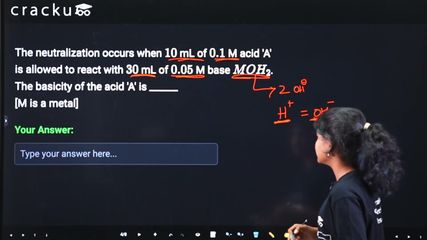
The neutralization occurs when $$10$$ mL of $$0.1$$ M acid 'A' is allowed to react with $$30$$ mL of $$0.05$$ M base $$MOH_2$$. The basicity of the acid 'A' is ______
[M is a metal]
Correct Answer: 3
To determine the basicity of acid 'A', we apply the law of equivalence, which states that in a complete neutralization reaction, the milliequivalents (mEq) of the acid must equal the milliequivalents of the base. The formula for calculating milliequivalents is Molarity × Volume × n-factor. First, we calculate the milliequivalents for the base, $$M(OH)_2$$. Its volume is 30 mL, its molarity is 0.05 M, and its acidity (n-factor) is 2 because it can donate two hydroxide ions. Multiplying these together gives $$30 \times 0.05 \times 2 = 3$$ mEq. Next, we set up the expression for acid 'A', which has a volume of 10 mL, a molarity of 0.1 M, and an unknown basicity (n-factor) that we will call '$$x$$'. This gives us $$10 \times 0.1 \times x = 1x$$ mEq. By setting the milliequivalents equal to each other ($$1x = 3$$), we find that $x$ equals 3. Therefore, the basicity of the acid is 3.
Was this solution helpful?
Click on the Email ☝️ to Watch the Video Solution
Create a FREE account and get:
_1.webp)

Educational materials for JEE preparation

Ask our AI anything

AI can make mistakes. Please verify important information.
AI can make mistakes. Please verify important information.


