
Join Our JEE Preparation Group
Prep with like-minded aspirants; Get access to free daily tests and study material.
Sign in
Please select an account to continue using cracku.in
↓ →
Join Our JEE Preparation Group
Prep with like-minded aspirants; Get access to free daily tests and study material.
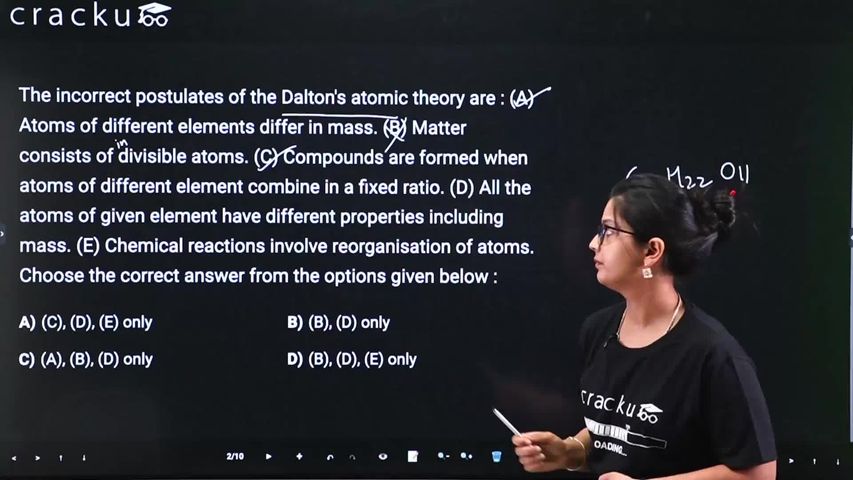
The incorrect postulates of the Dalton's atomic theory are : (A) Atoms of different elements differ in mass. (B) Matter consists of divisible atoms. (C) Compounds are formed when atoms of different element combine in a fixed ratio. (D) All the atoms of given element have different properties including mass. (E) Chemical reactions involve reorganisation of atoms. Choose the correct answer from the options given below :
We need to identify the incorrect postulates of Dalton's atomic theory.
(A) Atoms of different elements differ in mass. This is a correct postulate. ✓
(B) Matter consists of divisible atoms. Dalton stated that atoms are indivisible. So this is an incorrect statement of Dalton's theory. ✗
(C) Compounds are formed when atoms of different elements combine in a fixed ratio. This is a correct postulate. ✓
(D) All the atoms of a given element have different properties including mass. Dalton stated that all atoms of a given element are identical in all properties including mass. So this is an incorrect statement. ✗
(E) Chemical reactions involve reorganisation of atoms. This is a correct postulate. ✓
The incorrect postulates are (B) and (D).
The correct answer is Option (2): (B), (D) only.
Was this solution helpful?
Click on the Email ☝️ to Watch the Video Solution
Create a FREE account and get:
_1.webp)

Educational materials for JEE preparation

Ask our AI anything

AI can make mistakes. Please verify important information.
AI can make mistakes. Please verify important information.
