
Join Our JEE Preparation Group
Prep with like-minded aspirants; Get access to free daily tests and study material.
Sign in
Please select an account to continue using cracku.in
↓ →
Join Our JEE Preparation Group
Prep with like-minded aspirants; Get access to free daily tests and study material.
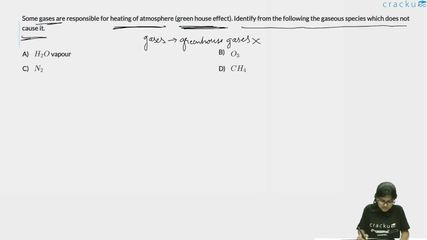
Some gases are responsible for heating of atmosphere (green house effect). Identify from the following the gaseous species which does not cause it.
We need to identify which gas does NOT contribute to the greenhouse effect.
The greenhouse effect occurs when certain gases in the atmosphere absorb and re-emit infrared radiation, trapping heat. A gas must be able to change its dipole moment during molecular vibration to absorb infrared radiation.
Option A: $$H_2O$$ vapour - Water vapour is the most abundant greenhouse gas. It has a bent molecular geometry and a permanent dipole moment, allowing it to absorb infrared radiation effectively. This IS a greenhouse gas.
Option B: $$O_3$$ - Ozone has a bent structure and absorbs infrared radiation. This IS a greenhouse gas.
Option C: $$N_2$$ - Nitrogen is a homonuclear diatomic molecule. It has no permanent dipole moment and its symmetric stretching vibration does not produce a change in dipole moment. Therefore, it does NOT absorb infrared radiation and is NOT a greenhouse gas.
Option D: $$CH_4$$ - Methane has vibrational modes that change the dipole moment, making it a potent greenhouse gas. This IS a greenhouse gas.
The correct answer is Option C: $$N_2$$.
Was this solution helpful?
Click on the Email ☝️ to Watch the Video Solution
Create a FREE account and get:
_1.webp)

Educational materials for JEE preparation

Ask our AI anything

AI can make mistakes. Please verify important information.
AI can make mistakes. Please verify important information.
