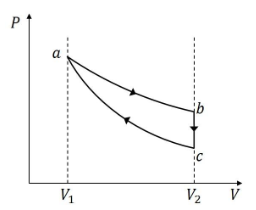
Given: Monoatomic gas $$\implies \gamma = \frac{5}{3}$$, $$C_v = \frac{3}{2}R$$, $$\ln 2 \approx 0.7$$
Along adiabatic compression $$c \rightarrow a$$:
$$T_c V_c^{\gamma-1} = T_a V_a^{\gamma-1} \implies \frac{T_a}{T_c} = \left(\frac{V_c}{V_a}\right)^{\gamma-1} = \left(\frac{V_2}{V_1}\right)^{2/3}$$
At $$\frac{V_2}{V_1} = 8$$:
$$\frac{T_a}{T_c} = (8)^{2/3} = 4 \implies T_a = 4T_c$$
Along isothermal expansion $$a \rightarrow b$$:
$$T_a = T_b \implies P_a V_1 = P_b V_2 \implies \frac{P_a}{P_b} = \frac{V_2}{V_1} = 8$$
$$Q_{\text{in}} = Q_{ab} = nRT_a \ln\left(\frac{V_2}{V_1}\right) = nRT_a \ln 8 = 3nRT_a \ln 2 \approx 2.1nRT_a$$
Along isochoric cooling $$b \rightarrow c$$:
$$Q_{\text{out}} = \vert{}Q_{bc}\vert{} = nC_v(T_b - T_c) = \frac{3}{2}nR(T_a - T_c) = \frac{3}{2}nR\left(T_a - \frac{T_a}{4}\right) = \frac{9}{8}nRT_a = 1.125nRT_a$$
$$Q_{\text{out}} < Q_{\text{in}}$$
Evaluating efficiency $$\eta$$:
$$\eta = \frac{Q_{\text{in}} - Q_{\text{out}}}{Q_{\text{in}}} = 1 - \frac{\frac{9}{8}nRT_a}{3nRT_a\ln 2} = 1 - \frac{3}{8\ln 2}$$
 91- 6303239042