Heat Capacity at Constant Volume

Rarely Tested

Heat Capacity at Constant Volume

### Formula

$$C_V=\frac{1}{n}\frac{Q}{\Delta T}$$

### For Ideal Gas

$$\Delta Q=nC_V\Delta T$$

### Terminologies

- CV β†’ Molar heat capacity at constant volume.

- n β†’ Number of moles.

- Ξ”T β†’ Change in temperature.

### Conditions / Special Cases

At constant volume:

$$W=0$$

Therefore:

$$Q=\Delta U$$

### Usage

- Used in internal energy calculations.
Question 1

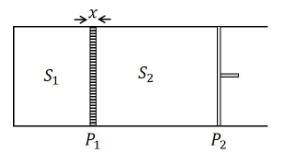
As shown in the figure, an insulated container is fitted with a thermally conducting but immovable partition ($$P_1$$) and a freely movable but thermally insulated piston ($$P_2$$). The partition $$P_1$$ with thermal conductivity $$K$$, cross sectional area $$A$$ and width $$x$$ divides the container into two sections, $$S_1$$ and $$S_2$$, each containing one mole of a monoatomic gas. The piston $$P_2$$ moves freely such that the gas in $$S_2$$ is always at the atmospheric pressure. Initially, the difference between the temperatures of $$S_1$$ and $$S_2$$ is $$\Delta T_0$$. The time it takes for the temperature difference to become $$\dfrac{\Delta T_0}{2}$$ is $$nxR/KA$$, where $$R$$ is the universal gas constant. The value of $$n$$ is:

[ Given: $$\ln 2\approx 0.7$$ ]

image

Go back to topics

Join CAT 2026 course by 5-Time CAT 100%iler

Start your IIM journey with the right preparation and crack CAT 2026.