Degrees of Freedom

Rarely Tested

Degrees of Freedom

Degrees of freedom represent the number of independent ways in which molecules can store energy.

### Internal Energy Formula

$$U=\frac{f}{2}nRT$$

### Heat Capacity Relation

$$C_V=\frac{f}{2}R$$

### Terminologies

- f β†’ Degrees of freedom.

- R β†’ Gas constant.

### Conditions / Special Cases

Monoatomic gas:

$$f=3$$

Diatomic gas:

$$f=5$$

### Usage

- Used in ideal gas energy calculations.

Question 1

Ten moles of an ideal monatomic gas, initially in state $$\boldsymbol{a}$$ at atmospheric pressure and temperature $$T_a=27^\circ\mathrm{C}$$, is enclosed in a metal cylinder of volume $$V_0$$ fitted with a frictionless piston. The gas is suddenly compressed to state $$\boldsymbol{b}$$ with volume $$V_0/3$$. Now, keeping the piston stationary, the cylinder is submerged in a water bath of temperature $$11^\circ\mathrm{C}$$ until the gas reaches the temperature of the water bath, which is denoted as state $$\boldsymbol{c}$$. Finally, while still in the water bath, the piston is brought slowly to its initial position, which is denoted as state $$\boldsymbol{f}$$. If $$R$$ is universal gas constant, then the correct option(s) is/are:

[Given: $$9^{1/3}=2.08$$]

Question 2

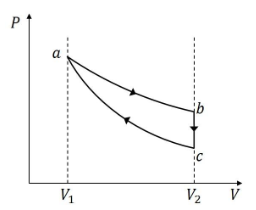
A quasi-static cycle of a monoatomic ideal gas contains an isothermal process ($$\boldsymbol{ab}$$), followed by an isochoric process ($$\boldsymbol{bc}$$) and an adiabatic process ($$\boldsymbol{ca}$$) as shown in the figure. The volumes of the gas are $$V_1$$ and $$V_2$$ at $$\boldsymbol{a}$$ and $$\boldsymbol{b}$$, respectively. If the cycle has heat input $$Q_{\text{in}}$$ and output $$Q_{\text{out}}$$, then the efficiency of the cycle is defined as $$\eta=\dfrac{Q_{\text{in}}-Q_{\text{out}}}{Q_{\text{in}}}$$. The correct statement(s) is(are):

[Given: $$\ln 2\approx 0.7$$]

image
Question 3

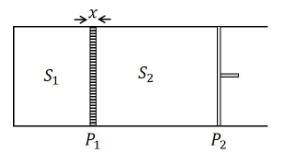
As shown in the figure, an insulated container is fitted with a thermally conducting but immovable partition ($$P_1$$) and a freely movable but thermally insulated piston ($$P_2$$). The partition $$P_1$$ with thermal conductivity $$K$$, cross sectional area $$A$$ and width $$x$$ divides the container into two sections, $$S_1$$ and $$S_2$$, each containing one mole of a monoatomic gas. The piston $$P_2$$ moves freely such that the gas in $$S_2$$ is always at the atmospheric pressure. Initially, the difference between the temperatures of $$S_1$$ and $$S_2$$ is $$\Delta T_0$$. The time it takes for the temperature difference to become $$\dfrac{\Delta T_0}{2}$$ is $$nxR/KA$$, where $$R$$ is the universal gas constant. The value of $$n$$ is:

[ Given: $$\ln 2\approx 0.7$$ ]

image

Go back to topics

Join CAT 2026 course by 5-Time CAT 100%iler

Start your IIM journey with the right preparation and crack CAT 2026.