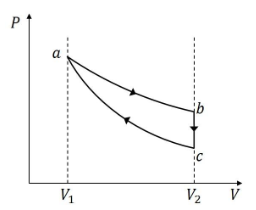
Thermodynamic process equations govern individual state paths: sudden compression $$a \rightarrow b$$ is adiabatic, stationary cooling $$b \rightarrow c$$ is isochoric, and slow expansion $$c \rightarrow f$$ inside the water bath is isothermal.
Given: $$n = 10$$, $$\gamma = \frac{5}{3}$$, $$C_v = \frac{3}{2}R$$, $$T_a = 27^\circ\text{C} = 300\text{ K}$$, $$T_c = T_f = 11^\circ\text{C} = 284\text{ K}$$, $$V_a = V_f = V_0$$, $$V_b = V_c = \frac{V_0}{3}$$, $$9^{1/3} = 2.08$$
Along adiabatic path $$a \rightarrow b$$:
$$T_a V_a^{\gamma-1} = T_b V_b^{\gamma-1}$$
$$300 \times V_0^{2/3} = T_b \left(\frac{V_0}{3}\right)^{2/3} \implies T_b = 300 \times 3^{2/3} = 300 \times 9^{1/3} = 300 \times 2.08 = 624\text{ K}$$
$$P_a V_a^\gamma = P_b V_b^\gamma \implies P_b = P_a\left(\frac{V_a}{V_b}\right)^\gamma = P_a(3)^{5/3} = P_a \times 3 \times 3^{-1/3} \approx 6.24 P_a$$
$$\Delta U_{a \rightarrow b} = nC_v(T_b - T_a) = 10 \times \frac{3}{2}R \times (624 - 300) = 15R \times 324 = 4860R$$
Evaluating net change in internal energy for the entire process $$a \rightarrow b \rightarrow c \rightarrow f$$:
$$\Delta U_{\text{net}} = nC_v(T_f - T_a) = 10 \times \frac{3}{2}R \times (284 - 300) = 15R \times (-16) = -240R$$
Answer: Option (A), Option (B), Option (C)
 91- 6303239042