“Seeing . . . operates on the foundation of covenants with images that establish the conditions for meaningful visual experience.” In light of the passage, which one of the following statements best conveys the meaning of this sentence?
Sign in
Please select an account to continue using cracku.in
↓ →
The passage below is accompanied by a set of questions. Choose the best answer to each question.
The claims advanced here may be condensed into two assertions: [first, that visual] culture is what images, acts of seeing, and attendant intellectual, emotional, and perceptual sensibilities do to build, maintain, or transform the worlds in which people live. [And second, that the] study of visual culture is the analysis and interpretation of images and the ways of seeing (or gazes) that configure the agents, practices, conceptualities, and institutions that put images to work. . . .
Accordingly, the study of visual culture should be characterized by several concerns. First, scholars of visual culture need to examine any and all imagery - high and low, art and non-art. . . . They must not restrict themselves to objects of a particular beauty or aesthetic value. Indeed, any kind of imagery may be found to offer up evidence of the visual construction of reality. . . .
Second, the study of visual culture must scrutinize visual practice as much as images themselves, asking what images do when they are put to use. If scholars engaged in this enterprise inquire what makes an image beautiful or why this image or that constitutes a masterpiece or a work of genius, they should do so with the purpose of investigating an artist’s or a work’s contribution to the experience of beauty, taste, value, or genius. No amount of social analysis can account fully for the existence of Michelangelo or Leonardo. They were unique creators of images that changed the way their contemporaries thought and felt and have continued to shape the history of art, artists, museums, feeling, and aesthetic value. But study of the critical, artistic, and popular reception of works by such artists as Michelangelo and Leonardo can shed important light on the meaning of these artists and their works for many different people. And the history of meaning-making has a great deal to do with how scholars as well as lay audiences today understand these artists and their achievements.
Third, scholars studying visual culture might properly focus their interpretative work on life worlds by examining images, practices, visual technologies, taste, and artistic style as constitutive of social relations. The task is to understand how artifacts contribute to the construction of a world. . . . Important methodological implications follow: ethnography and reception studies become productive forms of gathering information, since these move beyond the image as a closed and fixed meaning-event. . . .
Fourth, scholars may learn a great deal when they scrutinize the constituents of vision, that is, the structures of perception as a physiological process as well as the epistemological frameworks informing a system of visual representation. Vision is a socially and a biologically constructed operation, depending on the design of the human body and how it engages the interpretive devices developed by a culture in order to see intelligibly. . . . Seeing . . . operates on the foundation of covenants with images that establish the conditions for meaningful visual experience.
Finally, the scholar of visual culture seeks to regard images as evidence for explanation, not as epiphenomena.
“Seeing . . . operates on the foundation of covenants with images that establish the conditions for meaningful visual experience.” In light of the passage, which one of the following statements best conveys the meaning of this sentence?
Let's look at the options one by one.
Option B is "Images are meaningful visual experiences when they have a foundation of covenants seeing them." This is a distorted option. The actual statement states that sight becomes a meaning visual experience when images are associated with covenants . There is nowhere any discussion about the meaningfulness of images

Option C is "Sight as a meaningful visual experience is possible when there is a foundational condition established in images of covenants." Again a twisted option. There is nothing said about the possibility of sight as a visual experience. There could be other cases too in which meaningful visual experience could be established
Option D is "The way we experience sight is through images operated on by meaningful covenants." Entirely out of context option. The statement is about meaningful visual experience not about meaningful covenants.
Option A correctly encapsulates all the points. Hence it is the correct answer.
All of the following statements may be considered valid inferences from the passage, EXCEPT:
Option D states "studying visual culture requires institutional structures without which the structures of perception cannot be analysed".
Look at the penultimate paragraph of the question," Vision is a socially and a biologically constructed operation, depending on the design of the human body and how it engages the interpretive devices developed by a culture in order to see intelligibly"
Studying visual culture thus depends on the design of human body and interpretative devices developed by the culture. Nowhere it is mentioned that ,without institutional structures of culture vision can't be analysed as it also depends on the design of human body. Hence this is a wrong inference. Remaining all three options are correct.
Which one of the following best describes the word “epiphenomena” in the last sentence of the passage?
This is a vocab question. Epiphenomena means "a secondary effect or byproduct". The option "Phenomena supplemental to the evidence", is the closest one. Hence it is the correct answer.
“No amount of social analysis can account fully for the existence of Michelangelo or Leonardo.” In light of the passage, which one of the following interpretations of this sentence is the most accurate?
Let's look at the options one by one.
Option A states that ,"Socially existing beings cannot be analysed, unlike the art of Michelangelo or Leonardo which can." Twisted option. The excerpt from the passage states that "no amount of social analysis is enough for Michelangelo and Leonardo, because they were such vast artists" However other beings could be socially analysed because not everyone is like Michelangelo or Leonardo.
Option C states that ,"Michelangelo or Leonardo cannot be subjected to social analysis because of their genius." This is an entirely wrong option. These artists can be subjected to social analysis, but nothing will do justice to them.
Option D states that ,"No analyses exist of Michelangelo’s or Leonardo’s social accounts.". This is beyond the scope of the pasaage, as nothing has been mentioned about this.
Option B is the correct answer.
Which set of keywords below most closely captures the arguments of the passage?
This is a fact based easy question. Read the passage carefully. Imagery can be inferred from the second paragraph. And from the subsequent paragraphs you can also infer Visual Practices, Lifeworlds and Structures of Perception(penultimate paragraph).
Hence Option C is the correct answer.
The passage below is accompanied by a set of questions. Choose the best answer to each question.
174 incidents of piracy were reported to the International Maritime Bureau last year, with Somali pirates responsible for only three. The rest ranged from the discreet theft of coils of rope in the Yellow Sea to the notoriously ferocious Nigerian gunmen attacking and hijacking oil tankers in the Gulf of Guinea, as well as armed robbery off Singapore and the Venezuelan coast and kidnapping in the Sundarbans in the Bay of Bengal. For [Dr. Peter] Lehr, an expert on modern-day piracy, the phenomenon’s history should be a source of instruction rather than entertainment, piracy past offering lessons for piracy present. . . .
But . . . where does piracy begin or end? According to St Augustine, a corsair captain once told Alexander the Great that in the forceful acquisition of power and wealth at sea, the difference between an emperor and a pirate was simply one of scale. By this logic, European empire-builders were the most successful pirates of all time. A more eclectic history might have included the conquistadors, Vasco da Gama and the East India Company. But Lehr sticks to the disorganized small fry, making comparisons with the renegades of today possible.
The main motive for piracy has always been a combination of need and greed. Why toil away as a starving peasant in the 16th century when a successful pirate made up to £4,000 on each raid? Anyone could turn to freebooting if the rewards were worth the risk . . . .
Increased globalisation has done more to encourage piracy than suppress it. European colonialism weakened delicate balances of power, leading to an influx of opportunists on the high seas. A rise in global shipping has meant rich pickings for freebooters. Lehr writes: “It quickly becomes clear that in those parts of the world that have not profited from globalisation and modernisation, and where abject poverty and the daily struggle for survival are still a reality, the root causes of piracy are still the same as they were a couple of hundred years ago.” . . .
Modern pirate prevention has failed. After the French yacht Le Gonant was ransomed for $2 million in 2008, opportunists from all over Somalia flocked to the coast for a piece of the action. . . . A consistent rule, even today, is there are never enough warships to patrol pirate-infested waters. Such ships are costly and only solve the problem temporarily; Somali piracy is bound to return as soon as the warships are withdrawn. Robot shipping, eliminating hostages, has been proposed as a possible solution; but as Lehr points out, this will only make pirates switch their targets to smaller carriers unable to afford the technology.
His advice isn’t new. Proposals to end illegal fishing are often advanced but they are difficult to enforce. Investment in local welfare put a halt to Malaysian piracy in the 1970s, but was dependent on money somehow filtering through a corrupt bureaucracy to the poor on the periphery. Diplomatic initiatives against piracy are plagued by mutual distrust: the Russians execute pirates, while the EU and US are reluctant to capture them for fear they’ll claim asylum.
“Why toil away as a starving peasant in the 16th century when a successful pirate made up to £4,000 on each raid?” In this sentence, the author’s tone can best be described as being:
Option A states that the author is "facetious". Facetious means, treating serious issues with inappropriate humor. Author is nowhere mocking the hard life of peasants. On the contrary, he is actually admitting it and suggesting it as the reason why so many people became pirates in the first place. Hence this option is incorrect.
Option B states analytical. The author is nowhere contrasting the lives of peasant and pirates. He has not portrayed the lives of pirates in a pleasant light. Ultimately they also have to face surveillance and other dangers, thus the contrast in the option is wrong.
Indignant is completely wrong. The author is not angry at the pirates , for amassing huge wealth. Entirely out of context.
Option C talks about irony, which is actually correct. The author is ironical that an honest peasant has to toil day and night and still has to sleep empty stomach but on the other hand a pirate could easily amass twice the fortunes of peasant, without breaking much sweat. This entirely captures the essence of the mentioned line. Hence this answer is correct.
“A more eclectic history might have included the conquistadors, Vasco da Gama and the East India Company. But Lehr sticks to the disorganised small fry . . .” From this statement we can infer that the author believes that:
Option B and Option C are factually out of scope. Nothing has been said about who laid the groundwork for modern piracy. Neither has any comparisons made between the piracy of today and yesteryears,
In this statement , the author is obviously not assigning any blame to Vasco Da Gama and East India company. He just wants to highlight their roles in early pirates history.
Option D can be inferred from the passage.
We can deduce that the author believes that piracy can best be controlled in the long run:
Look at the 4th paragraph of the passage. " It quickly becomes clear that in those parts of the world that have not profited from globalisation and modernisation, and where abject poverty and the daily struggle for survival are still a reality, the root causes of piracy are still the same as they were a couple of hundred years ago." Hence to best control the problem of piracy one has to solve this root problem that is eliminate income disparities and poverty in affected regions. Hence 1 is the correct answer. Remaining options are solution but not the one which can eliminate piracy in the long run.
The author ascribes the rise in piracy today to all of the following factors EXCEPT:
The author in the passage that. "surveillance is there, but they are costly and will never be enough to cover the entire sea" He nowhere mentions that surveillance has decreased, actually it is not possible to map the entire sea. Hence this option is incorrect. Remaining all the options are correct.
The passage below is accompanied by a set of questions. Choose the best answer to each question.
Aggression is any behavior that is directed toward injuring, harming, or inflicting pain on another living being or group of beings. Generally, the victim(s) of aggression must wish to avoid such behavior in order for it to be considered true aggression. Aggression is also categorized according to its ultimate intent. Hostile aggression is an aggressive act that results from anger, and is intended to inflict pain or injury because of that anger. Instrumental aggression is an aggressive act that is regarded as a means to an end other than pain or injury. For example, an enemy combatant may be subjected to torture in order to extract useful intelligence, though those inflicting the torture may have no real feelings of anger or animosity toward their subject. The concept of aggression is very broad, and includes many categories of behavior (e.g., verbal aggression, street crime, child abuse, spouse abuse, group conflict, war, etc.). A number of theories and models of aggression have arisen to explain these diverse forms of behavior, and these theories/models tend to be categorized according to their specific focus. The most common system of categorization groups the various approaches to aggression into three separate areas, based upon the three key variables that are present whenever any aggressive act or set of acts is committed. The first variable is the aggressor him/herself. The second is the social situation or circumstance in which the aggressive act(s) occur. The third variable is the target or victim of aggression.
Regarding theories and research on the aggressor, the fundamental focus is on the factors that lead an individual (or group) to commit aggressive acts. At the most basic level, some argue that aggressive urges and actions are the result of inborn, biological factors. Sigmund Freud (1930) proposed that all individuals are born with a death instinct that predisposes us to a variety of aggressive behaviors, including suicide (self directed aggression) and mental illness (possibly due to an unhealthy or unnatural suppression of aggressive urges). Other influential perspectives supporting a biological basis for aggression conclude that humans evolved with an abnormally low neural inhibition of aggressive impulses (in comparison to other species), and that humans possess a powerful instinct for property accumulation and territorialism. It is proposed that this instinct accounts for hostile behaviors ranging from minor street crime to world wars. Hormonal factors also appear to play a significant role in fostering aggressive tendencies. For example, the hormone testosterone has been shown to increase aggressive behaviors when injected into animals. Men and women convicted of violent crimes also possess significantly higher levels of testosterone than men and women convicted of non violent crimes. Numerous studies comparing different age groups, racial/ethnic groups, and cultures also indicate that men, overall, are more likely to engage in a variety of aggressive behaviors (e.g., sexual assault, aggravated assault, etc.) than women. One explanation for higher levels of aggression in men is based on the assumption that, on average, men have higher levels of testosterone than women.
All of the following statements can be seen as logically implied by the arguments of the passage EXCEPT:
Look at the last paragraph of the passage," Other influential perspectives supporting a biological basis for aggression conclude that humans evolved with an abnormally low neural inhibition of aggressive impulses". While the first option talks about neural regulation of testosterone, which is factually incorrect. Hence this is the answer.
The author identifies three essential factors according to which theories of aggression are most commonly categorised. Which of the following options is closest to the factors identified by the author?
The author explains that theories of aggression are often categorized based on three main factors: the aggressor (the person or group committing the aggression), the circumstances surrounding the aggressive act, and the victim (the person or group being targeted). These factors help to understand and explain different types of aggression.
“[A]n enemy combatant may be subjected to torture in order to extract useful intelligence, though those inflicting the torture may have no real feelings of anger or animosity toward their subject.” Which one of the following best explicates the larger point being made by the author here?
Let's look at the options one by one.
Option B is a distorted option. The sentence is not about the reliability of the information. Its about the inherent aggression involved.
Option C is also incorrect. Nothing has been mentioned about when the enemy refuses to reveal information. Hence this is beyond the scope of the passage.
On similar lines option D is also incorrect. Nothing has been said about the most effective method to extract information.
Option A correctly captures the essence. Sometimes the aggressor has no intention to inflict pain, its just a means to an utilitarian end. Hence this is the correct option.
The author discusses all of the following arguments in the passage EXCEPT that:
Option C is a twisted option. It distorts what is given in the passage. The passage talks about the identification of death instinct by Freud. It doesn't talk about its moderation and keeping the resulting aggression in check. Hence this option is completely out of context and is incorrect.
The passage below is accompanied by a set of questions. Choose the best answer to each question.
In a low-carbon world, renewable energy technologies are hot business. For investors looking to redirect funds, wind turbines and solar panels, among other technologies, seem a straightforward choice. But renewables need to be further scrutinized before being championed as forging a path toward a low-carbon future. Both the direct and indirect impacts of renewable energy must be examined to ensure that a climate-smart future does not intensify social and environmental harm. As renewable energy production requires land, water, and labor, among other inputs, it imposes costs on people and the environment. Hydropower projects, for instance, have led to community dispossession and exclusion . . . Renewable energy supply chains are also intertwined with mining, and their technologies contribute to growing levels of electronic waste . Furthermore, although renewable energy can be produced and distributed through small-scale, local systems, such an approach might not generate the high returns on investment needed to attract capital.
Although an emerging sector, renewables are enmeshed in long-standing resource extraction through their dependence on minerals and metals . . . Scholars document the negative consequences of mining . . . even for mining operations that commit to socially responsible practices[:] “many of the world’s largest reservoirs of minerals like cobalt, copper, lithium, [and] rare earth minerals”—the ones needed for renewable technologies—“are found in fragile states and under communities of marginalized peoples in Africa, Asia, and Latin America.” Since the demand for metals and minerals will increase substantially in a renewable-powered future . . . this intensification could exacerbate the existing consequences of extractive activities.
Among the connections between climate change and waste, O’Neill . . . highlights that “devices developed to reduce our carbon footprint, such as lithium batteries for hybrid and electric cars or solar panels[,] become potentially dangerous electronic waste at the end of their productive life.” The disposal of toxic waste has long perpetuated social injustice through the flows of waste to the Global South and to marginalized communities in the Global North . . .
While renewable energy is a more recent addition to financial portfolios, investments in the sector must be considered in light of our understanding of capital accumulation. As agricultural finance reveals, the concentration of control of corporate activity facilitates profit generation. For some climate activists, the promise of renewables rests on their ability not only to reduce emissions but also to provide distributed, democratized access to energy . . . But Burke and Stephens . . . caution that “renewable energy systems offer a possibility but not a certainty for more democratic energy futures.” Small-scale, distributed forms of energy are only highly profitable to institutional investors if control is consolidated somewhere in the financial chain. Renewable energy can be produced at the household or neighborhood level. However, such small-scale, localized production is unlikely to generate high returns for investors. For financial growth to be sustained and expanded by the renewable sector, production and trade in renewable energy technologies will need to be highly concentrated, and large asset management firms will likely drive those developments.
Which one of the following statements best captures the main argument of the last paragraph of the passage?
The last paragraph talks about how renewable energy can be produced at local or household level but it also talks about the roadblocks in terms of financing. Hence it portrays two sides of the coin, talking about both the positives and negatives. Thus we can fairly conclude that renewable energy is a double edged sword. Option1 is the correct answer.
Which one of the following statements, if true, could be an accurate inference from the first paragraph of the passage?
Look at these lines from the first paragraph of the passage, "But renewables need to be further scrutinized before being championed as forging a path toward a low-carbon future. Both the direct and indirect impacts of renewable energy must be examined to ensure that a climate-smart future does not intensify social and environmental harm. As renewable energy production requires land, water, and labor, among other inputs, it imposes costs on people and the environment."
These lines clearly indicate that the author has reservations about the renewable energy systems.
Option (2) is factually incorrect. Option 3 is beyond the scope of the passage. No comparison has been made as such. Option (4) is partially correct. The author has reservations about profitability and various other factors too which is accurately captured by the first option.
Which one of the following statements, if false, could be seen as best supporting the arguments in the passage?
Here we have to look at those options which if false will support the author's arguments. Look at the option 2. It states that renewable energy have little or no environmental impact. Its negation will be renewable energy have considerable environmental impact, this is what the author states throughout the passage, about the harmful impact of renewable energy. Hence option 2 is correct.
All of the following statements, if true, could be seen as supporting the arguments in the passage, EXCEPT:
Look at the last line of the passage," For financial growth to be sustained and expanded by the renewable sector, production and trade in renewable energy technologies will need to be highly concentrated, and large asset management firms will likely drive those developments " Nowhere it is mentioned that the negative impacts of renewable energy needs to be studied , for it to be financially viable. Hence option 4 is incorrect.
Based on the passage, we can infer that the author would be most supportive of which one of the following practices?
Let's look at the options one by one. Option 2 states "The study of the coexistence of marginalised people with their environments." This passage is about the impact of renewable energy on marginalized people, not about their coexistence. Hence ignore this option.
Option 3 states "Encouragement for the development of more environment-friendly carbon-based fuels". In the third paragraph, the author talks about reducing carbon footprint. Hence he will never support carbon based fuels. This option is incorrect.
Option 4 is completely negated by the last paragraph. The author talks about the financial viability of the localised small scale production. Hence this option too is incorrect.
Option 1 is completely correct."many of the world’s largest reservoirs of minerals like cobalt, copper, lithium, [and] rare earth minerals”—the ones needed for renewable technologies—“are found in fragile states and under communities of marginalized peoples in Africa, Asia, and Latin America.” Since the demand for metals and minerals will increase substantially in a renewable-powered future . . . this intensification could exacerbate the existing consequences of extractive activities."
This intensification could exacerbate the existing consequences, i.e. if propar disposal of toxic materials is not done it can make the conditions worse. Option 1 is the correct answer.
The passage given below is followed by four alternate summaries. Choose the option that best captures the essence of the passage.
All humans make decisions based on one or a combination of two factors. This is either intuition or information. Decisions made through intuition are usually fast, people don’t even think about the problem. It is quite philosophical, meaning that someone who made a decision based on intuition will have difficulty explaining the reasoning behind it. The decision-maker would often utilize her senses in drawing conclusions, which again is based on some experience in the field of study. On the other side of the spectrum, we have decisions made based on information. These decisions are rational — it is based on facts and figures, which unfortunately also means that it can be quite slow. The decision-maker would frequently use reports, analyses, and indicators to form her conclusion. This methodology results in accurate, quantifiable decisions, meaning that a person can clearly explain the rationale behind it.
Let's look at the options one by one.
The author has not made any comparisons between the two methodologies, about which method is better. Hence optionA is incorrect.
Option 3 is incorrect too because it doesnot summarise the para accurately. Nothing is mentioned about decisions based on information.
Although time is a factor, nowhere it is mentioned that time is the factor in determining the method of our decision making. Hence Option4 is incorrect too.
Option 2 correctly summarises the passage by differentiating between the two methods. Hence it is correct.
The passage given below is followed by four alternate summaries. Choose the option that best captures the essence of the passage.
The rural-urban continuum and the heterogeneity of urban settings pose an obvious challenge to identifying urban areas and measuring urbanization rates in a consistent way within and across countries. An objective methodology for distinguishing between urban and rural areas that is based on one or two metrics with fixed thresholds may not adequately capture the wide diversity of places. A richer combination of criteria would better describe the multifaceted nature of a city’s function and its environment, but the joint interpretation of these criteria may require an element of human judgment.
Option B is incorrect, as it mentions "is no longer relevant" whereas the author says may no longer be relevant.
Option C is incorrect too, as the passage talks about distinguishing between urban/rural, not about accurately identifying rural areas.
Option D is distorted. Judgement would be required on the richer criteria , not on the objective methodology, as mentioned in this option.
Option A is correct as it correctly captures the essence of the passage.
Five jumbled up sentences, related to a topic, are given below. Four of them can be put together to form a coherent paragraph. Identify the odd one out and key in the number of the sentence as your answer:
1. You can observe the truth of this in every e-business model ever constructed: monopolise and protect data.
2. Economists and technologists believe that a new kind of capitalism is being created - different from industrial capitalism as was merchant capitalism.
3. In 1962, Kenneth Arrow, the guru of mainstream economics, said that in a free market economy the purpose of inventing things is to create intellectual property rights.
4. There is, alongside the world of monopolised information and surveillance, a different dynamic growing up: information as a social good, incapable of being owned or exploited or priced.
5. Yet information is abundant. Information goods are freely replicable. Once a thing is made, it can be copied and pasted infinitely.
We notice that Statement (3) serves as an introduction by touching upon the topic of intellectual property rights. Statement (2) continues along this line and mentions how 'monopolizing and protecting data' {an idea perhaps associated with the aforementioned intellectual property rights} can be observed in certain business models. Thus, the discussion revolves around data/information and its place in the market system. Statement (5) mentions that despite the monopolization, "information is abundant". And this brings us to the description in Statement (4) which portrays information differently - as a social good. Hence, although a bit discontiguous, 3-1-5-4 seems to talk about the same subject while Statement (2) {on "Merchant Capitalism"} diverges from it. Therefore, (2) is the odd-one-out.
The four sentences (labelled 1, 2, 3, 4) below, when properly sequenced would yield a coherent paragraph. Decide on the proper sequencing of the order of the sentences and key in the sequence of the four numbers as your answer:
1. But the attention of the layman, not surprisingly, has been captured by the atom bomb, although there is at least a chance that it may never be used again.
2. Of all the changes introduced by man into the household of nature, [controlled] large-scale nuclear fission is undoubtedly the most dangerous and most profound.
3. The danger to humanity created by the so-called peaceful uses of atomic energy may, however, be much greater.
4. The resultant ionizing radiation has become the most serious agent of pollution of the environment and the greatest threat to man’s survival on earth.
Of all the sentences, sentence 2 will be the starting point because it introduces the concept of nuclear fission. Sentence 4 continues this concept by talking about the "resulting ionizing radiation". Out of sentence 1 and 3, 1 will come first because it introduces the concept of atom bomb and sentence 3 further explores it by talking about how the impact of atomic energy could be much greater. Hence the correct order is 2413.
The passage given below is followed by four alternate summaries. Choose the option that best captures the essence of the passage.
With the Treaty of Westphalia, the papacy had been confined to ecclesiastical functions, and the doctrine of sovereign equality reigned. What political theory could then explain the origin and justify the functions of secular political order? In his Leviathan, published in 1651, three years after the Peace of Westphalia, Thomas Hobbes provided such a theory. He imagined a “state of nature” in the past when the absence of authority produced a “war of all against all.” To escape such intolerable insecurity, he theorized, people delivered their rights to a sovereign power in return for the sovereign’s provision of security for all within the state’s border. The sovereign state’s monopoly on power was established as the only way to overcome the perpetual fear of violent death and war.
Let's look at the options one by one. Option 1 talks about voluntary surrender of rights. But the passage talks about "transfer" of rights, not "surrender" of rights.
The main point is not about "powers of papacy", option 2 is inconsequential.
Option 3 does not cover one of the main points of the passage, the transfer of rights, between people and the sovereign power. It's an incomplete option.
Option 4 is the correct summary, it talks about the transactional relationship i.e give and take or transfer of rights between people and sovereign government.
Five jumbled up sentences, related to a topic, are given below. Four of them can be put together to form a coherent paragraph. Identify the odd one out and key in the number of the sentence as your answer:
1. The victim’s trauma after assault rarely gets the attention that we lavish on the moment of damage that divided the survivor from a less encumbered past.
2. One thing we often do with narratives of sexual assault is sort their respective parties into different temporalities: it seems we are interested in perpetrators’ futures and victims’ pasts.
3. One result is that we don’t have much of a vocabulary for what happens in a victim’s life after the painful past has been excavated, even when our shared language gestures toward the future, as the term “survivor” does.
4. Even the most charitable questions asked about the victims seem to focus on the past, in pursuit of understanding or of corroboration of painful details.
5. As more and more stories of sexual assault have been made public in the last two years, the genre of their telling has exploded --- crimes have a tendency to become not just stories but genres.
The subject here is about the narratives of sexual assault and the subsequent treatment of the victims. The paragraph begins with Statement (5) which talks about sexual assault narratives turning into a genre. Statement (2) comments on a stark element within these narratives: the general interest in perpetrators’ futures and victims’ pasts. Statement (3) delineates on the outcome of the latter: the focus on a victim's past' and Statement (1) further adds to this point. Although Statement (4) appears on a similar topic, we cannot place it in the above arrangement since it diverges into the subject of asking questions to the survivors {an element that is yet to be discussed}. Thus, (4) is the odd-one-out.
The four sentences (labelled 1, 2, 3, 4) below, when properly sequenced would yield a coherent paragraph. Decide on the proper sequencing of the order of the sentences and key in the sequence of the four numbers as your answer:
1. It also has four movable auxiliary telescopes 1.8 m in diameter.
2. Completed in 2006, the Very Large Telescope (VLT) has four reflecting telescopes, 8.2 m in diameter that can observe objects 4 billion times weaker than can normally be seen with the naked eye.
3. This configuration enables one to distinguish an astronaut on the Moon.
4. When these are combined with the large telescopes, they produce what is called interferometry: a simulation of the power of a mirror 16 m in diameter and the resolution of a telescope of 200 m.
This is a very easy parajumble question. Sentence 2 introduces the topic, VLT. Option 4 further explores it by discussing about the telescopes. 43 forms a natural block as one provides the use and other the application. Hence 2143 is the correct order
The four sentences (labelled 1, 2, 3, 4) below, when properly sequenced would yield a coherent paragraph. Decide on the proper sequencing of the order of the sentences and key in the sequence of the four numbers as your answer:
1. While you might think that you see or are aware of all the changes that happen in your immediate environment, there is simply too much information for your brain to fully process everything.
2. Psychologists use the term ‘change blindness’ to describe this tendency of people to be blind to changes though they are in the immediate environment.
3. It cannot be aware of every single thing that happens in the world around you.
4. Sometimes big shifts happen in front of your eyes and you are not at all aware of these changes.
1 and 3 forms a natural block , as the "It" in sentence 3 refers to the "brain" discussed in statement 1. Again 4 and 2 forms a natural block, as the "this tendency" in statement 2 , refers to the tendency of the people ignoring things happening in front of their eyes as discussed in statement 4. Hence the correct order is 1342
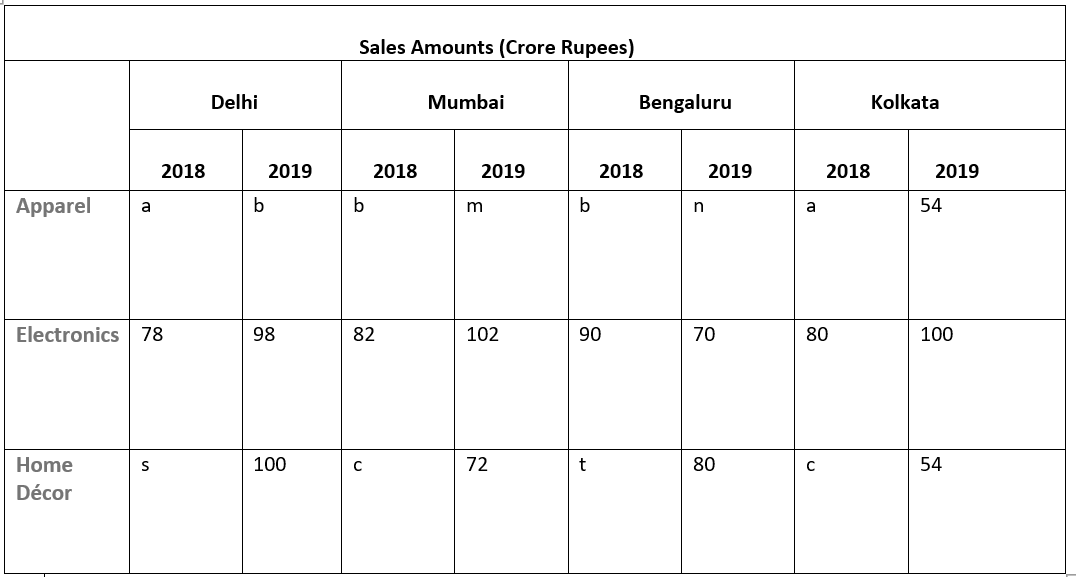
A chain of departmental stores has outlets in Delhi, Mumbai, Bengaluru and Kolkata. The sales are categorized by its three departments - ‘Apparel’, ‘Electronics’, and ‘Home Décor’. An Accountant has been asked to prepare a summary of the 2018 and 2019 sales amounts for an internal report. He has collated partial information and prepared the following table.

The following additional information is known.
1. The sales amounts in the Apparel departments were the same for Delhi and Kolkata in 2018.
2. The sales amounts in the Apparel departments were the same for Mumbai and Bengaluru in 2018. This sales amount matched the sales amount in the Apparel department for Delhi in 2019.
3. The sales amounts in the Home Décor departments were the same for Mumbai and Kolkata in 2018.
4. The sum of the sales amounts of four Electronics departments increased by the same amount as the sum of the sales amounts of four Apparel departments from 2018 to 2019.
5. The total sales amounts of the four Home Décor departments increased by Rs 70 Crores from 2018 to 2019.
6. The sales amounts in the Home Décor departments of Delhi and Bengaluru each increased by Rs 20 Crores from 2018 to 2019.
7. The sales amounts in the Apparel departments of Delhi and Bengaluru each increased by the same amount in 2019 from 2018. The sales amounts in the Apparel departments of Mumbai and Kolkata also each increased by the same amount in 2019 from 2018.
8. The sales amounts in the Apparel departments of Delhi, Kolkata and Bengaluru in 2019 followed an Arithmetic Progression.
In Home Décor departments of which cities were the sales amounts the highest in 2018 and 2019, respectively?
From 1, Let sales amounts in the Apparel departments for Delhi and Kolkata in 2018 be a.
From 2, Let sales amounts in the Apparel departments for Mumbai and Bengaluru in 2018 and for Delhi be b.
From 3, let the sales amounts in the Home Décor departments for Mumbai and Kolkata in 2018 be c and that of Delhi and Bengaluru be s and t respectively.
Let the Let sales amounts in the Apparel departments for Mumbai and Bengaluru in 2019 be m and n respectuvely.
The table looks like:
From 6, s=80 and t=60.
From 5, s+c+t+c+70=306 => 2c=96 => c=48.
From 4, (b-a)+(m-b)+(n-b)+(54-a)=(20)+20-20+20 => 54+m+n-2a-b=40=> 2a+b=14+m+n => 2b=28+2m+2n-4a...(i)
From 7, b-a=n-b => 2b=a+n...(ii) and m-b=54-a=> a+m=54+b=>2b=2a+2m-108...(iii)
From 8, 108=b+n=>2b=216-2n...(iv)
from (i) & (iii), 28+2m+2n-4a=2a+2m-108 => 6a=136+2n => 3a=68+n...(v)
from (ii) & (iv), 216-2n=a+n => a+3n=216=> 3a=648-9n...(vi)
from (v) & (vi), 648-9n=68+n => n=58 => a=42 => b=50 => m=62.
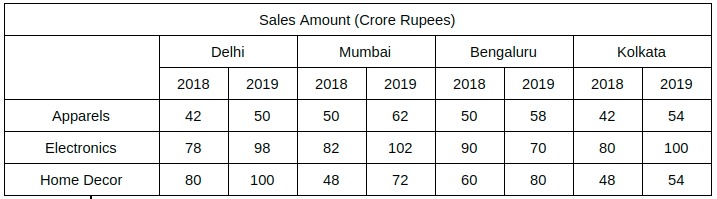
The final table looks like this
We see that Delhi has the highest sales in Decor department in both the years. Hence D is the answer
What was the increase in sales amount, in Crore Rupees, in the Apparel department of Mumbai from 2018 to 2019?
From 1, Let sales amounts in the Apparel departments for Delhi and Kolkata in 2018 be a.
From 2, Let sales amounts in the Apparel departments for Mumbai and Bengaluru in 2018 and for Delhi be b.
From 3, let the sales amounts in the Home Décor departments for Mumbai and Kolkata in 2018 be c and that of Delhi and Bengaluru be s and t respectively.
Let the Let sales amounts in the Apparel departments for Mumbai and Bengaluru in 2019 be m and n respectuvely.
The table looks like:
From 6, s=80 and t=60.
From 5, s+c+t+c+70=306 => 2c=96 => c=48.
From 4, (b-a)+(m-b)+(n-b)+(54-a)=(20)+20-20+20 => 54+m+n-2a-b=40=> 2a+b=14+m+n => 2b=28+2m+2n-4a...(i)
From 7, b-a=n-b => 2b=a+n...(ii) and m-b=54-a=> a+m=54+b=>2b=2a+2m-108...(iii)
From 8, 108=b+n=>2b=216-2n...(iv)
from (i) & (iii), 28+2m+2n-4a=2a+2m-108 => 6a=136+2n => 3a=68+n...(v)
from (ii) & (iv), 216-2n=a+n => a+3n=216=> 3a=648-9n...(vi)
from (v) & (vi), 648-9n=68+n => n=58 => a=42 => b=50 => m=62.
The final table looks like this
Increase in sales =12
Among all the 12 departments (i.e., the 3 departments in each of the 4 cities), what was the maximum percentage increase in sales amount from 2018 to 2019?
From 1, Let sales amounts in the Apparel departments for Delhi and Kolkata in 2018 be a.
From 2, Let sales amounts in the Apparel departments for Mumbai and Bengaluru in 2018 and for Delhi be b.
From 3, let the sales amounts in the Home Décor departments for Mumbai and Kolkata in 2018 be c and that of Delhi and Bengaluru be s and t respectively.
Let the Let sales amounts in the Apparel departments for Mumbai and Bengaluru in 2019 be m and n respectuvely.
The table looks like:
From 6, s=80 and t=60.
From 5, s+c+t+c+70=306 => 2c=96 => c=48.
From 4, (b-a)+(m-b)+(n-b)+(54-a)=(20)+20-20+20 => 54+m+n-2a-b=40=> 2a+b=14+m+n => 2b=28+2m+2n-4a...(i)
From 7, b-a=n-b => 2b=a+n...(ii) and m-b=54-a=> a+m=54+b=>2b=2a+2m-108...(iii)
From 8, 108=b+n=>2b=216-2n...(iv)
from (i) & (iii), 28+2m+2n-4a=2a+2m-108 => 6a=136+2n => 3a=68+n...(v)
from (ii) & (iv), 216-2n=a+n => a+3n=216=> 3a=648-9n...(vi)
from (v) & (vi), 648-9n=68+n => n=58 => a=42 => b=50 => m=62.
The final table looks like this
Hence the percentage change is 50.
What was the total sales amount, in Crore Rupees, in 2019 for the chain of departmental stores?
From 1, Let sales amounts in the Apparel departments for Delhi and Kolkata in 2018 be a.
From 2, Let sales amounts in the Apparel departments for Mumbai and Bengaluru in 2018 and for Delhi be b.
From 3, let the sales amounts in the Home Décor departments for Mumbai and Kolkata in 2018 be c and that of Delhi and Bengaluru be s and t respectively.
Let the Let sales amounts in the Apparel departments for Mumbai and Bengaluru in 2019 be m and n respectuvely.
The table looks like:
From 6, s=80 and t=60.
From 5, s+c+t+c+70=306 => 2c=96 => c=48.
From 4, (b-a)+(m-b)+(n-b)+(54-a)=(20)+20-20+20 => 54+m+n-2a-b=40=> 2a+b=14+m+n => 2b=28+2m+2n-4a...(i)
From 7, b-a=n-b => 2b=a+n...(ii) and m-b=54-a=> a+m=54+b=>2b=2a+2m-108...(iii)
From 8, 108=b+n=>2b=216-2n...(iv)
from (i) & (iii), 28+2m+2n-4a=2a+2m-108 => 6a=136+2n => 3a=68+n...(v)
from (ii) & (iv), 216-2n=a+n => a+3n=216=> 3a=648-9n...(vi)
from (v) & (vi), 648-9n=68+n => n=58 => a=42 => b=50 => m=62.
The final table looks like this
.'. total sales amount, in Crore Rupees, in 2019 for the chain of departmental stores =900 cr.
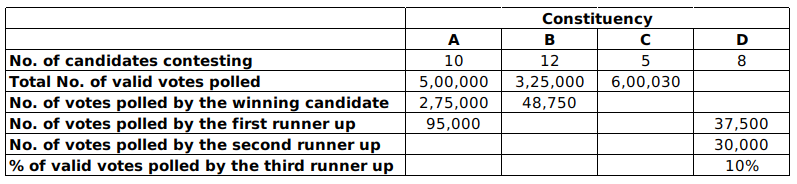
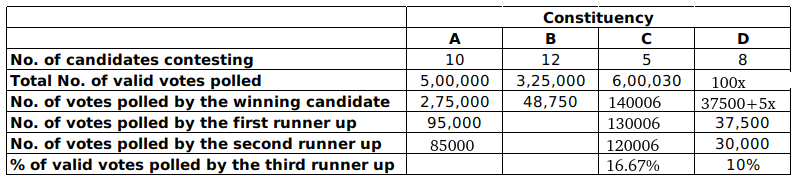
In an election several candidates contested for a constituency. In any constituency, the winning candidate was the one who polled the highest number of votes, the first runner up was the one who polled the second highest number of votes, the second runner up was the one who polled the third highest number of votes, and so on. There were no ties (in terms of number of votes polled by the candidates) in any of the constituencies in this election. In an electoral system, a security deposit is the sum of money that a candidate is required to pay to the election commission before he or she is permitted to contest. Only the defeated candidates (i.e., one who is not the winning candidate) who fail to secure more than one sixth of the valid votes polled in the constituency, lose their security deposits.
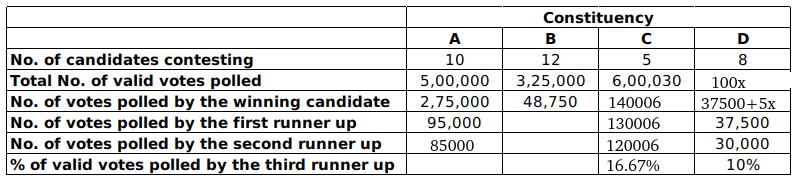
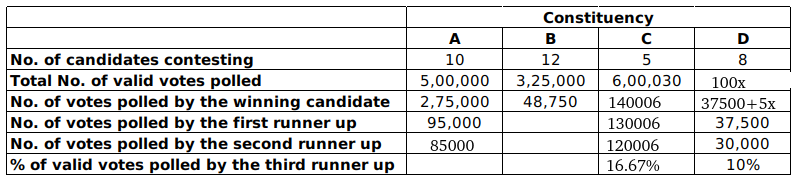
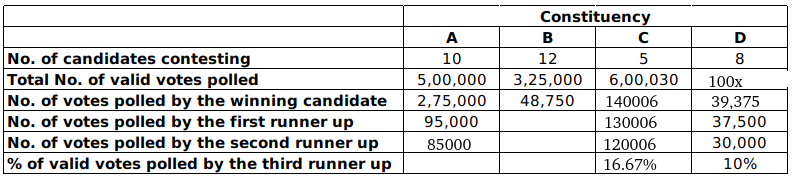
The following table provides some incomplete information about votes polled in four constituencies: A, B, C and D, in this election .

The following additional facts are known:
1. The first runner up polled 10,000 more votes than the second runner up in constituency A.
2. None of the candidates who contested in constituency C lost their security deposit. The difference in votes polled by any pair of candidates in this constituency was at least 10,000.
3. The winning candidate in constituency D polled 5% of valid votes more than that of the first runner up. All the candidates who lost their security deposits while contesting for this constituency, put together, polled 35% of the valid votes.
What is the percentage of votes polled in total by all the candidates who lost their security deposits while contesting for constituency A?
It's given in the question that the first runner up polled 10,000 more votes than the second runner up in constituency A. Now the first runner up has got 95000 votes, hence the second runner up will get 85000 votes.
Now the remaining votes will be 500000-275000-95000-85000=45000
From 2, None of the candidates who contested in constituency C lost their security deposit. The difference in votes polled by any pair of candidates in this constituency was at least 10,000 => the person who got 5th highest votes must have got > 600030/6 => $$\ge$$ 100006. Since it is also given that the difference of votes is $$\ge$$ 10000, the only possible case is winner, 1st runner up, 2nd runner up, 3rd runner up, 4th runner up must have got 140006,130006,120006,110006,100006 respectively which sums upto exactly 600030.
Let the number of votes polled in D be 100x.
From 3, The winning candidate in constituency D must have got 15x+37500
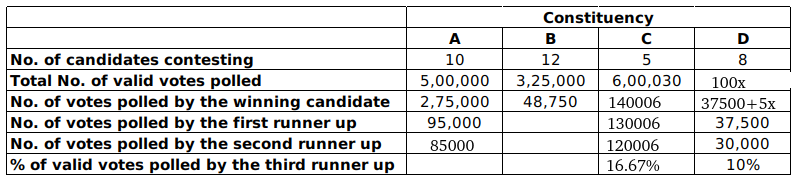
The table now looks like:

Total votes in A = 500000 => the candidates who got $$\le$$ 83333 must have lost their security deposits => candidates till 2nd runner up didn't lose their deposit =>all the candidates who received 500000-275000-95000-85000=45000 lost their deposits.
The percentage of votes polled in total by all the candidates who lost their security deposits while contesting for constituency A = 45000*100/500000 =9%
How many candidates who contested in constituency B lost their security deposit?
It's given in the question that the first runner up polled 10,000 more votes than the second runner up in constituency A. Now the first runner up has got 95000 votes, hence the second runner up will get 85000 votes.
Now the remaining votes will be 500000-275000-95000-85000=45000
From 2, None of the candidates who contested in constituency C lost their security deposit. The difference in votes polled by any pair of candidates in this constituency was at least 10,000 => the person who got 5th highest votes must have got > 600030/6 => $$\ge$$ 100006. Since it is also given that the difference of votes is $$\ge$$ 10000, the only possible case is winner, 1st runner up, 2nd runner up, 3rd runner up, 4th runner up must have got 140006,130006,120006,110006,100006 respectively which sums upto exactly 600030.
Let the number of votes polled in D be 100x.
From 3, The winning candidate in constituency D must have got 5x+37500
The table now looks like:

In constituency B, the mark for not losing the security deposit is 1/6(325000) or 54,167.
But winner himself/herself got < 54167 => all the other candidates lost their security deposits.
11 is the correct answer,
What BEST can be concluded about the number of votes polled by the winning candidate in constituency C?
It's given in the question that the first runner up polled 10,000 more votes than the second runner up in constituency A. Now the first runner up has got 95000 votes, hence the second runner up will get 85000 votes.
Now the remaining votes will be 500000-275000-95000-85000=45000
From 2, None of the candidates who contested in constituency C lost their security deposit. The difference in votes polled by any pair of candidates in this constituency was at least 10,000 => the person who got 5th highest votes must have got > 600030/6 => $$\ge$$ 100006. Since it is also given that the difference of votes is $$\ge$$ 10000, the only possible case is winner, 1st runner up, 2nd runner up, 3rd runner up, 4th runner up must have got 140006,130006,120006,110006,100006 respectively which sums upto exactly 600030.
Let the number of votes polled in D be 100x.
From 3, The winning candidate in constituency D must have got 37500+5x.
The table now looks like:

Number of votes polled to winning candidate must be 140006.
What was the number of valid votes polled in constituency D?
It's given in the question that the first runner up polled 10,000 more votes than the second runner up in constituency A. Now the first runner up has got 95000 votes, hence the second runner up will get 85000 votes.
Now the remaining votes will be 500000-275000-95000-85000=45000
From 2, None of the candidates who contested in constituency C lost their security deposit. The difference in votes polled by any pair of candidates in this constituency was at least 10,000 => the person who got 5th highest votes must have got > 600030/6 => $$\ge$$ 100006. Since it is also given that the difference of votes is $$\ge$$ 10000, the only possible case is winner, 1st runner up, 2nd runner up, 3rd runner up, 4th runner up must have got 140006,130006,120006,110006,100006 respectively which sums upto exactly 600030.
From 3, Let the total votes in D be 100x => The winning candidate in constituency D must have got 37500+5x.
The table now looks like:

The candidates who didn't lose the deposit must have got <16.67% => 3rd runner up must surely didn't get the deposit.
Also, the candidates who got security deposit must have got 65% of votes.
Case I:
Let top three candidates got the security deposit => 37500+5x+37500+30000 =65x => x=1750 => 100x= 175000
Case II:
Let top three candidates got the security deposit => 37500+5x+37500 =65x => 60x = 1250 => x=125000 but 16.66% of 125000 =20834 => 2nd runner up must got security deposit. So, this case is not valid.
The increasing order C will always come after D which is not happening in the third option. Hence that is the correct answer.
The winning margin of a constituency is defined as the difference of votes polled by the winner and that of the first runner up. Which of the following CANNOT be the list of constituencies, in increasing order of winning margin?
It's given in the question that the first runner up polled 10,000 more votes than the second runner up in constituency A. Now the first runner up has got 95000 votes, hence the second runner up will get 85000 votes.
Now the remaining votes will be 500000-275000-95000-85000=45000
From 2, None of the candidates who contested in constituency C lost their security deposit. The difference in votes polled by any pair of candidates in this constituency was at least 10,000 => the person who got 5th highest votes must have got > 600030/6 => $$\ge$$ 100006. Since it is also given that the difference of votes is $$\ge$$ 10000, the only possible case is winner, 1st runner up, 2nd runner up, 3rd runner up, 4th runner up must have got 140006,130006,120006,110006,100006 respectively which sums upto exactly 600030.
From 3, The winning candidate in constituency D must have got 1.05*37500 = 39375.
Let the number of votes polled in D be 100x.
The table now looks like:

As calculated in the previous question, candidate D got 175000 votes. The winner got 5% more votes than first runner up, hence the winner got 0.05*175000 i.e 8750 more votes than first runner up . Thus 8750 is the winning margin for constituency D. Moreover margin in constituency is atleast 10000 . Hence in the increasing order C will always come after D which is not happening in the third option. Hence that is the correct answer.
For all the four constituencies taken together, what was the approximate number of votes polled by all the candidates who lost their security deposit expressed as a percentage of the total valid votes from these four constituencies?
It's given in the question that the first runner up polled 10,000 more votes than the second runner up in constituency A. Now the first runner up has got 95000 votes, hence the second runner up will get 85000 votes.
Now the remaining votes will be 500000-275000-95000-85000=45000
From 2, None of the candidates who contested in constituency C lost their security deposit. The difference in votes polled by any pair of candidates in this constituency was at least 10,000 => the person who got 5th highest votes must have got > 600030/6 => $$\ge$$ 100006. Since it is also given that the difference of votes is $$\ge$$ 10000, the only possible case is winner, 1st runner up, 2nd runner up, 3rd runner up, 4th runner up must have got 140006,130006,120006,110006,100006 respectively which sums upto exactly 600030.
From 3, Let the total votes in D be 100x => The winning candidate in constituency D must have got 37500+5x.
The table now looks like:

The candidates who didn't lose the deposit must have got <16.67% => 3rd runner up must surely didn't get the deposit.
Also, the candidates who got security deposit must have got 65% of votes.
Case I:
Let top three candidates got the security deposit => 37500+5x+37500+30000 =65x => x=1750 => 100x= 175000
Case II:
Let top three candidates got the security deposit => 37500+5x+37500
=65x => 60x = 1250 => x=125000 but 16.66% of 125000 =20834 =>
2nd runner up must got security deposit. So, this case is not valid.
For all the constituencies lets look at the candidates who lost their security deposit.
A (500000-275000-95000-85000)=45000.
B (325000-48750)=276250
C (0) and D (61250)=175000-46250-30000-37500
Hence percentage will be 382500/1600000× 100=23.91%
Twenty five coloured beads are to be arranged in a grid comprising of five rows and five columns. Each cell in the grid must contain exactly one bead. Each bead is coloured either Red, Blue or Green. While arranging the beads along any of the five rows or along any of the five columns, the rules given below are to be followed:
1. Two adjacent beads along the same row or column are always of different colours.
2. There is at least one Green bead between any two Blue beads along the same row or column.
3. There is at least one Blue and at least one Green bead between any two Red beads along the same row or column.
Every unique, complete arrangement of twenty five beads is called a configuration.
The total number of possible configurations using beads of only two colours is:
Since we are required to use only two colours, these can be either
1. Green + Blue
2. Blue + Red
3. Green + Red
But we know that Between any two Red coloured beads in a row or a column, there have to be both a Green and a Blue coloured bead. Hence without both Green and Blue, Red beads cannot be used to fill the grid.Thus if we use only Green and Blue beads, the two configurations that are possible are:
There are only 2 configurations possible
What is the maximum possible number of Red beads that can appear in any configuration?

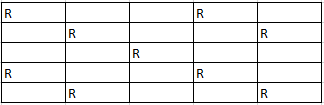
Maximum 9 red beads are possible as shown here
What is the minimum number of Blue beads in any configuration?
To solve this question we can use the answer of the previous question, since maximum 9 red beads are possible, filling the remaining space with green and blue beads, in such a way that number of blue beads is minimised
Hence number of blue beads is 6
Two Red beads have been placed in ‘second row, third column’ and ‘third row, second column’. How many more Red beads can be placed so as to maximise the number of Red beads used in the configuration?
6 more beads can be placed as shown
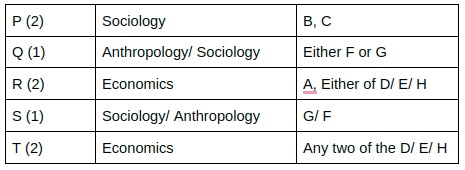
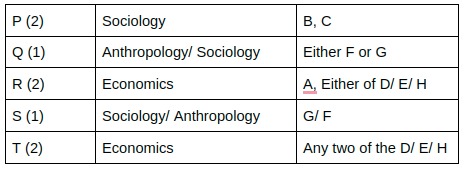
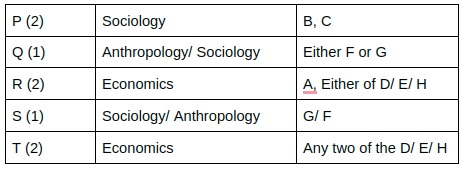
The Humanities department of a college is planning to organize eight seminars, one for each of the eight doctoral students - A, B, C, D, E, F, G and H. Four of them are from Economics, three from Sociology and one from Anthropology department. Each student is guided by one among P, Q, R, S and T. Two students are guided by each of P, R and T, while one student is guided by each of Q and S. Each student is guided by a guide belonging to their department. Each seminar is to be scheduled in one of four consecutive 30-minute slots starting at 9:00 am, 9:30 am, 10:00 am and 10:30 am on the same day. More than one seminars can be scheduled in a slot, provided the guide is free. Only three rooms are available and hence at the most three seminars can be scheduled in a slot. Students who are guided by the same guide must be scheduled in consecutive slots.
The following additional facts are also known.
1. Seminars by students from Economics are scheduled in each of the four slots.
2. A’s is the only seminar that is scheduled at 10:00 am. A is guided by R.
3. F is an Anthropology student whose seminar is scheduled at 10:30 am.
4. The seminar of a Sociology student is scheduled at 9:00 am.
5. B and G are both Sociology students, whose seminars are scheduled in the same slot. The seminar of an Economics student, who is guided by T, is also scheduled in the same slot.
6. P, who is guiding both B and C, has students scheduled in the first two slots.
7. A and G are scheduled in two consecutive slots.
Which one of the following statements is true?
Let's look at all the students we have A,B,C,D,E,F,G,H. The guides are P,Q,R,S,T and they mentor 2,1,2,1,2 students respectively.
Slots are 9:00,9:30,10:00,10:30 . Moreover economics, sociology and anthropology have 4,3,1 students respectively.
Now from 5th statement, two sociology seminars and economics seminars are held in the same slot. This will not take place at 10:00(only one seminar is scheduled at 10:00), this will also not take place at 10:30( An anthropology seminar is scheduled at 10:30 and maximum three seminars are scheduled in a slot. Hence this will happen at either 9 or 9:30. Now from (7) A and G are scheduled in consecutive slots. A is scheduled at 10:00. Hence G will be scheduled at 9:30. SO from (5), there will be three students having their seminars at 9:30.
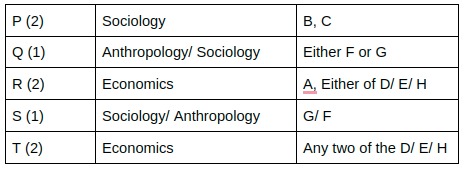
Combining this data with the remaining points we get the following table

Moreover we do know that students having same subject are scheduled in consecutive slots. So we get
Here we can see that two seminars are scheduled in first slot.
Who all are NOT guiding any Economics students?
Let's look at all the students we have A,B,C,D,E,F,G,H. The guides are P,Q,R,S,T and they mentor 2,1,2,1,2 students respectively.
Slots are 9:00,9:30,10:00,10:30 . Moreover economics, sociology and anthropology have 4,3,1 students respectively.
Now from 5th statement, two sociology seminars and economics seminars are held in the same slot. This will not take place at 10:00(only one seminar is scheduled at 10:00), this will also not take place at 10:30( An anthropology seminar is scheduled at 10:30 and maximum three seminars are scheduled in a slot. Hence this will happen at either 9 or 9:30. Now from (7) A and G are scheduled in consecutive slots. A is scheduled at 10:00. Hence G will be scheduled at 9:30. SO from (5), there will be three students having their seminars at 9:30.
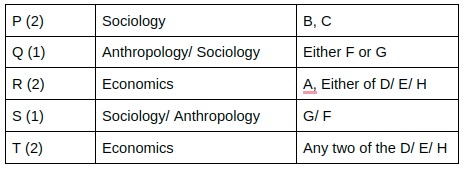
Combining this data with the remaining points we get the following table

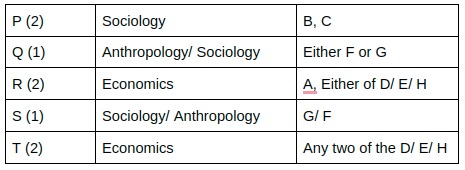
Moreover we do know that students having same subject are scheduled in consecutive slots. So we get
As we can see from the above table, P,Q and S are not guiding any economics student
Which of the following statements is necessarily true?

As we can clearly say from here that H/D/E are all economics students. Hence Option B is definitely correct
If D is scheduled in a slot later than Q's, then which of the following two statement(s) is(are) true?
(i) E and H are guided by T.
(ii) G is guided by Q.

Now D is scheduled in a slot later than Q. Q can mentor only F or G, but obviously he can't mentor F because F is in the last slot, hence Q will mentor G. In that scenario D has to take the 10:30 slot which means D will be mentored by R and E/H will be mentored by T. So statement 1 and statement 2 both are correct.
If E and Q are both scheduled in the same slot, then which of the following statements BEST describes the relationship between D, H, and T?

If E and Q are scheduled in the same slot, they both can be in the last slot. In that case E will be guided by R and both D and H will be guided by T. Moreover if they are in the second slot, E will be guided by T and atleast one of D and H will be guided by T. Hence option (c) is correct
If D is scheduled in the slot immediately before Q’s, then which of the following is NOT necessarily true?

Now D is scheduled in the slot immediately before Q. In that case Q will be in the 9:30 slot and D will be in the 9:00 am slot. Hence D will be mentored by T and one of E/H will be mentored by R and the other by T. Obviously E is guided by R is not necessarily true as he can be mentored by T also.
A shopping mall has a large basement parking lot with parking slots painted in it along a single row. These slots are quite narrow; a compact car can fit in a single slot but an SUV requires two slots. When a car arrives, the parking attendant guides the car to the first available slot from the beginning of the row into which the car can fit.
For our purpose, cars are numbered according to the order in which they arrive at the lot. For example, the first car to arrive is given a number 1, the second a number 2, and so on. This numbering does not indicate whether a car is a compact or an SUV. The configuration of a parking lot is a sequence of the car numbers in each slot. Each single vacant slot is represented by letter V.
For instance, suppose cars numbered 1 through 5 arrive and park, where cars 1, 3 and 5 are compact cars and 2 and 4 are SUVs. At this point, the parking lot would be described by the sequence 1, 2, 3, 4, 5. If cars 2 and 5 now vacate their slots, the parking lot would now be described as 1, V, V, 3, 4. If a compact car (numbered 6) arrives subsequently followed by an SUV (numbered 7), the parking lot would be described by the sequence 1, 6, V, 3, 4, 7.
Answer the following questions INDEPENDENTLY of each other.
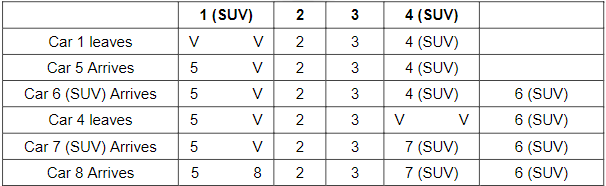
Initially cars numbered 1, 2, 3, and 4 arrive among which 1 and 4 are SUVs while 2 and 3 are compact cars. Car 1 then leaves, followed by the arrivals of car 5 (a compact car) and car 6 (an SUV). Car 4 then leaves. Then car 7 (an SUV) and car 8 (a compact car) arrive. At this moment, which among the following numbered car is parked next to car 3?
following is the order of arrival and departure of cars

As we can see that car 2 and car 7 are parked next to car 3
Suppose eight cars have arrived, of which two have left. Also suppose that car 4 is a compact and car 7 is an SUV. Which of the following is a POSSIBLE current configuration of the parking lot?
Let's look at option 4.
Order of cars is 8,2,3,V,5,6,7. This sequence is easily possible.
Let's say cars 1,2,3,4,5,6,7 arrive one after the another.
Now Car 1 leaves and Car 8 takes that place.
Finally Car 4 leaves. Hence we can see that this combination of cars is possible
Suppose the sequence at some point of time is 4, 5, 6, V, 3. Which of the following is NOT necessarily true?
The original sequence as given in the question is 4,5,6,V,3
This is possible when cars 1,2,3 arrived and then cars 1 and 2 leave. After that cars 4,5 and 6 arrive.
Now there are 4 slots to the left of car 3. This is only possible when cars 1 and 2 were SUVs. Now out of these 4 slots,
3 slots are occupied by cars 4,5 and 6. As a result these are compact cars . Car 3 can be a SUV or a Compact car and it won't impact the final solution.
Suppose that car 4 is not the first car to leave and that the sequence at a time between the arrival of the car 7 and car 8 is V, 7, 3, 6, 5. Then which of the following statements MUST be false?
Here we can see that cars 3 and 5 are still in their position. Thus car 4 was not the first car to leave, either 1 or 2 left before 4. Let's say only car 2 left before car 4. Now supposingly if car 2 is an SUV, car 6 was parked in that lot. Thus car 2 and car 7 are compact cars. Option 4 is correct.
The distance from B to C is thrice that from A to B. Two trains travel from A to C via B. The speed of train 2 is double that of train 1 while traveling from A to B and their speeds are interchanged while traveling from B to C. The ratio of the time taken by train 1 to that taken by train 2 in travelling from A to C is
Let the distance from A to B be "x", then the distance from B to C will be 3x. Now the speed of Train 2 is double of Train 1. Let the speed of Train 1 be "v", then the speed of Train 2 will be "2v" while travelling from A to B.
Time taken by Train 1 = (x/v)
Time taken by Train 2 = (x/2v)
Now from B to C distance is "3x" and the speed of Train 2 is (v) and the speed of Train 1 is (2v).
Time taken by Train 1 = 3x/2v
Time taken by Train 2 = 3x/v
Total time taken by Train 1 = x/v(1+(3/2)) = (5/2)(x/v)
Total time taken by Train 2 = x/v(3+(1/2))= (7/2)(x/v)
Ratio of time taken = $$\frac{5}{\frac{2}{\frac{7}{2}}}=\frac{5}{7}$$
John takes twice as much time as Jack to finish a job. Jack and Jim together take one-thirds of the time to finish the job than John takes working alone. Moreover, in order to finish the job, John takes three days more than that taken by three of them working together. In how many days will Jim finish the job working alone?
Let Jack take "t" days to complete the work, then John will take "2t" days to complete the work. So work done by Jack in one day is (1/t) and John is (1/2t) .
Now let Jim take "m" days to complete the work. According to question, $$\frac{1}{t}+\frac{1}{m}=\frac{3}{2t}\ or\ \frac{1}{m}=\frac{1}{2t\ }or\ m=2t$$ Hence Jim takes "2t" time to complete the work.
Now let the three of them complete the work in "p" days. Hence John takes "p+3" days to complete the work.
$$\frac{1}{2t}\left(m+3\right)=\left(\frac{4}{2t}\right)m$$
or m=1. Hence JIm will take (1+3)=4 days to complete the work. Similarly John will also take 4 days to complete the work
Let $$f(x)=x^{2}+ax+b$$ and $$g(x)=f(x+1)-f(x-1)$$. If $$f(x)\geq0$$ for all real x, and $$g(20)=72$$. then the smallest possible value of b is
$$f\left(x\right)=\ x^2+ax+b$$
$$f\left(x+1\right)=x^2+2x+1+ax+a+b$$
$$f\left(x-1\right)=x^2-2x+1+ax-a+b$$
$$ g(x)=f(x+1)-f(x-1)= 4x+2a$$
Now $$g(20) = 72$$ from this we get $$a = -4$$ ; $$f\left(x\right)=x^2-4x\ +b$$
For this expression to be greater than zero it has to be a perfect square which is possible for $$b\ge\ 4$$
Hence the smallest value of 'b' is 4.
For the same principal amount, the compound interest for two years at 5% per annum exceeds the simple interest for three years at 3% per annum by Rs 1125. Then the principal amount in rupees is
For two years the compound interest is $$\frac{PR(1)}{100}+\frac{PR(1)}{100}\left(1+\frac{PR(1)}{100}\right)$$
For three years the simple interest is $$\frac{9PR}{100}$$
Now R(1)= 5% and R=3%
Hence $$\frac{5P}{100}+\frac{5P}{100}\left(1.05\right)-\frac{9P}{100}=1125$$
$$\frac{-4P}{100}+\frac{5.25P}{100}=1125$$
$$\frac{1.25P}{100}=1125$$
Solving we get P= 90000
Let C be a circle of radius 5 meters having center at O. Let PQ be a chord of C that passes through points A and B where A is located 4 meters north of O and B is located 3 meters east of O. Then, the length of PQ, in meters, is nearest to
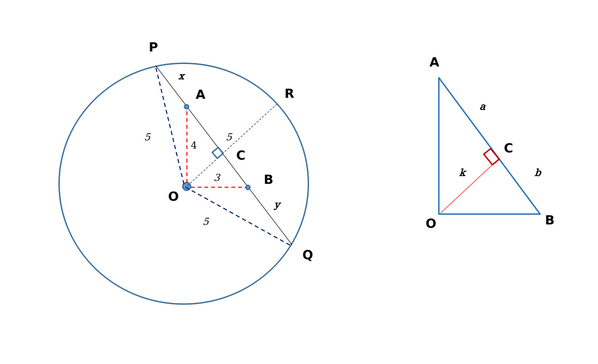
We can form the following figure based on the given information:
Since OA = 4 m and OB=3 m; AB = 5 m. OR bisects the chord into PC and QC.
Since AB = 5 m, we have $$a+b = 5 ...(i)$$ Also, $$4^2\ -k^2=a^2...\left(ii\right)$$ and $$3^2\ -k^2=b^2...\left(iii\right)$$
Subtracting (iii) from (ii), we get: $$a^2\ -b^2=7...\left(iv\right)$$
Substituting (i) in (iv), we get $$a - b = 1.4 ...(v)$$; $$\left[\left(a+b\right)\left(a\ -b\right)=7;\ \therefore\ \left(a-b\right)=\frac{7}{5}\right]$$
Solving (i) and (v), we obtain the value of $$a=3.2$$ and $$b=1.8$$
Hence, $$k^2\ =\ 5.76$$
Moving on to the larger triangle $$\triangle\ POC$$, we have $$5^2-k^2=\left(x+a\right)^2$$;
Substituting the previous values, we get: $$(25-5.76)=\left(x+3.2\right)^2$$
$$\sqrt{19.24}=\left(x+3.2\right)$$ or $$x = 1.19 m$$
Similarly, solving for y using $$\triangle\ QOC$$, we get $$y=2.59 m$$
Therefore, $$PQ = 5+2.59+1.19 = 8.78 \approx\ 8.8 m$$
Hence, Option A is the correct answer.
In a car race, car A beats car B by 45 km. car B beats car C by 50 km. and car A beats car C by 90 km. The distance (in km) over which the race has been conducted is
Now car A beats car B by 45km. Let the speed of car A be v(a) and speed of car B be v(b).
$$\frac{v\left(a\right)}{v\left(b\right)}=\frac{m}{m-45}$$ .....(1)where '"m" is the entire distance of the race track.
Moreover $$\frac{v\left(b\right)}{v\left(c\right)}=\frac{m}{m-50}$$.......(2)
and finally $$\frac{v\left(a\right)}{v\left(c\right)}=\frac{m}{m-90}$$......(3)
Multiplying (1) and (2) we get (3). $$\frac{m}{m-90}=\frac{m}{m-45}\left(\frac{m}{m-50}\right)$$
Solving we get m=450 which is the length of the entire race track
How many 4-digit numbers, each greater than 1000 and each having all four digits distinct, are there with 7 coming before 3?
Here there are two cases possible
Case 1: When 7 is at the left extreme
In that case 3 can occupy any of the three remaining places and the remaining two places can be taken by (0,1,2,4,5,6,8,9)
So total ways 3(8)(7)= 168
Case 2: When 7 is not at the extremes
Here there are 3 cases possible. And the remaining two places can be filled in 7(7) ways.(Remember 0 can't come on the extreme left)
Hence in total 3(7)(7)=147 ways
Total ways 168+147=315 ways
The sum of the perimeters of an equilateral triangle and a rectangle is 90cm. The area, T, of the triangle and the area, R, of the rectangle, both in sq cm, satisfying the relationship $$R=T^{2}$$. If the sides of the rectangle are in the ratio 1:3, then the length, in cm, of the longer side of the rectangle, is
Let the sides of the rectangle be "a" and "3a" m. Hence the perimeter of the rectangle is 8a.
Let the side of the equilateral triangle be "m" cm. Hence the perimeter of the equilateral triangle is "3m" cm. Now we know that 8a+3m=90......(1)
Moreover area of the equilateral triangle is $$\frac{\sqrt{\ 3}}{4}m^2$$ and area of the rectangle is $$3a^2$$
According to the relation given $$\left(\frac{\sqrt{\ 3}}{4}m^2\right)^{^2}=\ 3a^2$$
$$\frac{3}{16}m^4=\ 3a^2\ or\ a^2=\frac{m^4}{16}$$
$$a=\frac{m^2}{4}$$
Substituting this in (1) we get $$2m^2+3m-90\ =0$$ solving this we get m=6 (ignoring the negative value since side can't be negative)
Hence a=9 and the longer side of the rectangle will be 3a=27cm
A sum of money is split among Amal, Sunil and Mita so that the ratio of the shares of Amal and Sunil is 3:2, while the ratio of the shares of Sunil and Mita is 4:5. If the difference between the largest and the smallest of these three shares is Rs.400, then Sunil’s share, in rupees, is
Let the amount of money with Amal and Sunil be 6x and 4x. Now the amount of money with Mita be 5x. Difference between the largest and smallest amount is ₹400 i.e. 6x-4x=400 or 2x=400 or x=200 . Amount of money with Sunil is 200(4)=₹800
The value of $$\log_{a}({\frac{a}{b}})+\log_{b}({\frac{b}{a}})$$, for $$1<a\leq b$$ cannot be equal to
On expanding the expression we get $$1-\log_ab+1-\log_ba$$
$$or\ 2-\left(\log_ab+\frac{1}{\log_ab}\right)$$
Now applying the property of AM>=GM, we get that $$\frac{\left(\log_ab+\frac{1}{\log_ab}\right)}{2}\ge1\ or\ \left(\log_ab+\frac{1}{\log_ab}\right)\ge2$$ Hence from here we can conclude that the expression will always be equal to 0 or less than 0. Hence any positive value is not possible. So 1 is not possible.
Students in a college have to choose at least two subjects from chemistry, mathematics and physics. The number of students choosing all three subjects is 18, choosing mathematics as one of their subjects is 23 and choosing physics as one of their subjects is 25. The smallest possible number of students who could choose chemistry as one of their subjects is
Now 23 students choose maths as one of their subject.
This means (MPC)+ (MC) + (PC)=23 where MPC denotes students who choose all the three subjects maths, physics and chemistry and so on.
So MC + PM =5 Similarly we have PC+ MP =7
We have to find the smallest number of students choosing chemistry
For that in the first equation let PM=5 and MC=0. In the second equation this PC=2
Hence minimum number of students choosing chemistry will be (18+2)=20 Since 18 students chose all the three subjects.
In a group of 10 students, the mean of the lowest 9 scores is 42 while the mean of the highest 9 scores is 47. For the entire group of 10 students, the maximum possible mean exceeds the minimum possible mean by
Let x(1) be the least number and x(10) be the largest number. Now from the condition given in the question , we can say that
x(2)+x(3)+x(4)+........x(10)= 47*9=423...................(1)
Similarly x(1)+x(2)+x(3)+x(4)................+x(9)= 42*9=378...............(2)
Subtracting both the equations we get x(10)-x(1)=45
Now, the sum of the 10 observations from equation (1) is 423+x(1)
Now the minimum value of x(10) will be 47 and the minimum value of x(1) will be 2 . Hence minimum average 425/10=42.5
Maximum value of x(1) is 42. Hence maximum average will be 465/10=46.5
Hence difference in average will be 46.5-42.5=4 which is the correct answer
A and B are two points on a straight line. Ram runs from A to B while Rahim runs from B to A. After crossing each other. Ram and Rahim reach their destination in one minute and four minutes, respectively. if they start at the same time, then the ratio of Ram's speed to Rahim's speed is
Let the speed of Ram be v(r) and the speed of Rahim be v(h) respectively. Let them meet after time "t" from the beginning.
Hence Ram will cover v(r)(t) during that time and Rahim will cover v(h)t respectively.
Now after meeting Ram reaches his destination in 1 min i.e. Ram covered v(h)t in 1 minute or v(r)(1)= v(h)(t)
Similarly Rahim reaches his destination in 4 min i.e. Rahim covered v(r)t in 4 minutes or v(h)(4)= v(r)(t)
Dividing both the equations we get $$\frac{v\left(r\right)}{4v\left(h\right)}=\frac{v\left(h\right)}{v\left(r\right)}\ or\ \frac{v\left(r\right)}{v\left(h\right)}=2$$ Hence the ratio is 2.
Two circular tracks T1 and T2 of radii 100 m and 20 m, respectively touch at a point A. Starting from A at the same time, Ram and Rahim are walking on track T1 and track T2 at speeds 15 km/hr and 5 km/hr respectively. The number of full rounds that Ram will make before he meets Rahim again for the first time is
To complete one round Ram takes 100m/15kmph and Rahim takes 20m/5kmph
They meet for the first time after L.C.M of (100m/15kmph , 20m/5kmph) = 100m/5kmph=20m/kmph.
Distance traveled by Ram =20m/kmph * 15kmph =300m.
So, he must have ran 300/100=3 rounds.
Note:
CAT gave both 2 and 3 as correct answers because of the word 'before'.
Let C1 and C2 be concentric circles such that the diameter of C1 is 2cm longer than that of C2. If a chord of C1 has length 6cm and is a tangent to C2, then the diameter, in cm, of C1 is
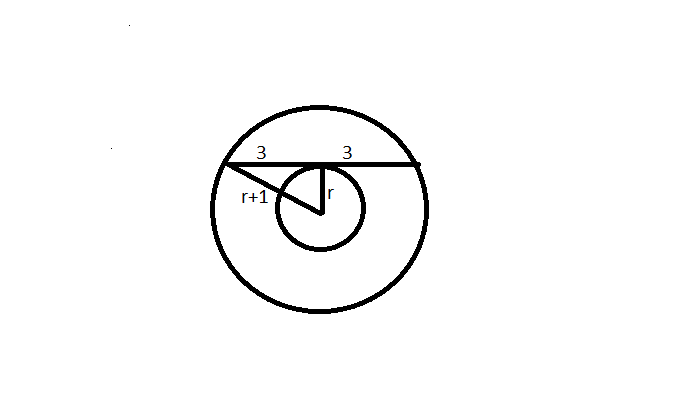
Now we know that the perpendicular from the centre to a chord bisects the chord. Hence at the point of intersection of tangent, the chord will be divided into two parts of 3 cm each. As you can clearly see in the diagram, a right angled triangle is formed there.
Hence $$\left(r+1\right)^2=r^2+9$$ or $$r^{2\ }+1+2r\ =\ r^2+9\ or\ 2r=8\ or\ r=4cm$$
Hence the radius of the larger circle is 5cm and diameter is 10cm.
Anil buys 12 toys and labels each with the same selling price. He sells 8 toys initially at 20% discount on the labeled price. Then he sells the remaining 4 toys at an additional 25% discount on the discounted price. Thus, he gets a total of Rs 2112, and makes a 10% profit. With no discounts, his percentage of profit would have been
Let the CP of the each toy be "x". CP of 12 toys will be "12x". Now the shopkeeper made a 10% profit on CP. This means that
12x(1.1)= 2112 or x=160 . Hence the CP of each toy is ₹160.
Now let the SP of each toy be "m". Now he sold 8 toys at 20% discount. This means that 8m(0.8) or 6.4m
He sold 4 toys at an additional 25% discount. 4m(0.8)(0.75)=2.4m Now 6.4m+2.4m=8.8m=2112 or m=240
Hence CP= 160 and SP=240. Hence profit percentage is 50%.
The number of integers that satisfy the equality $$(x^{2}-5x+7)^{x+1}=1$$ is
$$\left(x^2-5x+7\right)^{x+1}=1$$
There can be a solution when $$\left(x^2-5x+7\right)=1$$ or $$x^2-5x\ +6=0$$
or x=3 and x=2
There can also be a solution when x+1 = 0 or x=-1
Hence three possible solutions exist.
The number of pairs of integers $$(x,y)$$ satisfying $$x\geq y\geq-20$$ and $$2x+5y=99$$
We have 2x + 5y = 99 or $$x=\frac{\left(99-5y\right)}{2}$$
Now $$x\ge\ y\ \ge\ -20$$ ; So $$\frac{\left(99-5y\right)}{2}\ge\ y\ ;\ 99\ge7y\ or\ y\le\ \approx\ 14$$
So $$-20\le y\le14$$. Now for this range of "y", we have to find all the integral values of "x". As the coefficient of "x" is 2,
then (99 - 5y) must be even, which will happen when "y" is odd. However, there are only 17 odd values of "y" be -20 and 14.
Hence the number of possible values is 17.
From an interior point of an equilateral triangle, perpendiculars are drawn on all three sides. The sum of the lengths of the three perpendiculars is s. Then the area of the triangle is

Based on the question: AD, CE and BF are the three altitudes of the triangle. It has been stated that {GD+GE+GF = s}
Now since the triangle is equilateral, let the length of each side be "a". So area of triangle will be
$$\frac{1}{2}\times\ GD\times\ a+\ \frac{1}{2}\times\ GE\times\ a\ +\frac{1}{2}\times\ GF\times\ a=\frac{\sqrt{\ 3}}{4}a^2$$
Now $$GD+GE+GF=\frac{\sqrt{\ 3}a}{2}$$ or $$s=\frac{\sqrt{\ 3}a}{2}\ or\ a=\frac{2s}{\sqrt{\ 3}}$$
Given the area of the equilateral triangle = $$\ \frac{\sqrt{3}}{4}a^2\ $$ ; substituting the value of 'a' from above, we get the area {in terms 's'}= $$\frac{s^2}{\sqrt{3}}$$
Let the m-th and n-th terms of a geometric progression be $$\frac{3}{4}$$ and 12. respectively, where $$m < n$$. If the common ratio of the progression is an integer r, then the smallest possible value of $$r + n - m$$ is
Let the first term of the GP be "a" . Now from the question we can show that
$$ar^{m-1}=\frac{3}{4}$$ $$ar^{n-1}=12$$
Dividing both the equations we get $$r^{m-1-n+1}=\frac{1}{16}\ or\ r^{m-n}=16^{-1\ }or\ r^{n-m}=16$$
So for the minimum possible value we take Now give minimum possible value to "r" i.e -4 and n-m=2
Hence minimum possible value of r+n-m=-4+2=-2
In May, John bought the same amount of rice and the same amount of wheat as he had bought in April, but spent ₹ 150 more due to price increase of rice and wheat by 20% and 12%, respectively. If John had spent ₹ 450 on rice in April, then how much did he spend on wheat in May?
Let John buy "m" kg of rice and "p" kg of wheat.
Now let the price of rice be "r" in April. Price in May will be "1.2(r)"
Now let the price of wheat be "w" in April . Price in April will be "1.12(w)".
Now he spent ₹150 more in May , so 0.2(rm)+0.12(wp)=150
Its also given that he had spent ₹450 on rice in April. So (rm)=450
So 0.2(rm)= (0.2)(450)=90 Substituting we get (wp)=60/0.12 or (wp)=500
Amount spent on wheat in May will be 1.12(500)=₹560
If x and y are non-negative integers such that $$x + 9 = z$$, $$y + 1 = z$$ and $$x + y < z + 5$$, then the maximum possible value of $$2x + y$$ equals
We can write x=z-9 and y=z-1 Now we have x+y< z+5
Substituting we get z-9+z-1<z+5 or z<15
Hence the maximum possible value of z is 14
Maximum value of "x" is 5 and maximum value of "y" is 13
Now 2x+y = 10+13=23
Aron bought some pencils and sharpeners. Spending the same amount of money as Aron, Aditya bought twice as many pencils and 10 less sharpeners. If the cost of one sharpener is ₹ 2 more than the cost of a pencil, then the minimum possible number of pencils bought by Aron and Aditya together is
Let the number of pencils bought by Aron be "p" and the cost of each pencil be "a".
Let the number of sharpeners bought Aron be "s" and the cost of each sharpener be "b".
Now amount spent by Aron will be (pa)+(sb)
Aditya bought (2p) pencils and (s-10) sharpeners. Amount spent will be (2pa)+(s-10)b
Amount spent in both the cases is same
pa + sb = 2pa + (s-10)b or pa=10b
Now its given in the question that cost of sharpener is 2 more than pencil i.e. b=a+2
pa= 10a+20 or a=20/(p-10)
Now the number of pencils has to be minimum, for that we have to find smallest "p" such that both "p" and "a" are integers. The smallest such value is p=11 . Total number of pencils bought will be p+2p=11+22=33
For real x, the maximum possible value of $$\frac{x}{\sqrt{1+x^{4}}}$$ is
Now $$\frac{x}{\sqrt{\ 1+x^4}}=\ \frac{\ 1}{\sqrt{\ \ \frac{\ 1+x^4}{x^2}}}=\frac{1}{\sqrt{\ \frac{1}{x^2}+x^2}}$$
Applying A.M>= G.M.
$$\frac{\left(\frac{1}{x^2}+x^2\right)}{2}\ge\ 1\ or\ \ \frac{1}{x^2}+x^2\ge\ 2$$ Substituting we get the maximum possible value of the equation as $$\frac{1}{\sqrt{\ 2}}$$
In how many ways can a pair of integers (x , a) be chosen such that $$x^{2}-2\mid x\mid+\mid a-2\mid=0$$ ?
$$x^{2}-2\mid x\mid+\mid a-2\mid=0$$
where x>= 0 and x>=2
$$x^2-2x+a-2\ =0$$ Using quadratic equation we have $$x=\ 1+\sqrt{\ 3-a}\ and\ x=1-\sqrt{\ 3-a}$$ Only two integer values are possible
a=2 and a=3. So corresponding "x" values are x=1 and a=3, x=2 and a=2, x=0 and a=2
where x>=0 and x<2
Applying the above process we get x=1 and a=1
where x<0 and x>=2 we get a=3 and x=-1 , a=2 and x=-2
where x<0 and x<2 we get a=1 and x=-1
Hence there are total 7 values possible
if x and y are positive real numbers satisfying $$x+y=102$$, then the minimum possible valus of $$2601(1+\frac{1}{x})(1+\frac{1}{y})$$ is
Now we have $$2601\left(1+\frac{1}{x}\right)\left(1+\frac{1}{y}\right)=2601\left(\frac{xy+y+x+1}{xy}\right)$$
Now we know that x+y=102. Substituting it in the above equation
$$2601\left(\frac{xy+y+x+1}{xy}\right)=2601\left(\frac{103}{xy}+1\right)$$
Maximum value of xy can be found out by AM>= GM relationship
$$\ \frac{\ x+y}{2}\ge\ \sqrt{xy}\ or\ \ \sqrt{\ xy}\le\ 51\ or\ xy\le\ 2601$$
Hence the maximum value of "xy" is 2601. Substituting in the above equation we get
$$2601\left(\ \frac{\ 103+2601}{2601}\right)=2704$$
Educational materials for CAT preparation