Hello sir in RC I can usually eliminate two options, but choosing between the remaining two is where I get stuck. Do you have any tips or strategies for handling this
Hello sir in RC I can usually eliminate two options, but choosing between the remaining two is where I get stuck. Do you have any tips or strategies for handling this
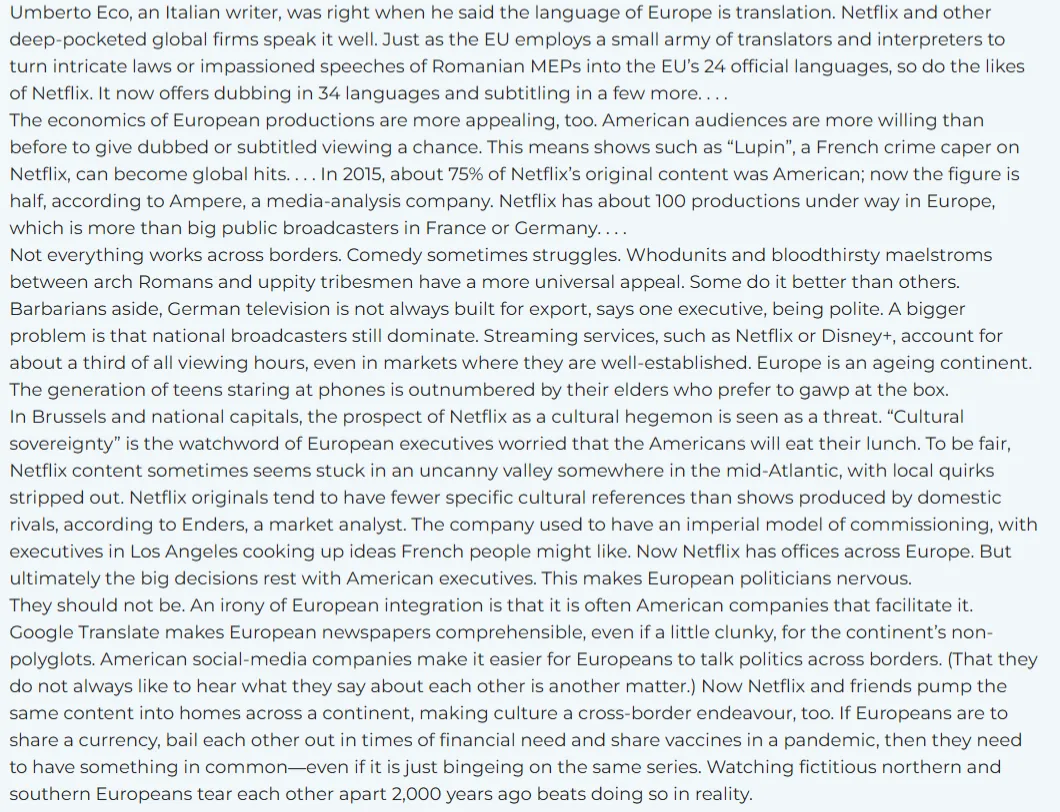
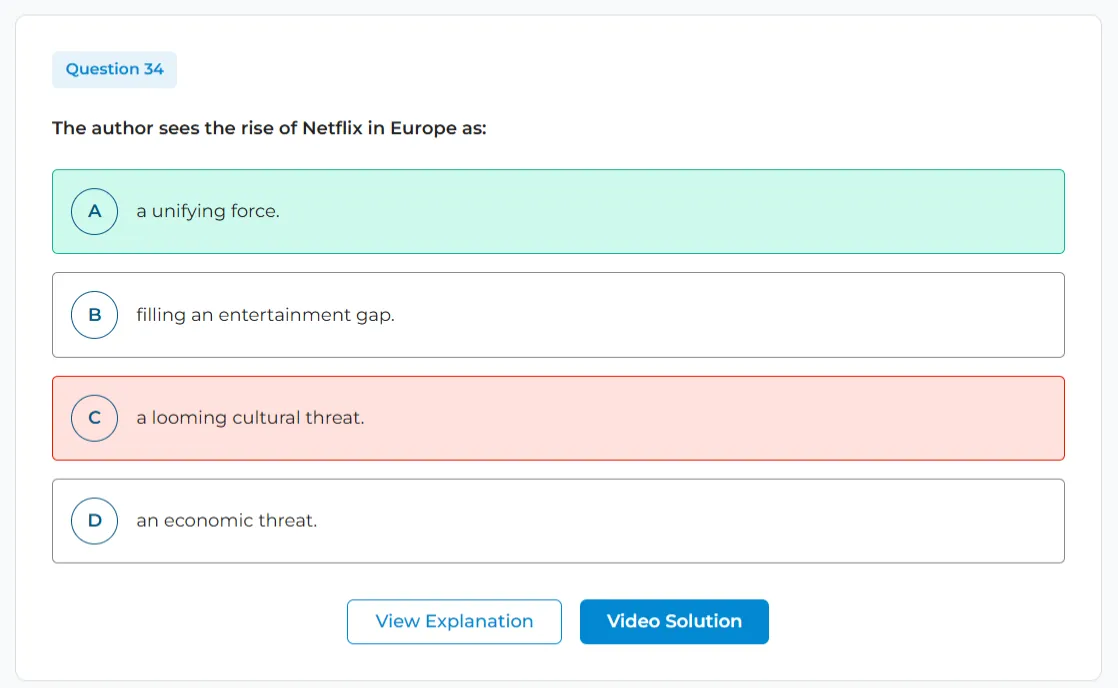
1. In ques 34, taking reference of the line, "In Brussels and national capitals, the prospect of Netflix as a cultural hegemon is seen as a threat. “Cultural sovereignty” is the watchword of European executives worried that the Americans will eat their lunch." won't give an idea that Netflix is perceived as threat to culture. And can't the answer be opt (c) .??
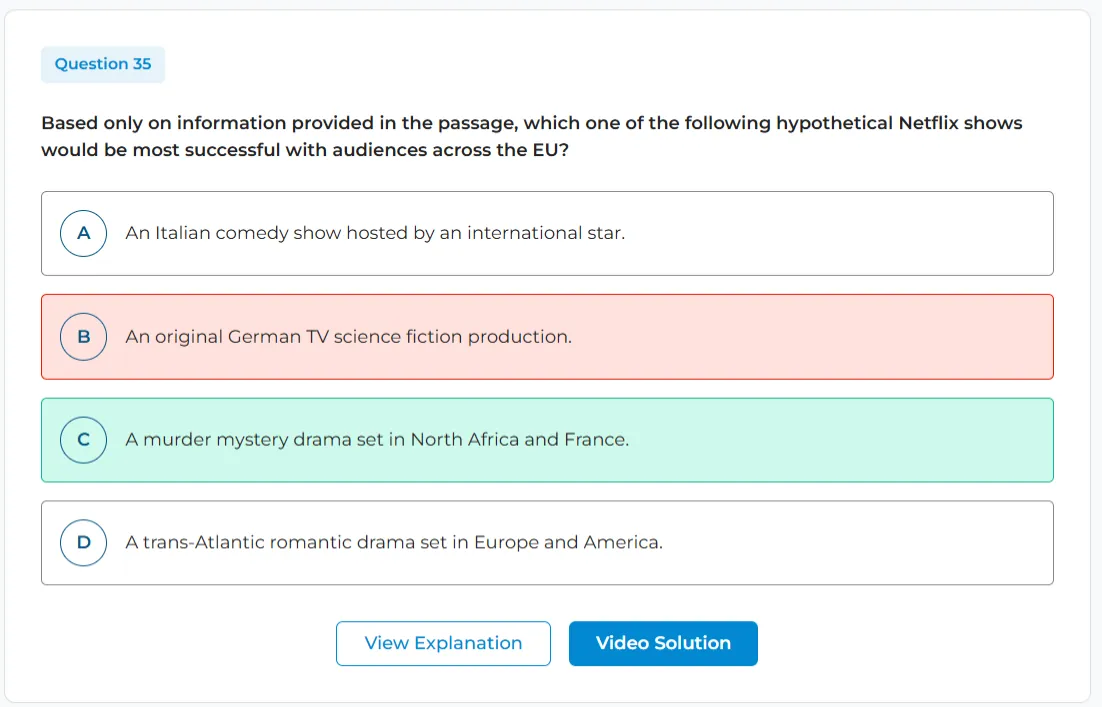
2. In ques 35, taking the reference of passage, isn't it true that content original to the native region are more viewed among the local people. So can't opt (b) be right..??
Hello, so there's this idk problem i have been facing recently where during the actual VARC sectional or mock attempt i don't seem to understand the passage very well and even the options seem alien at times, but when analyzing the same attempt without even re-reading the passage attempting the ones i did not attempt or the ones i got wrong I'm able to get it right most of the times. I don't exactly understand what might be causing this. May i please know what I might be doing wrong and/or how can I fix this? Thank you. Regards
Hi, my score in VARC is not improving. Mainly, RC accuracy is very low, so even if I manage to attempt 3 RCs + 5 VA, 8-9 questions get wrong & that drops my score. I tried to attempt only 2 RC with proper time – that also didn't improve my accuracy much. I try my best to do option elimination, but I think sometimes I overthink too much in an option – eventually scoring me negative. I want to know how the English-background people do. What's the approach? And what attempt breakdown will be ideal for me?
The passage below is accompanied by four questions. Based on the passage, choose the best answer for each question. In 2006, the Met [art museum in the US] agreed to return the Euphronios krater, a masterpiece Greek urn that had been a museum draw since 1972. In 2007, the Getty [art museum in the US] agreed to return 40 objects to Italy, including a marble Aphrodite, in the midst of looting scandals. And in December, Sotheby's and a private owner agreed to return an ancient Khmer statue of a warrior, pulled from auction two years before, to Cambodia.
Cultural property, or patrimony, laws limit the transfer of cultural property outside the source country's territory, including outright export prohibitions and national ownership laws. Most art historians, archaeologists, museum officials and policymakers portray cultural property laws in general as invaluable tools for counteracting the ugly legacy of Western cultural imperialism.
During the late 19th and early 20th century — an era former Met director Thomas Hoving called "the age of piracy" — American and European art museums acquired antiquities by hook or by crook, from grave robbers or souvenir collectors, bounty from digs and ancient sites in impoverished but art-rich source countries. Patrimony laws were intended to protect future archaeological discoveries against Western imperialist designs. . . .
I surveyed 90 countries with one or more archaeological sites on UNESCO's World Heritage Site list, and my study shows that in most cases the number of discovered sites diminishes sharply after a country passes a cultural property law. There are 222 archaeological sites listed for those 90 countries. When you look into the history of the sites, you see that all but 21 were discovered before the passage of cultural property laws. . . .
Strict cultural patrimony laws are popular in most countries. But the downside may be that they reduce incentives for foreign governments, nongovernmental organizations and educational institutions to invest in overseas exploration because their efforts will not necessarily be rewarded by opportunities to hold, display and study what is uncovered. To the extent that source countries can fund their own archaeological projects, artifacts and sites may still be discovered. . . . The survey has far-reaching implications. It suggests that source countries, particularly in the developing world, should narrow their cultural property laws so that they can reap the benefits of new archaeological discoveries, which typically increase tourism and enhance cultural pride. This does not mean these nations should abolish restrictions on foreign excavation and foreign claims to artifacts.
China provides an interesting alternative approach for source nations eager for foreign archaeological investment. From 1935 to 2003, China had a restrictive cultural property law that prohibited foreign ownership of Chinese cultural artifacts. In those years, China's most significant archaeological discovery occurred by chance, in 1974, when peasant farmers accidentally uncovered ranks of buried terra cotta warriors, which are part of Emperor Qin's spectacular tomb system.
In 2003, the Chinese government switched course, dropping its cultural property law and embracing collaborative international archaeological research. Since then, China has nominated 11 archaeological sites for inclusion in the World Heritage Site list, including eight in 2013, the most ever for China. It can be inferred from the passage that archaeological sites are considered important by some source countries because they: 1. give a boost to the tourism sector. 2. are a symbol of Western imperialism. 3. generate funds for future discoveries. 4. are subject to strict patrimony laws. ik its tourism but my doubt is tourism point is given by author to suggest for the narrow down thier laws its not given as why countries wants to protect those?
Most of the times while reading the options I see that there are a few words/nuances which are used and then based on my understanding of the passage I can make sense why they have used that particular phrase or what they "might" be referring to when they say 'xyz' thing in the options. But, when I see the solution it says that 'xyz' thing was never mentioned in the passage hence we can eliminate that option. The correct answer is also never mentioned as is in the passage. We need to infer and correlate things to pick the correct answer. What to do in such scenarios? How do I improve? It feels like I have hit a roadblock and no matter what I do my accuracy in RCs keeps fluctuating, like a hit and a miss.
heres what i do first i read rc —> read questions —> locate n read again --- > eliminate options idk if its true or not n any advice to improve it n also drop yours