The main issues of interpretation arising from the work of professionally trained anthropologists are that they are late in colonial/post - colonial trajectories, because professional training shapes their interpretations. However, within field of interest and training, their works are most thorough and systematic The best conclusion drawn from the above paragraph is analogous to:
The given paragraph refers to two different aspects of work and how professional training makes their work systematic, but there is no update on trajectories. The main idea is that we cannot simultaneously achieve two different aspects of a single entity. Among the given options, the same idea is reflected in option A.
Consider merit pay for teachers. Schools face constant pressure to change their management approaches to improve performance, which is usually assessed by standardized reading, math, and science scores. In most school teacher’s pay is determined by seniority, years of total teaching experience, and credentials. Pay is rarely based on performance, which is contrary to the belief among parents and private sector. Parents and business leaders lament that there are no carrots/sticks used to motivate teachers. Consequently, there has been greater push to implement some form of merit pay to improve the motivation. Which of the following statements will disapprove the claim of the parents and business leaders?
Parents push to implement some form of merit pay to motivate teachers. In this question, we need to disapprove of the statement made by parents. Options A states that teachers are self-motivated and don't need external input.
Read the following newspaper report: In a new study by Harvard School of Public Health (HSPH), researchers explored how caffeine can serve as a “mild anti - depressant”. They concluded that “drinking several cups of coffee daily appears to reduce the risk of suicide”. Data pulled in from three large studies in the US showed that the suicide risk of those who drank two to four cups of caffeinated coffee a day was about half of those who drank decaffeinated coffee or very little or no coffee. In the studies, a respondent’s caffeine consumption was assessed every four years through a questionnaire. The respondents were all adults, and the study was published online. The authors, however, cautioned the public from increasing coffee intake as it could result in “unpleasant side effects”. “Overall, our results suggest that there is little further benefit for consumption above two to three cups/day or 400 mg of caffeine/day,” wrote the researchers. The authors observed that there` was no major difference in suicide risk for adults who drank two to three cups a day from those who drank four cups or more. Which of the following shaped graph would best capture the above paragraph(x - axis represents “coffee intake” and “Y - axis represents “suicidal tendency”)?
According to the given paragraph, coffee intake is indirectly proportional to suicidal tendency, i.e. when caffeine intake is low the risk of suicide is higher and decreases with the increase of coffee intake. Graph should be similar to the graph of xy = c.
A group of nine runners will finish the 400 meters race in a certain order. The runners are: Ashok, Benjamin, Chetan, Divya, Eshant, Girish, Himani, and Irravaty. They all finish at different times, and their finishing order is as follow: 1.Faneesh finishes before Ashok 2.Divya finishes before Benjamin and Eshant 3.Irravaty finishes after Chetan 4.Girish finishes after Ashok Which is the best position Girish can finish?
Girish finishes after Ashok who finishes after Faneesh. No information about anybody else finishing before Girish can be deduced from the given clues. So, the best positon at which Girish can finish the race is third. Hence, option C is the correct answer.
Read the following case – let and answer the that follow
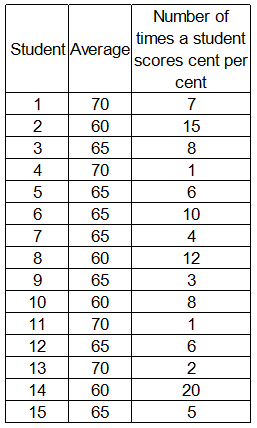
Ms. Banerjee, class teacher for 12th standard, wants to send teams (based on past performance) of three students each to district, state, national, and international competition in mathematics.Till now, every student of the class has appeared in 100 school level tests. The students had following distribution of marks in the tests, in terms of “average” and “number of times a student scored cent per cent marks”.
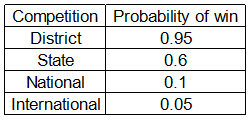
Ms. Banerjee has carefully studied chances of her school winning each of the competitions. Based on in - depth calculations, she realized that her school is quite likely to win district level competition but has low chances of winning the international competition. She listed down the following probabilities of wins for different competitions. Prize was highest for international competition and lowest for district level competition (in that order).
All the students are studying in the school for last twelve years. She wanted to select the best team for all four competitions (Ms. Banerjee had no other information to select students).
The probability of winning an international competition is the lowest. So, most consistent scorers must be chosen who have scored the highest most number of times. Thus, 2, 8 and 14 is an appropriate choice. Hence, option B is the correct answer.
Since the probability of winning is highest at the district level, the students who have the highest average and scored 100 least number of times must be selected. So, she must select 4, 11 and 13. Hence, option D is the correct answer.
Ms. Banerjee has to select the team for national competition after she has selected the team for international competition. A student selected for international competition cannot be a part of national competition. Which is the best team for the national competition?
Ms Banarjee selects the national team only after selecting the international team :
For selection of international team our choices must be focused on people with high number of cent percents because the probability of success is low need some one securing high cent percent and low averages so that we do not waste people with higher averages in a case where the chances of success are very low .
Hence we select 2, 8, 14 who are having an average of 60 which is the lowest and high cent percents which are 12 +15+20 =47.
Since 2,8,14 are selected they cannot be used while selecting the national team.Now while selecting the national team the probability is success is relatively low but still improved from the international competition and since 2,8,14 are already selected we cannot use them and coming to the first option 1,4,7 has people with very high averages and lower cent percentage and hence does not fit our criteria.
The best option is option D where people are averaged in relatively better and also holds good number of cent percents.
Read the following case - let and answer the question that follow
Krishna Reddy was the head of a pharmaceutical company that was trying to develop a new product. Reddy, along with his friend Prabhakar Rao, assessed that such products had mixed success. Reddy and Rao realized that if a new product (a drug) was a success, it may result in sales of 100 crores but if it is unsuccessful, the sales may be only 20 crores. They further assessed that a new drug was likely to be successful 50% of times. Cost of launching the new drug was likely to be 50 crores.
Now, Reddy and Rao were in a quandary whether the company should go ahead and market the drug. They contacted Raj Adduri, a common friend for advice. Adduri was of the opinion that given the risky nature of the launch, it may be a better idea to test the market. Rao and Reddy realized test marketing would cost 10 crores. Adduri told them the previous test marketing results have been favourable 70% of times and success rate of products favourably tested was 80%. Further, when test marketing results were unfavourable; the products have been successful 30% of the times.
How much profit can the company expect to make if the product is launched after favourable test marketing results(assume there are no additional costs)?
Now, Reddy and Rao were in a quandary whether the company should go ahead and market the drug. They contacted Raj Adduri, a common friend for advice. Adduri was of the opinion that given the risky nature of launch, it may be a better idea to test the market. Rao and Reddy realized test marketing would cost 10 crores. Adduri told them the previous test marketing results have been favorable 70% of times and success rate of products favorably tested was 80%.Further, when test marketing results were unfavorable; the products have been successful 30% of the times.
What is the probability of product failure if Reddy and Rao decide to test market it?
Now, Reddy and Rao were in a quandary whether the company should go ahead and market the drug. They contacted Raj Adduri, a common friend for advice. Adduri was of the opinion that given the risky nature of launch, it may be a better idea to test the market. Rao and Reddy realized test marketing would cost 10 crores. Adduri told them the previous test marketing results have been favorable 70% of times and success rate of products favorably tested was 80%.Further, when test marketing results were unfavorable; the products have been successful 30% of the times.
If Rao and Reddy decide to launch the product despite unfavourable test marketing, how much profit can the company expect to earn?
After testing the market the total cost incurred= 50+10=60Cr.
The product will be a success 30% of times after the marketing test is unfavourable. So the probability of success is 0.3.
The probability of failure= 0.7.
The expected return is = 20 $$\times\ $$ 0.7+100$$\times\$$0.3 = 44Cr.
Total profit= 44-60 Cr=-16Cr.
Please read the three reports (newspaper articles) on ranking of different players and products in smart phones industry and answer the questions that follow.
Report 1: (Feb, 2013) Apple nabs crown as current top US mobile phone vendor
Apple’s reign may not be long, as Samsung is poised to overtake Apple in April, 2013. For the first time since Apple entered the mobile phone market in 2007, it has been ranked the top mobile phone vendor in the US. For the latter quarter of 2012, sales of its iPhone accounted for 34 percent of all mobile phone sales in the US - including feature phones - according to the latest data from Strategy Analytics.
While the iPhone has consistently been ranked the top smartphone sold in the US, market research firm NPD noted that feature phone sales have fallen off a cliff recently, to the point where 8 out of every 10 mobile phones sold in the US are now smartphones. That ratio is up considerably from the end of 2011, when smartphones had just cracked the 50 percent mark. Given this fact it’s no surprise that Apple, which only sells smartphones, has been able to reach the top of the overall mobile phone market domestically. For the fourth quarter of 2012, Apple ranked number one with 34 percent of the US mobile market, up from 25.6 percent year over year. Samsung grew similarly, up to 32.3 percent from 26.9 percent - but not enough to keep from slipping to second place. LG dropped to 9 percent from 13.7 percent, holding its third place spot. It should be noted that Samsung and LG both sell a variety of feature phones in addition to smartphones. Looking only at smartphones, the ranking is a little different according to NPD. Apple holds the top spot with 39 percent of the US smartphone market, while Samsung again sits at number two with 30 percent. Motorola manages to rank third with 7 percent, while HTC dropped to fourth with 6 percent. In the US smartphone market, LG is fifth with 6 percent. Note how the percentages aren’t all that different from overall mobile phone market share - for all intents and purposes, the smartphone market is the mobile phone market in the US going forward. Still, Samsung was the top mobile phone vendor overall for 2012, and Strategy Analytics expects Samsung to be back on top soon. “Samsung had been the number one mobile phone vendor in the US since 2008, and it will surely be keen to recapture that title in 2013 by launching improved new models such as the rumored Galaxy S4”. And while Apple is the top vendor overall among smartphones, its iOS platform is still second to the Android platform overall. Samsung is the largest vendor selling Android-based smartphones, but Motorola, HTC, LG, and others also sell Android devices, giving the platform a clear advantage over iOS both domestically and globally.
Report 2: Reader’s Response (2013, Feb)
I don’t actually believe the numbers for Samsung. Ever since the debacle in early 2011, when Lenovo called into question the numbers Samsung was touting for tablet shipments, stating that Samsung had only sold 20,000 of the 1.5 million tablets they shipped into the US the last quarter of 2010, Samsung (who had no response to Lenovo) has refused to supply quarterly sales numbers for smartphones or tablets. That’s an indication that their sales aren’t what analysts are saying. We can look to several things to help understand why. In the lawsuit between Apple and Samsung here last year, both were required to supply real sales numbers for devices under contention. The phones listed turned out to have sales between one third and one half of what had been guessed by IDC and others. Tablet sales were even worse. Of the 1.5 million tablets supposedly shipped to the US during that time, only 38,000 were sold. Then we have the usage numbers. Samsung tablets have only a 1.5% usage rate, where the iPad has over 90%. Not as much a difference with the phones but it’s still overwhelmingly in favor of iPhone. The problem is that with Apple’s sales, we have actual numbers to go by. The companies who estimate can calibrate what they do after those numbers come out. But with Samsung and many others, they can’t ever calibrate their methods, as there are no confirming numbers released from the firms. A few quarters ago, as a result, we saw iSupply estimate Samsung’s smartphone sales for the quarter at 32 million, with estimates from others all over the place up to 50 million. Each time some other company reported a higher number for that same quarter, the press dutifully used that higher number as THE ONE. But none of them was the one. Without accurate self-reporting of actual sales to the end users, none of these market share charts are worth a damn!
Report 3: Contradictory survey (Feb, 2013)
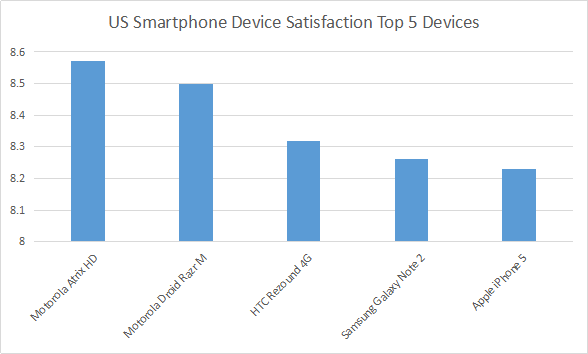
iPhone5 Ranks Fifth In U.S. Customer Satisfaction Survey inShare. The iPhone5 ranks fifth in customer satisfaction according to the results of a recent survey from OnDevice Research, a mobile device research group. In the poll, they asked 320,000 smartphone and tablet users from six different countries, how satisfied they were with their devices. According to 93,825 people from the US, Motorola Atrix HD is the most satisfying and Motorola’s Droid Razr took second spot. HTC Corp (TPE : 2498)’s Rezound 4G and Samsung Galaxy Note 2 took third and fourth spots, while Apple’s iPhone5 landed in fifth spot. It appears that Apple may be lagging in consumer interest. OnDevice Research, Sarah Quinn explained, “Although Apple created one of the most revolutionary devices of the past decade, other manufactures have caught up, with some Android powered devices now commanding higher levels of user satisfaction.” Despite the lower rankings, things aren’t looking too bad for Apple Inc. (NASDAQ:AAPL) elsewhere. In the United Kingdom, they ranked second place, right after HTC One X. Interesting enough, Apple did take top spot for overall satisfaction of mobile device, whereas Google Inc. (NASDAQ:GOOG) ranked second. Motorola Mobility Holdings Inc. (NYSE:NOK) took third, fourth, and fifth places respectively, while Sony Ericsson trailed behind at sixth place. The survey sampled mobile device users in the following countries: United States, United Kingdom, France, Germany, Japan, and Indonesia. Although OnDevice didn’t share the full list of devices mentioned in the survey, it does show some insight to what customers want. Unfortunately, there were still many questions regarding the survey that were left unanswered. Everyone wants to know why Google Inc. (NASDAQ:GOOG) was on the list when they are not an actual smartphone maker and why was Samsung Electronics Co., Ltd. (LON:BC94) on the bottom of the satisfaction list when the brand is leading elsewhere.
Source: 92.825 US mobile users, July 2012 - January 2013 Fortunately, those questions were answered by OnDevice Research’s representative. He explained that the survey was conducted on mobile web where the survey software could detect the taker’s device and since user’s rate their satisfaction levels on a 1 to 10 scale, thanks to the Nexus device, Google was included.
We do have any information to state that the given information is wrong and we do not know the sources of content given in the reports. Therefore, options A and B cannot be inferred. Options D and E cannot be inferred from the given reports.
Assume report1 and report3 are both correct, which of the following can be a reason for seemingly divergent ranks of different companies and their products?
Option A doesn't explain report 3, i.e. customer satisfaction. Option B and C are not where related to the given statement. Option D is incorrect, from given statement we cannot infer that customer satisfaction never leads to higher customer loyalty.
If report1 and report3 are both correct, which of the following can be a reason for seemingly divergent ranks reported for different companies and their products?
Report 1 talks about sales data and report 3 presents data on customer satisfaction. Among the given options, only option D answers the question. The answer is option D.
The reader doesn't believe the numbers published by Samsung. He says without accurate self-reporting of actual sales to the end users, none of these market share charts are correct. The reader wants more objective data to be released by the companies.
The answer is option E.
Read the following case-let and choose the best alternative for the questions that follow.
Ajay was thinking deeply about a problem that his organization, a business consulting company, faced. Globalization had affected his company like many other companies. Despite the downturn, the current revenues remained healthy. However, Ajay knew it was inevitable that the company could not do business the same way. The complexity of managing the business had increased with time. Consultants were under pressure to deliver good and innovative solutions. The organization had consultants from different age groups having a good mix of domain and industry expertise. It was a flat organization with three levels. The biggest challenge for Ajay was to have consultants with latest knowledge who would also earn revenues. Getting additional business was a challenge as all the consultants were busy and it was very difficult to hire new consultants.
Some of the consultants were adept at applying old solutions to new problems. Ajay was not very sure if this would work for long. Some of the clients had complained about the performance of old and reputed consultants. Ajay was mulling over the following five solutions to tackle this problem.
1.Decrease time spent on client interaction and increase time spent for generating solutions. 2.Increase support staff to help consultants to remain updated. 3.Decrease the number of simultaneous projects handled by consultants. 4.Make it compulsory for consultants to work on inter-industry and inter-domain problems. 5.Recruit more consultants. Which of the following would be the best sequence of decisions taken by Ajay (starting from immediate to distant)?
Statement 1 as the course of action is out of the question. Therefore, 1 is the course of action which need not be taken immediately. Therefore, options A and E are eliminated. Given that Ajay wants to make situations better, statement 3 should be one of his initial course of actions. Therefore, option D is eliminated. Among the remaining options, option B is the appropriate one. The answer is option B.
After Ajay implemented some of the steps mentioned above, consultants wanted to renegotiate their contract with the organization. It seems that the organization had never mentioned that consultants have to work across industries and domains. Some of the old consultants were reluctant to change their ways, while many of the younger consultants were willing to follow Ajay’s advice. Which of the following decision can be taken by Ajay to handle this situation?
Among the given approaches, only option E is the appropriate one. Only option E is a step to find the solution for the concerns raised by old consultants.
Ajay was to retire in five years and he wanted to leave behind a legacy. Order the following activities, from the most important to the least important, that Ajay should undertake in next five year: 1.Do nothing. 2.Set a future direction for the organization in these challenging times. 3.Benchmark performance with respect to the best consulting company in industry. 4.Empower senior consultants and at the same time seek opinion of all others for handling future challenges. 5.Infuse fresh thinking by hiring outsiders. Choose the best option from the following sequences
Doing nothing will not progress the organization. Therefore, (1) is ruled out. It is important to set a direction for the organization in this challenging time. Therefore, (2) is the most important step followed by (3) and (4). In view of necessity of ideas, it is important to hire new consultants. Hence, the order is 2, 3, 4, and 5.
The answer is option B.
Read the following case - let and answer the questions that follow
Intercontinental Business Manufacturing (IBM) was doing a roaring business. Demand of the products was high and supply of raw - material was abundant. IBM was manufacturing three different products. Some customers bought two types of products and some bought only one. The three products were “quickie - quick”, “run - of - the - mill”, and “maxi - max”. Customers were not complaining loudly. Ram, the product manager, was confused! Demand for “quickie - quick “was increasing .Raw material suppliers wanted to supply lower quality at cheaper price. It was profitable for the company to increase production .Quality department was not happy with the product. Ram met Rahim, the CEO, who, as always, wanted higher profits. He said that IBM will set up a committee for improving the quality.
Since there is good demand for quickie-quick it is essential that the quality is maintained to ensure the demand doesn't fall. Therefore, options B and C can be done. Options D and E may reduce the sales for some period but it is good keeping the market in view. Only producing quickie-quick products not concerning about the quality is not a good idea. Therefore, the answer is option A.
Rahim set up a “brand” committee comprising of a few selected managers, headed by Robert. The committee proposed that IBM should continue to manufacture the three differently branded products. It also proposed to recruit a new brand manager for improving brand image of the products. It agreed with Rahim that the company should increase the price. Rocket Singh, head of sales, was confused because he realized that customers were miffed with “run - of - the - mill” and “maxi - max”. What should Rocket Singh do?
Options A and B doesn't address the dissatisfaction of customers. Options C and D also doesn't help in finding the reason for customer's dissatisfaction. The answer is option E.
Some of the managers in production department were discussing the problems faced in shipping products in time. They complained that they had to undertake responsibility of creating financial and marketing plans in addition to responsibility of production planning. At the same time, finance and marketing managers were to be involved in preparing production plans. It was expected that this will reduce customer complaints. It was rumored that these changes were initiated by the managers educated in the U.S. Which of the following is the best possible course of action available to the affected managers?
In the given context, we can infer that no rights violated in any manner. Therefore, options A, B and D are incorrect. Going to US for further education is irrelevant in the given context. Creating a forum for discussion may resolve the issues. The answer is option C.
Read the following case-let and answer the questions that follow
Rajinder Singh was 32 years old from the small town of Bhathinda, Punjab. Most of the families living there had middle class incomes, with about 10% of the population living below the poverty level. The population consisted of 10 percent small traders, 30 percent farmers, besides others. Rajinder liked growing up in Bhathinda, where people knew and cared about each other.
Even as a youngster it was clear that Rajinder was smart and ambitious. Neighbors would often say, “Someday you’re going to make us proud!” He always had a job growing up at Singh’s General Store - Uncle Balwant’s store. Balwant was a well-intentioned person. Rajinder loved being at the store and not just because Balwant paid him well. He liked helping customers, most of who were known by the nicknames. Setting up displays and changing the merchandise for different seasons and holidays was always exciting. Uncle Balwant had one child and off late, his interest in business had declined. But he had taught Rajinder ‘the ins and outs of retailing’. He had taught Rajinder everything, including ordering merchandise, putting on a sale, customer relations, and keeping the books.
The best part about working at the store was Balwant himself. Balwant loved the store as much as Rajinder did. Balwant had set up the store with a mission to make sure his neighbors got everything they needed at a fair price. He carried a wide variety of goods, based on the needs of the community. If you needed a snow shovel or piece of jewelry for your wife, it was no problem - Singh’s had it all. Rajinder was impressed by Balwant’s way of handling and caring for customers. If somebody was going through “hard times”, Balwant somehow knew it. When they came into the store, Balwant would make them feel comfortable, and say something like, “you know Jaswant, let’s put everything on credit today”. This kind of generosity made it easy to understand why Balwant was loved and respected throughout the community.
Rajinder grew up and went to school and college in Bhathinda. Later on, he made it to an MBA program in Delhi. Rajinder did well in the MBA course and was goal oriented. After first year of his MBA, the career advisor and Balwant advised Rajinder for an internship at Bigmart. That summer, Rajinder was amazed by the breadth and comprehensiveness of the internship experience. Rajinder got inspired by the life story of the founder of Bigmart, and the value the founder held. Bigmart was one of the best companies in the world.
The people that Rajinder worked for at Bigmart during the internship noticed Rajinder’s work ethic, knowledge, and enthusiasm for the business. Before the summer ended, Rajinder had been offered a job as a Management Trainee by Bigmart, to start upon graduation. Balwant was happy to see Rajinder succeed. Even for Rajinder, this was a dream job - holding the opportunity to move up the ranks in a big company. Rajinder did indeed move up the ranks quickly, from management trainee, to assistant store manager, to supervising manager of three stores, to the present position - Real Estate Manager, North India. This job involved locating new sites within targeted locations and community relations.
One day Rajinder was eagerly looking forward to the next assignment. When he received email for the same, his world came crashing down. He was asked to identify next site in Bhathinda. It was not that Rajinder didn’t believe in Bigmart’s explanation. What was printed in the popular press,especially the business press, only reinforced Rajinder’s belief in Bigmart. An executive viewed as one of the wisest business persons in the world was quoted as saying, “Bigmart had been a major force in improving the quality of life for the average consumer around the world offering great prices on good, giving them one stop solution for almost everything.” Many big farmers also benefitted through low prices, as middlemen were removed. At the same time, Rajinder knew that opening a new Bigmart could disrupt small business in Bhathinda. Some local stores in small towns went out of business within a year of the Bigmart’s opening.
In Bhathinda, one of the local stores Singh’s,now run by Balwant’s son, although Balwant still came in every day to “straighten out the merchandise.” As Rajinder thought about this assignment, depression set in, and the nightmares followed. Rajinder was frozen in time and space. Rajinder’s nightmares involved Balwant screaming something- although Rajinder could not make out what Balwant was saying. This especially troubled Rajinder, since Balwant never raised his voice.
Rajinder didn’t know what to do - who might be helpful? Rajinder’s spouse, who was a housewife? Maybe talking it through could lead to some positive course of action. Rajinder’s boss?Would Bigmart understand? Could Rajinder really disclose the conflict without fear? Uncle Balwant? Should Rajinder really disclose the situation and ask for advise? He wanted a solution that would make all satkeholders happy.
The passage doesn't mention about the knowledge Rajinder's wife has. Therefore, option A is incorrect. His boss will only be interested in expanding Bigmart's business. Therefore, option B is incorrect. Talking to his uncle Balwant, would help him in finding a way out.
After delibertation with many people and a lot of research, Rajinder came across a study published in leading journal, which stated that most local farmers benefited because Bigmart bought agricultural produce directly from the farmers. Which of the following actions would you prefer Rajinder to take, after he got this fresh information?
Neither (D) nor (E) will help in the expansion of Bigmark's market. Therefore, options D and E are incorrect. Options A or B cannot be the answer. Rajinder is worried about small traders. Rajinder should see this as an opportunity to take concerns of local traders and find a way out to benefit the small traders. The answer is option C.
 91- 6303239042