91- 6303239042
“On a wing and a prayer the Indian team landed in Heathrow to take on their formidable opponents”. From the above sentence it can be inferred that the Indian team was
Sign in
Please select an account to continue using cracku.in
↓ →
“On a wing and a prayer the Indian team landed in Heathrow to take on their formidable opponents”. From the above sentence it can be inferred that the Indian team was
The phrase "On a wing and a prayer" means to do something without preparation and hoping to succeed. From the sentence it can be inferred that the Indian team was under prepared and hoping to succeed.
Hence, the correct answer is Option D
It _____________ not look like a great deal today, but back then it was a coup: no man before ___________ to import tea directly into Ireland. The option that will best fill the blanks in the
above sentences would be:
From the narrative, it is clear that the act of importing tea into Ireland is an event of the past and that perhaps doing so today is not a "big deal". This means that the act of importing tea should be spoken of in the past perfect tense as we are referring to a past event (of importing tea directly) when standing at a point which itself is a point of past from today's perspective (the point when it was considered a coup). Hence, "had dared" is the most apt for the second blank and hence, B should be the answer.
The sequence of events has to be understood like this: daring to import tea ---> being considered as a coup ----> not a big deal today.
“It was AC Milan’s success in Europe in the sixties that introduced the ‘libero’ as the Italian default and, a quarter of a century later, it was AC Milan’s success in Europe that killed it off.” Which of the following was not implied in the above sentence?
The given sentence implies that 'libero' was introduced as the Italian default due to Milan's success and it was killed a century later due to their success.
Option D implies the opposite of what has been mentioned in the given sentence. All other option can be implied.
Hence, option D is the correct answer.
Choose the odd one:
Antonym of Chaos is Order.
Antonym of Fact is Fiction.
Antonym of Virtue is Vice.
Antonym of Light is Darkness.
Synonym of Study is Analyse.
All pairs other than D are antonyms of each other.
Option D is the odd one out because study and analyse are synonyms of each other.
The 2001 census showed a sharp decline in the literacy rate compared to 1991, but the 2006 literacy rate increase suggests that India progressed in literacy between 1991 and 2006.
Which of the following statements, if true, best refutes the above argument?
The argument is that India made up for the loss incurred in literacy rate from 1991 to 2001 by improving in the 5 year span from 2001 to 2006.
This can be refuted if it can be proven that the progress made in 2001 to 2006 was not good enough in amount to cover the losses incurred in the previous 10 year period. So even if India improved in 2001-06, the improvement might have been marginal and hardly substantial.
This is given to us by option D. Hence, the answer.
Ravindra Dubey was guilty of embezzlement. It means that Ravindra Dubey
'Embezzlement' means theft or misappropriation of funds placed in one's trust or belonging to one's employer. Option B represents the most appropriate meaning of the given sentence.
Hence, option B is the correct answer.
Read the sentences and choose the option that best arrange them in a logical order.
A. Some of these are tangible while others are not.
B. The micro factors look at brand building, product development, competition, pricing, decision making within organizations etc.
C. Another way to classify these factors is to distinguish which of them are macro in nature and which of them are micro.
D. The macro factors comprise government policies, state of the economy, changing demographics etc.
E.The factors influencing forecasts include social, technological, economic, political, religious, ethnic, governmental, and natural factors.
From the given sentence, we can infer easily that sentence C precedes sentences D and B. We place sentence D and then B because sentence C mentions macro factors first and then micro ones. Hence, C-D-B is a mandatory sequence.
This is available only in options A and C.
Obviously, the sequence cannot start with sentence A and hence, the sequence E-A-C-D-B has to be the answer.
Read the following passage and provide appropriate answers for the questions
There is an essential and irreducible ‘duality’ in the normative conceptualization of an individual person. We can see the person in terms of his or her ‘agency’, recognizing and respecting his or her ability to form goals, commitments, values, etc., and we can also see the person in terms of his or her ‘well-being’. This dichotomy is lost in a model of exclusively self- interested motivation, in which a person’s agency must be entirely geared to his or her own well-being. But once that straitjacket of self-interested motivation is removed, it becomes possible to recognize the indisputable fact that the person’s agency can well be geared to considerations not covered - or at least not fully covered - by his or her own well-being. Agency may be seen as important (not just instrumentally for the pursuit of well-being, but also intrinsically), but that still leaves open the question as to how that agency is to be evaluated and appraised. Even though the use of one’s agency is a matter for oneself to judge, the need for careful assessment of aims, objective, allegiances, etc., and the conception of the good, may be important and exacting. To recognize the distinction between the ‘agency aspect’ and the ‘well-being aspect’ of a person does not require us to take the view that the person’s success as an agent must be independent, or completely separable from, his or her success in terms of well-being. A person may well feel happier and better off as a result of achieving what he or she wanted to achieve - perhaps for his or her family, or community, or class, or party, or some other cause. Also it is quite possible that a person’s well-being will go down as a result of frustration if there is some failure to achieve what he or she wanted to achieve as an agent, even though those achievements are not directly concerned with his or her well-being. There is really no sound basis for demanding that the agency aspect and the well-being aspect of a person should be independent of each other, and it is, I suppose, even possible that every change in one will affect the other as well. However, the point at issue is not the plausibility of their independence, but the sustainability and relevance of the distinction. The fact that two variables may be so related that one cannot change without the other, does not imply that they are the same variable, or that they will have the same values, or that the value of one can be obtained from the other on basis of some simple transformation. The importance of an agency achievement does not rest entirely on the enhancement of well-being that it may indirectly cause. The agency achievement and well-being achievement, both of which have some distinct importance, may be casually linked with each other, but this fact does not compromise the specific importance of either. In so far as utility - based welfare calculations concentrate only on the well- being of the person, ignoring the agency aspect, or actually fails to distinguish between the agency aspect and well-being aspect altogether, something of real importance is lost.
According to the ideas in the passage, the following are not true expect:
Consider these sentences from the 4th line of given passage:
"This dichotomy is lost in a model of exclusively self- interested motivation, in which a person’s agency must be entirely geared to his or her own well-being. But once that straitjacket of self-interested motivation is removed, it becomes possible to recognize the indisputable fact that the person’s agency can well be geared to considerations not covered - or at least not fully covered - by his or her own well-being."
They make it clear that the author believes it is incorrect to completely align a person's agency to his/her well being. It is very likely that a person's agency might not be related completely with his/her idea of well being.
This idea is reflected in option A.
Option B is not true because it says that both the said issues are completely independent which is not the case. The author clearly mentions that there can be a good correlation between the two but not always or in a complete sense.
Hence, only A can be thought of as the true sentence.
In the case of Japan, there is a strong empirical evidence to suggest that systematic departure
from self-interested behavior, in the direction of duty, loyalty and goodwill have played a substantial part in industrial success.Which of the following in closest to the ideas presented in the passage?
The key focus of the passage is to let the reader know that the sense of agency in a person and the sense of well being, even though very strongly correlated, are individual and independent factors. While they may heavily influence each other, one should not mistake them to be the same thing or even assume that knowing the value of one can help us easily arrive at the value of another.
This can be applied to the industrial success in Japan by understanding that helping their country achieve success in industrial world must have given a sense of satisfaction and achievement (i.e. agency) and to the Japanese people, and also improved their sense of own well being, it is not necessarily the only driver behind the success. The agency of people in contributing to industrial success must also have some roots in reasons other than personal well-being.
This is best reflected in the option D.
Of the options presented below, which one is the best example for the ideas propounded in the passage?
The closing lines of the passage act as a good guide here. It says that if we forget the individuality of the sense of agency and sense of well being and end up correlating them all the time, then we might end up drawing incorrect inferences.
In the last option given to us, we can see that a politician is going on a hunger strike which means he is putting his sense of well being (by depriving his body of necessity of food) on the backburner but ends up fulfilling his sense of agency by achieving a good image in the minds of his voters. If we would have thought that sense of well being and sense of agency are correlated all the time, then we might never have understood the rationale behind the politician's hunger strike (and some might even have deemed such an event as an impossibility). The incident of hunger strike is a proof that sense of agency might well be driven NOT by sense of well being all the time. And this is the point of the entire passage. Hence, it is an apt answer.
Read the sentences given below and choose the option that is best in accordance with the ideas in the passage.
I.There is a need to distinguish between the agency aspect and the well-being aspect of a person.
II.A person can be conceptualized in terms of either agency or well-being.
III.A person is important, not just instrumentally, for the pursuit of well-being
Sentence 1 and 3 can be inferred from the passage. Sentence 2 is incorrect because of these lines form the passage:
"The fact that two variables may be so related that one cannot change without the other, does not imply that they are the same variable, or that they will have the same values, or that the value of one can be obtained from the other on basis of some simple transformation."
This makes it clear that knowing the value of sense of agency doesn't necessarily mean that the value of sense of well being can be easily calculated. The 2 issues might be very closely correlated but they are not the same thing and thus, not linked 100% of the time completely.
The idea of agency, as used in the passage, is implied in all the options given below, except:
We have been explained sense of agency by these words:
"We can see the person in terms of his or her ‘agency’, recognizing and respecting his or her ability to form goals, commitments, values, etc."
Option A,B,C,D can be seen as people being driven by their sense of agency. However, E is out of sync with the given sentence as an ascetic is someone who has renounced the world and thus, in terms of understanding of the sense of agency, he must hardly have any interest in world affairs. Hence, for him to be praying for world peace, he must be driven by something other than an immediate sense of agency. Hence, it is the answer.
Which of the following sentences is grammatically incorrect?
'Ability of' is incorrect in option E. The correct usage is 'ability to'. All other options are grammatically correct.
Hence, option E is the correct answer.
Alfredo, Diego and Lionel are discussing Argentinean football.
Alfredo: Argentina was a football powerhouse.
Diego: Argentina is a football powerhouse.
Lionel: Argentina will be a football powerhouse.
Which of the following cannot be inferred from the above conversation?
Alfredo has a good thought about the past while Diego has a good thought about the present.
This does not mean that Alfredo would disagree heavily with Diego and be adamant that only the past state of Argentinian football was a bright one and the present is not. Hence, D is incorrect.
Choose the grammatically correct sentence from the options given below.
"those who" is grammatically correct because "who had previously challenged his leadership" refers to people.
The other options are incorrect due to improper pronoun usage: "they who" and "them who" are incorrect; "they" and "them" are subject and object pronouns, respectively, and do not fit properly here. "he who" is incorrect because "he" is a subject pronoun, but the phrase requires a demonstrative pronoun ("those"). "that who" is incorrect because "that" refers to things, not people.
Answer is option D.
Ethologists, people who study animal behavior, have traditionally divided an organism’s actions into two categories: learned behavior (based on experience) and instinctive behavior (based on genotype). Some current scholars reject this distinction, claiming that all behavior is a predictable interaction of experience and genotype.
Which of the following, if true, most strengthens the arguments made in the sentence above?
The main point of the paragraph is that the behavior of all organisms is an outcome of the interaction between experience and genotypes. Hence, all organisms with identical genotypes and identical experience will always behave in identical manner. This is given in option D.
Hence, option D is the correct answer.
The benefits of psychotherapy result not only from the advice the therapist gives but also from the supportive relationship offered to the patient. Even though this relationship may cost large amounts of money over many years, most patients interpret the therapist’s concern for them as genuine and identify this caring relationship as the primary factor in improving their mental health. However, recent studies have found that only eight percent of therapist/patient relationships continue after the patient terminates formal paid visits.
Which of the following is in accordance with the ideas contained in the passage? Choose the best option.
The passage states that even though psychotherapy is expensive, the supportive relationship offered by therapists benefits patients a lot. But in the last line, it has been mentioned that very few therapists continue this relationship after the paid visits are terminated. Hence, we can infer that they are equally concerned with money-making. Option A is the correct answer.
All other options are irrelevant or alien to the passage.
Most of the Asian countries have trade-deficit with China. Bangladesh’s trade deficit with China this year has increased by 35%. Despite large increases in exports to China, Indonesia’s trade deficit with China continues to increase. So does that of South Korea, home of Samsung Electronics, one of the world’s largest manufacturers of electronic gadgets.
Which of the following, if true, would be most inconsistent with the above passage?
In the given paragraph, it has been mentioned that exports to China from Indonesia has increased significantly. At the same time the trade deficit of Indonesia with China has widened. Trade deficit is exports minus imports. If the trade deficit has widened then the imports should have increased at a higher rate as compared to the exports.
So, option C which mentions the decrease in exports to Indonesia from china is inconsistent with the information given in the passage.
Hence, option C is the correct answer.
All who studied commerce enjoy sports. No tax consultant enjoys sports. All those who enjoy sports love classical music.
If the above sentences are true, which of the following also must be true?
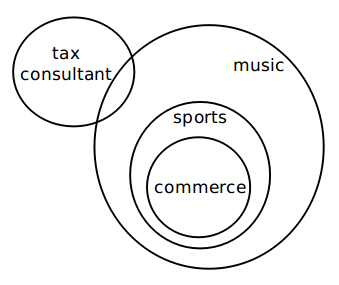
From the venn diagram, we can see that only option D is possible.
Hence, option D is the correct answer.
The head ___________ was annoyed to see a _________ in the soup.
The option that would best fill the blanks in the above sentence would be:
Before the first blank, 'head' is present. So, 'chief' which has the same meaning as 'head' cannot fill the first blank. Thus, the first blank would be filled by 'chef'.
Housefly is the name of an insect which could fill the second blank.
Hence, option B is the correct answer.
Which word is the opposite of the word
‘hypothesize’?
'Hypothesize' means to put forward something as a hypothesis. 'Refute' means to disprove. So, 'refute' is the most appropriate antonym.
Hence, option D is the correct answer.
Read the sentences and choose the option that best arranges them in a logical order.
A. In fact, it is considered as a dumping ground for unwanted people in quite a few organizations.
B. In many parts of the country, traditional castes such as Kothari, Kotwal, Bhandari and Bhandarkar have for generations been dealing in procuring, stocking, distributing goods and merchandise.
C. This is due to the fact that Indian traders have been trading with many parts of the world.
D. However, though the concept of warehousing has been prevalent for over 2000 years, the warehouse has not yet obtained due recognition in modern times.
E. The concept of warehousing or stores function is not new in India.
D-A will be a mandatory pair as we can see that these 2 statements tell us about the negative perception around warehousing. E-C is a good pair which tells us about and the reason for warehousing being a common occupation/function in India. This is available to us only in option B and hence, the answer.
Concurrence means all of the following except:
Concurrence is synonymous with all the given words except 'harmony'.
Harmony which means Orderly combination of elements as a whole.
Hence, option E is the correct answer.
Read the sentences and choose the option that best arranges them in a logical order.
i. All it has to do is to drive up the inflation rate-examples are the damage Lyndon Johnson’s inflationary policies did to the US economy and the damage which consistently pro-inflationary policies have done to the economy of Italy.
ii.It is easy, the record shows, for a government to do harm to its domestic economy.
iii.Contrary to what economists confidently promised forty years ago, business cycles have not been abolished.
iv.They still operate pretty much the way they have been operating for the past 150 years
v.But there is not the slightest evidence that any government policy to stimulate the economy has impact, whether that policy be Keynesian, monetarist, supply - side or neoclassical.
We can see that the (ii)-(i) and (iii)-(iv) are two mandatory pairs. Sentence (v) comes either immediately after (i) or before (ii).
This makes only A or E feasible. Option A cannot be a desirable sequence because it positions (ii) (which talks about Govt. actions) immediately after (iv) (which talks about business cycles staying the same). This is not a smooth idea flow.
In comparison, option E makes a good switch from the ideas of (iii)-(iv) to the impact of Govt. actions. Hence, the answer.
When income tax rates are reduced, there is an increase in taxable income, and an increase in
taxable income results in increased total income tax revenues for the government. Which of the following is analogues to the argument above in terms of its logical features?
The given situation talks about a benefit getting reaped by a counter-intuitive step. If Govt. wants increased tax revenues then a straightforward suggestion would have been to increase tax rates. Any suggestion to reduce tax rates would be thought of as complete opposite of desired result. But as the situation given in the question explains, it actually helps the Govt. in fulfilling its goal.
Similarly, if a product is to be advertised, it is expected that the prospective customer be told about it in as much detail as possible. But that would backfire as no one bothers reading long ads. So brief ads with less than 25 words which would initially seem too short to advertise the product well turn out to be the best way to market the product. This is analogous to the income tax rate situation of the Govt. Hence, the answer.
Not wanting to present an unwanted optimistic picture in the board meeting, the CEO estimated the sales growth _____________.
The option that will best fill the blank in the above sentence would be:
It is given that the CEO did not want to give an unneeded optimistic picture. This is another way of saying that the CEO wanted to be pragmatic and willing to give a realistic picture. Hence, options like B and C get ruled out.
Strictly is not relevant to the context.
Pessimistic is not the right word because the CEO was not going to announce bad news or bad forecasts. The CEO simply wanted to abvoid exuberance - this does not mean being overtly negative.
Hence, E is the correct choice.
Read the following passage and provide appropriate answers for the questions
The idea of demarcating certain areas within the country as special economic zones to promote investment and growth is not new. A large country unable to provide the kind of facilities and environment that can attract foreign investment throughout the country often finds it feasible and attractive to carve up some of its areas where such facilities can be provided. The laws and procedures for setting up new industries are waived to make the area business-friendly with developed infrastructure and a one-window interaction with government. In addition, huge tax benefits are promised to lure investors. China’s experience shows that if chalked out and implemented with care such a policy can accelerate the flow of capital and technology from abroad and thereby speed up growth.
However, SEZs may not be the best option in all situations to clear the bottlenecks in growth.
India’s experience with export processing zones (EPZs) bears this out. They have failed in India for the simple reason that the factors that made the SEZs successful in China have been absent here. In India, as in China, EPZs were thought of as a way of providing an escape route from the stranglehold of control that prevailed over the Indian economy. But even while promising to ease the rigours of controls, Indian policy-makers could not give up their penchant for micromanaging from the centre and undoing the promised relaxations with all kinds of qualifications and “guidelines”.
Over last two decades India has evolved into a market economy and much of governmental control has disappeared, but the flow of foreign direct investment has not reached anywhere near the levels of China. Besides, infrastructure building has fallen far short of what is required. Even after three years of the enactment of the Electricity Act (2003), private investment in electricity generation is still a trickle with the states refusing to give up the monopoly of their electricity boards in the matter of purchase of the power generated. While swearing by growth, governments at both the centre and the states cite the fiscal responsibility laws to plead their helplessness in making the required investments to improve infrastructure.
Given the situation, the SEZs have apparently been thought of as a simple way out. In its enthusiasm for SEZs the commerce ministry forgot two critical lessons of the Chinese experience, viz., that an SEZ must be of an adequate size to provide opportunities for reaping the benefits of large-scale operations and their number should be few. Every industry or economic activity worth its name is now seeking SEZ status. Proposals are now being floated to invite foreign educational institutions to come to India with promises of SEZ treatment! The finance ministry apprehends a loss of nearly 1,75,000 crore in direct taxes, customs duties and excise duties over the next five years.
The objective of the author in writing the above passage seems to be to
In the last paragraph author mentioned that " SEZ must be of an adequate size to provide opportunities for reaping the benefits of large-scale operations and their number should be few." In the first half of the passage author define SEZ's, EPZ's and their shortcomings as compared to China. But the main argument of the author was that there is a proliferation of SEZs in India which is not suitable for its economy.
Option A would have been correct if it mentions SEZ instead of EPZ.
Option B and Option C are mentioned but not the objective of the passage.
Option E is incorrect author mentioned that though India had imitated the Chinese policies but are not successful.
The author’s arguments suggest the following conclusions, except
In the last line of third paragraph its given that " While swearing by growth, governments at both the center and the states cite the fiscal responsibility laws to plead their helplessness in making the required investments to improve infrastructure. "
Option 3 is a misrepresentation of what is given in the paragraph. It states that fiscal responsibility laws limit the investment on infrastructure by the Government of India. But paragraph mentions that it is a reason which is given by the government, actual reason is not mentioned. So Option C is incorrect.
The other options can be inferred from the passage.
The author does not oppose
In the 1st paragraph, it is given that "In addition, huge tax benefits are promised to lure investors." Author do not oppose the tax benefits provided in the SEZs. Option C is correct.
Option A: Author does oppose SEZ treatment of foreign educational institutes in India as mentioned in the last paragraph "Proposals are now being floated to invite foreign educational institutions to come to India with promises of SEZ treatment! The finance ministry apprehends a loss of nearly 1,75,000 crore in direct taxes, customs duties and excise duties over the next five years."
Option B is incorrect as the passage states: "But even while promising to ease the rigours of controls, Indian policy-makers could not give up their penchant for micromanaging from the center and undoing the promised relaxations with all kinds of qualifications and “guidelines”. " Therefore, the author disapprove qualifiers which undo relaxation of government controls.
Options D and E are also mentioned in the third paragraph.
The passage was most likely written in the year:
It is mentioned in the paragraph "Even after three years of the enactment of the Electricity Act (2003)" So the correct answer is 2006, Option D.
Read the following passage and provide appropriate answers for the questions
This is one of the unanswered questions that I want to explore. I believe that this is certainly one of the
deeper questions about technology. Why do I say so? Without evolution technologies seem to be born
independently and improve independently. Each must come from some unexplained mental process,
some form of creativity or thinking outside the box that brings it into existence and separately develops
it. With evolution, new technologies would be birthed in some precise way from previous ones, albeit with considerable mid-wifing, and develop though some understood process of adaptation. In other words, if
we could understand evolution, we could understand the most precious of processes: innovation. But, let
me define evolution before I proceed further. The word evolution has two general meanings. One is the
gradual development of something, as with the evolution of ballet or the English madrigal. The other
is the process by which all objects of some class are related by ties of common descent from the collection of earlier objects. The latter is what I mean by evolution.
Which of the following can be inferred from the passage?
I. The author’s main concern is to develop a theory of innovation.
II. The author is interested in putting forth a theory of technological evolution.
III. The author believes before developing a theory of technological evolution, one needs to investigate whether technology evolves at all.
IV. Evolution, as the author puts it, is a sense of common relatedness.
Statement I: Since this is the author's primary concern in the passage, this is a correct statement.
Statement II: This statement can also be understood as the author's contention to put forth a theory of the development of technologies. This should not be confused with the theory of evolution that the author described in the passage. Thus, this statement is also correct.
Statement III: Since this statement is nowhere mentioned and stated in the passage, this is not a correct statement.
Statement IV: Evolution as a 'sense of relatedness' is a very vague description. Thus, this is not a correct statement.
Thus, the correct option is A.
I. In 1867, S. Colum Gilfillan, a sociologist traced the evolution of ships from the dugout canoe to the modern steamship of the day.
II. Many theories propose the existence of a technology in many forms. From these variations, some perform better and are selected for further use and development.
III. Till date the people who have thought hardest about the general questions of technology have only been social scientists. They have viewed technology from the outside as stand-alone objects without studying earlier technologies.
IV. Some technologies, for example, the laser, the jet engine, the radar, the quick sort algorithm and the locomotive just appear, or at least they seem to just appear unlike novel biological species which are versions of earlier objects.
V. Radar descends from radio but you can vary 1930s radio circuits as radically you like but you will never get radar. Radar requires a different principle.
Assuming the above statements are true, which option would most strengthen the author’s premise that the question that he has identified has not been solved as yet?
The author has mentioned two processes through which technologies have been born. The unanswered question is about the innovation process, which the author wants to understand.
Options I and II present the cases for the process of evolution.
Options III. IV and V present the cases for the process of innovation.
Thus, the correct option is E.
Start your IIM journey with the right preparation and crack CAT 2026.

Educational materials for CAT preparation
 Share
Share