91- 6303239042
Which is the seventh number in the sequence 5, 9, 16, 29, 54,
Sign in
Please select an account to continue using cracku.in
↓ →
Which is the seventh number in the sequence 5, 9, 16, 29, 54,
5, 9, 16, 29, 54,__, ?
5x2-1=9
9x2-2=16
16x2-3=29
29x2-4=54
54x2-5=103
103x2-6=200
Answer 200
Which of the below pendulums will move the slowest, if each one of them is displaced by an angle of $$60^\circ$$ from the center?
Loading solution...
Lectures by industry experts have to be scheduled in Marketing, Finance, Operations, Organisational Behaviour and Information Systems. This has to be scheduled on a weekday (Monday to Friday). Only one lecture can be scheduled per day. Marketing cannot be scheduled on Tuesday as it is inconvenient for the expert. Expert for Finance is available only on Tuesday. As Information Systems and Finance are always considered important, Information Systems has to be scheduled immediately on the day following the Marketing lecture. The Dean has decided that Organisational Behaviour lecture has to be scheduled immediately before the day of Marketing lecture. Finally the schedule is prepared which satisfies all conditions.
Which lecture is scheduled on Monday?
Loading solution...

If Golu is son of Molu, Molu and Polu are sisters, Pillu is Polu's mother, Gannu is son of Pillu, which of the following statements is definitely true?
Loading solution...
If Pig: Farrow and Lion : Cub, then Bear :
Loading solution...
A fast train leaves Chennai to Bengaluru and at the same point in time a slow train leaves from Bengaluru to Chennai. The fast train moves at a speed of 60 km /hr and the slow train moves at half of the speed of the fast train. Both these trains meet at a point after some time. Which of these trains are further away from Chennai when they meet? (Do not consider the length of the train)
Loading solution...

Given the series Z, Y, X, V, S, the next alphabet will be?
Loading solution...
If PUNE / GOA = 1 and CHENNAI / GOA = 1.5, then MUMBAI / PUNE = ?
Loading solution...
Find the missing number (?)

Loading solution...

Find the missing number (?)

Loading solution...

If A and B are represented by the above diagrams as two circles then shaded area is represented as?
Loading solution...
Unmesh is facing Jayesh and when he hears a bell ring he turns towards Rajesh by making 90 shift. He continues to do this every time the bell rings. If the bell rang 3926 times, whom will Unmesh be facing?

Loading solution...

Ram places three identical cones of radius on a table in such a way that each cone base touches the other two, also the altitude of the cone is perpendicular to the table. The radius
of the circle drawn through the cone vertices would be?
Loading solution...

Three lamps A, B and C as shown in the figure above are burning using oil as its source of energy. Three incense sticks, E, F and G are taken. E is dipped in oil, F is dipped in petrol and G is dipped in water and are immediately placed over the wick of A, B and C respectively. Then
Loading solution...
Find the missing number in the series:
16, _ , 68, 88
Loading solution...

A Men Singles Tennis Tournament is being held out at Mumbai. 30 players participated in the tournament. There is a rule that is implemented, the rule states that, if a player loses a match then he is eliminated from the tournament. How many matches have to be played to decide the winner of the tournament?
Loading solution...
Ramu has several friends and all of them are well settled in India. $$\frac{1}{5^{th}}$$ of Ramu's friends went to Mumbai and $$\frac{1}{3^{rd}}$$ of his friends went to Delhi, three times the difference of these two went to Chennai and only one went to Pune. How many of his friends went to Mumbai?
Loading solution...
There are 3 closed cartons in a room. One of the cartons contains cash. There is a printed message that is displayed outside each carton. Only one message is True and the other two messages are False. The first carton has the message: Cash is not in the Carton. The second carton has the message: No cash in the Carton. The third carton has the message: Cash is in the second carton. Which carton has the cash?
Loading solution...
The figure below has been made by folding paper as given in one of the options, choose the correct option.

Loading solution...
The figure given has been made by folding paper as given in one of the options, choose the correct option

Loading solution...
Four classes Rural Marketing, Digital Marketing, International Marketing and Service Marketing were taught in four consecutive periods of one hour each starting from 8.00 am on a week day.
Read the statements and find out the probable option which can be sufficient to answer the question:
At what time was the Digital Marketing class scheduled?
Statement I. International marketing class ended at 10.00 am which was preceded by Service Marketing.
Statement II. Rural Marketing was scheduled as the last class.
Statement III. International Marketing was immediately followed by Digital Marketing.
Loading solution...
Read the statements and find out the probable option which can be sufficient to answer the question:
What is the total monthly salary of Kakade?
Statement I. Kakade‘s basic salary is Rs.100/- more than Madan’s salary, who also serves in Kakade’s company.
Statement II. Other allowance taken by Madan besides his basic salary is $$\frac{1}{10^{th}}$$ of Kakade’s salary.
Statement III. Madan’s basic salary is Rs.15000/- per month.
Loading solution...
Babu is younger than Gopu. Somu is older than Pappu. Read the statements and find out the probable option which can be sufficient to answer the question:
Who among them is the oldest?
Statement I. Somu is older than Babu.
Statement II. Gopu is older than Somu.
Statement III. Pappu is the youngest of all.
Loading solution...
If in a coded language, MASTER is written as 79 7 115 121 31 109 then LAUGH will be written as
(Note: - Do NOT include any spaces in your answer)
Loading solution...
There were 12 friends A, B, C, D, E, F, G, H, I, J, K, & L. In the year 1996, A celebrated his birthday on January 11 and it was Thursday. B celebrated his birthday on February 20, which was a Tuesday and C, D, E, F, G, H and I, celebrated on April 05 (Friday), May 05 (Sunday), June 05 (Wednesday), July 05 (Friday), August 05 (Monday), September 05 (Thursday) and October 05 (Saturday) respectively. J, K and L celebrated their birthday on November 15 (Friday), March 15, (Friday) and December 15 (Sunday) respectively. Before the year 2025, when will all of them celebrate their birthdays again on the same day as they did in 1996?
(Note:- DO NOT include spaces in your answer)
Loading solution...
If January = 10125, June = 10605, then July = ?
(Note:- DO NOT include spaces in your answer)
Loading solution...

In the figure given above there are maximum ........... number of triangles that can be identified
(Note:- DO NOT include spaces in your answer)
Loading solution...
Rohan (Coded as 1), Pawan (Coded as 2), Mohan (Coded as 3), Sohan (Coded as 4)are waiting for a group photo to be taken. The photographer arrives to take the photo. They decide to stand in a straight row and inform the photographer to take photo by facing them. Mohan is to the left of Pawan and Sohan is to the right of Pawan. Rohan is between Sohan and Pawan.
The code of the person who would be second from the left for the photographer is ?
(Note:- DO NOT include spaces in your answer)
Loading solution...
Please read the following information and answer the questions.
There are 12 seats in total which are arranged as 6 in a row facing each other. Ten people have occupied the seats in such a way that 5 are seated in each row and there is equal distance between adjacent seats. In row 1, Sadhana, David, Lakshmi, Sonal and Anu are seated and all of them are facing south. In row 2, Lily, Suresh, Deepika, Mahesh and Arvind are sitting and all of them are facing north. One seat is vacant in each row. In the given seating arrangement described above, each person seated in a row faces another member of the other row or a vacant seat. Each member likes only one activity or sport namely, kabaddi, Cricket, Baseball, Chess, Wrestling, Boating, walking, Running, Swimming and Skating. Mahesh sits third to the right of Deepika and likes Chess. Only 2 people sit between Suresh and the vacant seat. Suresh sits at one of the extreme end. Deepika does not like Kabbadi and Running. Suresh does not like Wrestling and Baseball. Ann is not an immediate neighbor of Lakshmi. David likes Skating. The one who likes Baseball faces the other one who likes Running. Vacant seat of row 1 does not face Mahesh and he does not sit at any extreme ends. The one who likes baseball sits opposite to the one, who sits third right of the one, who sits opposite to Mahesh. Lakshmi is not an immediate neighbor of Sonal. Arvind, who neither likes Wrestling nor Boating does not face vacant seat and sits opposite to the person who likes Kabaddi. Deepika does not sit at extreme ends. Sonal faces Deepika. Vacant seats are not opposite to each other. Two seats are there between Lakshmi and David. David sits third right of the one who likes Walking. The one who likes swimming faces the one who likes chess. The person who likes kabaddi and running are adjacent to each other. Vacant seat of the row 1 is not an immediate neighbor of Sonal. Lakshmi is located at an extreme end.
What sport does Lily like?
Loading solution...
What sport does Deepika like?
Loading solution...
Who is between David and Sadhana?
Loading solution...
Who among the following sits to the immediate right of the person who faces the vacant seat?
Loading solution...
Find the statement which is false
Loading solution...
Who face vacant seats?
Loading solution...
Which sports do Arvind, Suresh, Sadhana and Ann like?
Loading solution...
$$\left\{\frac{2^{\frac{1}{2}} \times 3^{\frac{1}{3}} \times 4^{\frac{1}{4}}}{10^{\frac{-1}{5}} \times 5^{\frac{3}{5}}} \div \frac{3^{\frac{4}{3}} \times 5^{\frac{-7}{5}}}{4^{\frac{-3}{5}} \times 6}\right\} \times 2 =$$
Loading solution...
In the figure given below $$L_1 \mid \mid L_2$$ then x = ______________.

Loading solution...
If $$h, c, v,$$ are the height, the curved surface area and the volume of a cone, then $$3\pi vh^3$$ is
Loading solution...
ABC Paints Ltd. is planning to create different combination of dyes. The research team has decided they will be using five different green dyes, three different red dyes and four different blue dyes. How many combinations of dyes can be created by ABC Paints Ltd., by including at least one blue and one green dye?
Loading solution...
The expression $$(a - b)^3 + (b - c)^3 + (c - a)^3$$ can be factorized as
Loading solution...
Sonal and Meenal appear in an interview for same post having two vacancies. If $$\frac{1}{7}$$ is Sonal's probability of selection and $$\frac{1}{5}$$ is Meenal's probability of selection then what is the probability that only one of them is selected?
Loading solution...
If $$\log_{10}{11} = a$$ then $$\log_{10}{\left(\frac{1}{110}\right)}$$ is equal to
Loading solution...
A man purchased a TV and fridge. If the price of TV is 150% of price of fridge then price of fridge is what percentage of the total cost of TV and fridge?
Loading solution...
During the placement season of a class, 21 students got shortlisted for company A, 26 got shortlisted for Company B and 29 got shortlisted for company C and 14 students got shortlisted for both A and B, 12 students got shortlisted for A and C and 15 for both B and C. All the companies shortlisted 8 students from the class. Then what is the ratio of number of students who got shortlisted for only B and number of students who got shortlisted for only C?
Loading solution...
Pune taxi services has a fixed charge plus a variable charge based on the distance covered. For travelling 10km the total fare paid by Somu is Rs.150 and for a journey of 15km the total fare paid by Ramu is RS220. Then Tomy will pay _as the total fare for travelling a distance of 25 km.
Loading solution...
In the following diagram there are four semi circular arcs and a shaded region. The diameter of largest semi circle is 28cm and of the smallest is 7cm. The area of shaded region is
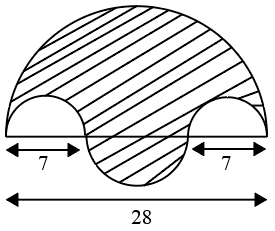
Loading solution...
An umbrella is made by stitching 10 triangular pieces of cloth of two different colours each piece measuring 30cm, 60cm, 60cm. How much cloth of each colour is required for Umbrella?
Loading solution...
If $$R_c=m\times\ln\left(1+\ \frac{\ R_m}{m}\right)$$ then $$R_m$$ is equal to
Loading solution...
If a labour output function for laundry service is described by the following equation: $$O = (a^\circ - 4L^\circ)^6$$, where L denotes Labour and O denotes output. Then, output ..........
Loading solution...
Assume that the taxes on petrol is 125% of the price of petrol per litre as received by the retailer minus the taxes. If in the last week, the petrol prices per litre as received by the retailer minus the taxes was 35, 34, 35.5, 37, 37.5 and 38, the average amount of tax collected per litre of petrol is
Loading solution...
Big Bang Theory cast wishes to find out the number of ways in which the word ASTRONAUT can be scrambled. They find that the number of ways in which it can be put in an unscrambling puzzle is?
Loading solution...
Students of an MBA school have got together to constitute a fund where each student has contributed Rs. 10000. This group of 20 students laid down certain rules for investment where it was agreed that 50 percent of the fund would be invested in riskless government securities while the rest 50 percent would be invested in equities. At the end of the year the group realizes that the crash in the stock market has left them with zero return on equities but 1 percent dividend gain on the shares bought. The return on the riskless government
security has been 7.8 percent in the last year. If the gains are to be divided equally, the gain per student is
Loading solution...
In the figure given below, a Cylinder is inserted into a cone and the vertical height of the cone is 30 cm. The diameter of the cylinder is 8. What is the volume of the cone? The base of the cylinder and the base of the cone are on the same plane.

Loading solution...
Nisha went to buy three types of stationery products, each of them were priced at Rs. 5, Rs, 2 and Rs. 1 respectively. She purchased all three types of products in more than one quantity and gave Rs. 20 to the shopkeeper. Since the shopkeeper had no change with him/her; he/she gave Nisha three more products of price Rs. 1 each. Find out the number of products with Nisha at the end of the transaction.
Loading solution...
If the ratio of sides of a rectangle is 2 : 7 and perimeter is 360 m, then find out its length and breadth.
Loading solution...
If the price of Sugar increases by 20%, and Salman intends to spend only an additional 5% on Sugar, then find out the percentage decrease in his sugar consumption.
Loading solution...
A man lends some money to his friend at 5% per annum of interest rate. After 2 years, the difference between the Simple and the compound interest on money is Rs. 50. What will be the value of the amount at the end of 3 years if compounded annually?
Loading solution...
Sham is trying to solve the expression:
$$\log \tan 1^\circ + \log \tan 2^\circ + \log \tan 3^\circ + ........ + \log \tan 89^\circ$$.
The correct answer would be?
Loading solution...
Sumit was doing a multiplication, but by mistake instead of taking 25 as one of the multiplier, he took 34. Now, because of this mistake, the answer was 405 more than the correct answer. Find out the answer that Sumit arrived at.
Loading solution...
How many different words can be formed with the word CUSTOM with a condition that the word should begin with M?
Assume that all words have 6 distinct letters.
Loading solution...
The number of ways that 5 Marathi, 3 English and 3 Tamil books be arranged if the books of each language are to be kept together is
Loading solution...
Excluding the halts, the speed of the bus is 50 km/ hr and including the halts it is 40 km/hr. For how many minutes does the bus stop per hour?
Loading solution...
A is able to do a piece of work in 10 days and B can do the same work in 15 days. If they can work together for four days, what is the fraction of work left?
Loading solution...
If 20% of x = y, then y% of 20 is same as
Loading solution...
In a running race, when one runner allows another runner to stay ahead at the start of the race, then it is termed as startup and when runners reach the finishing line at the same time, then it is termed as dead heat. In a race of 4 km distance, Anu wins by 600m over Binu. Binu can give a startup of 200m to Caira in a 4 km race. By how much distance should Caira get startup so that the race between Anu and Caira ends in dead heat in the same race of 4 km?
Loading solution...
Mr. Sandeep was placing an order with his carpenter to make wooden boxes to pack his cotton toys which were to be delivered to his friend. Sandeep wanted 2 types of boxes. The larger one with a dimension of 25cm x 20cm x 5cm and the smaller box with a dimension of 15cm x 12cm x 5cm. Sandeep also told the carpenter that 5% of total surface area is required as extra to cover the overlaps. If the cost of the wood is Rs.4/- cmz, the cost of wood required for supplying 250 boxes of each type would be Rs. ______.
[Note:-D0 NOT include spaces in your answer)
Loading solution...
David is trying to solve the expression :-
$$\frac{(4)^2 \times 2^{n + 1} - 4 \times 2^n}{(4)^2 \times 2^{n + 2} - 2 \times 2^{n + 2}}$$
And you help him to do the same and finally arrive at the answer with correct to one decimal which would be -
(Note:- DO NOT include spaces in your answer)
Loading solution...
Mahesh has a toy which has the shape of a trapezium. The two sides which are parallel have a length of 60 cm and 77 cm and the other sides are 25 cm and 26 cm. He requests you to calculate the area and you help him to arrive at the correct answer which is sq.cm.
[Note:- DO NOT include spaces in your answer)
Loading solution...
Ramesh is trying to Simplify the expression
$$(p + q)^3 - (p -q)^3 - 6q(p^2 - q^2)$$ and if $$q = 1$$-
You helped him and the solution arrived was..........
Loading solution...
In Roman Numerals, a number has been written as MMXVIII. In Arabic numbers it will be ............
(Note:- DO NOT include spaces in your answer)
Loading solution...
Find the odd man out
Loading solution...
Find the odd man out
Loading solution...
Choose the appropriate words from the options given to fill in the blanks in the given sentence.
The young man said that he had no _____ riches.
Loading solution...
She kept all her _____ in the bank locker.
Loading solution...
I wish ________ that Harish was ill, I would have gone to see him.
Loading solution...
Choose the correct meaning of the following idiom:
Mea Culpa
Loading solution...
Find a correct match of grammatical function with the usage of the word STILL

Loading solution...
Find a correct match of grammatical function with the usage of the word WELL

Loading solution...
Select the pair that best expresses the relationship similar to that expressed in this pair - turmoil: confusion
Loading solution...
Directions for questions 80 and 81: Choose the correct conjunction:
Do not eat the cake, wait your friends come.
Loading solution...
Study hard _ you will not pass the exam.
Loading solution...
Choose the synonym of : Usurp
Loading solution...
Choose the synonym of : Flagrant
Loading solution...
Choose the antonym of : Ostentatious
Loading solution...
Change the speech: "I have won the race!"
Loading solution...
Change the speech: "Wait there till I get back please." she told the boys.
Loading solution...
: The options given below combine to form a meaningful sentence. Identify the erroneous statement from among the options:
1. I am fully aware that
2. my wife is one of those
3. who is totaly committed
4. to the family and its wellbeing.
Loading solution...
1. He made me to wait
2. for him, while he
3. changed his coat,
4. as it was cold.
Loading solution...
Look at the underlined part of the sentence below. The sentence is given three possible substitutes for the underlined part. If one of them is better than the underlined part, mark that as the answer. If none of the substitutions improve the sentence, mark no improvement as your answer.
The winter was such severe that even water in the taps was frozen and this created a lot of inconvenience to everyone in the family.
Loading solution...
The members of his family are coming in this train and I am sure that it will be a memorable trip for all of them.
Loading solution...
Some words are given below. In which order should they be arranged to give an affirmative sentence, so that the part of the day comes last?
AT / EVENING / AGAIN / LAST / MET / WE / HER / HOSPITAL / THE
1 2 3 4 5 6 7 8 9
(Note:— DO NOT include spaces in your answer)
Loading solution...
In a class, Roll No 101 states that the plural of the word CRISIS is CRISES. Roll No 102 states that the plural is CRISISES, and Roll No 103 states that the plural is CRISIS itself. The Roll No of the student who gave the correct answer is
[Notez- DO NOT include spaces in your answer)
Loading solution...
There are 4 boards in a business school which have displayed the meaning of the term that means "A process in which an independent person makes an official decision that ends a legal disagreement without the need for it to be solved in court."
Board 1: ARBITRATION
Board 2: ARBITERATION
Board 3: ARBETRATION
Board 4: ARBITATION
The board that has displayed the correct spelling of the term is Board No:
(Note:- DO NOT include spaces in your answer)
Loading solution...
In an English Test, Column A gives a word, Column B gives its past participle and Column C gives the code of the pair as below:

Which Code should Shamu choose, if he is asked to choose the correct pair of word and its corresponding past participle?
(Note:- DO NOT include spaces in your answer)
Loading solution...
Four friends 1, 2, 3 and 4 are arguing on who is right in stating an English proverb.
1. states that the correct proverb is "A swarm in May is worth a load of hay; a swarm in June is worth a full moon; but a swarm in July is not worth a fly."
2. states that the proverb is "A swarm in May is worth a load of hay; a swarm in June is worth a looney toon; but a swarm in July is not worth a fly."
3. states the proverb as "A swarm in May is worth a load of hay; a swarm in June is worth a silver spoon ; but a swarm in July is not worth a fly."
4. states that the proverb actually is "A swarm in May is worth a load of hay; a swarm in June is worth a golden boon; but a swarm in July is not worth a fly."
Who is correct in stating the proverb?
(Note:- DO NOT include spaces in your answer)
Loading solution...
Read the following passage and answer the questions that follow.
ASSOCIATED PRESS
San Francisco August 13 2018
Google wants to know where you go so badly that it records your movements even when you explicitly tell it not to. An Associated Press investigation found that many Google services on Android devices and iPhones store your location data even if you've used privacy settings that say they will prevent it from doing so. Computer science researchers at Princeton confirmed these findings at the AP's request. For the most part, Google is upfront about asking permission to use your location information. An app like Google Maps will remind you to allow access to location if you use it for navigating. If you agree to let it record your location over time, Google Maps will display that history for you in a "timeline" that maps out your daily movements. Storing your minute-by—minute travels carries privacy risks and has been used by police to determine the location of suspects - such as a warrant that police in North Carolina, served on Google last year to find devices near a murder scene. So the company will let you "pause' a setting called Location History. Google says this will prevent the company from remembering where you have been. Google’s support page on the subject states. "You can turn off Location History at any time. With Location History off, the places you go are no longer stored”. That isn’t true. Even with Location History paused, some Google apps automatically store time — stamped location data without asking. For example, Google stores a snapshot of where you are when you merely open its Maps app. Automatic daily weather updates on Android phones pinpoint roughly where you are. And some searches that have nothing to do with location, like “chocolate chip cookies" or "kids science kits," pinpoint your precise latitude and longitude — accurate to the square foot and save it to the Google account. The privacy issue affects some two billion users of devices that run Google's Android operating software and hundreds of millions of world wide iPhone users who rely on Google for maps or search. Storing location data in violation of a user’s preferences is wrong, said Ionathon Mayer, a Princeton computer scientist. A researcher from Mayer’s lab confirmed the AP's findings; the AP conducted its own tests on several iPhones that found the same behaviour. “If you are going to allow users to turn off something called ‘Location History‘, then all the places where you maintain ‘Location History' should be turned off," Mayer said. "That seems like a pretty straightforward position to have”. Google says it is being perfectly clear. "There are a number of different ways that Google may use location to improve people’s experience, including: Location History, Web and App activity and through device-level Location Services" a Google spokesperson said. "We provide clear descriptions of these tools, and robust controls, so people can turn them on and off, and delete their histories at any time." To stop Google from saving these location markers, the company says, users can turn off another setting, one that does not specifically reference location information. Called "Web and App activity" and enabled by default, that setting stores a variety of information from Google apps and websites to your Google account. When paused, it will prevent activity on any device from being saved to your account But leaving "Web and App activity” on and turning "Location History" off only prevents Google from adding your movements to the "timeline", its visualization of your daily travels. It does not stop Google’s collection of other location markers.
For the most part, Google is upfront about asking permission to use your location information. This sentence means:
Loading solution...
When the author says : ‘That isn't true' to Google's claim that "you can turn off Location History at any time....and the places you go are no longer stored" ...he means
Loading solution...
How many users does the privacy issue affect?
Loading solution...
What does the author mean when he says: ‘It does not stop Google’s collection of other location markers?
Loading solution...
An appropriate title to this passage would be:
Loading solution...
Read the following passage and answer the questions that follow.
Frederic Bastiat, who was that rarest of creatures, a French free-market economist, wrote to this newspaper in 1846 to express a noble and romantic hope: ”May all the nations soon throw down the barriers which separate them." Those words were echoed 125 years later by the call of John Lennon, who was not an economist but a rather successful global capitalist, to "imagine there's no countries”. As he said in his 1971 song. it isn't hard to do. But despite the spectacular rise in living standards that has occurred as barriers between nations have fallen, and despite the resulting escape from poverty by hundreds of millions of people in those places that have joined the world economy, it is still hard to convince publics and politicians of the merits of openness. Now, once again, a queue is forming to denounce openness—i.e, globalisation. It is putting at risk the next big advance in trade liberalisation and the next big reduction in poverty in the developing countries. The world will find out, to some extent, next month when ministers from the 148 countries in the WTO meet in Hong Kong. The last time they gathered for such a crucial meeting was in September 2003 in Cancun, and the result was a shambles. There was a bitter row between rich countries and poor ones, and the meeting broke up in acrimony. At that stage, however, there was still plenty of time to repair the damage. For in effect, the deadline for the Doha round comes in June 2007, when the trade-negotiating authority granted by Congress to President Bush expires. But, although that leaves more than a year and a half after Hong Kong, the complexity of a negotiation involving 148 countries and scores of highly technical issues means that the deal really needs to be done during 2006, with the political framework for it set early on—which essentially means in Hong Kong. The case for selfish generosity Trade- liberalisation rounds are arcane affairs about which free-traders are often thought to cry wolf. The previous talks, known as the Uruguay round, went through lots of brinkmanship and delays before they were completed. The result was still disappointing in many ways, especially to developing countries, and yet, since the round's completion in 1993, the world economy has grown lustily and the biggest developing countries, China, India and Brazil, have all burst on to the global trading scene. Would the world really be hurt if the EU merely refuses to expose its farmers to more competition? The likeliest outcome both from the Hong Kong meeting and the eventual Doha agreement is a compromise—as always. The European position is feeble but not risible, for it has offered an overall average cut in its farm tariffs of 39%, up from 25% only a month ago, though with rather a lot of loop holes that could severely limit the benefits. France, and other European farm protectionists, may prove more flexible than they currently imply: this is hardly the first time they have promised to man the barricades shortly before striking a deal. Yet though some sort of fudge in Hong Kong must be likely, with the Americans lowering their ambition and the Europeans raising theirs a little, such an outcome would still represent both a missed opportunity and a risk. The missed opportunity is that Doha has offered the first proper chance to involve developing countries in trade negotiations—they now make up two- thirds of the WTO members—but also thereby to use a full exchange of agricultural, industrial and service liberalisations to make a big advance in free trade that could benefit a wide range of countries. Some of that progress may still be made, even in a fudged deal: Brazil, for example, stands to benefit hugely from freer trade in agriculture, so it should be willing to promote other concessions in return. India is reluctant to cut its own farm tariffs but has a big interest in liberalising trade in services, wanting more freedom in everything from finance to health care to entertainment But if the rich world could gird itself to be more ambitious on agriculture, the gains would be even greater: help for the poorest countries, making the rich look generous; better access to the biggest and richest developing countries for western companies; and a rise in global income in a decade's time of $300 billion a year (says the World Bank), which would thus help everyone. The risk is that failure to agree on a new wave of openness during a period [the past two years) in which the world economy has been growing at its fastest for three decades, with more countries sharing in that growth than ever before, will set a sour political note for what may well be tougher times ahead. A turn away from trade liberalisation just ahead of an American recession, say, or a Chinese economic slowdown, could open up a chance not just for a slowdown in progress but for a rollback Currently, for example, the Schumer bill to put a penal tariff on Chinese goods looks unlikely to pass. If American unemployment were rising and world trade talks had turned acrimonious, that might change. So might the political wind in many developing countries. If so, that would be a tragedy for the whole world. Although the case for reducing poverty by sending more aid to the poorest countries has some merit, the experience of China, South Korea, Chile and India shows that the much better and more powerful way to deal with poverty is to use the solution that worked in the past in America, western Europe and japan: open, trading economies, exploiting the full infrastructure of capitalism (including financial services) amid a rule of law provided by government In other words, globalisation. To paraphrase Samuel Johnson, anyone who is tired of that, is tired of life.
According to the article, why is Frederic Bastiat called the "rarest of creatures"?
Loading solution...
Who was John Lennon?
Loading solution...
According to the article, the better way to deal with poverty is:
Loading solution...
"Trade-liberalisation rounds are arcane affairs". The adjective arcane means:
Loading solution...
As per the article, India’s position with respect to the talks is:
Loading solution...
The Statue of Unity, built as a tribute to the first was inaugurated on Oct 31, 2018.
Loading solution...
In August 2018, Intel was overtaken by as the world's largest chipmaker, has made a major move into the autonomous driving space, with its acquisition of Israeli visual sensor company Mobileye.
Loading solution...
In 2017, Facebook acquired the video editing technology company named
Loading solution...
In October 2018, , the ex-director of Amazon joined as a Chief Technology and Product Officer (CTPO) for Chqbookcom., the Gurgaon based financial technology startup.
Loading solution...
Recently the of the RBI Act came into spotlight amid the war between the Central government and the Reserve Bank of India (RBI). The provision in the RBI Act empowers the government to issue directions to the RBI.
Loading solution...
The Prime Minister of India, on September 23, 2018, rolled out the , touted as the world's largest healthcare scheme. The insurance scheme provides an annual health cover of Rs 5 lakhs per family for secondary and tertiary care hospitalization.
Loading solution...
Recently, Tata Motor's, first SUV built on Land Rover's D8 architecture was developed in collabration with jaguar Land Rover. It is called
Loading solution...
In September 2018, and were all set to acquire Aditya Birla Groups Food and grocery retail chain, even as investment bank exited the consortium.
Loading solution...
The world's first holographic screen phone has a holographic screen that produces 3-D visuals without needing special glasses.
Loading solution...
Almost six months after chief economic advisor Arvind Subramanian left the finance ministry, the government has recently appointed to the post.
Loading solution...
Assembly Polls were held in between November 2018 to December 2018.
Loading solution...
The Political party floated by the actor turned politician Kamal Haasan is
Loading solution...
In lune 2018, was appointed MD and CEO of IDBI Bank in place of who took
charge as Deputy Governer of Reserve Bank of India.
Loading solution...
In October 2018, received the Champions of the Earth, a top United Nations honour that recognises contribution in the field of environment and environment protection.
Loading solution...
In September 2018, was appointed as the Vice Chairman of the University Grants
Commission.
Loading solution...
In December 2017, bought Foodpanda India from its German parent Delivery
in a stock deal pegged at about $30 Million, entering a resurgent food-delivery market that has matured and become more competitive.
Loading solution...
In October 2018, Dish TV— India's first and largest direct-to-home (DTH) company, signed up as its brand ambassador as it is planning to woo the younger audience with its largest brand campaign.
Loading solution...
Who is the person shown in the picture below who won the Ramon Magsaysay Award 2018?

Loading solution...
The Nobel Peace Prize 2018 was awared jointly to and for their efforts to end
the use of sexual violence as a weapon of war and armed conflict;
Loading solution...
From the beginning of 2018 which of these sectors has been allowed for automatic hundred per cent foreign direct investment (FDI) in India?
Loading solution...
The 2018 Asian Games were held in how many cities of Indonesia?
(Note:- DO NOT include spaces in your answer)
Loading solution...
The Ministry of Agriculture and Farmer Welfare launched the Krishi Kalyan Abhiyan from the _th month of 2018 which could lead and advise farmers on the means to improve their farming techniques.
(Note:- DO NOT include spaces in your answer)
Loading solution...
What was the rank of India in 2018 United Nation World Happiness Index Report?
(Note:- DO NOT include spaces in your answer)
Loading solution...
.......... was the number of seats won by the party who got majority in Chhatisgarh in recent 2018 Vidhan Sabha elections.
(Note:-DO NOT include spaces in your answer)
Loading solution...
How many persons were awarded the Nobel Prize in Economic Sciences in 2018
(Note:- DO NOT include spaces in your answer)
Loading solution...
Start your IIM journey with the right preparation and crack CAT 2026.

Educational materials for CAT preparation
 Share
Share