For the following questions answer them individually
Given below are two statements. One is labelled as Assertion (A) and the other is labelled as Reason (R).
Assertion (A) :
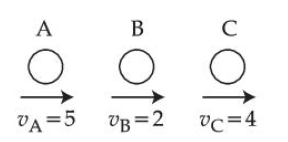
Three identical spheres of same mass undergo one dimensional motion as shown in figure with initial velocities $$v_A = 5\,\text{m/s},\; v_B = 2\,\text{m/s},\; v_C = 4\,\text{m/s}$$. If we wait sufficiently long for elastic collision to happen, then $$v_A = 4\,\text{m/s},\; v_B = 2\,\text{m/s},\; v_C = 5\,\text{m/s}$$, will be the final velocities.
Reason (R): In an elastic collision between identical masses, two objects exchange their velocities. In the light of the above statements, choose the correct answer from the options given below :
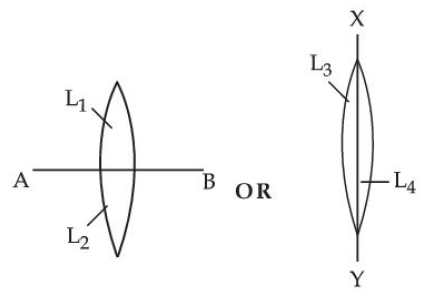
Two identical symmetric double convex lenses of focal length f are cut into two equal parts $$L_{1}, L_{2}$$ by AB plane and $$L_{3}, L_{4}$$ by XY plane as shown in figure respectively. The ratio of focal lengths of lenses $$L_{1}$$ and $$L_{3}$$ i
Two bodies A and B of equal mass are suspended from two massless springs of spring constant $$k_{1}$$ and $$k_{2}$$, respectively. If the bodies oscillate vertically such that their amplitudes are equal, the ratio of the maximum velocity of A to the maximum velocity of B is
Given below are two statements. One is labelled as Assertion (A) and the other is labelled as Reason (R).
Assertion (A) : With the increase in the pressure of an ideal gas, the volume falls off more rapidly in an isothermal process in comparison to the adiabatic process.
Reason (R) : In isothermal process, PV = constant, while in adiabatic process $$PV^{\gamma}$$ = constant. Here $$\gamma$$ is the ratio of specific heats, P is the pressure and V is the volume of the ideal gas. In the light of the above statements, choose the correct answer from the options given below :

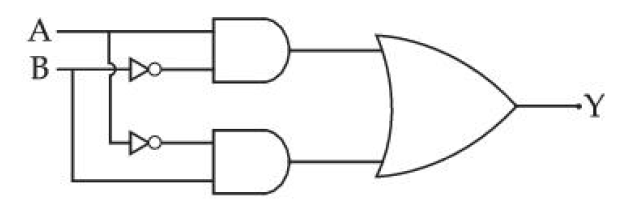
The truth table for the circuit given below is :
The difference of temperature in a material can convert heat energy into electrical energy. To harvest the heat energy, the material should have
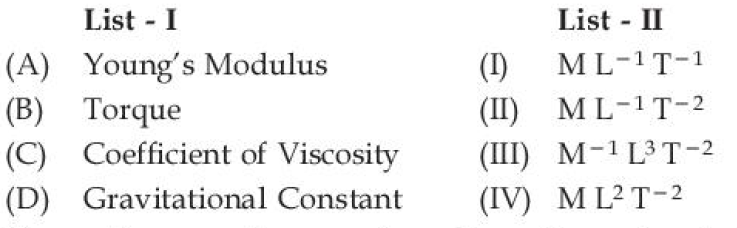
Match List - I with List - II.
Choose the correct answer from the options given below :
A sand dropper drops sand of mass m(t) on a conveyer belt at a rate proportional to the square root of speed (v)of the belt, i.e. $$\frac{dm}{dt} \propto \sqrt{v}$$. If P is the power delivered to run the belt at constant speed then which of the following relationship is true?
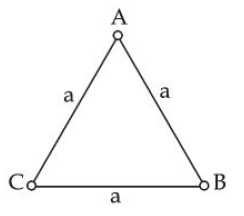
Three equal masses m are kept at vertices (A, B, C) of an equilateral triangle of side a in free space. At t=0, they are given an initial velocity $$\vec{V}_A = V_0 \overrightarrow{AC}$$, $$\vec{V}_B = V_0 \overrightarrow{BA}$$ and $$\vec{V}_C = V_0 \overrightarrow{CB}$$. Here $$\overrightarrow{AC}$$, $$\overrightarrow{CB}$$ and $$\overrightarrow{BA}$$ are unit vectors along the edges of the triangle. If the three masses interact gravitationally, then the magnitude of the net angular momentum of the system at the point of collision is :
The number of spectral lines emitted by atomic hydrogen that is in the $$4^{th}$$ energy level, is
A convex lens made of glass (refractive index = 1.5) has focal length 24 cm in air. When it is totally immersed in water (refractive index 1.33), its focal length changes to
In an experiment with photoelectric effect, the stopping potential,
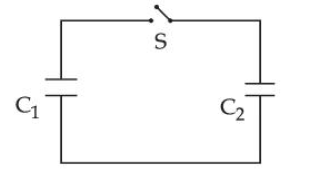
A capacitor $$C_1 = 6\,\mu\text{F}$$, is charged to a potential difference of $$V_{0} = 5$$ using a 5 V battery. The battery is removed and another capacitor, $$C_2 = 12\,\mu\text{F}$$ is inserted in place of the battery. When the switch 'S' is closed, the charge flows between the capacitors for some time until equilibrium condition is reached. What are the charges ($$q_{1}$$ and $$q_{2}$$ on the capacitors $$C_{1}$$ and $$C_{2}$$ when equilibrium condition is reached.
A plane electromagnetic wave propagates along the +x direction in free space. The components of the electric field, $$\vec{E}$$ and magnetic field, $$\vec{B}$$
vectors associated with the wave in Cartesian frame are
A cup of coffee cools from $$90^{\circ}$$ to $$80^{\circ}$$ in t minutes when the room temperature is $$20^{\circ}$$. The time taken by the similar cup of coffee to cool from $$80^{\circ}$$ to $$60^{\circ}$$ at the same room temperature is :

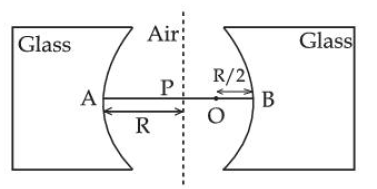
Two concave refracting surfaces of equal radii of curvature and refractive index 1.5 face each other in air as shown in figure. A point object O is placed midway, between P and B . The separation between the images of O , formed by each refracting surface is :
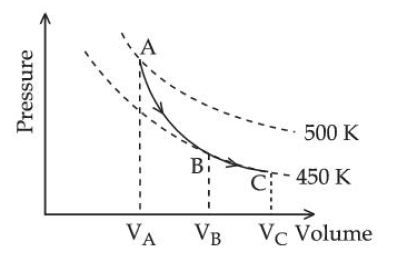
A poly-atomic molecule ($$C_V = 3R,\, C_P = 4R$$, where R is gas constant) goes from phase space point $$A\ (P_A = 10^5\,\text{Pa},\ V_A = 4 \times 10^{-6}\,\text{m}$$ to point $$B\ (P_B = 5 \times 10^4\,\text{Pa},\ V_B = 6 \times 10^{-6}\,\text{m}^3)$$ to point $$C\,(P_C = 10^4\,\text{Pa},\; V_C = 8 \times 10^{-6}\,\text{m}^3).$$ A to B is an adiabatic path B and C to is an isothermal path. The net heat absorbed per unit mole by the system is :
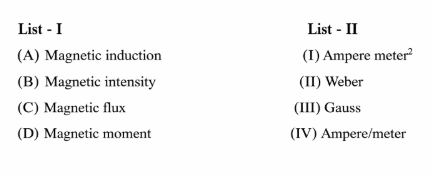
Match List - I with List - II.
A point charge causes an electric flux of $$-2 \times 10^{4}\,\text{N m}^2 \text{C}^{-1}$$ to pass through a spherical Gaussian surface of 8.0 cm radius, centred on the charge. The value of the point charge is : (Given $$\varepsilon_0 = 8.85 \times 10^{-12}\,\text{C}^2 \text{N}^{-1} \text{m}^{-2}$$ )
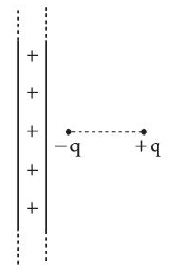
An electric dipole is placed at a distance of 2 cm from an infinite plane sheet having positive charge density $$\sigma_{0}$$.
Choose the correct option from the following.
The magnetic field inside a 200 turns solenoid of radius 10 cm is 2.9 $$\times$$ $$10^{-4}$$ Tesla . If the solenoid carries a current of 0.29 A , then the length of the solenoid is ________ $$\pi$$ cm.
A parallel plate capacitor consisting of two circular plates of radius 10 cm is being charged by a constant current of 0.15 A . If the rate of change of potential difference between the plates is $$7 \times 10^{8}\,\text{V/s}$$ then the integer value of the distance between the parallel plates is (Take $$\varepsilon_0 = 9 \times 10^{-12}\,\frac{F}{m},\ \pi = \frac{22}{7}$$), ________ $$\mu\text{m}$$.
Two planets, A and B are orbiting a common star in circular orbits of radii $$R_{A}$$ and $$R_{B}$$, respectively, with $$R_{B} = 2R_{A}$$. The planet B is $$4\sqrt{2}$$ times more massive than planet A. The ratio $$\left(\frac{L_{B}}{L_{A}}\right)$$ of angular momentum $$(L_{B})$$ of planet B to that of planet $$A(L_{A})$$ is closest to integer ________.
Two cars P and Q are moving on a road in the same direction. Accleration of car P increases linearly with
time whereas car Q moves with a constant accleration. Both cars cross each other at time t=0, for the first
time. The maximum possible number of crossing(s) (including the crossing at t=0) is ________.
A physical quantity Q is related to four observables a,b,c,d as follows : $$Q = \frac{ab^{4}}{cd}$$ where, $$a = (60 \pm 3)\,\text{Pa}$$; $$b = (20 \pm 0.1)\,\text{m}$$; $$c = (40 \pm 0.2)\,\text{Nsm}^{-2}$$; and $$d = (50 \pm 0.1)\,\text{m}$$ , then the percentage error in Q is $$\frac{x}{1000}$$ , where x = ________ .