
Join Our JEE Preparation Group
Prep with like-minded aspirants; Get access to free daily tests and study material.
Sign in
Please select an account to continue using cracku.in
↓ →
Join Our JEE Preparation Group
Prep with like-minded aspirants; Get access to free daily tests and study material.
A capacitor $$C_1 = 6\,\mu\text{F}$$, is charged to a potential difference of $$V_{0} = 5 V$$ using a battery. The battery is removed and another capacitor, $$C_2 = 12\,\mu\text{F}$$ is inserted in place of the battery. When the switch 'S' is closed, the charge flows between the capacitors for some time until equilibrium condition is reached. What are the charges ($$q_{1}$$ and $$q_{2}$$ on the capacitors $$C_{1}$$ and $$C_{2}$$ when equilibrium condition is reached.
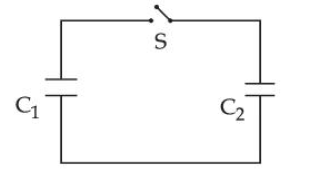
step 1: initial condition
only $$C_1$$ is charged:
$$q_{\text{initial}}=C_1V=6\mu F\times5=30\mu C$$
$$C_2$$ is uncharged
step 2: after switch is closed
the two capacitors are connected in parallel (like plates joined)
so:
• total charge is conserved = 30 μC
• final voltage across both is same
step 3: find final voltage
$$C_{\text{eq}}=C_1+C_2=6+12=18\mu F$$
$$V_f=\frac{Q_{\text{total}}}{C_{\text{eq}}}=\frac{30}{18}=\frac{5}{3}\text{ V}$$
step 4: final charges
$$q_1=C_1V_f=6\times\frac{5}{3}=10\mu C$$
$$q_2=C_2V_f=12\times\frac{5}{3}=20\mu C$$
Was this solution helpful?
Click on the Email ☝️ to Watch the Video Solution
Create a FREE account and get:
_1.webp)

Educational materials for JEE preparation

Ask our AI anything

AI can make mistakes. Please verify important information.
AI can make mistakes. Please verify important information.
