For the following questions answer them individually
In the density measurement of a cube, the mass and edge length are measured as $$(10.00 \pm 0.10)$$ kg and $$(0.10 \pm 0.01)$$ m, respectively. The error in the measurement of density is:
A ball is thrown vertically up (taken as +z-axis) from the ground. The correct momentum-height (p-h) diagram is:
The stream of a river is flowing with a speed of 2 km h$$^{-1}$$. A swimmer can swim at a speed of 4 km h$$^{-1}$$. The direction of the swimmer with respect to the flow of the river, to cross the river straight, is:
A uniform cable of mass $$M$$ and length $$L$$ is placed on a horizontal surface such that its $$\left(\frac{1}{n}\right)^{th}$$ part is hanging below the edge of the surface. To lift the hanging part of the cable upto the surface, the work done should be:
A body of mass 2 kg makes an elastic collision with a second body at rest and continues to move in the original direction but with one fourth of its original speed. What is the mass of the second body?
A stationary horizontal disc is free to rotate about its axis. When a torque is applied on it, its kinetic energy as a function of $$\theta$$, where $$\theta$$ is the angle by which it has rotated, is given as $$k\theta^2$$. If its moment of inertia is I then the angular acceleration of the disc is:
The following bodies are made to roll up (without slipping) the same inclined plane from a horizontal plane: (i) a ring of radius R, (ii) a solid cylinder of radius $$\frac{R}{2}$$ and (iii) a solid sphere of radius $$\frac{R}{4}$$. If, in each case, the speed of the center of mass at the bottom of the incline is same, the ratio of the maximum heights they climb is:
A solid sphere of mass M and radius a is surrounded by a uniform concentric spherical shell of thickness 2a and mass 2M. The gravitational field at distance 3a from the centre will be:
If 'M' is the mass of water that rises in a capillary tube of radius 'r', then mass of water which will rise in a capillary tube of radius '2r' is:
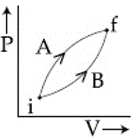
Following figure shows two processes A and B for a gas. If $$\Delta Q_A$$ and $$\Delta Q_B$$ are the amount of heat absorbed by the system in two cases, and $$\Delta U_A$$ and $$\Delta U_B$$ are changes in internal energies, respectively, then:
For given gas at 1 atm pressure, rms speed of the molecules is 200 m/s at 127°C. At 2 atm pressure and at 227°C, the rms speed of the molecules will be:
An HCl molecule has rotational, translational and vibrational motions. If the rms velocity of HCl molecules in its gaseous phase is $$\bar{v}$$, m is its mass and k$$_B$$ is Boltzmann's constant, then its temperature will be:
A simple pendulum oscillating in air has period T. The bob of the pendulum is completely immersed in a non-viscous liquid. The density of the liquid is $$\frac{1}{16}$$th of the material of the bob. If the bob is inside liquid all the time, its period of oscillation in this liquid is:
A string is clamped at both the ends and it is vibrating in its 4th harmonic. The equation of the stationary wave is $$y = 0.3 \sin(0.157x) \cos(200\pi t)$$. The length of the string is: (All quantities are in SI units.)
The pressure wave, $$P = 0.01 \sin[1000t - 3x]$$ N m$$^{-2}$$, corresponds to the sound produced by a vibrating blade on a day when atmospheric temperature is 0°C. On some other day when temperature is T, the speed of sound produced by the same blade and at the same frequency is found to be 336 m s$$^{-1}$$. Approximate value of T is:
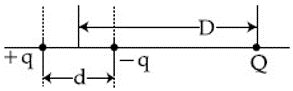
A system of three charges are placed as shown in the figure:
If $$D >> d$$, the potential energy of the system is best given by:
A capacitor with capacitance 5 $$\mu$$F is charged to 5 $$\mu$$C. If the plates are pulled apart to reduce the capacitance to 2 $$\mu$$F, how much work is done?
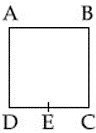
A wire of resistance R is bent to form a square ABCD as shown in the figure. The effective resistance between E and C is: (E is mid-point of arm CD)
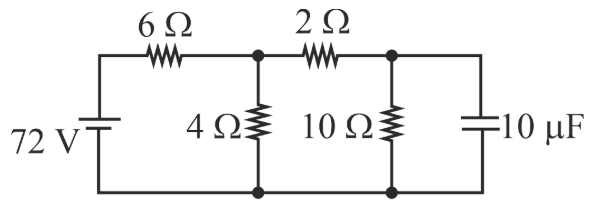
Determine the charge on the capacitor in the following circuit:
A moving coil galvanometer has resistance 50 $$\Omega$$ and it indicates full deflection at 4 mA current. A voltmeter is made using this galvanometer and a 5 k$$\Omega$$ resistance. The maximum voltage, that can be measured using this voltmeter, will be close to:
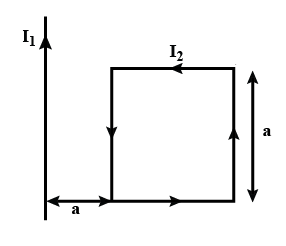
A rigid square loop of side 'a' and carrying current $$I_2$$ is lying on a horizontal surface near a long current $$I_1$$ carrying wire in the same plane as shown in figure. The net force on the loop due to the wire will be:
A rectangular coil (Dimension 5 cm $$\times$$ 2.5 cm) with 100 turns, carrying a current of 3 A in the clock-wise direction, is kept centered at the origin and in the X-Z plane. A magnetic field of 1 T is applied along X-axis. If the coil is tilted through 45° about Z-axis, then the torque on the coil is:
The total number of turns and cross-section area in a solenoid is fixed. However, its length L is varied by adjusting the separation between windings. The inductance of solenoid will be proportional to:
The magnetic field of a plane electromagnetic wave is given by $$\vec{B} = B_0[\hat{i}\cos(kz - \omega t)] + B_1[\hat{j}\cos(kz + \omega t)]$$, where $$B_0 = 3 \times 10^{-5}$$ T and $$B_1 = 2 \times 10^{-6}$$ T. The RMS value of the force experienced by a stationary charge $$Q = 10^{-4}$$ C at z = 0 is closest to:
A concave mirror for face viewing has a focal length of 0.4 m. The distance at which you hold the mirror from your face in order to see your image upright with a magnification of 5 is:
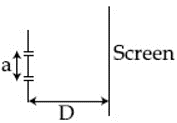
The figure shows a Young's double slit experimental setup. It is observed that when a thin transparent sheet of thickness t and refractive index $$\mu$$ is put in front of one of the slits, the central maximum gets shifted by a distance equal to n fringe width. If the wavelength of light used is $$\lambda$$ then t will be:
The electric field of light wave is given as $$\vec{E} = 10^{-3} \cos\left(\frac{2\pi x}{5 \times 10^{-7}} - 2\pi \times 6 \times 10^{14}t\right) \hat{x} \frac{N}{C}$$. This light falls on a metal plate of work function 2 eV. The stopping potential of the photo-electrons is: Given, E (in eV) = $$\frac{12375}{\lambda(\text{in } \mathring{A})}$$
Taking the wavelength of first Balmer line in hydrogen spectrum (n = 3 to n = 2) as 660 nm, the wavelength of the 2nd Balmer line (n = 4 to n = 2) will be:
An NPN transistor is used in common emitter configuration as an amplifier with 1 k$$\Omega$$ load resistance. Signal voltage of 10 mV is applied across the base-emitter. This produces a 3 mA change in the collector current and 15 $$\mu$$A change in the base current of the amplifier. The input resistance and voltage gain are:
A signal A cos$$\omega$$t is transmitted using $$v_0 \sin\omega_0 t$$ as carrier wave. The correct amplitude modulated (AM) signal is: