Join WhatsApp Icon JEE WhatsApp Group

NTA JEE Main 8th April 2017 Online - Physics

For the following questions answer them individually

Time ($$T$$), velocity ($$C$$) and angular momentum ($$h$$) are chosen as fundamental quantities instead of mass, length and time. In terms of these, the dimensions of mass would be:

An object is dropped from a height $$h$$ from the ground. Every time it hits the ground it loses 50% of its kinetic energy. The total distance covered as $$t \to \infty$$ is:

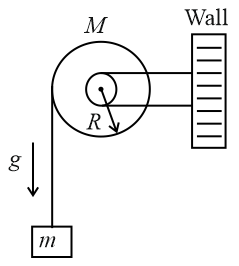
A uniform disc of radius $$R$$ and mass $$M$$ is free to rotate only about its axis. A string is wrapped over its rim and a body of mass $$m$$ is tied to the free end of the string as shown in the figure. The body is released from rest. Then the acceleration of the body is:

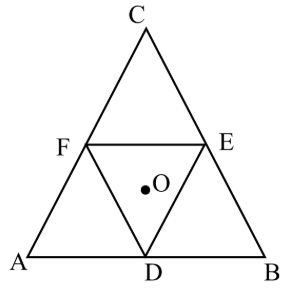
Moment of inertia of an equilateral triangular lamina $$ABC$$, about the axis passing through its centre $$O$$ and perpendicular to its plane is $$I_0$$ as shown in the figure. A cavity $$DEF$$ is cut out from the lamina, where $$D$$, $$E$$, $$F$$ are the mid points of the sides. Moment of inertia of the remaining part of lamina about the same axis is:

image

In a physical balance working on the principle of moments, when 5 mg weight is placed on the left pan, the beam becomes horizontal. Both the empty pans of the balance are of equal mass. Which of the following statements is correct?

If the Earth has no rotational motion, the weight of a person on the equator is $$W$$. Determine the speed with which the earth would have to rotate about its axis so that the person at the equator will weigh $$\frac{3}{4}W$$. The radius of the Earth is 6400 km and $$g = 10$$ m s$$^{-2}$$.

A compressive force, $$F$$ is applied at the two ends of a long thin steel rod. It is heated, simultaneously, such that its temperature increases by $$\Delta T$$. The net change in its length is zero. Let $$l$$ be the length of the rod, $$A$$ its area of cross-section, $$Y$$ its Young's modulus, and $$\alpha$$ its coefficient of linear expansion. Then, $$F$$ is equal to:

In an experiment, a sphere of aluminium of mass 0.20 kg is heated up to 150°C. Immediately, it is put into water of volume 150 cc at 27°C kept in a calorimeter of water equivalent to 0.025 kg. The final temperature of the system is 40°C. The specific heat of the aluminium is (take 4.2 Joule = 1 calorie):

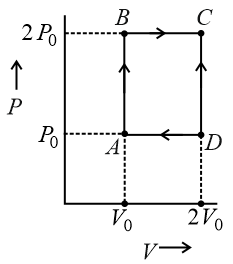
An engine operates by taking $$n$$ moles of an ideal gas through the cycle $$ABCDA$$ shown in figure. The thermal efficiency of the engine is: (Take $$C_v = 1.5R$$, where $$R$$ is gas constant)

The ratio of maximum acceleration to maximum velocity in a simple harmonic motion is 10 s$$^{-1}$$. At, $$t = 0$$ the displacement is 5 m. What is the maximum acceleration? The initial phase is $$\frac{\pi}{4}$$.

A 1 kg block attached to a spring vibrates with a frequency of 1 Hz on a frictionless horizontal table. Two springs identical to the original spring are attached in parallel to a 8 kg block placed on the same table. So, the frequency of vibration of the 8 kg block is:

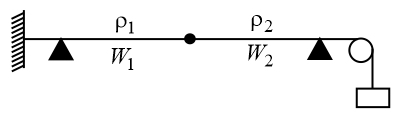
Two wires $$W_1$$ and $$W_2$$ have the same radius $$r$$ and respective densities $$\rho_1$$ and $$\rho_2$$, such that $$\rho_2 = 4\rho_1$$. They are joined together at the point $$O$$, as shown in the figure. The combination is used as a sonometer wire and kept under tension $$T$$. The point $$O$$ is midway between the two bridges. When a stationary wave is set up in the composite wire, the joint is found to be a node. The ratio of the number of antinodes formed in $$W_1$$ to $$W_2$$ is:

There is a uniform electrostatic field in a region. The potential at various points on a small sphere centred at $$P$$, in the region, is found to vary between the limits 589.0 V to 589.8 V. What is the potential at a point on the sphere whose radius vector makes an angle of 60° with the direction of the field?

The energy stored in the electric field produced by a metal sphere is 4.5 J. If the sphere contains 4 $$\mu$$C charge, its radius will be: $$\left[\text{Take } : \frac{1}{4\pi\epsilon_0} = 9 \times 10^9 \text{ N m}^2 \text{ C}^{-2}\right]$$


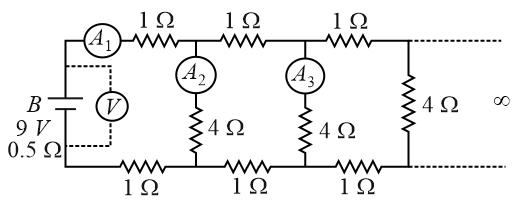
A 9 V battery with an internal resistance of 0.5 $$\Omega$$ is connected across an infinite network, as shown in the figure. All ammeters $$A_1$$, $$A_2$$, $$A_3$$ and voltmeter $$V$$ are ideal. Choose the correct statement.

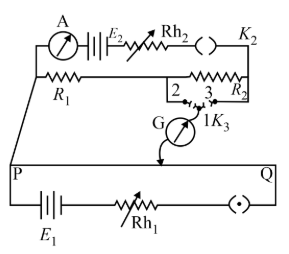
A potentiometer $$PQ$$ is set up to compare two resistances, as shown in the figure. The ammeter $$A$$ in the circuit reads 1.0 A when the two-way key $$K_3$$ is open. The balance point is at a length $$l_1$$ cm from $$P$$ when the two-way key $$K_3$$ is plugged in between 2 and 1, while the balance point is at a length $$l_2$$ cm from $$P$$ when the key $$K_3$$ is plugged in between 3 and 1. The ratio of two resistances $$\frac{R_1}{R_2}$$, is found to be:

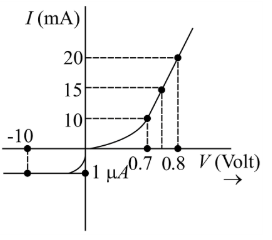
image

A magnetic dipole in a uniform magnetic field has: (Take zero potential energy when magnetic dipole is perpendicular to magnetic field)

In a certain region static electric and magnetic fields exist. The magnetic field is given by $$\vec{B} = B_0(\hat{i} + 2\hat{j} - 4\hat{k})$$. If a test charge moving with a velocity $$\vec{v} = v_0(3\hat{i} - \hat{j} + 2\hat{k})$$ experiences no force in that region, then the electric field in the region, in SI units, is:

A small circular loop of wire of radius $$a$$ is located at the centre of a much larger circular wire loop of radius $$b$$. The two loops are in the same plane. The outer loop of radius $$b$$ carries an alternating current $$I = I_0 \cos(\omega t)$$. The emf induced in the smaller inner loop is nearly:

Magnetic field in a plane electromagnetic wave is given by, $$\vec{B} = B_0 \sin(kx + \omega t)\hat{j}$$ T. Expression for corresponding electric field will be: (Where $$c$$ is speed of light)

Let the refractive index of a denser medium with respect to a rarer medium be $$n_{12}$$ and its critical angle be $$\theta_C$$. At an angle of incidence $$A$$ when light is travelling from denser medium to rarer medium, a part of the light is reflected and the rest is refracted and the angle between reflected and refracted rays is 90°. Angle $$A$$ is given by:

A single slit of width $$b$$ is illuminated by a coherent monochromatic light of wavelength $$\lambda$$. If the second and fourth minima in the diffraction pattern at a distance 1 cm from the slit are at 3 cm and 6 cm respectively from the central maximum, what is the width of the central maximum? (i.e. distance between first minimum on either side of the central maximum)

The maximum velocity of the photoelectrons emitted from the surface is $$v$$ when light of frequency $$n$$ falls on a metal surface. If the incident frequency is increased to $$3n$$, the maximum velocity of the ejected photoelectrons will be:

According to Bohr's theory, the time averaged magnetic field at the centre (i.e., nucleus) of a hydrogen atom due to the motion of electrons in the $$n^{th}$$ orbit is proportional to: ($$n$$ = principal quantum number)

Two deuterons undergo nuclear fusion to form a Helium nucleus. The energy released in this process is (given binding energy per nucleon for deuteron = 1.1 MeV and for helium = 7.0 MeV):

The conductivity of a semiconductor sample having electron concentration of $$5 \times 10^{18}$$ electrons m$$^{-3}$$, hole concentration of $$5 \times 10^{19}$$ holes m$$^{-3}$$, electron mobility of 2.0 m$$^2$$ V$$^{-1}$$ s$$^{-1}$$ and hole mobility of 0.01 m$$^2$$ V$$^{-1}$$ s$$^{-1}$$ is: (Take charge of an electron as $$1.6 \times 10^{-19}$$ C)

A signal of frequency 20 kHz and peak voltage of 5 Volt is used to modulate a carrier wave of frequency 1.2 MHz and peak voltage 25 Volts. Choose the correct statement.