The energy of an electron in the first Bohr orbit of hydrogen atom is $$-2.18 \times 10^{-18}$$ J. Its energy in the third Bohr orbit is _____.
Sign in
Please select an account to continue using cracku.in
↓ →
Join Our JEE Preparation Group
Prep with like-minded aspirants; Get access to free daily tests and study material.
The energy of an electron in the first Bohr orbit of hydrogen atom is $$-2.18 \times 10^{-18}$$ J. Its energy in the third Bohr orbit is _____.
Login to view the detailed solution.
Which of the following statements are not correct?
A. The electron gain enthalpy of F is more negative than that of Cl.
B. Ionization enthalpy decreases in a group of periodic table.
C. The electronegativity of an atom depends upon the atoms bonded to it.
D. Al$$_2$$O$$_3$$ and NO are examples of amphoteric oxides.
Choose the most appropriate answer from the options given below:
In which of the following processes, the bond order increases and paramagnetic character changes to diamagnetic one?
Login to view the detailed solution.
ClF$$_5$$ at room temperature is a
Login to view the detailed solution.
Among the following compounds, the one which shows highest dipole moment is
Login to view the detailed solution.
Given below are two statements:
Statement I: Permutit process is more efficient compared to the synthetic resin method for the softening of water.
Statement II: Synthetic resin method results in the formation of soluble sodium salts.
In the light of the above statements, choose the most appropriate answer from the options given below:
Login to view the detailed solution.
Be(OH)$$_2$$ reacts with Sr(OH)$$_2$$ to yield an ionic salt. Choose the incorrect option related to this reaction from the following
Login to view the detailed solution.
In the following reaction 'X' is
CH$$_3$$(CH$$_2$$)$$_4$$CH$$_3$$ $$\xrightarrow{\text{Anhy. AlCl}_3 / \text{HCl}, \Delta}$$ X (major product)
Login to view the detailed solution.
The radical which mainly causes ozone depletion in the presence of UV radiations is :
Login to view the detailed solution.
What happens when a lyophilic sol is added to a lyophobic sol?
Login to view the detailed solution.
Which one of the following is most likely a mismatch?
Login to view the detailed solution.
The incorrect statement from the following for borazine is:
Login to view the detailed solution.
The pair of lanthanides in which both elements have high third-ionization energy is:
Login to view the detailed solution.
The mismatched combinations are
A. Chlorophyll $$-$$ Co
B. Water hardness $$-$$ EDTA
C. Photography $$-$$ [Ag(CN)$$_2$$]$$^-$$
D. Wilkinson catalyst $$-$$ [(Ph$$_3$$P)$$_3$$RhCl]
E. Chelating ligand $$-$$ D $$-$$ Penicillamine
Choose the correct answer from the options given below.
Login to view the detailed solution.
2-Methyl propyl bromide reacts with C$$_2$$H$$_5$$O$$^-$$ and gives 'A' whereas on reaction with C$$_2$$H$$_5$$OH it gives 'B'. The mechanism followed in these reactions and the products 'A' and 'B' respectively are:
Login to view the detailed solution.
In the reaction given below

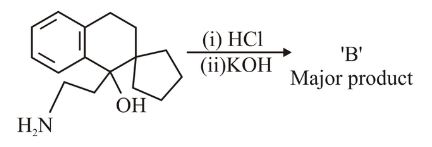
An amino alcohol reacts with (i) HCl (ii) KOH to give 'B' Major product. 'B' is:
Login to view the detailed solution.
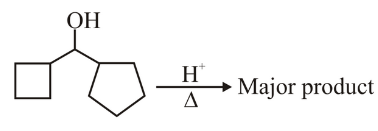
In the above reaction, left hand side and right hand side rings are named as 'A' and 'B' respectively. They undergo ring expansion. The correct statement for this process is:

Login to view the detailed solution.
D $$-$$ (+) $$-$$ Glyceraldehyde $$\xrightarrow{\text{i) HCN}}$$ $$\xrightarrow{\text{ii) H}_2\text{O/H}^+}$$ $$\xrightarrow{\text{iii) HNO}_3}$$
The products formed in the above reaction are
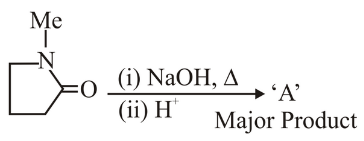
A cyclic amide (lactam) reacts with (i) NaOH, $$\Delta$$ (ii) H$$^+$$ to give 'A' (Major Product).
'A' is:
Login to view the detailed solution.
Match the following
| Column-A | Column-B | ||
|---|---|---|---|
| a | Nylon 6 | I | Natural Rubber |
| b | Vulcanized Rubber | II | Cross Linked |
| c | cis-1, 4-polyisoprene | III | Caprolactam |
| d | Polychloroprene | IV | Neoprene |
Login to view the detailed solution.
An organic compound gives $$0.220$$ g of CO$$_2$$ and $$0.126$$ g of H$$_2$$O on complete combustion. If the % of carbon is $$24$$ then the % of hydrogen is _____ $$\times 10^{-1}$$. (Nearest integer)
Login to view the detailed solution.
A certain quantity of real gas occupies a volume of $$0.15$$ dm$$^3$$ at $$100$$ atm and $$500$$ K when its compressibility factor is $$1.07$$. Its volume at $$300$$ atm and $$300$$ K (When its compressibility factor is $$1.4$$) is _____ $$\times 10^{-4}$$ dm$$^3$$ (Nearest integer)
Login to view the detailed solution.
A$$_2$$ + B$$_2$$ $$\to$$ 2AB. $$\Delta H_f = -200$$ kJ mol$$^{-1}$$
AB, A$$_2$$ and B$$_2$$ are diatomic molecules. If the bond enthalpies of A$$_2$$, B$$_2$$ and AB are in the ratio 1 : 0.5 : 1, then the bond enthalpy of A$$_2$$ is _____ kJ mol$$^{-1}$$ (Nearest integer)
Login to view the detailed solution.
$$25.0$$ mL of $$0.050$$ M Ba(NO$$_3$$)$$_2$$ is mixed with $$25.0$$ mL of $$0.020$$ M NaF. K$$_{sp}$$ of BaF$$_2$$ is $$0.5 \times 10^{-6}$$ at 298K. The ratio of $$[\text{Ba}^{2+}][\text{F}^-]^2$$ and K$$_{sp}$$ is _____.
Login to view the detailed solution.
KMnO$$_4$$ is titrated with ferrous ammonium sulphate hexahydrate in presence of dilute H$$_2$$SO$$_4$$. Number of water molecules produced for 2 molecules of KMnO$$_4$$ is _____.
Login to view the detailed solution.
$$20$$ mL of calcium hydroxide was consumed when it was reacted with $$10$$ mL of unknown solution of H$$_2$$SO$$_4$$. Also $$20$$ mL standard solution of $$0.5$$ M HCl containing 2 drops of phenolphthalein was titrated with calcium hydroxide, the mixture showed pink colour when burette displayed the value of $$35.5$$ mL whereas the burette showed $$25.5$$ mL initially. The concentration of H$$_2$$SO$$_4$$ is _____ M. (Nearest integer)
Solution of $$12$$ g of non-electrolyte (A) prepared by dissolving it in $$1000$$ mL of water exerts the same osmotic pressure as that of $$0.05$$ M glucose solution at the same temperature. The empirical formula of A is CH$$_2$$O. The molecular mass of A is _____ g. (Nearest integer)
Login to view the detailed solution.
A metal surface of $$100$$ cm$$^2$$ area has to be coated with nickel layer of thickness $$0.001$$ mm. A current of 2A was passed through a solution of Ni(NO$$_3$$)$$_2$$ for 'x' seconds to coat the desired layer. The value of x is _____. (Nearest integer)
($$\rho$$Ni (density of Nickel) is $$10$$ g mL$$^{-1}$$, Molar mass of Nickel is $$60$$ g mol$$^{-1}$$, F $$= 96500$$ C mol$$^{-1}$$)
Login to view the detailed solution.
t$$_{87.5}$$ is the time required for the reaction to undergo $$87.5\%$$ completion and t$$_{50}$$ is the time required for the reaction to undergo $$50\%$$ completion. The relation between t$$_{87.5}$$ and t$$_{50}$$ for a first order reaction is
t$$_{87.5}$$ = x $$\times$$ t$$_{50}$$
The value of x is _____. (Nearest integer)
Login to view the detailed solution.
For the given reaction

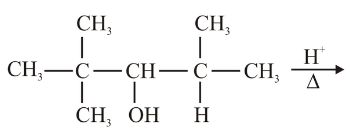
The total number of possible products formed by tertiary carbocation of A is _____.
Educational materials for JEE preparation