
Join Our JEE Preparation Group
Prep with like-minded aspirants; Get access to free daily tests and study material.
Sign in
Please select an account to continue using cracku.in
↓ →
Join Our JEE Preparation Group
Prep with like-minded aspirants; Get access to free daily tests and study material.
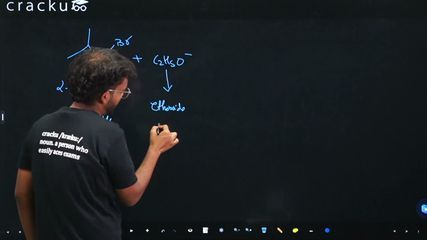
2-Methyl propyl bromide reacts with C$$_2$$H$$_5$$O$$^-$$ and gives 'A' whereas on reaction with C$$_2$$H$$_5$$OH it gives 'B'. The mechanism followed in these reactions and the products 'A' and 'B' respectively are:
We are given that 2-methyl propyl bromide (isobutyl bromide, (CH$$_3$$)$$_2$$CHCH$$_2$$Br) reacts with C$$_2$$H$$_5$$O$$^-$$ to give product A, and with C$$_2$$H$$_5$$OH to give product B.
Reaction with C$$_2$$H$$_5$$O$$^-$$ (ethoxide ion — strong nucleophile):
Ethoxide is a strong nucleophile. With a primary alkyl halide, the reaction follows an S$$_N$$2 mechanism. In S$$_N$$2, the nucleophile attacks the carbon bearing the leaving group directly via backside attack, with no carbocation intermediate and no rearrangement.
$$(CH_3)_2CHCH_2Br + C_2H_5O^- \xrightarrow{S_N2} (CH_3)_2CHCH_2OC_2H_5$$
Product A = iso-butyl ethyl ether.
Reaction with C$$_2$$H$$_5$$OH (ethanol — weak nucleophile/polar protic solvent):
Ethanol is a weak nucleophile and a polar protic solvent, which favors the S$$_N$$1 pathway. Although 2-methyl propyl bromide is a primary halide, the initially formed primary carbocation undergoes a 1,2-hydride shift to form a more stable tertiary carbocation:
$$(CH_3)_2CHCH_2^+ \xrightarrow{1,2\text{-hydride shift}} (CH_3)_3C^+$$
The stable tertiary carbocation then reacts with ethanol (acting as nucleophile) to form:
Product B = tert-butyl ethyl ether.
This matches Option A: S$$_N$$2, A = iso-butyl ethyl ether; S$$_N$$1, B = tert-butyl ethyl ether.
Was this solution helpful?
Click on the Email ☝️ to Watch the Video Solution
Create a FREE account and get:
_1.webp)

Educational materials for JEE preparation

Ask our AI anything

AI can make mistakes. Please verify important information.
AI can make mistakes. Please verify important information.


