
Join Our JEE Preparation Group
Prep with like-minded aspirants; Get access to free daily tests and study material.
Sign in
Please select an account to continue using cracku.in
↓ →
Join Our JEE Preparation Group
Prep with like-minded aspirants; Get access to free daily tests and study material.
In the above reaction, left hand side and right hand side rings are named as 'A' and 'B' respectively. They undergo ring expansion. The correct statement for this process is:
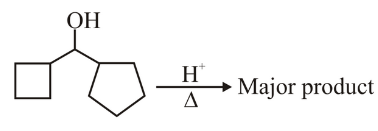
The reagent used in the given transformation first converts the -OH group into a good leaving group, generates a carbocation adjacent to oxygen and then triggers a 1,2-alkyl shift. Such 1,2-shifts are nothing but the well-known pinacol / semipinacol type rearrangements that enlarge the size of a cyclic skeleton by one carbon at every step.
Key facts about pinacol (or semipinacol) ring expansion that one must always remember:
1. The migration occurs only from the carbon directly bonded to the positively charged centre (a strict 1,2-shift).
2. Each individual shift enlarges the ring by exactly one member: $$n \rightarrow n+1$$.
3. The thermodynamic driving force is release of angle (Baeyer) strain. Three-, four- and even five-membered rings are quite strained, six is nearly strain-free, while seven is also comfortably strain-free.
4. Beyond seven members, two new problems appear: (i) there is hardly any extra angle strain left to be relieved, and (ii) trans-annular (across-the-ring) interactions begin to build up. Hence further expansion (to eight, nine …) is not favoured under ordinary laboratory conditions.
Because of points 3 and 4, a sequence of pinacol-type ring expansions will proceed stepwise until a seven-membered ring is produced and then automatically stop. The same logic is valid for every ring present in the substrate. Therefore, both rings marked ‘A’ and ‘B’ can keep enlarging, but none of them will ever grow beyond seven.
Now examine the statements:
A. Ring expansion can go up to seven-membered rings — TRUE, exactly as argued above.
B. Both rings will finally become six-membered — FALSE; the process normally continues one step further to the seven-membered stage.
C. Both rings will finally become five-membered — FALSE for the same reason.
D. Only A will become six-membered — FALSE; nothing restricts ring B from expanding, and “six” is not the limit anyway.
Hence the only correct statement is:
Option A which is: Ring expansion can go upto seven membered rings
Was this solution helpful?
Create a FREE account and get:
_1.webp)

Educational materials for JEE preparation

Ask our AI anything

AI can make mistakes. Please verify important information.
AI can make mistakes. Please verify important information.


