
Join Our JEE Preparation Group
Prep with like-minded aspirants; Get access to free daily tests and study material.
Sign in
Please select an account to continue using cracku.in
↓ →
Join Our JEE Preparation Group
Prep with like-minded aspirants; Get access to free daily tests and study material.
In the following reaction 'X' is
CH$$_3$$(CH$$_2$$)$$_4$$CH$$_3$$ $$\xrightarrow{\text{Anhy. AlCl}_3 / \text{HCl}, \Delta}$$ X (major product)
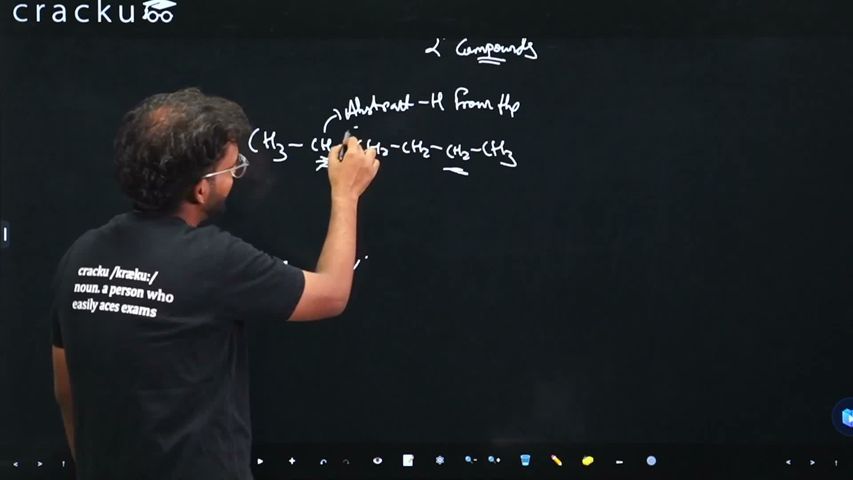
The reactant is $$n$$-hexane ($$\text{CH}_3(\text{CH}_2)_4\text{CH}_3$$), a straight-chain alkane.
The reagent used is anhydrous $$\text{AlCl}_3 / \text{HCl}$$ with heating ($$\Delta$$).
For $$n$$-hexane, the rearrangement yields a mixture of branched isomers, primarily:
$$\text{CH}_3-\text{CH}_2-\text{CH}_2-\text{CH}_2-\text{CH}_2-\text{CH}_3 \xrightarrow{\text{Anhy. AlCl}_3/\text{HCl}, \Delta} \text{CH}_3-\underset{\substack{| \\ \text{CH}_3}}{\text{CH}}-\text{CH}_2-\text{CH}_2-\text{CH}_3$$
Was this solution helpful?
Click on the Email ☝️ to Watch the Video Solution
Create a FREE account and get:
_1.webp)

Educational materials for JEE preparation

Ask our AI anything

AI can make mistakes. Please verify important information.
AI can make mistakes. Please verify important information.


