
Join Our JEE Preparation Group
Prep with like-minded aspirants; Get access to free daily tests and study material.
Sign in
Please select an account to continue using cracku.in
↓ →
Join Our JEE Preparation Group
Prep with like-minded aspirants; Get access to free daily tests and study material.
A cyclic amide (lactam) reacts with (i) NaOH, $$\Delta$$ (ii) H$$^+$$ to give 'A' (Major Product).
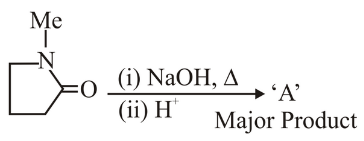
'A' is:
Lactams are cyclic amides. Under strong aqueous base and heat they undergo alkaline hydrolysis (amide cleavage). The hydroxide ion attacks the carbonyl carbon, opening the ring and producing the salt of an ω-amino-acid. Subsequent acidification (step ii : $$H^+$$) protonates both the carboxylate and the amide-derived anion, giving the neutral amino-acid.
For the lactam given in the paper (the monomer of Nylon-6, $$\varepsilon$$-caprolactam), the ring contains six methylene units between the nitrogen and the carbonyl carbon. Ring opening therefore produces a straight chain of six carbon atoms that carries a terminal $$COOH$$ group at one end and an $$NH_2$$ group at the other:
$$\varepsilon\text{-caprolactam} \xrightarrow[\Delta]{NaOH} \;^-OOC-(CH_2)_5-NH^- \;\xrightarrow{H^+}\; HOOC-(CH_2)_5-NH_2$$
Thus ‘A’ is 6-aminocaproic acid (also called 6-aminohexanoic acid), whose structure is
$$NH_2-(CH_2)_5-COOH$$
That corresponds to Option C.
Answer: Option C which is: 6-aminocaproic acid, $$NH_2-(CH_2)_5-COOH$$.
Was this solution helpful?
Create a FREE account and get:
_1.webp)

Educational materials for JEE preparation

Ask our AI anything

AI can make mistakes. Please verify important information.
AI can make mistakes. Please verify important information.


