Join WhatsApp Icon JEE WhatsApp Group

NTA JEE Main 11th April 2014 Online - Physics

For the following questions answer them individually

A body of mass 5 kg under the action of constant force $$\vec{F} = F_x\hat{i} + F_y\hat{j}$$ has velocity at t = 0 s as $$\vec{v} = (6\hat{i} - 2\hat{j})$$ m/s and at t = 10 s as $$\vec{v} = +6\hat{j}$$ m/s. The force $$\vec{F}$$ is:

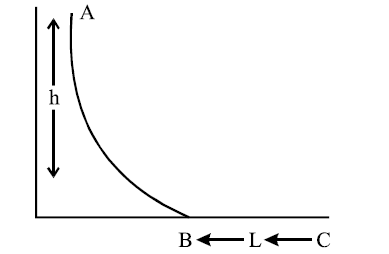
A small ball of mass m starts at a point A with speed $$v_o$$ and moves along a frictionless track AB as shown. The track BC has coefficient of friction $$\mu$$. The ball comes to stop at C after travelling a distance L which is:

A thin bar of length L has a mass per unit length $$\lambda$$, that increases linearly with distance from one end. If its total mass is M and its mass per unit length at the lighter end is $$\lambda_0$$, then the distance of the centre of mass from the lighter end is:

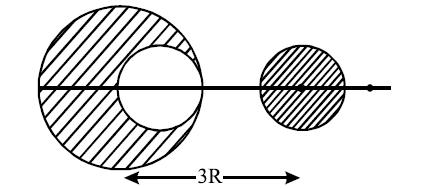
From a sphere of mass M and radius R, a smaller sphere of radius $$\frac{R}{2}$$ is carved out such that the cavity made in the original sphere is between its centre and the periphery (see the figure). For the configuration in the figure where the distance between the centre of the original sphere and the removed sphere is 3R, the gravitational force between the two spheres is:

The bulk moduli of ethanol, mercury and water are given as 0.9, 25 and 2.2 respectively in units of $$10^9$$ Nm$$^{-2}$$. For a given value of pressure, the fractional compression in volume is $$\frac{\Delta V}{V}$$. Which of the following statements about $$\frac{\Delta V}{V}$$ for these three liquids is correct?

The average mass of rain drops is $$3.0 \times 10^{-5}$$ kg and their average terminal velocity is 9 m/s. Calculate the energy transferred by rain to each square metre of the surface at a place which receives 100 cm of rain in a year.

A tank with a small hole at the bottom has been filled with water and kerosene (specific gravity 0.8). The height of water is 3 m and that of kerosene is 2 m. When the hole is opened, the velocity of fluid coming out from it is nearly: (take g = 10 ms$$^{-2}$$ and density of water = $$10^3$$ kg m$$^{-3}$$)

An air bubble of radius 0.1 cm is in a liquid having surface tension 0.06 N/m and density $$10^3$$ kg/m$$^3$$. The pressure inside the bubble is 1100 Nm$$^{-2}$$ greater than the atmospheric pressure. At what depth is the bubble below the surface of the liquid? ($$g = 9.8$$ ms$$^{-2}$$)

A hot body, obeying Newton's law of cooling is cooling down from its peak value 80°C to an ambient temperature of 30°C. It takes 5 minutes in cooling down from 80°C to 40°C. How much time will it take to cool down from 62°C to 32°C? (Given ln 2 = 0.693, ln 5 = 1.609)

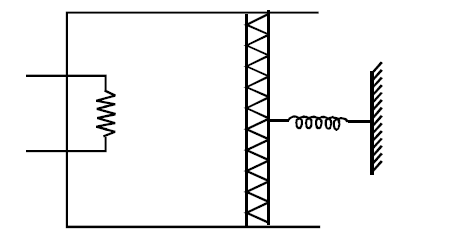
An ideal monoatomic gas is confined in a cylinder by a spring loaded piston of cross section $$8.0 \times 10^{-3}$$ m$$^2$$. Initially the gas is at 300 K and occupies a volume of $$2.4 \times 10^{-3}$$ m$$^3$$ and the spring is in its relaxed state as shown in figure. The gas is heated by a small heater until the piston moves out slowly by 0.1 m. The force constant of the spring is 8000 N/m and the atmospheric pressure is $$1.0 \times 10^5$$ N/m$$^2$$. The cylinder and the piston are thermally insulated. The piston and the spring are massless and there is no friction between the piston and the cylinder. The final temperature of the gas will be: (Neglect the heat loss through the lead wires of the heater. The heat capacity of the heater coil is also negligible).

The angular frequency of the damped oscillator is given by, $$\omega = \sqrt{\left(\frac{k}{m} - \frac{r^2}{4m^2}\right)}$$ where k is the spring constant, m is the mass of the oscillator and r is the damping constant. If the ratio $$\frac{r^2}{mk}$$ is 8%, the change in time period compared to the undamped oscillator is approximately as follows:

Two factories are sounding their sirens at 800 Hz. A man goes from one factory to other at a speed of 2 m/s. The velocity of sound is 320 m/s. The number of beats heard by the person in one second will be:

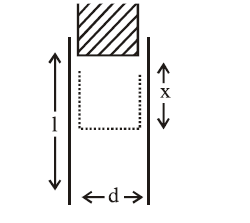
A parallel plate capacitor is made of two plates of length l, width w and separated by a distance d. A dielectric slab (dielectric constant K) that fits exactly between the plates is held near the edge of the plates. It is pulled into the capacitor by a force $$F = -\frac{\partial U}{\partial x}$$, where U is the energy of the capacitor when dielectric is inside the capacitor up to distance x (see the figure). If the charge on the capacitor is Q then the force on the dielectric when it is near the edge is:

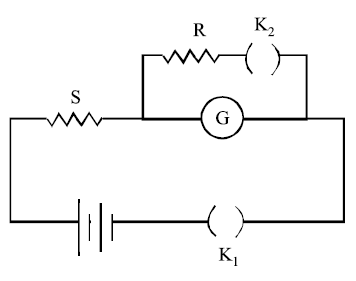
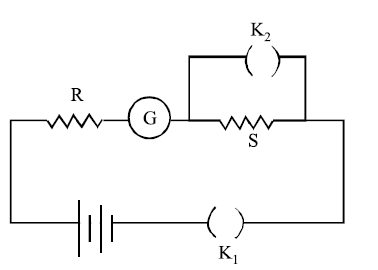
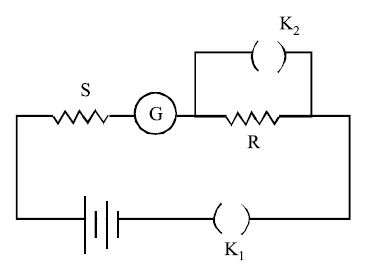
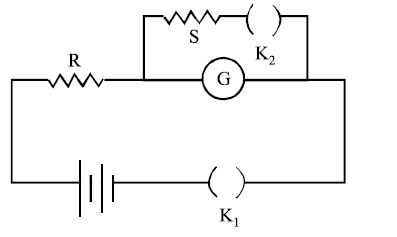
In the circuit diagrams (A, B, C and D) shown below, R is a high resistance and S is a resistance of the order of galvanometer resistance G. The correct circuit, corresponding to the half deflection method for finding the resistance and figure of merit of the galvanometer, is the circuit labelled as:

(a)

(b)

(c)

(d)

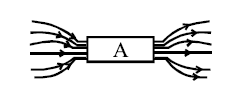
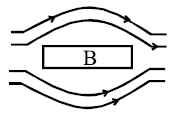
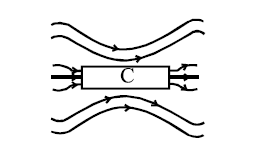
Three identical bars A, B and C are made of different magnetic materials. When kept in a uniform magnetic field, the field lines around them look as follows:

Make the correspondence of these bars with their material being diamagnetic (D), ferromagnetic (F) and paramagnetic (P):

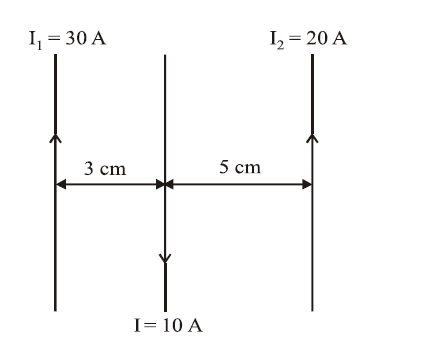
Three straight parallel current carrying conductors are shown in the figure. The force experienced by the middle conductor of length 25 cm is:

A coil of circular cross-section having 1000 turns and 4 cm$$^2$$ face area is placed with its axis parallel to a magnetic field which decreases by $$10^{-2}$$ Wb m$$^{-2}$$ in 0.01 s. The e.m.f. induced in the coil is:

An electromagnetic wave of frequency $$1 \times 10^{14}$$ hertz is propagating along z-axis. The amplitude of electric field is 4 V/m. If $$\varepsilon_0 = 8.8 \times 10^{-12}$$ C$$^2$$/N-m$$^2$$, then average energy density of electric field will be:

An object is located in a fixed position in front of a screen. Sharp image is obtained on the screen for two positions of a thin lens separated by 10 cm. The size of the images in two situations are in the ratio 3 : 3. What is the distance between the screen and the object?

In a compound microscope the focal length of objective lens is 1.2 cm and focal length of eye piece is 3.0 cm. When object is kept at 1.25 cm in front of objective, final image is formed at infinity. Magnifying power of the compound microscope should be:

Two monochromatic light beams of intensity 16 and 9 units are interfering. The ratio of intensities of bright and dark parts of the resultant pattern is:

A photon of wavelength $$\lambda$$ is scattered from an electron, which was at rest. The wavelength shift $$\Delta\lambda$$ is three times of $$\lambda$$ and the angle of scattering $$\theta$$ is 60°. The angle at which the electron recoiled is $$\phi$$. The value of $$\tan \phi$$ is: (electron speed is much smaller than the speed of light)

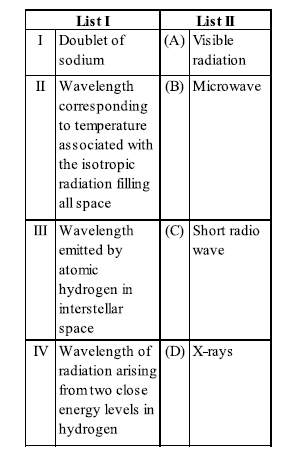
Match the List-I (Phenomenon associated with electromagnetic radiation) with List-II (Part of electromagnetic spectrum) and select the correct code from the choices given below this lists:

A radioactive nuclei with decay constant 0.5/s is being produced at a constant rate of 100 nuclei/s. If at t = 0 there were no nuclei, the time when there are 50 nuclei is: