
Join Our JEE Preparation Group
Prep with like-minded aspirants; Get access to free daily tests and study material.
Sign in
Please select an account to continue using cracku.in
↓ →
Join Our JEE Preparation Group
Prep with like-minded aspirants; Get access to free daily tests and study material.
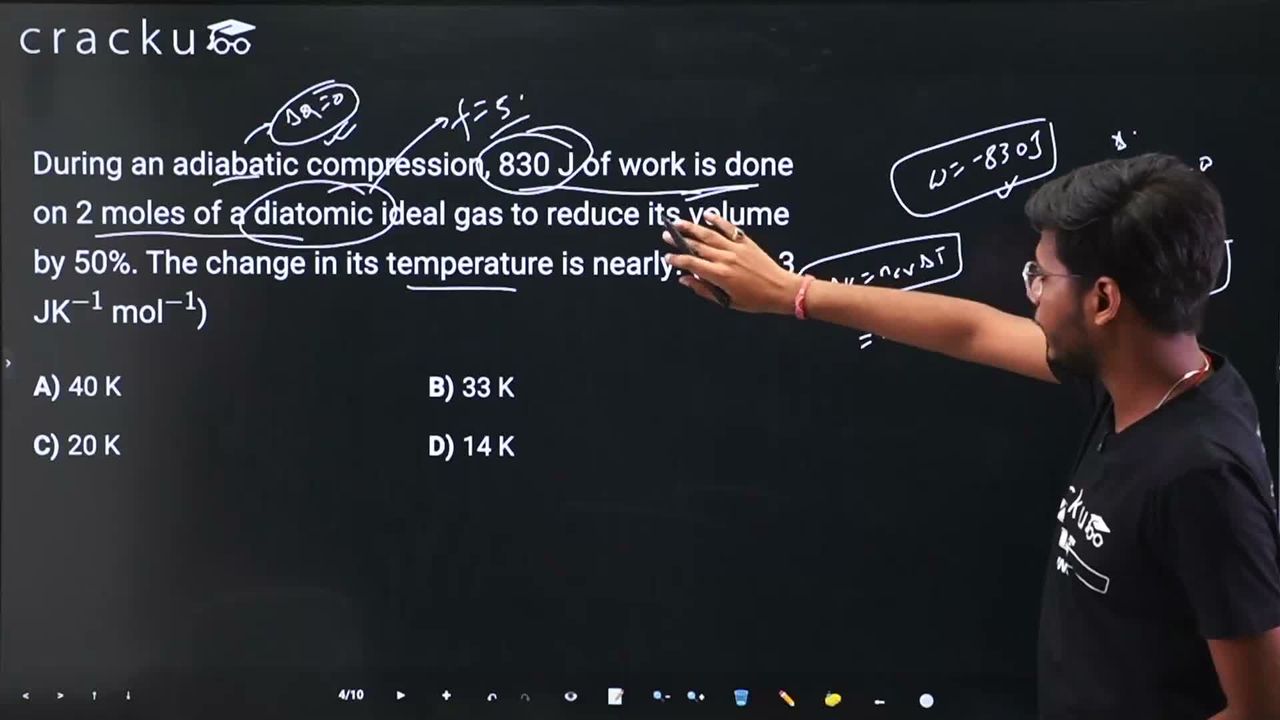
During an adiabatic compression, 830 J of work is done on 2 moles of a diatomic ideal gas to reduce its volume by 50%. The change in its temperature is nearly: (R = 8.3 JK$$^{-1}$$ mol$$^{-1}$$)
In this problem, we are dealing with an adiabatic compression of a diatomic ideal gas. The work done on the gas is 830 J, the number of moles is 2, and the volume is reduced by 50%. The gas constant R is given as 8.3 J K⁻¹ mol⁻¹. We need to find the change in temperature.
First, recall that an adiabatic process means there is no heat exchange, so Q = 0. According to the first law of thermodynamics, the change in internal energy, ΔU, is related to the heat added to the system and the work done by the system by the equation:
$$\Delta U = Q - W$$
Since Q = 0, this simplifies to:
$$\Delta U = -W$$
Now, the work done on the gas is given as 830 J. This means the work done by the system is -830 J (because work done on the system is positive, so work done by the system is negative). Substituting W = -830 J:
$$\Delta U = -(-830) = 830 \text{ J}$$
So, the change in internal energy is 830 J.
For an ideal gas, the internal energy depends only on temperature. For a diatomic gas, the molar specific heat at constant volume, C_V, is (5/2)R, because diatomic gases have 5 degrees of freedom (3 translational and 2 rotational). The change in internal energy for n moles is given by:
$$\Delta U = n C_V \Delta T = n \left( \frac{5}{2} R \right) \Delta T$$
We have n = 2 moles, R = 8.3 J K⁻¹ mol⁻¹, and ΔU = 830 J. Substituting these values:
$$830 = 2 \times \left( \frac{5}{2} \times 8.3 \right) \times \Delta T$$
Simplify the expression inside the parentheses:
$$830 = 2 \times \frac{5}{2} \times 8.3 \times \Delta T$$
The factor of 2 and the denominator 2 cancel each other:
$$830 = 5 \times 8.3 \times \Delta T$$
Now, compute 5 times 8.3:
$$5 \times 8.3 = 41.5$$
So the equation becomes:
$$830 = 41.5 \times \Delta T$$
Solving for ΔT:
$$\Delta T = \frac{830}{41.5}$$
Performing the division:
$$\Delta T = 20 \text{ K}$$
Therefore, the change in temperature is 20 K. Note that the volume reduction by 50% was not directly used in this calculation because the change in internal energy depends only on the change in temperature for an ideal gas, and we were able to find ΔU from the work done.
Hence, the correct answer is Option C.
Was this solution helpful?
Click on the Email ☝️ to Watch the Video Solution
Create a FREE account and get:
_1.webp)

Educational materials for JEE preparation

Ask our AI anything

AI can make mistakes. Please verify important information.
AI can make mistakes. Please verify important information.
