For the following questions answer them individually
In terms of resistance R and time T, the dimensions of ratio $$\frac{\mu}{\varepsilon}$$ of the permeability $$\mu$$ and permittivity $$\varepsilon$$ is:
The initial speed of a bullet fired from a rifle is 630 m/s. The rifle is fired at the centre of a target 700 m away at the same level as the target. How far above the centre of the target must the rifle be aimed in order to hit the target?
A body of mass 5 kg under the action of constant force $$\vec{F} = F_x\hat{i} + F_y\hat{j}$$ has velocity at t = 0 s as $$\vec{v} = (6\hat{i} - 2\hat{j})$$ m/s and at t = 10 s as $$\vec{v} = +6\hat{j}$$ m/s. The force $$\vec{F}$$ is:
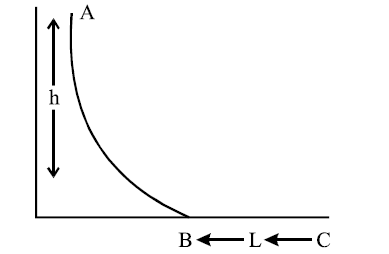
A small ball of mass m starts at a point A with speed $$v_o$$ and moves along a frictionless track AB as shown. The track BC has coefficient of friction $$\mu$$. The ball comes to stop at C after travelling a distance L which is:
A thin bar of length L has a mass per unit length $$\lambda$$, that increases linearly with distance from one end. If its total mass is M and its mass per unit length at the lighter end is $$\lambda_0$$, then the distance of the centre of mass from the lighter end is:
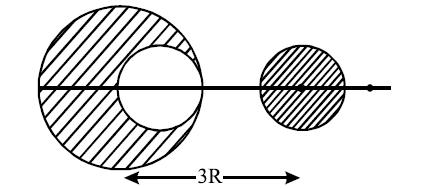
From a sphere of mass M and radius R, a smaller sphere of radius $$\frac{R}{2}$$ is carved out such that the cavity made in the original sphere is between its centre and the periphery (See figure). For the configuration in the figure where the distance between the centre of the original sphere and the removed sphere is 3R, the gravitational force between the two spheres is:
The bulk moduli of ethanol, mercury and water are given as 0.9, 25 and 2.2 respectively in units of $$10^9$$ Nm$$^{-2}$$. For a given value of pressure, the fractional compression in volume is $$\frac{\Delta V}{V}$$. Which of the following statements about $$\frac{\Delta V}{V}$$ for these three liquids is correct?
The average mass of rain drops is $$3.0 \times 10^{-5}$$ kg and their average terminal velocity is 9 m/s. Calculate the energy transferred by rain to each square metre of the surface at a place which receives 100 cm of rain in a year.
A tank with a small hole at the bottom has been filled with water and kerosene (specific gravity 0.8). The height of water is 3 m and that of kerosene 2 m. When the hole is opened the velocity of fluid coming out from it is nearly: (take g = 10 ms$$^{-2}$$ and density of water = $$10^3$$ kg m$$^{-3}$$)
An air bubble of radius 0.1 cm is in a liquid having surface tension 0.06 N/m and density $$10^3$$ kg/m$$^3$$. The pressure inside the bubble is 1100 Nm$$^{-2}$$ greater than the atmospheric pressure. At what depth is the bubble below the surface of the liquid? ($$g = 9.8$$ ms$$^{-2}$$)