
Join Our JEE Preparation Group
Prep with like-minded aspirants; Get access to free daily tests and study material.
Sign in
Please select an account to continue using cracku.in
↓ →
Join Our JEE Preparation Group
Prep with like-minded aspirants; Get access to free daily tests and study material.
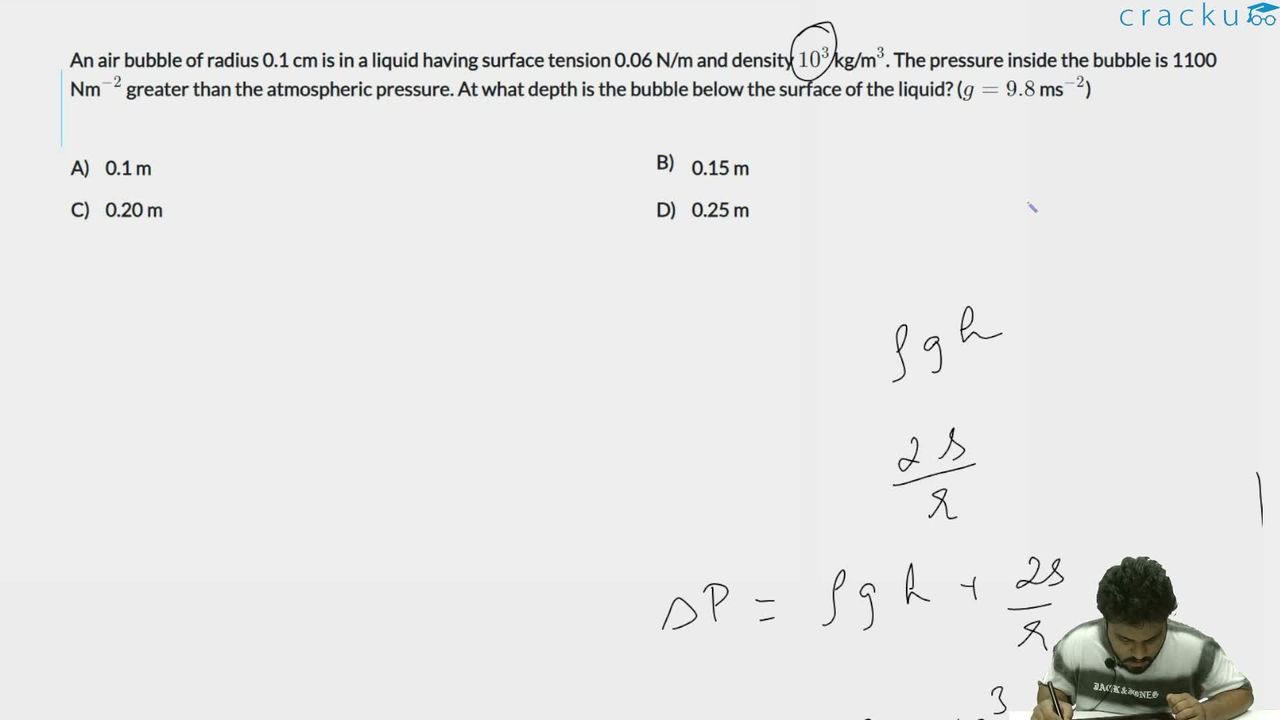
An air bubble of radius 0.1 cm is in a liquid having surface tension 0.06 N/m and density $$10^3$$ kg/m$$^3$$. The pressure inside the bubble is 1100 Nm$$^{-2}$$ greater than the atmospheric pressure. At what depth is the bubble below the surface of the liquid? ($$g = 9.8$$ ms$$^{-2}$$)
We are given:
We need to find the depth $$ h $$ (in meters) of the bubble below the surface of the liquid.
For an air bubble inside a liquid, the excess pressure inside the bubble over the atmospheric pressure is the sum of two components:
Therefore, the equation for excess pressure is:
$$ \Delta P = \rho g h + \frac{2S}{r} $$
Substitute the given values:
$$ 1100 = (1000) \times (9.8) \times h + \frac{2 \times 0.06}{0.001} $$
First, calculate the surface tension term:
$$ \frac{2 \times 0.06}{0.001} = \frac{0.12}{0.001} = 120 \, \text{N/m}^2 $$
So the equation becomes:
$$ 1100 = 9800h + 120 $$
Now, solve for $$ h $$. Subtract 120 from both sides:
$$ 1100 - 120 = 9800h $$
$$ 980 = 9800h $$
Divide both sides by 9800:
$$ h = \frac{980}{9800} $$
Simplify the fraction:
$$ h = \frac{98}{980} = \frac{98 \div 98}{980 \div 98} = \frac{1}{10} = 0.1 \, \text{m} $$
Therefore, the depth of the bubble is 0.1 m.
Comparing with the options:
Hence, the correct answer is Option A.
Was this solution helpful?
Click on the Email ☝️ to Watch the Video Solution
Create a FREE account and get:
_1.webp)

Educational materials for JEE preparation

Ask our AI anything

AI can make mistakes. Please verify important information.
AI can make mistakes. Please verify important information.
