
Join Our JEE Preparation Group
Prep with like-minded aspirants; Get access to free daily tests and study material.
Sign in
Please select an account to continue using cracku.in
↓ →
Join Our JEE Preparation Group
Prep with like-minded aspirants; Get access to free daily tests and study material.
A parallel plate capacitor is made of two plates of length l, width w and separated by a distance d. A dielectric slab (dielectric constant K) that fits exactly between the plates is held near the edge of the plates. It is pulled into the capacitor by a force $$F = -\frac{\partial U}{\partial x}$$, where U is the energy of the capacitor when dielectric is inside the capacitor up to distance x (see the figure). If the charge on the capacitor is Q then the force on the dielectric when it is near the edge is:
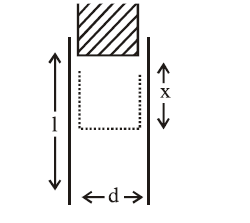
Capacitance with dielectric ($$C_1$$): $$C_1 = \frac{K\epsilon_0(xw)}{d}$$
Capacitance with air ($$C_2$$): $$C_2 = \frac{\epsilon_0(l-x)w}{d}$$
Total Capacitance ($$C$$): $$C = C_1 + C_2 = \frac{\epsilon_0 w}{d} [Kx + (l-x)] = \frac{\epsilon_0 w}{d} [l + x(K-1)]$$
$$U = \frac{Q^2}{2C} = \frac{Q^2 d}{2 \epsilon_0 w [l + x(K-1)]}$$
$$F = -\frac{\partial U}{\partial x}$$
$$F = -\frac{Q^2 d}{2 \epsilon_0 w} \cdot \frac{d}{dx} [l + x(K-1)]^{-1}$$
$$F = -\frac{Q^2 d}{2 \epsilon_0 w} \cdot (-1)[l + x(K-1)]^{-2} \cdot (K-1)$$
$$F = \frac{Q^2 d (K-1)}{2 \epsilon_0 w [l + x(K-1)]^2}$$
When the slab is near the edge ($$x \approx 0$$): $$F = \frac{Q^2 d}{2 \epsilon_0 w l^2} (K-1)$$
Was this solution helpful?
Create a FREE account and get:
_1.webp)

Educational materials for JEE preparation

Ask our AI anything

AI can make mistakes. Please verify important information.
AI can make mistakes. Please verify important information.
