
Join Our JEE Preparation Group
Prep with like-minded aspirants; Get access to free daily tests and study material.
Sign in
Please select an account to continue using cracku.in
↓ →
Join Our JEE Preparation Group
Prep with like-minded aspirants; Get access to free daily tests and study material.
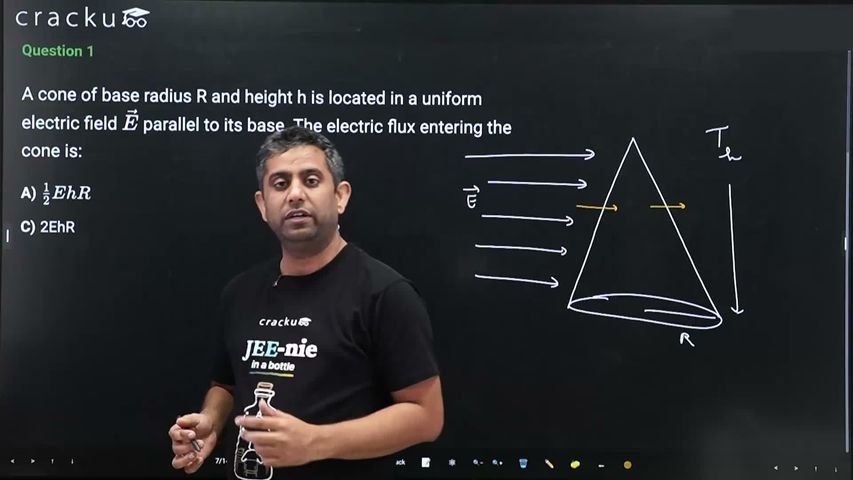
A cone of base radius R and height h is located in a uniform electric field $$\vec{E}$$ parallel to its base. The electric flux entering the cone is:
The cone has base radius $$R$$ and height $$h$$, and sits in a uniform electric field $$\vec{E}$$ directed parallel to the base. Since there is no enclosed charge, Gauss's law gives zero net flux through the entire closed surface of the cone (curved surface plus the circular base). Therefore the flux entering one side of the cone equals the flux leaving the other side.
To find the entering flux, consider the projection of the cone onto a plane perpendicular to $$\vec{E}$$. The cone's silhouette when viewed along the direction of $$\vec{E}$$ is a triangle with base equal to the diameter $$2R$$ and height equal to $$h$$. The area of this triangle is $$\dfrac{1}{2} \times 2R \times h = Rh$$.
Since the field is uniform, the flux through any closed surface equals the flux through the projected cross-sectional area perpendicular to the field. The entering flux (which equals the leaving flux) is therefore $$\Phi = E \times Rh = EhR$$.
Was this solution helpful?
Click on the Email ☝️ to Watch the Video Solution
Create a FREE account and get:
_1.webp)

Educational materials for JEE preparation

Ask our AI anything

AI can make mistakes. Please verify important information.
AI can make mistakes. Please verify important information.
