
Join Our JEE Preparation Group
Prep with like-minded aspirants; Get access to free daily tests and study material.
Sign in
Please select an account to continue using cracku.in
↓ →
Join Our JEE Preparation Group
Prep with like-minded aspirants; Get access to free daily tests and study material.
A small ball of mass m starts at a point A with speed $$v_o$$ and moves along a frictionless track AB as shown. The track BC has coefficient of friction $$\mu$$. The ball comes to stop at C after travelling a distance L which is:
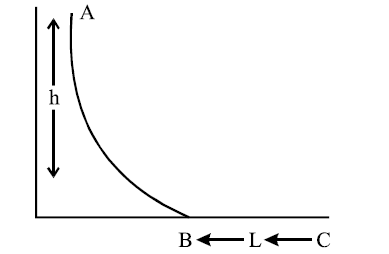
$$E_A = mgh + \frac{1}{2}mv_o^2$$
$$E_C = 0$$ (ball comes to stop)
$$W_{friction} = -f \cdot L = -\mu mgL$$
$$mgh + \frac{1}{2}mv_o^2 = \mu mgL$$ (The initial energy is dissipated by the work done by friction)
$$L = \frac{mgh}{\mu mg} + \frac{\frac{1}{2}mv_o^2}{\mu mg}$$
$$L = \frac{h}{\mu} + \frac{v_o^2}{2\mu g}$$
Was this solution helpful?
Create a FREE account and get:
_1.webp)

Educational materials for JEE preparation

Ask our AI anything

AI can make mistakes. Please verify important information.
AI can make mistakes. Please verify important information.
