
Join Our JEE Preparation Group
Prep with like-minded aspirants; Get access to free daily tests and study material.
Sign in
Please select an account to continue using cracku.in
↓ →
Join Our JEE Preparation Group
Prep with like-minded aspirants; Get access to free daily tests and study material.
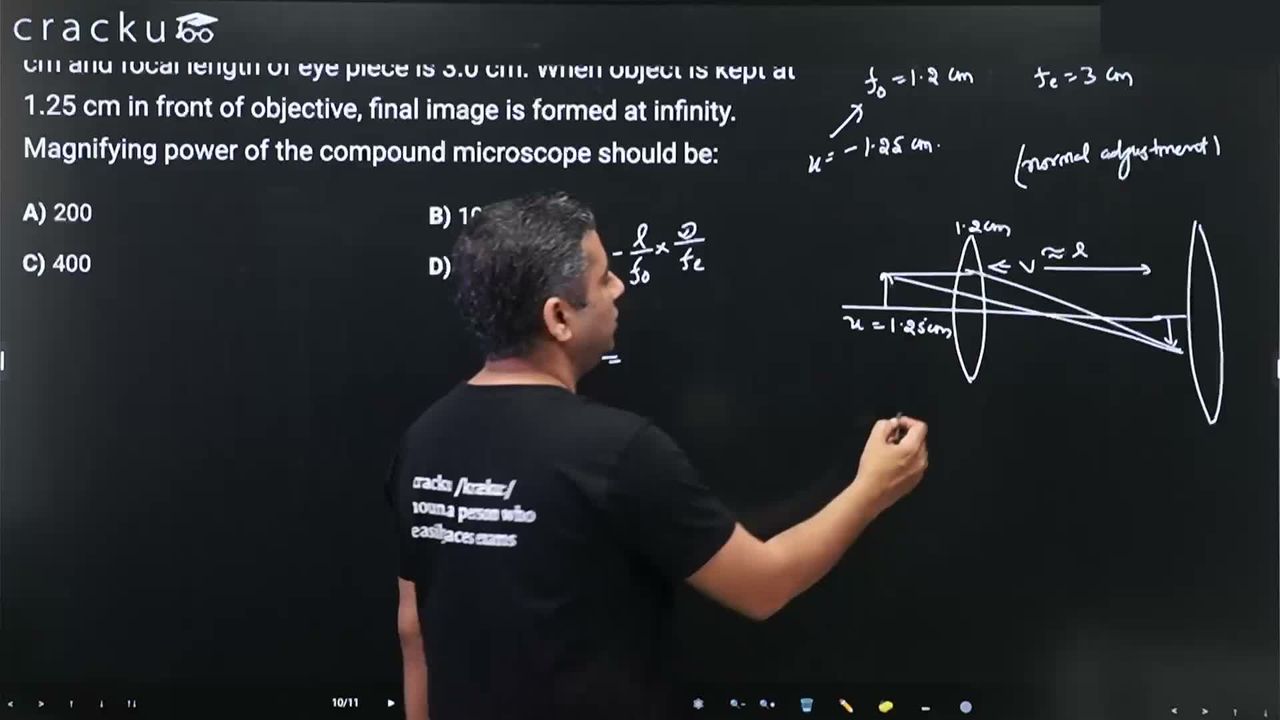
In a compound microscope the focal length of objective lens is 1.2 cm and focal length of eye piece is 3.0 cm. When object is kept at 1.25 cm in front of objective, final image is formed at infinity. Magnifying power of the compound microscope should be:
To solve this problem, we need to find the magnifying power of a compound microscope given the focal lengths and object distance. The focal length of the objective lens is $$ f_o = 1.2 $$ cm, the focal length of the eye piece is $$ f_e = 3.0 $$ cm, and the object is placed at $$ u_o = -1.25 $$ cm in front of the objective lens. The final image is formed at infinity. The magnifying power $$ M $$ for a compound microscope when the final image is at infinity is given by the product of the magnification of the objective lens ($$ m_o $$) and the magnification of the eye piece ($$ m_e $$), so $$ M = m_o \times m_e $$.
First, we calculate the magnification of the objective lens ($$ m_o $$). The magnification for a lens is $$ m_o = \frac{v_o}{u_o} $$, where $$ v_o $$ is the image distance for the objective lens. To find $$ v_o $$, we use the lens formula:
$$ \frac{1}{f_o} = \frac{1}{v_o} - \frac{1}{u_o} $$
Substituting the given values $$ f_o = 1.2 $$ cm and $$ u_o = -1.25 $$ cm:
$$ \frac{1}{1.2} = \frac{1}{v_o} - \frac{1}{-1.25} $$
Simplifying the right side:
$$ \frac{1}{1.2} = \frac{1}{v_o} + \frac{1}{1.25} $$
Now, compute the numerical values. $$ \frac{1}{1.2} = \frac{5}{6} $$ and $$ \frac{1}{1.25} = \frac{4}{5} $$, so:
$$ \frac{5}{6} = \frac{1}{v_o} + \frac{4}{5} $$
Subtract $$ \frac{4}{5} $$ from both sides:
$$ \frac{5}{6} - \frac{4}{5} = \frac{1}{v_o} $$
Find a common denominator for the subtraction. The least common multiple of 6 and 5 is 30:
$$ \frac{5}{6} = \frac{5 \times 5}{6 \times 5} = \frac{25}{30} $$
$$ \frac{4}{5} = \frac{4 \times 6}{5 \times 6} = \frac{24}{30} $$
So:
$$ \frac{25}{30} - \frac{24}{30} = \frac{1}{30} = \frac{1}{v_o} $$
Therefore:
$$ v_o = 30 \text{ cm} $$
Now, calculate the magnification of the objective lens:
$$ m_o = \frac{v_o}{u_o} = \frac{30}{-1.25} = -\frac{30}{1.25} $$
Simplify:
$$ \frac{30}{1.25} = \frac{30 \times 100}{1.25 \times 100} = \frac{3000}{125} = \frac{3000 \div 25}{125 \div 25} = \frac{120}{5} = 24 $$
So:
$$ m_o = -24 $$
The negative sign indicates an inverted image.
Next, we calculate the magnification of the eye piece ($$ m_e $$). Since the final image is at infinity, the magnification for the eye piece is given by $$ m_e = \frac{D}{f_e} $$, where $$ D $$ is the least distance of distinct vision, typically taken as 25 cm if not specified. Here, $$ f_e = 3.0 $$ cm, so:
$$ m_e = \frac{25}{3.0} = \frac{25}{3} $$
Now, compute the total magnifying power:
$$ M = m_o \times m_e = (-24) \times \left( \frac{25}{3} \right) $$
First, multiply:
$$ -24 \times \frac{25}{3} = -\frac{24 \times 25}{3} $$
Simplify by dividing 24 by 3:
$$ -\frac{24}{3} \times 25 = -8 \times 25 = -200 $$
Magnifying power is taken as positive, so we take the absolute value:
$$ |M| = 200 $$
Hence, the magnifying power of the compound microscope is 200.
Comparing with the options:
A. 200
B. 100
C. 400
D. 150
Hence, the correct answer is Option A.
Was this solution helpful?
Click on the Email ☝️ to Watch the Video Solution
Create a FREE account and get:
_1.webp)

Educational materials for JEE preparation

Ask our AI anything

AI can make mistakes. Please verify important information.
AI can make mistakes. Please verify important information.
