The greatest 4-digit number such that when divided by $$16$$, $$24$$ and $$36$$ leaves $$4$$ as remainder in each case is
NMTC Bhaskara ( junior level) 9th and 10th Aug 23 2025
For the following questions answer them individually
Solution
Let the number be $$n$$
The number reduced by $$4$$ must be a common multiple of $$16, 24, 36$$, so it is a multiple of their LCM.
So, $$(n-4)=k\times L.C.M[16,24,36]$$ ,where $$k$$ is some natural number
or, $$n=k\times L.C.M[16,24,36]+4$$
Since $$16 = 2^4$$, $$24 = 2^3 \times 3$$ and $$36 = 2^2 \times 3^2$$, the LCM is $$2^4 \times 3^2 = 144$$.
$$\therefore n=144k+4$$
Now, since $$n$$ is the greatest four-digit number that follows this pattern
So, we should take $$k=69$$ as any other value greater than $$69$$ makes $$n$$ a five digit number
$$\therefore n=144*69+4=9940$$
Hence, Option B is correct
$$ABCD$$ is a rectangle whose length $$AB$$ is $$20$$ units and breadth is $$10$$ units. Also, given $$AP = 8$$ units.
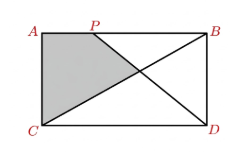
The area of the shaded region is $$\frac{p}{q}$$ sq unit, where $$p, q$$ are natural numbers with no common factors other than $$1$$. The value of $$p + q$$ is
Solution
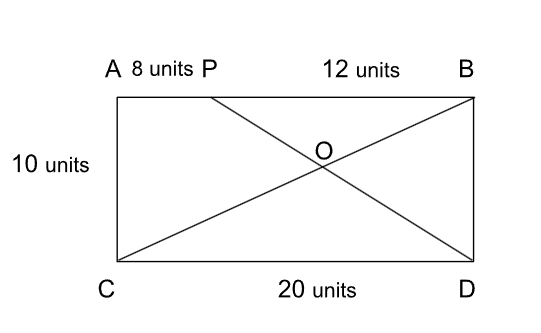
We are given that $$AP=8$$ units and $$PB=12$$ units
Now, in triangles $$POB$$ and $$DOC$$, we have:
$$\angle BOP=\angle COD$$ [vertically opposite angles]
$$\angle BPO=\angle CDO$$ [alternate interior angle between the parallel lines $$AB$$ and $$CD$$]
$$\angle PBO=\angle OCD$$ [alternate interior angle between the parallel lines $$AB$$ and $$CD$$]
So, triangles $$POB$$ and $$DOC$$ are similar triangles
$$\therefore \dfrac{BO}{OC}=\dfrac{PB}{CD}=\dfrac{3}{5}$$
Let us assume that $$BO$$ is $$3x$$ units long
Then, $$OC$$ is $$5x$$ units long
Now, the area of triangle $$ABC=0.5*20*10=100$$ square units
Also, the area of triangle $$BOP$$ : area of triangle $$ABC=0.5*PB*OB*Sin(\angle ABC):0.5*AB*BC*Sin(\angle ABC)$$
The area of triangle $$BOP$$ : area of triangle $$ABC=0.5*12*3x*Sin(\angle ABC):0.5*20*8x*Sin(\angle ABC)$$
The area of triangle $$BOP$$ : area of triangle $$ABC=9:40$$
We know that area of triangle $$ABC$$ is $$100$$ square units
So, area of triangle $$BOP: 100=9:40$$
Hence, the area of triangle $$BOP$$ is $$=\dfrac{45}{2}$$ square units
And the area of quadrilateral $$BPOC=$$area of triangle $$ABC-$$area of triangle $$BOP$$
The area of quadrilateral $$BPOC=100-\dfrac{45}{2}=\dfrac{155}{2}$$ square units
Hence, $$p=155$$ and $$q=2$$
This makes $$p+q=155+2=157$$
Hence, Option C is correct
The solution of $$\frac{\sqrt[7]{12+x}}{x} + \frac{\sqrt[7]{12+x}}{12} = \frac{64}{3}\left(\sqrt[7]{x}\right)$$ is of the form $$\frac{a}{b}$$ where $$a, b$$ are natural numbers with $$\text{GCD}(a,b) = 1$$; then $$(b-a)$$ is equal to
Solution
$$\dfrac{\sqrt[7]{12+x}}{x} + \dfrac{\sqrt[7]{12+x}}{12} = \dfrac{64}{3}\left(\sqrt[7]{x}\right)$$
Taking $$\sqrt[7]{12+x}$$ as common we get
$$\sqrt[7]{12+x} \left( \dfrac{1}{x} + \dfrac{1}{12}\right) = \dfrac{64}{3}\left(\sqrt[7]{x}\right)$$
$$\sqrt[7]{12+x} \left( \dfrac{x+12}{12x}\right) = \dfrac{64}{3}\left(\sqrt[7]{x}\right)$$
Transposing $$12x$$ to the other side of the equation we get
$$\sqrt[7]{12+x} (12+x) = \dfrac{64}{3}\left(12x\sqrt[7]{x}\right)$$
Now, we can $$\sqrt[7]{12+x}$$ as $${(12+x)}^{\frac{1}{7}}$$. Using the exponent rule that $$x^a.x^b = x^{a+b}$$, we can write
$${(12+x)}^{1+\frac{1}{7}} = (64 \times \dfrac{12}{3}) x^{1+\frac{1}{7}}$$
Simplifying the terms we get
$${(12+x)}^{\frac{8}{7}} =( 64 \times 4) x^{\frac{8}{7}}$$
$$64$$ can be expressed as $$2^6$$ and $$4 = 2^2$$. Thus, $$64 \times 4 = 2^8$$
$${(12+x)}^{\frac{8}{7}} = 2^8 x^{\frac{8}{7}}$$
Taking the eighth root we get
$${(12+x)}^{\frac{1}{7}} = 2 x^{\frac{1}{7}}$$
And raising the expression to the power of 7 we get
$$12+x = 128x \implies 127x = 12 \ \text{or}\ x = \dfrac{12}{127} $$
We can observe that $$12,127$$ have no common factors hence their $$gcd = 1$$
Thus $$ b-a = 127-12 = 115$$
.webp)
The value of $$(52+6\sqrt{43})^{3/2} - (52-6\sqrt{43})^{3/2}$$ is
Solution
We are given the expression: $$(52+6\sqrt{43})^{3/2} - (52-6\sqrt{43})^{3/2}$$
Now, the term $$52+6\sqrt{43}$$ can be rewritten as:
$$52+6\sqrt{43}=9+43+2*3*\sqrt{43}=(3+\sqrt{43})^2$$
Similarly, we can rewrite the term $$52-6\sqrt{43}$$ as:
$$52-6\sqrt{43}=9+43-2*3*\sqrt{43}=(3-\sqrt{43})^2$$ or $$(\sqrt{43}-3)^2$$
But whenever we have $$\sqrt{52-6\sqrt{43}}$$, the correct answer would be $$(\sqrt{43}-3)$$ as the square root is defined in mathematics to give only a positive answer due to functional constraints put on it.
Now, we had: $$(52+6\sqrt{43})^{3/2} - (52-6\sqrt{43})^{3/2}$$
$$=(\sqrt{52+6\sqrt{43}})^3 - (\sqrt{52-6\sqrt{43}})^3$$
$$=(3+\sqrt{43})^3-(\sqrt{43}-3)^3$$
$$=(27+\sqrt{43}^3+27\sqrt{43}+9*43)-(-27+\sqrt{43}^3+27\sqrt{43}-9*43)$$
$$=2(27+9*43)$$
$$=828$$
Hence, Option D is correct.
In the adjoining figure $$\angle DCE = 10^\circ$$, $$\angle CED = 98^\circ$$, $$\angle BDF = 28^\circ$$.
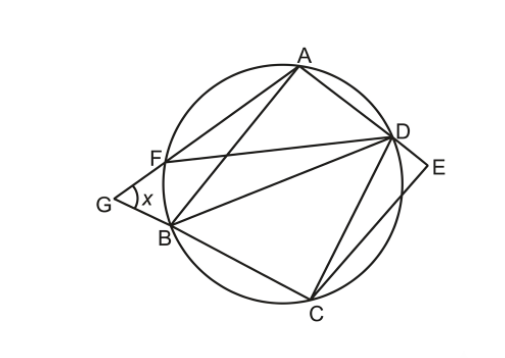
Then the measure of angle $$x$$ is
Solution
TO BE FILLED - figure required. The positions of the points $$B, F, G$$ on the circle relative to the star-shaped chord pattern cannot be determined reliably from the extracted text alone, so the arcs needed for the chord-angle theorem cannot be assigned with confidence.
$$ABC$$ is a right triangle in which $$\angle B = 90^\circ$$. The inradius of the triangle is $$r$$ and the circumradius of the triangle is $$R$$. If $$R \colon r = 5 \colon 2$$, then the value of $$\cot^2 \frac{A}{2} + \cot^2 \frac{C}{2}$$ is
Solution
Using $$\frac{r}{R} = 4\sin\frac{A}{2}\sin\frac{B}{2}\sin\frac{C}{2}$$ with $$B = 90^\circ$$ and $$\frac{r}{R} = \frac{2}{5}$$, solving for $$A$$ (with $$C = 90^\circ - A$$) gives a specific angle, and substituting back yields $$\cot^2\frac{A}{2} + \cot^2\frac{C}{2} = 13$$.
.webp)
If $$(\alpha, \beta)$$ and $$(\gamma, \beta)$$ are the roots of the simultaneous equations $$|x-1|+|y-5|=1$$, $$y = 5+|x-1|$$, then the value of $$\alpha + \beta + \gamma$$ is
Solution
We are given the equations: $$|x-1|+|y-5|=1$$, $$y = 5+|x-1|$$
From the second equation, we get:
$$|x-1|=y-5$$
Substituting this into the first equation
$$|x-1|+|y-5|=1$$
$$y-5+|y-5|=1$$
Now, we will have to make cases
CASE 1: $$y\geq5$$
$$y-5+y-5=1$$
or, $$y=\dfrac{11}{2}$$
Then, $$|x-1|=y-5=\dfrac{1}{2}$$
Which gives $$x=\dfrac{3}{2}$$ or $$x=\dfrac{1}{2}$$
Hence, we get $$2$$ solutions from case 1 for $$(x,y)$$, which are $$\left(\dfrac{1}{2},\dfrac{11}{2}\right),\left(\dfrac{3}{2},\dfrac{11}{2}\right)$$
CASE 2: $$y<5$$
$$y-5-(y-5)=1$$
or, $$0=1$$
Which is never true
So, we cannot get any answer from here.
The common $$y = \beta = \frac{11}{2}$$.
Taking $$\alpha = \frac{1}{2}$$ and $$\gamma = \frac{3}{2}$$ (or vice versa), we get:
$$\alpha+\beta+\gamma = 2 + \frac{11}{2} = \frac{15}{2}$$.
Three persons Ram, Ali and Peter were to be hired to paint a house. Ram and Ali can paint the whole house in $$30$$ days, Ali and Peter in $$40$$ days while Peter and Ram can do it in $$60$$ days. If all of them were hired together, in how many days can they all three complete $$ 50\% $$ the work?
Solution
Let the working rates of Ram, Ali and Peter be $$R,A$$ and $$P$$ respectively
$$R+A=\dfrac{1}{30}$$
$$A+P=\dfrac{1}{40}$$
$$R+P=\dfrac{1}{60}$$
Adding the three pairwise rates gives:
$$2(R+A+P) = \frac{1}{30}+\frac{1}{40}+\frac{1}{60} = \frac{3}{40}$$
So the combined rate is $$R+A+P = \frac{3}{80}$$ of the work per day.
The time for all three working together to finish the whole house is $$=\frac{80}{3} = 26\frac{2}{3}$$ days.
$$\frac{\sqrt{a+3b}+\sqrt{a-3b}}{\sqrt{a+3b}-\sqrt{a-3b}} = x$$, then the value of $$\frac{3bx^2+3b}{ax}$$ is
Solution
We are given: $$x=\dfrac{\sqrt{a+3b}+\sqrt{a-3b}}{\sqrt{a+3b}-\sqrt{a-3b}}$$
Rationalising the RHS
$$x=\dfrac{(\sqrt{a+3b}+\sqrt{a-3b})^2}{(\sqrt{a+3b}-\sqrt{a-3b})(\sqrt{a+3b}+\sqrt{a-3b})}$$
$$x=\dfrac{a+3b+a-3b+2\sqrt{a^2-9b^2}}{a+3b-a+3b}$$
$$x=\dfrac{a+\sqrt{a^2-9b^2}}{3b}$$ ....(1)
Now, squaring both sides
$$x^2=\dfrac{a^2+a^2-9b^2+2a\sqrt{a^2-9b^2}}{9b^2}$$
$$x^2=\dfrac{2a^2+2a\sqrt{a^2-9b^2}-9b^2}{9b^2}$$
$$x^2=\dfrac{2a^2+2a\sqrt{a^2-9b^2}}{9b^2}-1$$
$$x^2+1=\dfrac{2a^2+2a\sqrt{a^2-9b^2}}{9b^2}$$
$$3b(x^2+1)=\dfrac{2a^2+2a\sqrt{a^2-9b^2}}{3b}$$
$$\dfrac{3b(x^2+1)}{a}=\dfrac{2a+2\sqrt{a^2-9b^2}}{3b}$$
$$\dfrac{3b(x^2+1)}{a}=2\times\left(\dfrac{a+\sqrt{a^2-9b^2}}{3b}\right)$$
$$\dfrac{3b(x^2+1)}{a}=2\times x$$ [from 1]
$$\dfrac{3b(x^2+1)}{ax}=2$$
$$\dfrac{3bx^2+3b}{ax}=2$$
.webp)
The number of integral solutions of the inequation $$\left|\frac{2}{x-13}\right| > \frac{8}{9}$$ is
Solution
The inequality rearranges to $$|x-13| < \frac{9}{4} = 2.25$$ with $$x \neq 13$$. The integers satisfying $$10.75 < x < 15.25$$, excluding $$13$$ [as at $$x=13$$ the denominator of original inequation is undefined], are $$11, 12, 14, 15$$, giving $$4$$ integral solutions.
In the adjoining figure, $$P$$ is the centre of the first circle, which touches the other circle in $$C$$. $$PCD$$ is along the diameter of the second circle. $$\angle PBA = 20^\circ$$ and $$\angle PCA = 30^\circ$$.
[image]
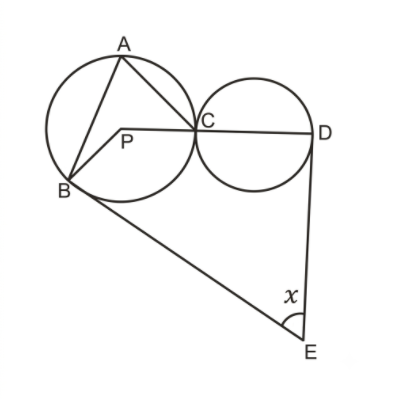
The tangents at $$B$$ and $$D$$ meet at $$E$$. The measure of the angle $$x$$ is
Solution
TO BE FILLED - figure required. The exact chord/tangent connections around points $$A, B, C, D, E$$ cannot be pinned down precisely enough from the extracted description to guarantee the correct angle-chase without the original diagram.
If $$\alpha, \beta$$ are the values of $$x$$ satisfying the equation $$3\sqrt{\log_2 x} - \log_2 8x + 1 = 0$$, where $$\alpha < \beta$$, then the value of $$\left(\frac{\beta}{\alpha}\right)$$ is
Solution
Let $$t = \sqrt{\log_2 x}$$
So $$\log_2 x = t^2$$ and $$\log_2 8x = 3+t^2$$.
Now, the equation becomes $$3t - (3+t^2) + 1 = 0$$
$$t^2-3t+2=0$$
$$t=1$$ or $$t=2$$
So $$x = 2$$ or $$x = 16$$.
Thus $$\alpha = 2$$, $$\beta = 16$$, and $$\dfrac{\beta}{\alpha} = 8$$.
When a natural number is divided by $$11$$, the remainder is $$4$$. When the square of this number is divided by $$11$$, the remainder is
Solution
Let the number be $$n$$
If $$n$$ leaves a remainder of $$4$$ when divided by $$11$$, than we can write $$n$$ as:
$$n=11k+4$$ , where $$k$$ is some natural number
Now, squaring both sides
$$n^2=121k^2+16+88k$$
$$n^2=121k^2+88k+11+5$$
$$n^2=11(11k^2+8k+1)+5$$
So, we can see that now if $$n^2$$ is divided by $$11$$, the leftover $$5$$ becomes the new remainder.
The unit's digit of a 2-digit number is twice the ten's digit. When the number is multiplied by the sum of the digits the result is $$144$$. For another 2-digit number, the ten's digit is twice the unit's digit and the product of the number with the sum of its digits is $$567$$. Then the sum of the two 2-digit numbers is
Solution
For the first number, with tens digit $$t$$ and units digit $$2t$$, the number is $$12t$$ and the digit sum is $$3t$$, so $$36t^2 = 144$$ gives $$t=2$$ and the number is $$24$$. For the second, with units digit $$u$$ and tens digit $$2u$$, the number is $$21u$$ and the digit sum is $$3u$$, so $$63u^2=567$$ gives $$u=3$$ and the number is $$63$$. The sum of the two numbers is $$24+63 = 87$$.
$$ABCDE$$ is a pentagon. $$\angle AED = 126^\circ$$, $$\angle BAE = \angle CDE$$ and $$\angle ABC$$ is $$4^\circ$$ less than $$\angle BAE$$ and $$\angle BCD$$ is $$6^\circ$$ less than $$\angle CDE$$. $$PR, QR$$ the bisectors of $$\angle BPC, \angle EQD$$ respectively, meet at $$R$$. Points $$P, C, D, Q$$ are collinear.
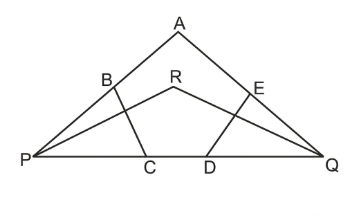
Then measure of $$\angle PRQ$$ is
Solution
Letting $$\angle BAE = \angle CDE = \theta$$, the pentagon angle sum $$\theta+(\theta-4)+(\theta-6)+\theta+126=540$$ gives $$\theta=106^\circ$$, so $$\angle ABC=102^\circ$$ and $$\angle BCD=100^\circ$$. With $$P$$ on the extensions of $$AB$$ and $$DC$$, triangle $$PBC$$ gives $$\angle BPC = \angle ABC+\angle BCD-180^\circ=22^\circ$$; similarly triangle $$QED$$ gives $$\angle EQD = (180^\circ-\angle AED)+(180^\circ-\angle CDE)-180^\circ = 52^\circ$$. Halving both by the bisectors gives $$11^\circ$$ and $$26^\circ$$ at $$P$$ and $$Q$$ in triangle $$PRQ$$, so $$\angle PRQ = 180^\circ-11^\circ-26^\circ = 143^\circ$$.
$$a, b, c$$ are real numbers such that $$b - c = 8$$ and $$bc + a^2 + 16 = 0$$.
The numerical value of $$a^{2025} + b^{2025} + c^{2025}$$ is ------.
Backspace
789
456
123
0.-
Clear All
789
456
123
0.-
Clear All
Solution
Since $$(b+c)^2 = (b-c)^2+4bc = 64+4(-a^2-16) = -4a^2$$, and a square cannot be negative, we need $$a=0$$, forcing $$b+c=0$$ as well. Combined with $$b-c=8$$, this gives $$b=4, c=-4$$. Then $$a^{2025}+b^{2025}+c^{2025} = 0+4^{2025}+(-4)^{2025} = 0$$, since $$2025$$ is odd.
Given $$f(x) = \frac{2025x}{x+1}$$ where $$x \neq -1$$. Then the value of $$x$$ for which $$f(f(x)) = (2025)^2$$ is ------.
Backspace
789
456
123
0.-
Clear All
789
456
123
0.-
Clear All
Solution
Substituting $$f(x)$$ into itself gives $$f(f(x)) = \frac{2025^2 x}{2026x+1}$$. Setting this equal to $$2025^2$$ gives $$x = 2026x+1$$, so $$-2025x = 1$$ and $$x = -\frac{1}{2025}$$.
The sum of all the roots of the equation $$\sqrt[3]{16-x^3} = 4-x$$ is ------.
Backspace
789
456
123
0.-
Clear All
789
456
123
0.-
Clear All
Solution
Cubing both sides gives $$16-x^3 = (4-x)^3$$, and expanding causes the $$x^3$$ terms to cancel, leaving $$x^2-4x+4=0$$, i.e. $$(x-2)^2=0$$. By Vieta's formulas the sum of the (repeated) roots of this quadratic is $$4$$.
In the adjoining figure, two Quadrants are touching at $$B$$. $$CE$$ is joined by a straight line, whose mid-point is $$F$$.
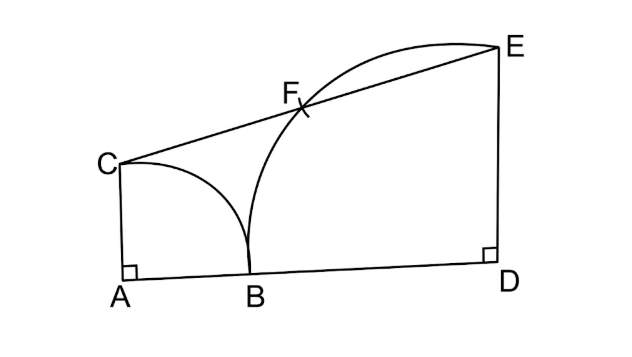
The measure of $$\angle CED$$ is ------.
Backspace
789
456
123
0.-
Clear All
789
456
123
0.-
Clear All
Solution
With the quadrant centred at $$A$$ of radius $$r_1$$ and the quadrant centred at $$D$$ of radius $$r_2$$ touching at $$B$$, requiring the midpoint $$F$$ of $$CE$$ to lie exactly on the second arc forces $$r_1 = r_2(\sqrt{2}-1)$$. Placing coordinates and computing the angle between $$EC$$ and $$ED$$ with this ratio gives $$\angle CED = 67.5^\circ$$.
The value of $$k$$ for which the equation $$x^3 - 6x^2+11x+(6-k)=0$$ has exactly three positive integer solutions is ------.
Backspace
789
456
123
0.-
Clear All
789
456
123
0.-
Clear All
Solution
For integer roots summing to $$6$$ with pairwise-product sum $$11$$, the only positive integer triple is $$1, 2, 3$$, since $$1+2+3=6$$ and $$1\cdot2+2\cdot3+3\cdot1=11$$. Comparing with Vieta's formulas, the product of roots is $$k-6$$, and $$1\times2\times3=6$$, so $$k=12$$.
The number of 3-digit numbers of the form $$ab5$$ (where $$a, b$$ are digits) which are divisible by $$9$$ is ------.
Backspace
789
456
123
0.-
Clear All
789
456
123
0.-
Clear All
Solution
The number $$100a+10b+5$$ is divisible by $$9$$ exactly when its digit sum $$a+b+5$$ is a multiple of $$9$$, i.e. $$a+b=4$$ or $$a+b=13$$ (with $$a\geq 1$$). For $$a+b=4$$ there are $$4$$ valid pairs ($$a=1,2,3,4$$), and for $$a+b=13$$ there are $$6$$ valid pairs ($$a=4$$ to $$9$$), giving $$4+6=10$$ numbers in total.
If $$a = \sqrt{(2025)^3 - (2023)^3}$$, the value of $$\sqrt{\frac{a^2-2}{6}}$$ is ------.
Backspace
789
456
123
0.-
Clear All
789
456
123
0.-
Clear All
Solution
Since $$a^2 = 2025^3-2023^3 = (2024+1)^3-(2024-1)^3$$
$$a^2=2024^2+1+3*2024+3*(2024)^2-[2024^2-1+3*(2024)-3*(2024)^2]$$
$$a^2=6*(2024)^2+2$$
$$a^2-2=6*(2024)^2$$
$$\dfrac{a^2-2}{6}=2024^2$$
$$\sqrt{\dfrac{a^2-2}{6}}=2024$$
In a math Olympiad examination, $$12\%$$ of the students who appeared from a class did not solve any problem; $$32\%$$ solved with some mistakes. The remaining $$14$$ students solved the paper fully and correctly. The number of students in the class is ------.
Backspace
789
456
123
0.-
Clear All
789
456
123
0.-
Clear All
Solution
The $$14$$ students who solved fully and correctly represent $$100\%-12\%-32\%=56\%$$ of the class. So the total number of students is $$\frac{14}{0.56}=25$$.
When $$a = 2025$$, the numerical value of $$|2a^3-3a^2-2a+1| - |2a^3-3a^2-3a-2025|$$ is ------.
Backspace
789
456
123
0.-
Clear All
789
456
123
0.-
Clear All
Solution
$$|2a^3-3a^2-2a+1| - |2a^3-3a^2-3a-2025|$$
or, $$|2a^3-3a^2-2a+1| - |2a^3-3a^2-3a-a|$$
or, $$|2a^3-3a^2-2a+1| - |2a^3-3a^2-4a|$$
Let us assume that $$t=2a^3-3a^2-2a$$
or, $$t=a(2a^2-3a-2)$$
or, $$t=a(2a+1)(a-2)$$
or, $$t=(2a+1)(a)(a-2)$$
Since, $$a=2025$$, we will get $$t>2a$$
Now, we have: $$|2a^3-3a^2-2a+1| - |2a^3-3a^2-4a|$$
Substituting value of $$t$$, we get:
$$|t+1|-|t-2a|$$
Since both of the quantities inside the modulus are positive
So, we get:
$$t+1-t+2a$$
$$=2a+1=4051$$
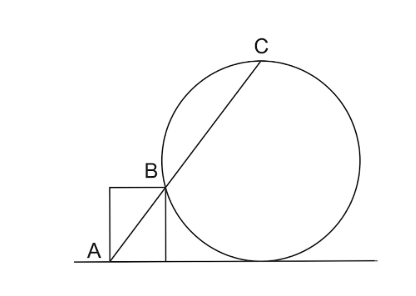
A circular hoop and a rectangular frame are standing on the level ground as shown. The diagonal $$AB$$ is extended to meet the circular hoop at the highest point $$C$$. If $$AB = 18$$ cm, $$BC = 32$$ cm, the radius of the hoop (in cm) is ------.
Backspace
789
456
123
0.-
Clear All
789
456
123
0.-
Clear All
Solution
TO BE FILLED - figure required. The exact tangency relationship between the rectangular frame and the circular hoop (which side of the frame touches the hoop, and where) cannot be determined with confidence from the extracted figure, and different reasonable assumptions give very different, non-matching radii.
'$$n$$' is a natural number. The number of '$$n$$' for which $$\frac{16(n^2-n-1)^2}{2n-1}$$ is a natural number is ------.
Backspace
789
456
123
0.-
Clear All
789
456
123
0.-
Clear All
Solution
We are given the expression: $$\frac{16(n^2-n-1)^2}{2n-1}$$
Now, let's try to rewrite the numerator as:
$$16(n^2-n-1)^2=(2n-1)Q(n)+r$$ where $$Q(n)$$ is the quotient and $$r$$ is the remainder
So, now to find the remainder, lets put $$n=\dfrac{1}{2}$$ on both sides
$$16(\dfrac{1}{4}-\dfrac{1}{2}-1)^2=(0)Q(\dfrac{1}{2})+r$$
$$25=r$$
So, $$16(n^2-n-1)^2=(2n-1)Q(n)+25$$
Now, $$\dfrac{16(n^2-n-1)^2}{2N-1}=Q(x)+\dfrac{25}{2n-1}$$
Now, $$Q(n)$$ is going to be a cubic function, which will give integral results
Only, term $$\dfrac{25}{2n-1}$$ will be troublesome
So $$2n-1$$ must divide $$25$$. The positive divisors of $$25$$ are $$1, 5, 25$$, giving $$n=1, 3, 13$$, so there are exactly $$3$$ such values of $$n$$
But we still need to verify these values so that we get natural numbers as a solution
Putting $$n=1$$ in $$\frac{16(n^2-n-1)^2}{2n-1}$$, we get :$$16$$
Putting $$n=3$$ in $$\frac{16(n^2-n-1)^2}{2n-1}$$, we get :$$80$$
Putting $$n=13$$ in $$\frac{16(n^2-n-1)^2}{2n-1}$$, we get :$$15,376$$
All of these are natural numbers, hence there are $$3$$ possible values of $$n$$
The number of solutions $$(x,y)$$ of the simultaneous equations $$\log_4 x - \log_2 y = 0$$, $$x^2 = 8+2y^2$$ is ------.
Backspace
789
456
123
0.-
Clear All
789
456
123
0.-
Clear All
Solution
The first equation gives $$\log_2 x = 2\log_2 y$$, i.e. $$x = y^2$$
Now, both $$x,y>0$$ as they are the arguments of the log function in the given equations
Substituting into the second equation gives $$y^4-2y^2-8=0$$,
Which can be factored as:
$$(y^2-4)(y^2+2)=0$$
So $$y^2=4$$,
$$y=2$$ (taking the positive root)
$$x=4$$.
This gives exactly $$1$$ valid solution pair which is $$(4,2)$$
In the adjoining figure, $$PA, PB$$ are tangents. $$AR$$ is parallel to $$PB$$.
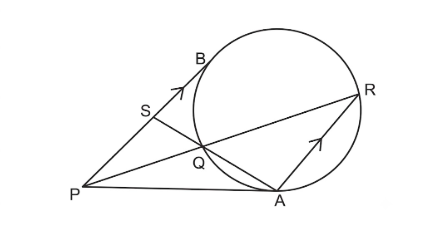
$$PQ = 6$$; $$QR = 18$$.
Length $$SB$$ = ------.
Backspace
789
456
123
0.-
Clear All
789
456
123
0.-
Clear All
Solution
TO BE FILLED - figure required. It is not possible to determine reliably from the extracted figure which points are collinear with $$Q$$ (chord $$SR$$ versus line $$BR$$ through the tangent $$PA$$), so the similar-triangle relation coming from $$AR \parallel PB$$ cannot be set up with confidence.
A large watermelon weighs $$20$$ kg with $$98\%$$ of its weight being water. It is left outside in the sunshine for some time. Some water evaporated and the water content in the watermelon is now $$95\%$$ of its weight in water. The reduced weight in kg is ------.
Backspace
789
456
123
0.-
Clear All
789
456
123
0.-
Clear All
Solution
The non-water (solid) content is $$2\%$$ of $$20$$ kg, i.e. $$0.4$$ kg, and this stays constant. After evaporation the solid content is $$5\%$$ of the new weight, so the new weight is $$\frac{0.4}{0.05}=8$$ kg. The reduction in weight is $$20-8=12$$ kg.
In a geometric progression, the fourth term exceeds the third term by $$24$$ and the sum of the second and third term is $$6$$. Then, the sum of the second, third and fourth terms is ------.
Backspace
789
456
123
0.-
Clear All
789
456
123
0.-
Clear All
Solution
With first term $$a$$ and common ratio $$r$$, the conditions give $$ar^2(r-1)=24$$ and $$ar(1+r)=6$$, which combine to $$r^2-5r-4=0$$, so $$r=\frac{5+\sqrt{41}}{2}$$ for the increasing case. Solving for $$a$$ and computing $$ar+ar^2+ar^3$$ with this ratio gives a sum of approximately $$35.1$$.

