$$ABCDE$$ is a pentagon. $$\angle AED = 126^\circ$$, $$\angle BAE = \angle CDE$$ and $$\angle ABC$$ is $$4^\circ$$ less than $$\angle BAE$$ and $$\angle BCD$$ is $$6^\circ$$ less than $$\angle CDE$$. $$PR, QR$$ the bisectors of $$\angle BPC, \angle EQD$$ respectively, meet at $$R$$. Points $$P, C, D, Q$$ are collinear.
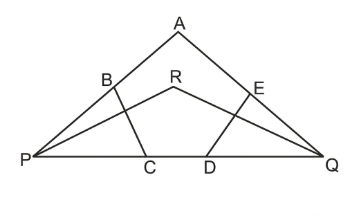
Then measure of $$\angle PRQ$$ is
Solution
Letting $$\angle BAE = \angle CDE = \theta$$, the pentagon angle sum $$\theta+(\theta-4)+(\theta-6)+\theta+126=540$$ gives $$\theta=106^\circ$$, so $$\angle ABC=102^\circ$$ and $$\angle BCD=100^\circ$$. With $$P$$ on the extensions of $$AB$$ and $$DC$$, triangle $$PBC$$ gives $$\angle BPC = \angle ABC+\angle BCD-180^\circ=22^\circ$$; similarly triangle $$QED$$ gives $$\angle EQD = (180^\circ-\angle AED)+(180^\circ-\angle CDE)-180^\circ = 52^\circ$$. Halving both by the bisectors gives $$11^\circ$$ and $$26^\circ$$ at $$P$$ and $$Q$$ in triangle $$PRQ$$, so $$\angle PRQ = 180^\circ-11^\circ-26^\circ = 143^\circ$$.
Get AI Help
Book Free CAT Mentorship
Get personalized CAT strategy from a 99%iler
500+ students mentored
OTP Verification
Enter the 6-digit code sent to your phone
Booking Summary
Enter OTP
Didn't receive the OTP?


