 JEE WhatsApp Group



JEE Probability and Statistics PYQs
JEE Probability and Statistics PYQs are an important part of the JEE Mathematics syllabus. They help you understand the kind of questions asked from this chapter and show how well you know the main concepts, such as probability, sample space, events, conditional probability, Bayes’ theorem, mean, median, mode, variance, and standard deviation.
In the exam, probability and statistics questions usually come as direct numerical problems or simple concept-based questions. The good thing is that this chapter becomes much easier when your basics are clear. Once you understand the concepts properly and know which formula or method to use, solving questions feels much more manageable. You do not need to think of probability and statistics as a very difficult chapter. With regular revision and smart practice, it can become one of the more scoring parts of JEE Mathematics.
In this blog, you will find a simple formula PDF, a section for important JEE Probability and Statistics PYQs in download format, a few practice questions with answers, and some extra questions to solve on your own. You will also learn about common mistakes students often make and a few easy tips to save time in the exam.
JEE Probability and Statistics Important PYQs PDF
This PDF can include the most important previous year questions from probability and statistics. It may cover topics like basic probability, sample space, independent and dependent events, conditional probability, Bayes’ theorem, random variables, mean, median, mode, variance, and standard deviation.
Practicing these questions will help you understand the exam pattern better. It will also improve your speed, accuracy, and confidence before the exam.
Important Formulas for JEE Probability and Statistics PYQs
You only need a few important formulas and ideas to solve most probability and statistics questions in JEE. These formulas help you understand event-based questions, data-based calculations, and result-based problems more clearly.
You can download the full formula PDF from the link above. Here is a quick look at some of the main formulas:
Concept | Formula |
Probability of an Event | P(E) = Number of favourable outcomes / Total number of outcomes |
Complementary Probability | P(E̅) = 1 − P(E) |
Addition Rule of Probability | P(A ∪ B) = P(A) + P(B) − P(A ∩ B) |
Conditional Probability | P(A/B) = P(A ∩ B) / P(B) |
Multiplication Rule | P(A ∩ B) = P(A) × P(B/A) |
Probability of Independent Events | P(A ∩ B) = P(A) × P(B) |
Bayes’ Theorem | P(Aᵢ/B) = [P(Aᵢ)P(B/Aᵢ)] / ΣP(Aⱼ)P(B/Aⱼ) |
Mean | Mean = Sum of observations / Number of observations |
Variance | σ² = Σ(x − x̄)² / n |
Standard Deviation | σ = √Variance |
Relation Between Mean, Median, and Mode | Mode = 3 Median − 2 Mean |
These formulas are commonly used in questions based on probability, conditional probability, Bayes’ theorem, and statistical measures. If you revise them properly, many JEE questions start to feel much easier.
Top 5 Common Mistakes to Avoid in JEE Probability and Statistics PYQs
Many students find probability and statistics confusing at first because it includes both logic-based and formula-based questions. But most mistakes happen because small details are missed while solving. Here are some common mistakes you should avoid:
Mixing up independent and dependent events
Independent events do not affect each other, while dependent events do. Many students use the same formula for both and get the wrong answer.
Forgetting the difference between union and intersection
In probability, “A or B” and “A and B” are not the same. Students often confuse union with intersection and apply the wrong formula.
Making mistakes in conditional probability
Conditional probability needs careful reading of the question. Students sometimes write the correct formula but place the wrong event in the denominator.
Using the wrong value in mean or variance calculations
In statistics, even one small calculation error in the average or squared terms can change the whole answer.
Ignoring the sample space properly
Many probability questions become easy once the sample space is written clearly. Students often skip this step and make avoidable mistakes.
List of JEE Probability and Statistics PYQs
Here is a short set of JEE-style probability and statistics questions for practice. These include common question types from probability, conditional probability, mean, and standard deviation. Solving them regularly can help you become faster and more confident.
Question 1
From the first 100 natural numbers, two numbers first a and then b are selected randomly without replacement. If the probability that $$a-b \geq 10$$ is $$\frac{m}{n}$$, gcd (m, n) = 1, then m + n is equal to______.
correct answer:- 311
Question 2
Two distinct numbers a and b are selected at random from 1, 2, 3, ... , 50. The probability, that their product ab is divisible by 3, is
correct answer:- 1
Question 3
From a lot containing 10 defective and 90 non-defective bulbs, 8 bulbs are selected one by one with replacement. Then the probability of getting at least 7 defective bulbs is
correct answer:- 4
Question 4
Let S be a set of 5 elements and P(S) denote the power set of S. Let E be an event of choosing an ordered pair (A, B) from the set P(S) x P(S) such that $$A\cap B=\phi.$$ If
the probability of the event E is $$\frac{3^{p}}{2^{q}}$$, where p,q $$\in$$ N, then p + q is equal to __________
correct answer:- 15
Question 5
If and are two events such that P(A ∩ B) = 0.1. and P(A | B) and P(B ∣ A) are the roots of the equation $$12x^{2} − 7x + 1 = 0$$, then the value of $$\frac{P(\overline{A} \cup \overline{B})}{P(\overline{A} \cap \overline{B}}$$ is:
correct answer:- 4

Question 6
Two balls are selected at random one by one without replacement from a bag containing 4 white and 6 black balls. If the probability that the first selected ball is black, given that the second selected ball is also black, is $$\frac{m}{n}$$, where $$gcd(m,n)=1$$, then $$m+n$$ is equal to :
correct answer:- 2
Question 7
A board has 16 squares as shown in the figure:
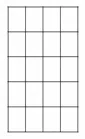
Out of these 16 squares, two squares are chosen at random. The probability that they have no side in common is:
correct answer:- 2
Question 8
A and B alternately throw a pair of dice. A wins if he throws a sum of 5 before B throws a sum of 8, and B wins if he throws a sum of 8 before A throws a sum of 5. The probability that A wins if A makes the first throw, is:
correct answer:- 2
Question 9
One die has two faces marked 1, two faces marked 2, one face marked 3 and one face marked 4. Another die has one face marked 1, two faces marked 2, two faces marked 3 and one face marked 4. The probability of getting the sum of numbers to be 4 or 5, when both the dice are thrown together, is
correct answer:- 2
Question 10
Bag 1 contains 4 white balls and 5 black balls, and Bag 2 contains n white balls and 3 black balls. One ball is drawn randomly from Bag 1 and transferred to Bag 2. A ball is then drawn randomly from Bag 2. If the probability, that the ball drawn is white, is 29/45 , then n is equal to :
correct answer:- 1

Question 11
Three urns A, B and C contain 7 red, 5 black; 5 red, 7 black and 6 red, 6 black balls, respectively. One of the urn is selected at random and a ball is drawn from it. If the ball drawn is black, then the probability that it is drawn from urn A is:
correct answer:- 1
Question 12
Let S be the set of all the words that can be formed by arranging all the letters of the word GARDEN. From the set S, one word is selected at random. The probability that the selected word will NOT have vowels in alphabetical order is :
correct answer:- 1
Question 13
Bag $$B_{1}$$ contains 6 white and 4 blue balls, Bag $$B_{2}$$ contains 4 white and 6 blue balls, and Bag $$B_{3}$$ contains 5 white and 5 blue balls. One of the bags is selected at random and a ball is drawn from it. If the ball is white, then the probability, that the ball is drawn from Bag $$B_{2}$$, is :
correct answer:- 1
Question 14
A bag contains $$8$$ balls, whose colours are either white or black. $$4$$ balls are drawn at random without replacement and it was found that $$2$$ balls are white and other $$2$$ balls are black. The probability that the bag contains equal number of white and black balls is:
correct answer:- 2
Question 15
Let Ajay will not appear in JEE exam with probability $$p = \frac{2}{7}$$, while both Ajay and Vijay will appear in the exam with probability $$q = \frac{1}{5}$$. Then the probability, that Ajay will appear in the exam and Vijay will not appear is:
correct answer:- 2

Question 16
A fair die is tossed repeatedly until a six is obtained. Let $$X$$ denote the number of tosses required and let $$a = P(X = 3)$$, $$b = P(X \geq 3)$$ and $$c = P(X \geq 6 \mid X > 3)$$. Then $$\frac{b + c}{a}$$ is equal to _______.
correct answer:- 12
Question 17
An urn contains 6 white and 9 black balls. Two successive draws of 4 balls are made without replacement. The probability, that the first draw gives all white balls and the second draw gives all black balls, is :
correct answer:- 3
Question 18
A fair die is thrown until $$2$$ appears. Then the probability, that $$2$$ appears in even number of throws, is
correct answer:- 3
Question 19
An integer is chosen at random from the integers $$1, 2, 3, \ldots, 50$$. The probability that the chosen integer is a multiple of at least one of $$4, 6$$ and $$7$$ is
correct answer:- 2
Question 20
Two integers $$x$$ and $$y$$ are chosen with replacement from the set $$\{0, 1, 2, 3, \ldots, 10\}$$. Then the probability that $$|x - y| > 5$$ is :
correct answer:- 1

Question 21
Bag $$A$$ contains 3 white, 7 red balls and bag $$B$$ contains 3 white, 2 red balls. One bag is selected at random and a ball is drawn from it. The probability of drawing the ball from the bag $$A$$, if the ball drawn is white, is:
correct answer:- 3
Question 22
Two marbles are drawn in succession from a box containing 10 red, 30 white, 20 blue and 15 orange marbles, with replacement being made after each drawing. Then the probability, that first drawn marble is red and second drawn marble is white, is
correct answer:- 4
Question 23
Three rotten apples are accidently mixed with fifteen good apples. Assuming the random variable $$x$$ to be the number of rotten apples in a draw of two apples, the variance of $$x$$ is
correct answer:- 4
Question 24
A coin is biased so that a head is twice as likely to occur as a tail. If the coin is tossed 3 times, then the probability of getting two tails and one head is
correct answer:- 1
Question 25
If the mean of the following probability distribution of a random variable $$X$$:
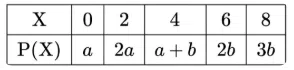
is $$\frac{46}{9}$$, then the variance of the distribution is
correct answer:- 2

Question 26
A random varaible X takes values 0,1,2,3 with probabilities $$\frac{2a+1}{30},\frac{8a-1}{30},\frac{4a+1}{30}$$, b respectively, where $$a,b \epsilon R$$. let $$\mu$$ and $$\sigma$$ respectively be the mean and standard deviation of X such that $$\sigma^{2}+\mu^{2}=2$$. Then $$\frac{a}{b}$$ is equal to :
correct answer:- 2
Question 27
Let the mean and variance of 7 observations 2, 4, 10, x, 12, 14, y, x > y, be 8 and 16 respectively. Two numbers are chosen from {1, 2, 3, x - 4,y,5} one after an other without replacement, then the probability, that the smaller number among the two chosen numbers is less than 4, is :
correct answer:- 3
Question 28
lf the mean deviation about the median of the numbers k, 2k, 3k, ..... , 1000k is 500, then $$k^{2}$$ is equal to :
correct answer:- 3
Question 29
Let the mean and variance of 8 numbers - 10, - 7, - 1, x, y, 9, 2, 16 be $$\frac{7}{2}\text{ and }\frac{293}{4}$$ respectively.
Then the mean of 4 numbers x, y, x + y + 1, |x-y| is:
correct answer:- 1
Question 30
If a random variable x has the probability distribution

then $$ P(3< x\leq 6)$$ is equal to
correct answer:- 2
Question 31
The mean and variance of a data of 10 observations are 1O and 2, respectively. If an observations $$\alpha$$ in this data is replaced by $$\beta$$, then the mean and variance become 10.1 and 1.99, respectively. Then $$\alpha+\beta$$ equals
correct answer:- 4
Question 32
Let $$X= \left\{x\in N:1\leq x\leq19 \right\}$$ and for some $$a,b \in \mathbb R, Y = \left\{ax+b:x\in X\right\}.$$ If the mean and variance of the elements of Y are 30 and 750, respectively, then the sum of all possible values of b is
correct answer:- 3
Question 33
The mean and variance of 10 observations are 9 and 34.2, respectively. If 8 of these observations are 2, 3, 5, 10, 11 , 13, 15, 21, then the mean deviation about the median of all the 10 observations is
correct answer:- 1
Question 34
If the mean and the variance of the data
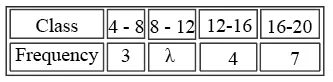
are $$ \mu $$ and 19 respectively, then the value of $$\lambda$$ $$+\mu$$ is
correct answer:- 4
Question 35
The probability distribution of a random variable X is given below:
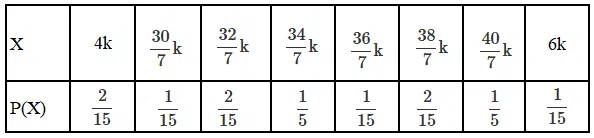
If $$ E(X)=\frac{263}{15} $$. then $$ P(X<20)$$ is equal to:
correct answer:- 2
Question 36
A coin is tossed three times. Let $$X$$ denote the number of times a tail follows a head. If $$\mu$$ and $$\sigma^{2}$$ denote the mean and variance of $$X$$, then the value of $$64(\mu+\sigma^{2})$$ is :
correct answer:- 4
Question 37
The variance of the numbers 8, 21, 34, 47,…, 320 is
correct answer:- 8788
Question 38
For a statistical data $$x_1,x_2,\ldots,x_{10}$$ of 10 values, a student obtained the mean as 5.5 and $$\sum_{i=1}^{10} x_i^2 = 371. $$ He later found that he had noted two values in the data incorrectly as 4 and 5, instead of the correct values 6 and 8 respectively. The variance of the corrected data is:
correct answer:- 3
Question 39
Three defective oranges are accidently mixed with seven good ones and on looking at them, it is not possible to differentiate between them. Two oranges are drawn at random from the lot. If $$x$$ denote the number of defective oranges, then the variance of $$x$$ is
correct answer:- 1
Question 40
Let $$x_{1},x_{2},...x_{10}$$ be ten observations such that $$\sum_{i=1}^{10}(x_{i}-2)=30,\sum_{i=1}^{10}(x_{i}-\beta)^{2}=98,\beta > 2$$, and their variance is $$\frac{4}{5}$$. If $$\mu$$ and $$\sigma^{2}$$ are respectively the mean and the variance of $$2(x_{1}-1)+4\beta, 2(x_{2}-1)+4\beta,....,2(x_{10}-1)+4\beta$$, then $$\frac{\beta \mu}{\sigma^{2}}$$ is equal to :
correct answer:- 1
Question 41
Marks obtains by all the students of class 12 are presented in a freqency distribution with classes of equal width. Let the median of this grouped data be 14 with median class interval 12-18 and median class frequency 12 . If the number of students whose marks are less than 12 is 18 , then the total number of students is
correct answer:- 3
Question 42
Let $$\alpha, \beta \in {R}$$. Let the mean and the variance of 6 observations −3, 4, 7, −6, α, β be 2 and 23, respectively. The mean deviation about the mean of these 6 observations is:
correct answer:- 1
Question 43
Let the median and the mean deviation about the median of 7 observations $$170, 125, 230, 190, 210, a, b$$ be $$170$$ and $$\frac{205}{7}$$ respectively. Then the mean deviation about the mean of these 7 observations is:
correct answer:- 3
Question 44
Consider 10 observations $$x_1, x_2, \ldots, x_{10}$$, such that $$\sum_{i=1}^{10}(x_i - \alpha) = 2$$ and $$\sum_{i=1}^{10}(x_i - \beta)^2 = 40$$, where $$\alpha, \beta$$ are positive integers. Let the mean and the variance of the observations be $$\frac{6}{5}$$ and $$\frac{84}{25}$$ respectively. Then $$\frac{\beta}{\alpha}$$ is equal to:
correct answer:- 1
Question 45
Let $$a_1, a_2, \ldots, a_{10}$$ be 10 observations such that $$\sum_{k=1}^{10} a_k = 50$$ and $$\sum_{\forall k < j} a_k \cdot a_j = 1100$$. Then the standard deviation of $$a_1, a_2, \ldots, a_{10}$$ is equal to :
correct answer:- 2
Question 46
The mean and standard deviation of 15 observations were found to be 12 and 3 respectively. On rechecking it was found that an observation was read as 10 in place of 12. If $$\mu$$ and $$\sigma^2$$ denote the mean and variance of the correct observations respectively, then $$15(\mu + \mu^2 + \sigma^2)$$ is equal to _____.
correct answer:- 2521
Question 47
If the mean and variance of the data $$65, 68, 58, 44, 48, 45, 60, \alpha, \beta, 60$$ where $$\alpha > \beta$$ are $$56$$ and $$66.2$$ respectively, then $$\alpha^2 + \beta^2$$ is equal to _______
correct answer:- 6344
Question 48
If the mean and variance of five observations are $$\frac{24}{5}$$ and $$\frac{194}{25}$$ respectively and the mean of first four observations is $$\frac{7}{2}$$, then the variance of the first four observations is equal to
correct answer:- 3
Question 49
Let $$M$$ denote the median of the following frequency distribution.

Then $$20M$$ is equal to :
correct answer:- 4
Question 50
If the variance $$\sigma^2$$ of the data
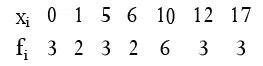
is $$k$$, then the value of $$k$$ is ______ (where $$.$$ denotes the greatest integer function)
correct answer:- 29
.webp)


