
Join Our JEE Preparation Group
Prep with like-minded aspirants; Get access to free daily tests and study material.
Sign in
Please select an account to continue using cracku.in
↓ →
Join Our JEE Preparation Group
Prep with like-minded aspirants; Get access to free daily tests and study material.
Consider 10 observations $$x_1, x_2, \ldots, x_{10}$$, such that $$\sum_{i=1}^{10}(x_i - \alpha) = 2$$ and $$\sum_{i=1}^{10}(x_i - \beta)^2 = 40$$, where $$\alpha, \beta$$ are positive integers. Let the mean and the variance of the observations be $$\frac{6}{5}$$ and $$\frac{84}{25}$$ respectively. Then $$\frac{\beta}{\alpha}$$ is equal to:
Given 10 observations with mean $$\bar{x} = \frac{6}{5}$$ and variance $$\sigma^2 = \frac{84}{25}$$. Also, $$\sum_{i=1}^{10} (x_i - \alpha) = 2$$ and $$\sum_{i=1}^{10} (x_i - \beta)^2 = 40$$, where $$\alpha$$ and $$\beta$$ are positive integers.
First, use the sum of deviations from $$\alpha$$ to find $$\alpha$$. The sum of deviations from a constant $$A$$ is given by $$\sum (x_i - A) = n(\bar{x} - A)$$. Here, $$n = 10$$, so:
$$\sum (x_i - \alpha) = 10 \left( \frac{6}{5} - \alpha \right) = 2$$
Solve for $$\alpha$$:
$$\frac{6}{5} - \alpha = \frac{2}{10} = \frac{1}{5}$$
$$\alpha = \frac{6}{5} - \frac{1}{5} = \frac{5}{5} = 1$$
Thus, $$\alpha = 1$$.
Next, use the variance to find $$\sum (x_i - \bar{x})^2$$. The variance formula is $$\sigma^2 = \frac{1}{n} \sum (x_i - \bar{x})^2$$, so:
$$\sum (x_i - \bar{x})^2 = n \sigma^2 = 10 \times \frac{84}{25} = \frac{840}{25} = \frac{168}{5}$$
Now, use the given $$\sum (x_i - \beta)^2 = 40$$. The formula relating sum of squared deviations from $$\beta$$ to the sum of squared deviations from the mean is:
$$\sum (x_i - \beta)^2 = \sum (x_i - \bar{x})^2 + n (\bar{x} - \beta)^2$$
Substitute the known values:
$$40 = \frac{168}{5} + 10 \left( \frac{6}{5} - \beta \right)^2$$
Solve for $$\beta$$:
$$40 - \frac{168}{5} = 10 \left( \frac{6}{5} - \beta \right)^2$$
$$\frac{200}{5} - \frac{168}{5} = \frac{32}{5} = 10 \left( \frac{6}{5} - \beta \right)^2$$
$$\frac{32}{50} = \frac{16}{25} = \left( \frac{6}{5} - \beta \right)^2$$
Take the square root:
$$\left| \frac{6}{5} - \beta \right| = \frac{4}{5}$$
This gives two cases:
Case 1: $$\frac{6}{5} - \beta = \frac{4}{5}$$
$$\beta = \frac{6}{5} - \frac{4}{5} = \frac{2}{5}$$
But $$\beta$$ must be a positive integer, so $$\frac{2}{5}$$ is invalid.
Case 2: $$\frac{6}{5} - \beta = -\frac{4}{5}$$
$$\beta = \frac{6}{5} + \frac{4}{5} = \frac{10}{5} = 2$$
This is a positive integer, so $$\beta = 2$$.
Thus, $$\alpha = 1$$ and $$\beta = 2$$, so:
$$\frac{\beta}{\alpha} = \frac{2}{1} = 2$$
The ratio $$\frac{\beta}{\alpha}$$ is 2, which corresponds to option A.
Was this solution helpful?
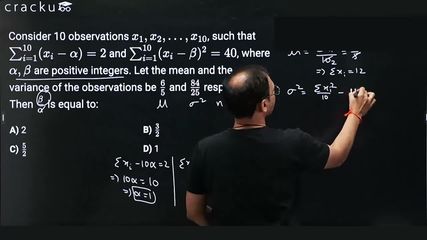
Click on the Email ☝️ to Watch the Video Solution
Create a FREE account and get:
_1.webp)

Educational materials for JEE preparation

Ask our AI anything

AI can make mistakes. Please verify important information.
AI can make mistakes. Please verify important information.
