
Join Our JEE Preparation Group
Prep with like-minded aspirants; Get access to free daily tests and study material.
Sign in
Please select an account to continue using cracku.in
↓ →
Join Our JEE Preparation Group
Prep with like-minded aspirants; Get access to free daily tests and study material.
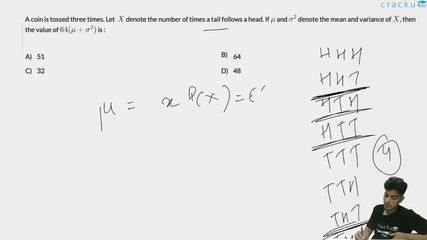
A coin is tossed three times. Let $$X$$ denote the number of times a tail follows a head. If $$\mu$$ and $$\sigma^{2}$$ denote the mean and variance of $$X$$, then the value of $$64(\mu+\sigma^{2})$$ is :
Since the coin is fair, each toss has two equally likely outcomes: head (H) or tail (T). With three tosses, the sample space has $$2^3 = 8$$ outcomes, each with probability $$\frac{1}{8}$$. We list all outcomes and determine $$X$$ for each by counting the number of times a tail immediately follows a head in consecutive tosses.
The outcomes and corresponding $$X$$ values are:
Tabulating the values:
Note that $$X$$ can only be 0 or 1 because it is impossible to have two occurrences (as that would require overlapping pairs like (H,T) and (T,H), which conflict on the middle toss).
The probability mass function is:
The mean $$\mu$$ is the expected value of $$X$$. The formula for expected value is $$\mu = E(X) = \sum x_i \cdot P(X = x_i)$$.
So,
$$\mu = 0 \cdot P(X=0) + 1 \cdot P(X=1) = 0 \cdot \frac{1}{2} + 1 \cdot \frac{1}{2} = \frac{1}{2}$$
The variance $$\sigma^2$$ is given by $$\sigma^2 = E(X^2) - [E(X)]^2$$. First, compute $$E(X^2)$$:
$$E(X^2) = 0^2 \cdot P(X=0) + 1^2 \cdot P(X=1) = 0 \cdot \frac{1}{2} + 1 \cdot \frac{1}{2} = \frac{1}{2}$$
Then,
$$\sigma^2 = E(X^2) - [E(X)]^2 = \frac{1}{2} - \left(\frac{1}{2}\right)^2 = \frac{1}{2} - \frac{1}{4} = \frac{1}{4}$$
Now, compute $$\mu + \sigma^2$$:
$$\mu + \sigma^2 = \frac{1}{2} + \frac{1}{4} = \frac{2}{4} + \frac{1}{4} = \frac{3}{4}$$
Then, $$64(\mu + \sigma^2) = 64 \cdot \frac{3}{4} = 64 \cdot 0.75 = 48$$.
Thus, the value is 48, which corresponds to option D.
Was this solution helpful?
Click on the Email ☝️ to Watch the Video Solution
Create a FREE account and get:
_1.webp)

Educational materials for JEE preparation

Ask our AI anything

AI can make mistakes. Please verify important information.
AI can make mistakes. Please verify important information.
