
Join Our JEE Preparation Group
Prep with like-minded aspirants; Get access to free daily tests and study material.
Sign in
Please select an account to continue using cracku.in
↓ →
Join Our JEE Preparation Group
Prep with like-minded aspirants; Get access to free daily tests and study material.
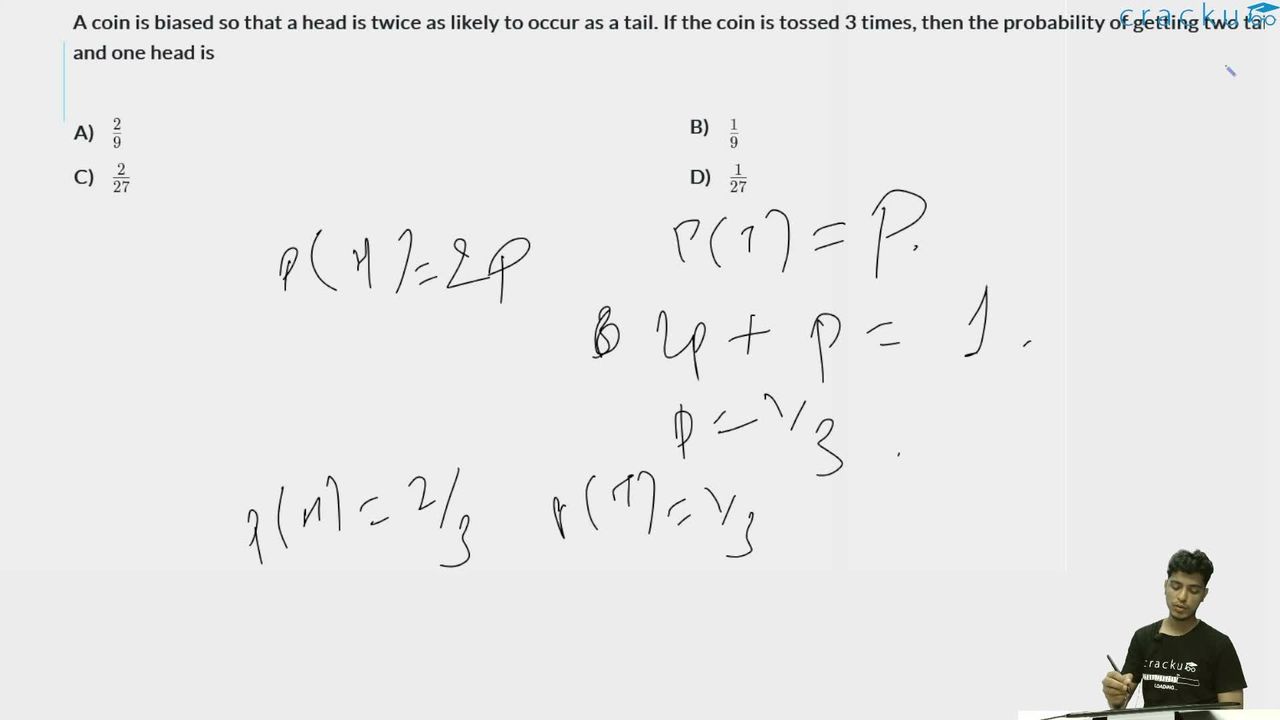
A coin is biased so that a head is twice as likely to occur as a tail. If the coin is tossed 3 times, then the probability of getting two tails and one head is
Let $$P(\text{Tail})=p$$ and $$P(\text{Head})=2p$$. Since the probabilities must sum to 1:
$$ p + 2p = 1 \implies 3p = 1 \implies p = \frac{1}{3} $$
So $$P(\text{Tail}) = \frac{1}{3}$$ and $$P(\text{Head}) = \frac{2}{3}$$.
Next, we use the binomial probability formula, which states that the probability of obtaining exactly $$k$$ tails in $$n$$ tosses is:
$$ P(X = k) = \binom{n}{k} \cdot p^k \cdot (1-p)^{n-k} $$
In this case, $$n = 3$$, $$k = 2$$, $$p = \frac{1}{3}$$, and $$1-p = \frac{2}{3}$$.
We now calculate the binomial coefficient $$\binom{3}{2}$$, which counts the number of ways to choose which two of the three tosses will be tails. The three possible arrangements are TTH, THT, and HTT.
$$ \binom{3}{2} = \frac{3!}{2! \cdot 1!} = 3 $$
Each such sequence with exactly two tails and one head has probability:
$$ \left(\frac{1}{3}\right)^2 \times \frac{2}{3} = \frac{1}{9} \times \frac{2}{3} = \frac{2}{27} $$
Multiplying by the number of arrangements gives:
$$ P(X = 2) = 3 \times \frac{2}{27} = \frac{6}{27} = \frac{2}{9} $$
Was this solution helpful?
Click on the Email ☝️ to Watch the Video Solution
Create a FREE account and get:
_1.webp)

Educational materials for JEE preparation

Ask our AI anything

AI can make mistakes. Please verify important information.
AI can make mistakes. Please verify important information.
